SPIFFE and SPIRE: Securing Identity in Ephemeral Infrastructure
An examination of SPIFFE and SPIRE for establishing secure workload identity, SVIDs, and attestation in modern infrastructure.
In modern cloud-native environments, the boundary between "server" and "workload" has dissolved. Containers spin up and down in seconds, Kubernetes pods migrate across nodes, and virtual machines scale elastically. Traditional Public Key Infrastructure (PKI), designed for static human identities and long-lived servers, collapses under this volatility. You cannot manually rotate certificates for thousands of ephemeral pods, nor can you rely on static hostnames for security.
SPIFFE (Secure Production Identity Framework For Everyone) and SPIRE (SPIFFE Runtime Environment) solve this by establishing a zero-trust identity layer. They provide machine identities that are cryptographically verifiable, infrastructure-agnostic, and automatically managed. This is not just about encryption; it is about proving who is speaking before any data exchange occurs.
The Failure of Traditional PKI for Machines
Human identities are stable. We have usernames, email addresses, and long-term credentials. Machine identities, however, are ephemeral. In a Kubernetes cluster, a pod running a microservice might exist for only five minutes. If you use traditional certificate authorities (CAs) or static SSH keys, you face two critical problems:
- Scalability: Manually provisioning certificates for dynamic workloads is impossible at scale.
- Trust Boundaries: Traditional PKI often relies on IP addresses or hostnames, which are easily spoofed in a shared network environment.
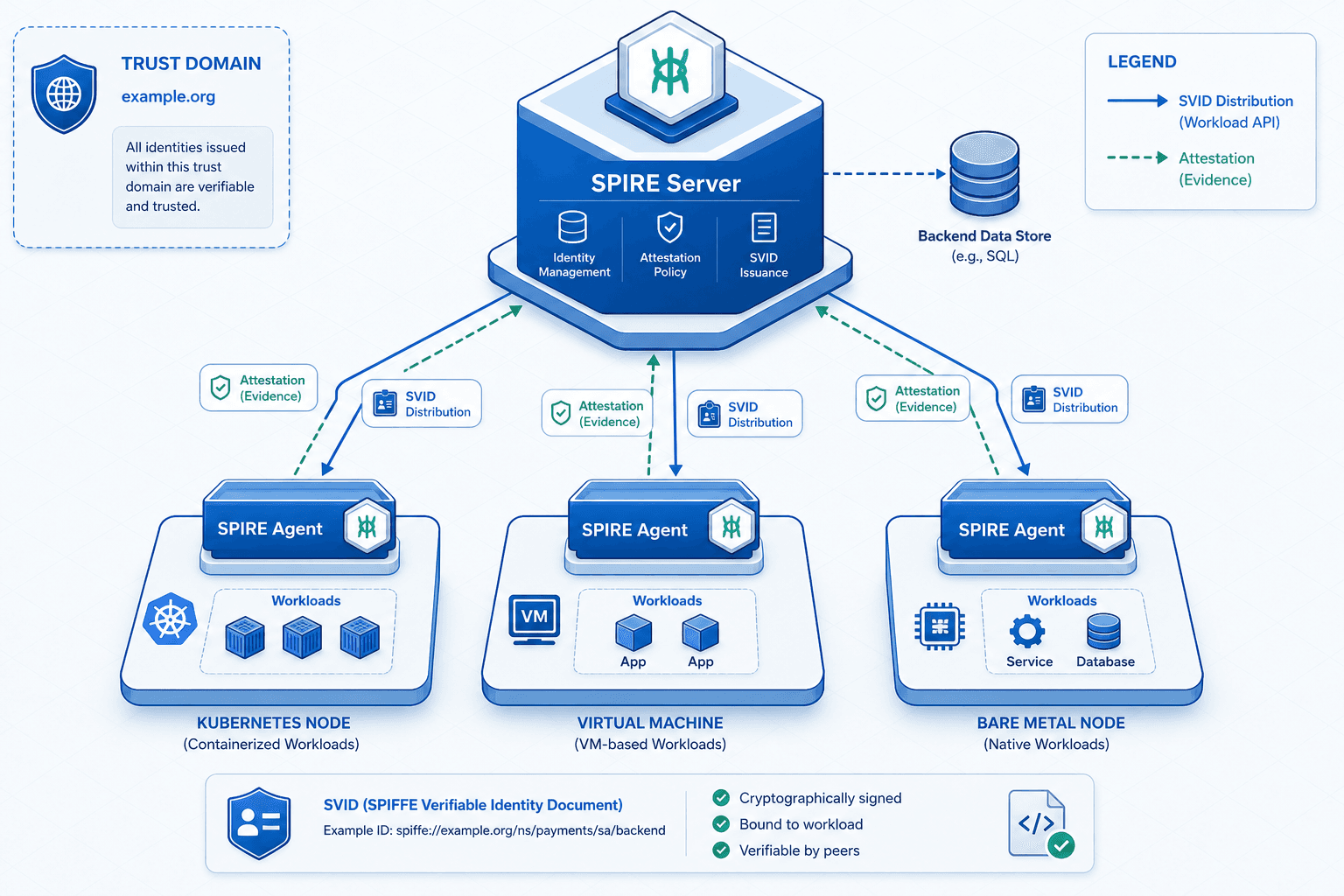
SPIFFE addresses this by defining a standard for machine identity that is independent of the infrastructure. It introduces the concept of a Trust Domain—a set of entities that trust each other based on a common root of trust. Within a trust domain, every workload receives a unique identifier called a SPIFFE ID (see SPIFFE Specification).
SPIRE: The Runtime Engine
SPIFFE is the specification; SPIRE is the implementation. SPIRE is a toolkit that enables organizations to issue and manage machine identities. It consists of two primary components that work together to secure identity:
- SPIRE Server: The central authority that manages the trust domain. It holds the root CA key, defines trust policies, and signs certificates.
- SPIRE Agent: A lightweight daemon running on every node (physical, virtual, or container) where workloads reside. Its job is to attest the node's identity and distribute certificates to local workloads.
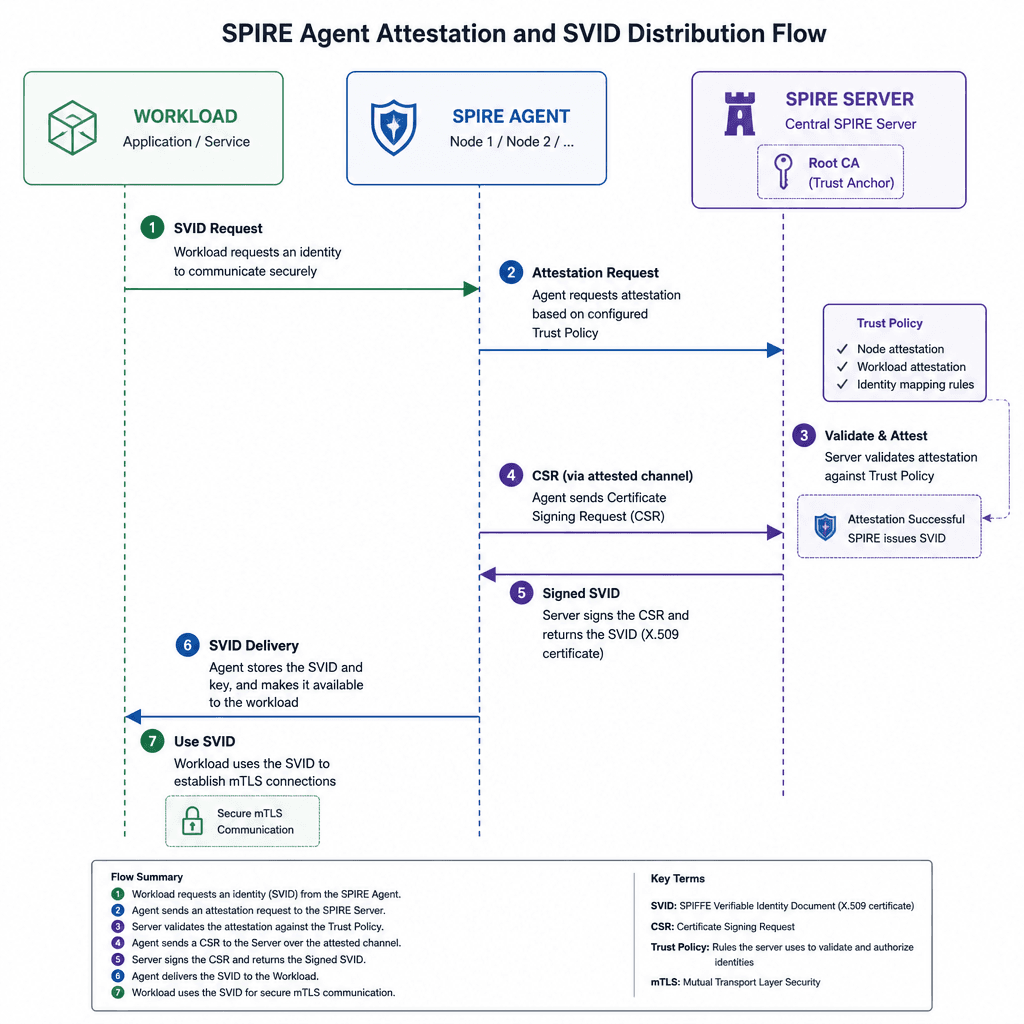
The interaction between these components follows a strict data flow. The SPIRE Agent attests the node's environment, sends a Certificate Signing Request (CSR) to the SPIRE Server, which validates the request against trust policies and signs an X.509 certificate (the SVID, see SPIRE Documentation). The agent then returns this certificate to the requesting workload via the Workload API, which is the specific interface workloads use to request SVIDs.
The SPIFFE ID and SVID Mechanism
At the core of this system is the SPIFFE ID, a URI that uniquely identifies a workload. The format is:
spiffe://<trust_domain_id>/<path>
For example, spiffe://example.org/my-service/payment. This ID is not just a label; it is cryptographically bound to the workload via a SPIFFE Verifiable Identity Document (SVID). An SVID is typically an X.509 certificate.
How Attestation Works
The security of the system hinges on attestation—the process of verifying the identity of the workload and its environment. The SPIRE Agent does not blindly issue certificates. It uses attestation plugins to verify the node's state before proceeding.
Consider a Kubernetes environment. The SPIRE Agent uses the Kubernetes attestation plugin. When a pod requests an SVID, the agent verifies that the pod is running in a trusted namespace with specific labels. This prevents an attacker from spoofing a request from an unauthorized pod.
Other attestation models include:
- AWS/GCP/Azure: Attesting via cloud provider instance metadata.
- TPM: Attesting via hardware-based root of trust on bare metal.
- Join Token: Attesting via a pre-shared token for bootstrapping trust.
This ensures that the SVID issued to a workload is only valid if the workload is running in an environment that meets the trust policy.
Short-Lived Certificates and Rotation
One of the most critical mechanisms in SPIRE is the short lifetime of SVIDs. Unlike traditional certificates that may last years, SPIFFE SVIDs are typically valid for only a few hours. This minimizes the window of opportunity for an attacker who might compromise a certificate.
Furthermore, SPIRE automates certificate rotation. The SPIRE Agent monitors the expiration time of the SVID and automatically requests a renewal from the SPIRE Server before it expires. The workload receives the new certificate automatically, without any manual intervention or downtime. This continuous rotation ensures that even if a certificate is compromised, it will expire quickly, limiting the damage.
Trust Policies and Federation
SPIRE uses trust policies to control which workloads can obtain which SVIDs. These policies are defined in the SPIRE Server and evaluated during the attestation process. A policy might state: "Only workloads in the 'production' namespace with the label 'app=payment' can obtain an SVID with the path '/payment'."
Additionally, SPIRE supports federation, allowing different trust domains to trust each other. For example, a payment service in example.org might need to communicate with a fraud detection service in partner.com. SPIRE enables this by exchanging root CA information between the two trust domains, allowing workloads in one domain to verify identities in the other.
Conclusion
SPIFFE and SPIRE provide a comprehensive framework for securing machine identity in dynamic environments. By decoupling identity from infrastructure and automating certificate lifecycle management, they enable a zero-trust architecture where every workload is verified before communication occurs. For platform and security engineers, adopting SPIFFE/SPIRE is not just about adding another layer of encryption; it is about establishing a fundamental trust model that scales with the elasticity of modern cloud-native applications.
The key takeaway is that identity is no longer a static attribute but a dynamic, verifiable credential that moves with the workload. This shift is essential for securing the future of distributed systems.
Related posts
SPIFFE and SPIRE: Universal Identity for Services
An examination of SPIFFE and SPIRE for establishing workload and service identity in Kubernetes and multi-cluster environments.
X.509 and mTLS for Service Identity
A technical guide to implementing X.509 certificates and mutual TLS for secure service identity in backend systems.
RBAC vs ABAC: Static Roles vs. Dynamic Attributes
A detailed examination of Role-Based Access Control versus Attribute-Based Access Control, covering OPA, XACML, and authorization strategies.