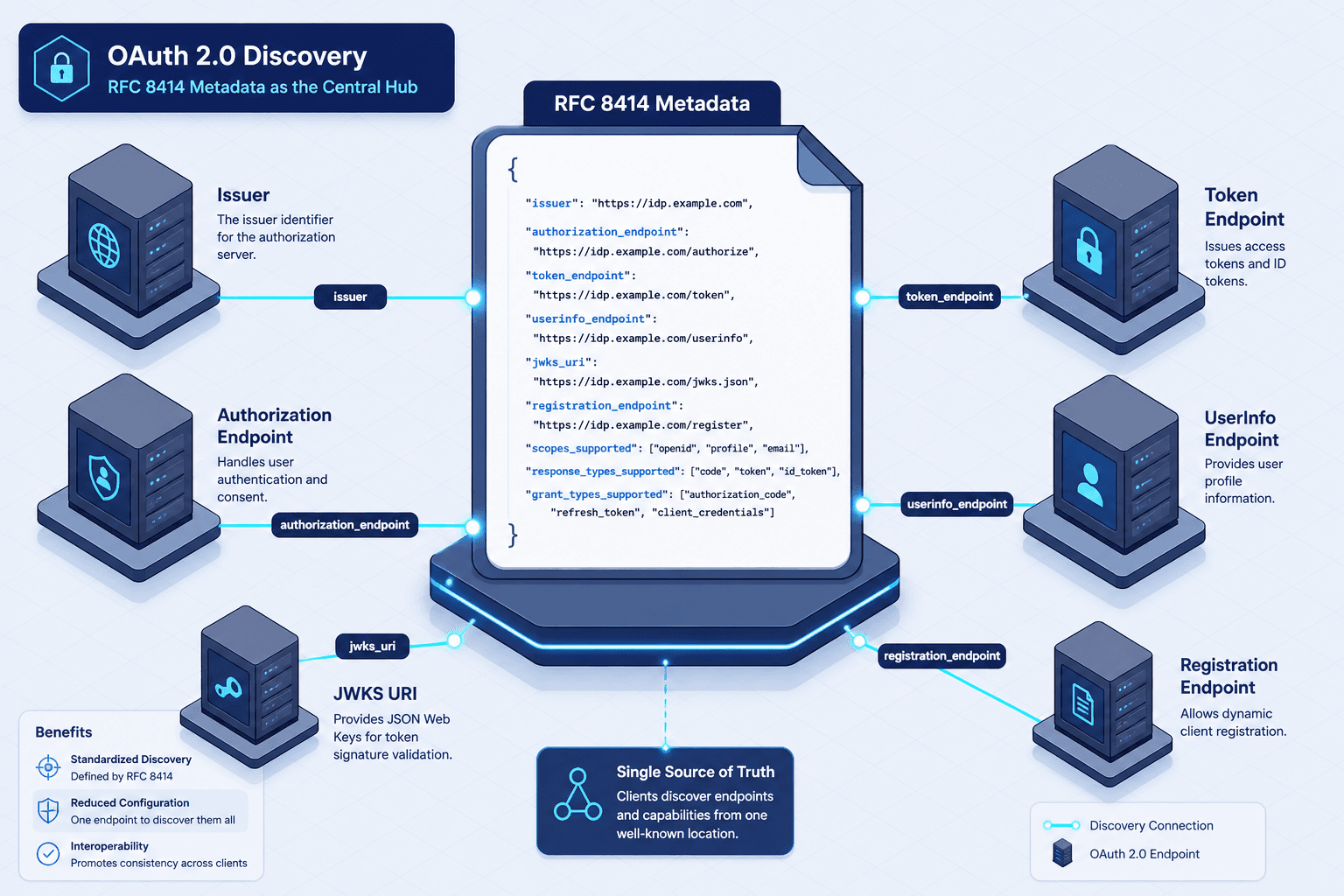
Every Field in the RFC 8414 Metadata Document, Explained
A detailed examination of RFC 8414 metadata fields, including issuer, authorization_endpoint, and token_endpoint, for backend developers and identity engineers.
In modern identity architecture, the relationship between a client application and an authorization server is not established by pre-shared secrets alone, but by a negotiated understanding of capabilities and boundaries. This understanding is codified in the OAuth 2.0 Authorization Server Metadata document, defined in RFC 8414. For backend developers and identity engineers, this JSON document is the primary source of truth for configuring SDKs, validating tokens, and routing requests.
Misunderstanding the mechanism of this metadata leads to brittle integrations that break when providers rotate endpoints or upgrade protocols. This guide dissects every field in the RFC 8414 metadata document, explaining not just what they are, but how they function as control mechanisms for security and interoperability.
Part 2 of the Authorization Server Metadata (RFC 8414) series.
The Discovery Mechanism
Before analyzing individual fields, one must understand the delivery mechanism. RFC 8414 defines a standardized URI where the metadata document resides, typically found at https://<issuer>/.well-known/oauth-authorization-server.
The client initiates trust by performing an HTTP GET request to this URI. The server responds with a Content-Type: application/json and the JSON document. Crucially, the client must validate that the response body matches the expected structure before trusting any endpoint contained within it. Hardcoding URLs like https://provider.com/token is an anti-pattern because it bypasses the negotiation phase, making the client vulnerable to configuration drift and man-in-the-middle attacks if the provider migrates infrastructure.
Caching and Error Handling
Efficient discovery requires respecting HTTP caching semantics defined in RFC 7234. The metadata document should be cached locally to avoid repeated network calls. Clients should inspect the Cache-Control and ETag headers returned by the server. If these headers are present, subsequent requests should use conditional GETs (with If-None-Match or If-Modified-Since) to minimize bandwidth and latency.
Furthermore, robust clients must handle error responses gracefully:
- 401 Unauthorized / 403 Forbidden: These errors often indicate that the issuer URL is incorrect, or the client lacks permission to view public metadata. In such cases, the client should fail fast and log the error, rather than retrying indefinitely.
- 404 Not Found: Indicates the
.well-knownendpoint is missing. This might suggest the server is not configured for RFC 8414, requiring a fallback to legacy discovery mechanisms (like OpenID Connect Discovery) or manual configuration.
Common Pitfalls
Implementing RFC 8414 discovery correctly is critical for security. Below are common mistakes engineers make:
- Hardcoding Endpoints: As mentioned, hardcoding URLs like
https://provider.com/tokenbypasses the negotiation phase. If the provider changes their infrastructure or rotates certificates, hardcoded URLs will break or become insecure. Always fetch metadata dynamically. - Ignoring Issuer Validation: The
issuerfield is the trust anchor. If a client accepts tokens without verifying that theissclaim matches theissuerfrom the metadata, it risks accepting tokens from a spoofed server. Always validate theissclaim against the fetched metadata. - Missing Scope Checks: Failing to check
scopes_supportedcan lead to ambiguous failures. If a client requests a scope that the server does not support, the server may reject the request with aninvalid_scopeerror, or worse, ignore the scope silently. Always validate requested scopes against the server's capabilities.
Practical Takeaways
To ensure robust and secure OAuth 2.0 integrations, follow these engineering actions:
- Fetch Metadata at Runtime: Do not cache metadata indefinitely. Respect
Cache-Controlheaders and re-fetch when expired or when errors occur. - Validate Trust Anchors: Always verify the
issuerfield in tokens against theissuerin the metadata document. - Check Capabilities: Before making requests, verify that the required
scopes,response_types, andgrant_typesare supported by the server.
FAQ
Q: Can I use OpenID Connect Discovery instead of RFC 8414?
A: Yes, if the server supports OpenID Connect. OIDC Discovery provides additional fields (like userinfo_endpoint) and uses a slightly different URI structure (/.well-known/openid-configuration). However, for pure OAuth 2.0 flows without user identity needs, RFC 8414 is sufficient and lighter.
Q: What if the metadata document is large? A: RFC 8414 metadata documents are typically small JSON objects. If a document is unusually large, it may indicate misconfiguration or excessive custom fields. Clients should still parse it but monitor for performance impacts.
Q: How do I handle metadata updates?
A: Use HTTP caching headers (Cache-Control, ETag) to manage updates. When the cache expires, re-fetch the metadata. If the issuer changes, treat it as a security event and re-evaluate trust.
Core Identity and Routing Fields
The first three fields establish the identity of the server and the primary routing paths for the OAuth 2.0 flow.
issuer
Mechanism: This field contains the Issuer Identifier URI. It is the canonical identifier for the authorization server. In the context of JWT validation, the iss claim in the ID Token or Access Token must match this issuer value.
Engineer Note: The issuer is often the base URL of the provider (e.g., https://auth.example.com). Clients must use this value to verify the iss claim in tokens. Do not rely on the URL used to fetch the metadata document; the issuer field is the authoritative source for token validation. If the issuer changes, the trust anchor changes.
authorization_endpoint
Mechanism: This is the URI where the user agent (browser) is redirected to authenticate and authorize the client. This endpoint handles the interactive consent flow.
Engineer Note: This field dictates the redirect URI logic. The client must construct a URL with response_type, client_id, redirect_uri, and state parameters. The security mechanism here relies on the state parameter to prevent CSRF attacks and the redirect_uri to ensure the authorization code is only delivered back to a trusted origin.
token_endpoint
Mechanism: This is the HTTPS endpoint where the client exchanges an authorization code (or refresh token) for an access token. Unlike the authorization endpoint, this request is machine-to-machine and typically requires client authentication (e.g., client_secret or private key).
Engineer Note: This endpoint is sensitive. If a client fails to validate the iss claim of the token received from this endpoint, it risks accepting tokens from a compromised or spoofed server. Always validate the TLS certificate and the token signature against the keys provided in the metadata.
Capability Negotiation Fields
RFC 8414 moves beyond static configuration to dynamic capability negotiation. These fields allow the client to fail fast if the server does not support the required protocol features.
scopes_supported
Mechanism: A JSON array of strings representing the scope values supported by the authorization server.
Engineer Note: When building an authorization request, the client should check if the requested scopes are in this list. If a scope is not listed, the server will likely reject the request with an invalid_scope error. This prevents ambiguous failures. For example, if offline_access is not in scopes_supported, requesting it is futile and indicates a misconfigured client.
response_types_supported
Mechanism: Lists the OAuth 2.0 response types supported (e.g., code, id_token, token).
Engineer Note: This field determines the flow. If the client needs an ID Token, it must ensure id_token is in this list. If the server only supports code, the client cannot use the Implicit Flow. This field is critical for ensuring compatibility between the client's SDK and the server's capabilities.
grant_types_supported
Mechanism: Lists the grant types supported (e.g., authorization_code, refresh_token, client_credentials).
Engineer Note: This field is essential for backend-to-backend integrations. If a service account needs to access an API without user interaction, it must use the client_credentials grant. If this value is not in grant_types_supported, the server will reject the token request.
Security and Trust Signal Fields
Modern OAuth 2.0 implementations require enhanced security measures. RFC 8414 provides fields to signal these capabilities.
jwks_uri
Mechanism: This field points to the JSON Web Key Set (JWKS) URI. The JWKS contains the public keys used to verify signatures on ID Tokens and Access Tokens.
Engineer Note: This is the trust anchor for token validation. The client must fetch the JWKS, cache it appropriately (respecting Cache-Control headers), and use the kid header in the JWT to select the correct key for verification. If the jwks_uri is missing, the client cannot validate tokens, rendering the integration insecure.
tls_client_certificate_bound_access_tokens
Mechanism: A boolean field indicating whether the authorization server supports mutual TLS (mTLS) binding for access tokens (RFC 8705).
Engineer Note: If true, the access token is bound to the client's TLS certificate. This prevents token theft via network eavesdropping or log leakage, as the token is only valid when presented with the specific client certificate. Clients must configure their HTTP client to present this certificate when calling the token_endpoint or protected resource endpoints.
dpop_signing_alg_values_supported
Mechanism: Lists the digital signature algorithms supported for DPoP (Demonstrating Proof-of-Possession) tokens (RFC 9449).
Engineer Note: DPoP is a mechanism where the client signs a request with a key pair, binding the access token to the specific request. This field tells the client which signing algorithm (e.g., ES256, RS256) to use when generating the DPoP proof. If this field is present, the client should prefer DPoP over standard bearer tokens for enhanced security.
Conclusion
The RFC 8414 metadata document is not just a list of URLs; it is a dynamic contract that defines the security posture and capabilities of the authorization server. By understanding the mechanism behind each field—how issuer anchors trust, how scopes_supported enables negotiation, and how jwks_uri enables validation—engineers can build integrations that are resilient, secure, and interoperable. Always fetch and validate this metadata at runtime to ensure alignment with the provider's current configuration.
Related posts
RFC 8414 Explained: OAuth 2.0 Authorization Server Metadata
RFC 8414 defines the Authorization Server Metadata protocol, enabling OAuth 2.0 clients to automatically discover endpoints and capabilities via a well-known URI.
Understanding OAuth2 Authorization Server Metadata (RFC 8414)
An examination of RFC 8414 regarding OAuth2 authorization server metadata, covering discovery mechanisms and configuration endpoints for secure integration.
OAuth 2.1: What Changed and Where the Draft Stands
An examination of OAuth 2.1 changes, IETF draft status, and migration strategies for backend developers and architects.