OAuth 2.1: What Changed and Where the Draft Stands
An examination of OAuth 2.1 changes, IETF draft status, and migration strategies for backend developers and architects.
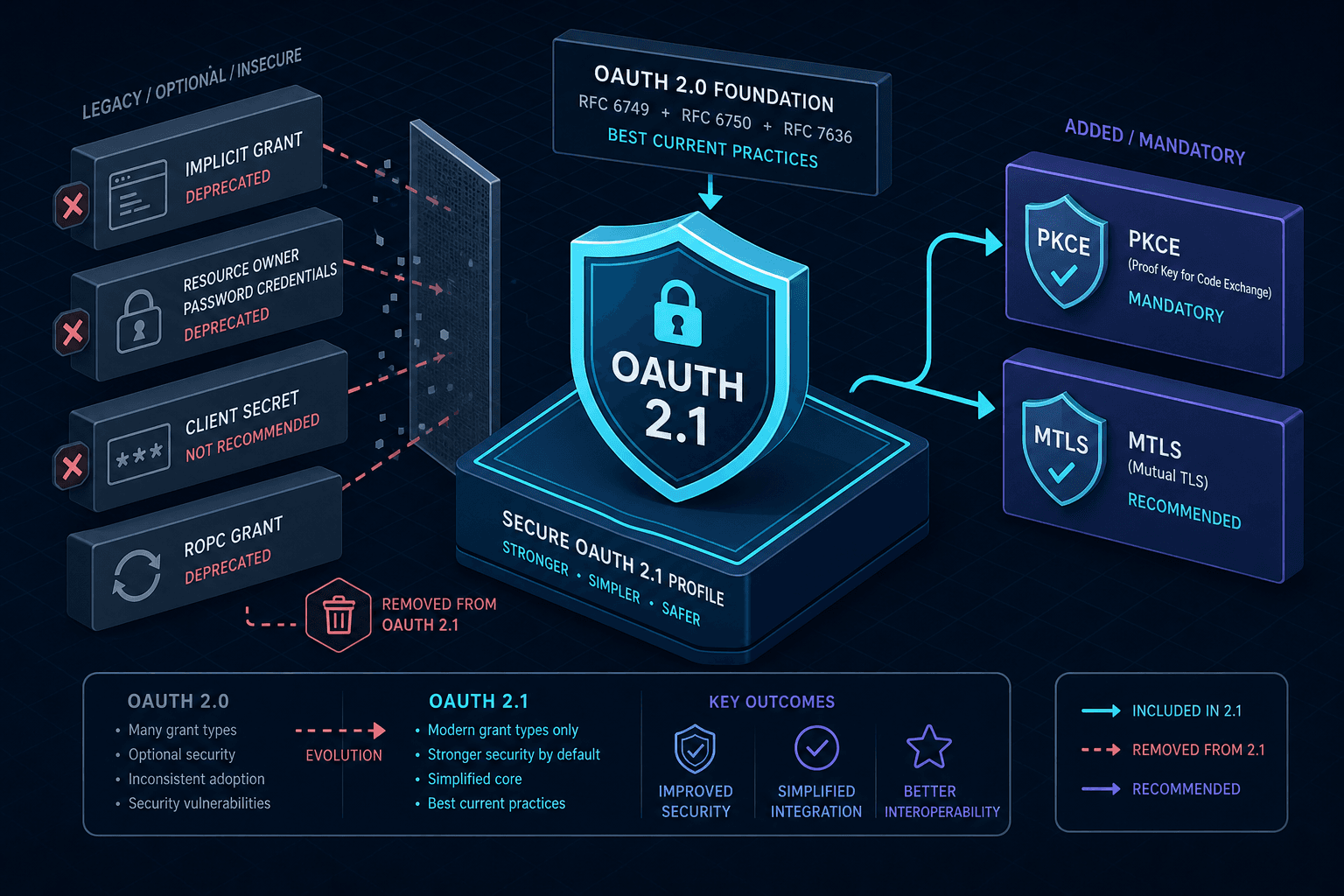
OAuth 2.1 is often misunderstood as a major version bump introducing new capabilities. In reality, it is a consolidation effort. The Internet Engineering Task Force (IETF) is taking the existing OAuth 2.0 specification (RFC 6749), stripping out features that have proven insecure or obsolete, and standardizing the remaining secure patterns into a single, definitive profile. For backend developers and architects, this means the "wild west" of OAuth implementations is being tamed by removing ambiguity and forcing security best practices into the core protocol definition.
This article is Part 8 of the "OAuth 2.0 RFCs Every Engineer Should Read" series.
The primary goal of OAuth 2.1 is to consolidate OAuth 2.0 (RFC 6749) with the security best practices that have emerged since its publication—such as mandatory PKCE and the removal of insecure grant types—into a single, coherent specification. By defining a single set of secure flows, the draft reduces the number of ways developers can implement OAuth insecurely, which simplifies integration for both providers and consumers.
The Death of Implicit Grant
The most significant change in OAuth 2.1 is the deprecation of the Implicit Grant flow. In the original OAuth 2.0 specification, this flow was designed for single-page applications (SPAs) where the client code runs entirely in the browser. It allowed the authorization server to return the access token directly in the URL fragment (#access_token=...) after user authentication.
This mechanism is fundamentally insecure. Access tokens in URL fragments are often exposed in browser history and can leak via referrer headers or malicious scripts on the page. Furthermore, JavaScript running in the browser can easily access these tokens, making them vulnerable to cross-site scripting (XSS) attacks. If an attacker injects malicious script, they can steal the token and impersonate the user.
OAuth 2.1 removes this flow entirely. The only supported flow for web applications is the Authorization Code Flow. This change forces all clients, including those running in browsers, to use a more secure pattern. The key enabler for this shift is PKCE, which we will discuss next.
Mandatory PKCE: Securing Public Clients
Proof Key for Code Exchange (PKCE), defined in RFC 7636, was originally an optional extension for public clients in OAuth 2.0. In OAuth 2.1, it becomes mandatory for all clients, regardless of whether they are public or confidential.
PKCE solves the authorization code interception attack. In a standard Authorization Code Flow, an attacker who intercepts the authorization code (e.g., via a malicious browser extension or network sniffing) could exchange it for an access token. PKCE adds a cryptographic verifier to this process.
Here is the mechanism:
- The client generates a code verifier (a random string) and a code challenge (a hashed version of the verifier).
- The client sends the code challenge to the authorization server during the initial authorization request.
- After the user authenticates, the authorization server returns an authorization code.
- The client exchanges the code for an access token, sending the original code verifier.
- The authorization server hashes the verifier and compares it to the stored challenge. If they match, the token is issued.
// Example: Generating a code challenge in TypeScript
import * as crypto from 'crypto';

const generateCodeChallenge = async (codeVerifier: string): Promise<string> => {
  const hash = crypto.createHash('sha256').update(codeVerifier).digest();
  // Base64url encoding
  return hash.toString('base64').replace(/=/g, '').replace(/\+/g, '-').replace(/\//g, '_');
};
This process ensures that only the client that initiated the authorization request can redeem the code. Even if an attacker intercepts the code, they cannot redeem it without the code verifier, which never leaves the client.
For backend developers, this means updating all OAuth integrations to include the code_challenge and code_challenge_method parameters in the authorization request. The S256 method (SHA-256 hash) is the only recommended method in OAuth 2.1.
Client Authentication: Moving Beyond Client Secrets
OAuth 2.0 allowed confidential clients (servers with secure storage) to authenticate using a simple client secret passed in the HTTP header or body. While this is still permitted in OAuth 2.1, the draft strongly encourages more secure methods.
The primary recommendation is to use TLS client certificates or private_key_jwt (JWT Bearer Token) for client authentication. These methods provide mutual authentication, ensuring that the client possesses a private key that corresponds to a public key registered with the authorization server.
For public clients (like SPAs or mobile apps), client secrets are not feasible because the secret would be exposed in the client code. PKCE serves as the primary defense against authorization code interception, preventing attackers from redeeming stolen codes, rather than performing identity authentication.
This shift has architectural implications. Organizations must update their identity providers to support client certificate authentication or private_key_jwt. This requires managing key pairs and configuring the authorization server to validate these credentials. However, the benefit is a significant reduction in the risk of credential theft.
Draft Status and Migration Strategy
It is crucial to understand that OAuth 2.1 is currently an IETF draft, not a final RFC. The working group is actively refining the specification based on feedback from implementers. This means the final text may change slightly, but the core security principles are unlikely to shift. For authoritative reference, the current draft can be found at https://www.ietf.org/archive/id/draft-ietf-oauth-v2-1-12.html (or the latest revision), building upon RFC 6749 and RFC 7636. Additional guidance is available through the OAuth.net documentation.
For backend developers, the migration strategy should be proactive but cautious, focusing on the oauth consolidation of various legacy flows into the single, secure profile defined by the draft:
- Audit Existing Flows: Identify any use of the Implicit Grant flow. Plan to migrate these clients to the Authorization Code Flow with PKCE.
- Enforce PKCE: Update all authorization servers and clients to require and validate PKCE. This is the most critical step and aligns with current best practices.
- Update Client Authentication: Begin migrating confidential clients to
private_key_jwtor client certificates. Keep client secrets as a fallback only if necessary for legacy systems. - Document Changes: Clearly communicate these changes to partner organizations and internal development teams. Provide updated integration guides.
- Monitor IETF Progress: Keep an eye on the IETF OAuth working group for the final publication of the RFC. This will signal when the specification is stable and ready for broad adoption.
Conclusion
OAuth 2.1 represents a maturation of the OAuth 2.0 protocol. By removing insecure features and mandating strong security mechanisms like PKCE, the draft provides a clearer, safer foundation for modern web applications. For backend developers, this means less complexity in implementation and stronger security guarantees. The transition requires effort, but the result is a more consistent and secure ecosystem.
The key takeaway is that OAuth 2.1 is not about adding new features; it is about enforcing the best practices that have emerged over the past decade. By aligning with this draft, organizations can future-proof their authentication systems and enhance overall authentication security by removing ambiguous flows.
Related posts
RFC 8628: The Device Authorization Grant
An examination of RFC 8628, the Device Authorization Grant, which enables users on devices without browsers to authenticate with OAuth 2.0 providers.
RFC 6749 Revisited: What Still Applies in 2026
An examination of RFC 6749 (OAuth 2.0) in 2026, analyzing which grant types remain relevant and why the implicit flow is deprecated.
Migrating an Existing User Base to Passwordless
A practical guide to migrating an existing user base to passwordless authentication, covering enrollment strategies, user adoption, and rollout planning.