OAuth2 for Machine Learning APIs: Securing Model Serving Endpoints
An examination of OAuth2 implementation strategies for securing machine learning model serving endpoints and ensuring API authentication.
Securing a machine learning model serving endpoint requires more than attaching a generic API key to a URL; the protection mechanism must align with the specific latency constraints and stateless nature of model inference. When deploying a model to production, you are building a high-throughput data pipeline rather than a website for human interaction. Applying standard interactive flows like "Authorization Code" introduces a fatal bottleneck: the requirement for a user to log in. For automated data science pipelines or mobile apps sending images for classification, such interaction is impossible. The solution lies in the Client Credentials grant type, which enables a service identity to authenticate directly with the authorization server, removing the human element entirely.
Mechanism of the Client Credentials Flow
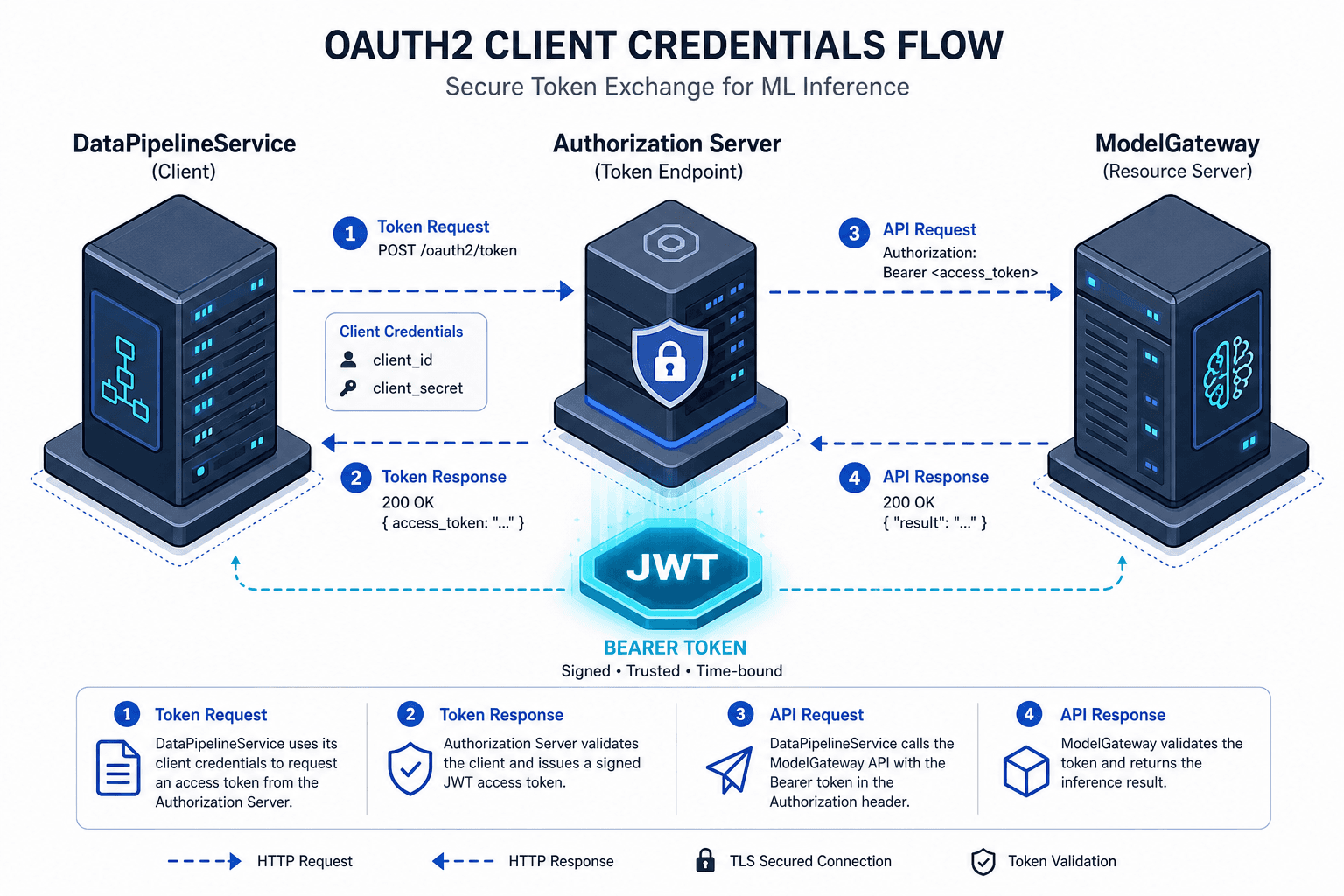
The Client Credentials flow is designed for scenarios where a client application needs to access its own resources or act on behalf of itself, rather than a specific user. Consider a scenario involving two actors: DataPipelineService (the client) and ModelGateway (the resource server). The DataPipelineService needs to send a batch of sensor readings to the ModelGateway to predict equipment failure. Unlike a traditional web flow where a user is redirected to a login page, the DataPipelineService acts as its own user.
It constructs a POST request to the token endpoint, typically POST /oauth/token. The payload includes the client_id and client_secret, along with the grant_type set to client_credentials. The authorization server validates these credentials against its registry of registered applications. If valid, it issues an Access Token. This token is then included in the Authorization: Bearer <token> header of the inference request. This mechanism allows the pipeline to run autonomously without user intervention.
# Example: Requesting a token via curl
curl -X POST https://auth.ml-platform.com/oauth/token \
  -H "Content-Type: application/x-www-form-urlencoded" \
  -d "grant_type=client_credentials" \
  -d "client_id=svc-prediction-pipeline" \
  -d "client_secret=super_secret_key_12345" \
  -d "scope=models:predict"
Token Lifecycle and Local Caching Strategies
A critical failure point in many ML implementations is the token lifecycle management. A common misconception is to request a new token for every single inference call. If your model serves 10,000 requests per second, making 10,000 network calls to the authorization server to fetch tokens will saturate your bandwidth and introduce significant latency jitter.
The mechanism here is local token caching. The DataPipelineService receives a token with an expiration time (expires_in) from the authorization server. The service stores this token in its local memory. Before making an inference request, the service checks if the cached token is still valid. It should only request a new token when the current one is expired or within a small buffer (e.g., 60 seconds before expiry) to handle clock skew. This ensures that the heavy lifting of authentication happens once per token lifetime, not once per request.
Scope Isolation for Model Versioning
Once the token is obtained, it must be structured correctly. While opaque tokens work, JSON Web Tokens (JWTs) are preferred in ML architectures because they carry claims. These claims allow the ModelGateway to make authorization decisions without querying a database for every request. The gateway can inspect the sub (subject) claim to identify the service, the iat (issued at) claim for validity, and crucially, custom claims for scope isolation.
In ML, scope is not just "read" or "write." It must be granular enough to distinguish between model versions. You might define a scope like models:predict:version-v2.1. If a script is updated to use the new model version, it must be configured with the correct scope. If an older, vulnerable script attempts to call the endpoint with the old scope, the gateway rejects it immediately. This prevents "privilege creep" where a compromised script gains access to a more sensitive or expensive model version.
Key Caching and Signature Verification
There is a specific tradeoff regarding the token signature verification. The ModelGateway must verify the token's signature using the public key of the authorization server to ensure it hasn't been tampered with. However, fetching this public key for every request is also inefficient. The mechanism here is key caching. The gateway fetches the JWK (JSON Web Key Set) from the well-known endpoint (e.g., /.well-known/jwks.json) and caches it locally, refreshing it only when the keys rotate. This is standard practice but often overlooked in rushed ML deployments. If you skip this verification, you open the door to replay attacks where an attacker captures a valid token and reuses it indefinitely.
Token Revocation and Short-Lived Lifetimes
Finally, consider the impact of token revocation. In a standard web app, if a user changes their password, the session ends. In an ML pipeline, if a service account's secret is compromised, you need to revoke the token immediately. However, because the ModelGateway relies on local caching of tokens and keys, it cannot instantly know a token was revoked unless it maintains a short-lived cache or uses a centralized blacklist.
A robust strategy involves using a short access_token lifetime (e.g., 5-15 minutes). RFC 6749 does not define refresh tokens for the Client Credentials grant type; therefore, revocation must rely solely on short-lived access tokens and key rotation. If vendor extensions are used to support refresh tokens, they must be explicitly qualified as non-standard implementations. If the client_secret is leaked, the attacker can only use the stolen token until it expires. This limits the window of opportunity for an attack, but the protocol itself does not inherently detect anomalies or invalidate tokens based on usage patterns. Anomaly detection requires external monitoring systems separate from the authentication flow.
Common Pitfalls
When implementing OAuth2 for ML services, several specific pitfalls frequently arise that can compromise security or performance:
- Token Leakage in Logs and Configs: Service secrets and tokens are often inadvertently logged by debugging tools or stored in plain text configuration files. Since these tokens are long-lived enough to be valuable, a single log leak can grant an attacker persistent access to your model endpoints.
- Caching Race Conditions: Improper implementation of token caching can lead to race conditions where multiple instances of a service simultaneously attempt to fetch a new token just before expiration, causing a sudden spike in authorization server load.
- Scope Misconfiguration: Granting overly broad scopes (e.g.,
models:*) to a specific pipeline service increases the blast radius if that service is compromised. It is essential to scope down permissions to the exact model version required.
Practical Takeaways
To implement a secure and efficient OAuth2 strategy for your ML infrastructure:
- Enforce Short Lifetimes: Configure access tokens to expire within 5 to 15 minutes to minimize the window of exposure in case of a secret leak.
- Implement Local Key Caching: Cache the JWK set from the authorization server to avoid latency spikes during signature verification while ensuring you update keys upon rotation.
- Audit Scope Definitions: Regularly review service scopes to ensure they adhere to the principle of least privilege, restricting access to specific model versions rather than the entire model registry.
FAQ
Q: Can I use refresh tokens with the Client Credentials grant? A: Standard OAuth2 (RFC 6749) does not define refresh tokens for the Client Credentials grant. Some vendors offer extensions, but these are non-standard and should be treated as such. Relying on short-lived access tokens is the standard approach for this flow.
Q: How do I handle token revocation in a stateless architecture? A: Since the resource server caches tokens for performance, it cannot instantly know about a revocation. The primary defense is short token lifetimes. For immediate revocation, you must implement a centralized blacklist or maintain a very short cache TTL, accepting the associated performance trade-off.
Q: Why not use API keys for ML endpoints? A: API keys are generally static and harder to rotate than OAuth2 tokens. They lack the granular scope capabilities and built-in expiration mechanisms of JWTs, making them less suitable for dynamic, high-volume ML inference environments where fine-grained access control is critical.
Conclusion
Securing ML model endpoints requires treating the model as a high-frequency service where latency and security are inextricably linked. The mechanism of protection is the Client Credentials flow, optimized with local token and key caching to minimize latency while maintaining a strong security posture. The scope must be defined to include model versions, ensuring that the right service calls the right model and preventing privilege creep. By adhering to these mechanisms, you move beyond simple authentication to a system that scales effectively with your inference traffic. Avoid forcing "Authorization Code" flows onto backend-to-backend ML services; the cost of a slow inference call is measurable in dollars and user experience, whereas the cost of a complex authentication flow is often invisible until it breaks under load.
Related posts
Keycloak Architecture: Realms, Clients, and the Data Model
An examination of Keycloak architecture, focusing on realms, clients, and the underlying data model for platform and identity engineers.
jwks_uri: Key Discovery, Rotation, and Caching
An examination of RFC 8414's JWKS URI for key discovery, key rotation strategies, and caching mechanisms for backend developers.
Implementing OAuth2 Resource Indicators (RFC 8707)
This article covers implementing OAuth2 Resource Indicators per RFC 8707 to enable audience restriction and multi-resource server configurations.