Implementing Delegated Administration in IAM Systems
A technical examination of delegated administration in IAM systems, covering scoped admin strategies and organizational access patterns.
The fundamental failure of naive Role-Based Access Control (RBAC) in large-scale organizations is not a lack of roles, but the inability to constrain those roles to specific subsets of the infrastructure. When a global administrator assigns a "User Admin" role to a junior engineer, a standard RBAC model often grants that engineer the ability to manage all users across the entire tenant. This is a critical security gap. Delegated administration solves this by introducing a mechanism of scope—a mathematical constraint that binds a privilege to a specific set of resource attributes or a hierarchical subtree.
The Mechanism of Scoping
Consider a fictional organization, "Nexus Corp," which operates three distinct regions: US-East, US-West, and EU-Central. Without delegation, a "Regional Admin" role might be created for each region, but managing three separate roles is brittle. If Nexus acquires a new region, the role definition must be duplicated. A more flexible mechanism uses Attribute-Based Access Control (ABAC) to define a single "Regional Admin" role that is dynamically scoped.
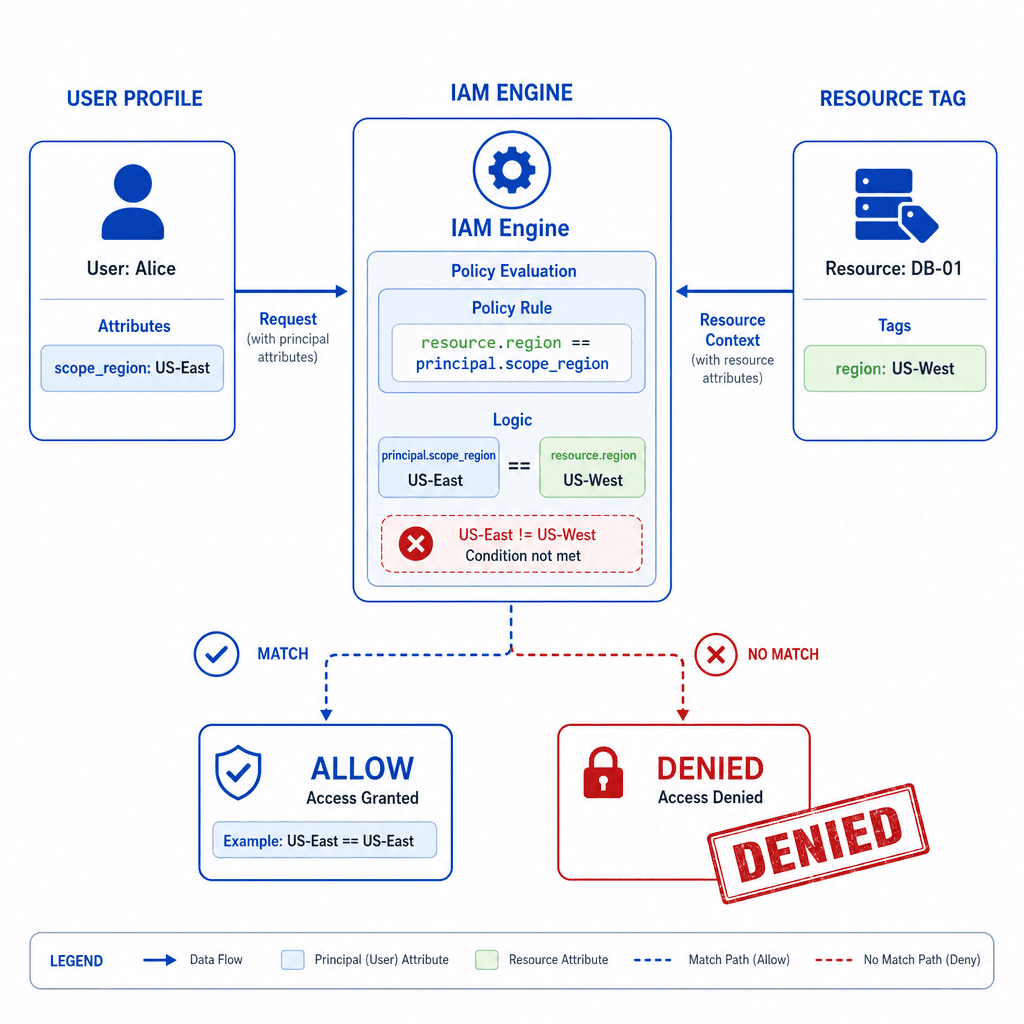
In this scenario, the IAM engine evaluates the request at runtime. When the junior engineer in US-East attempts to delete a user, the system does not just check "Does this user have the 'Regional Admin' role?" It checks "Does this user have the 'Regional Admin' role AND does the target resource's region attribute match the user's assigned scope_region attribute?"
{
  "principal": "junior-admin@nexus.corp",
  "action": "DeleteUser",
  "resource": {
    "id": "user-12345",
    "attributes": {
      "region": "US-West",
      "department": "Engineering"
    }
  },
  "policy_evaluation": {
    "role": "Regional-Admin",
    "scope_constraint": "resource.region == principal.scope_region",
    "result": "DENIED"
  }
}
The mechanism here is the explicit evaluation of the scope_constraint. If the engineer's identity profile states scope_region: US-East, the evaluation fails against a resource tagged US-West. This prevents lateral movement. The engineer cannot pivot to the West coast environment simply by knowing a username or UUID. This is the core of delegated administration: it transforms a binary "allow/deny" decision into a contextual one based on resource metadata.
Hierarchical Delegation and Permission Boundaries
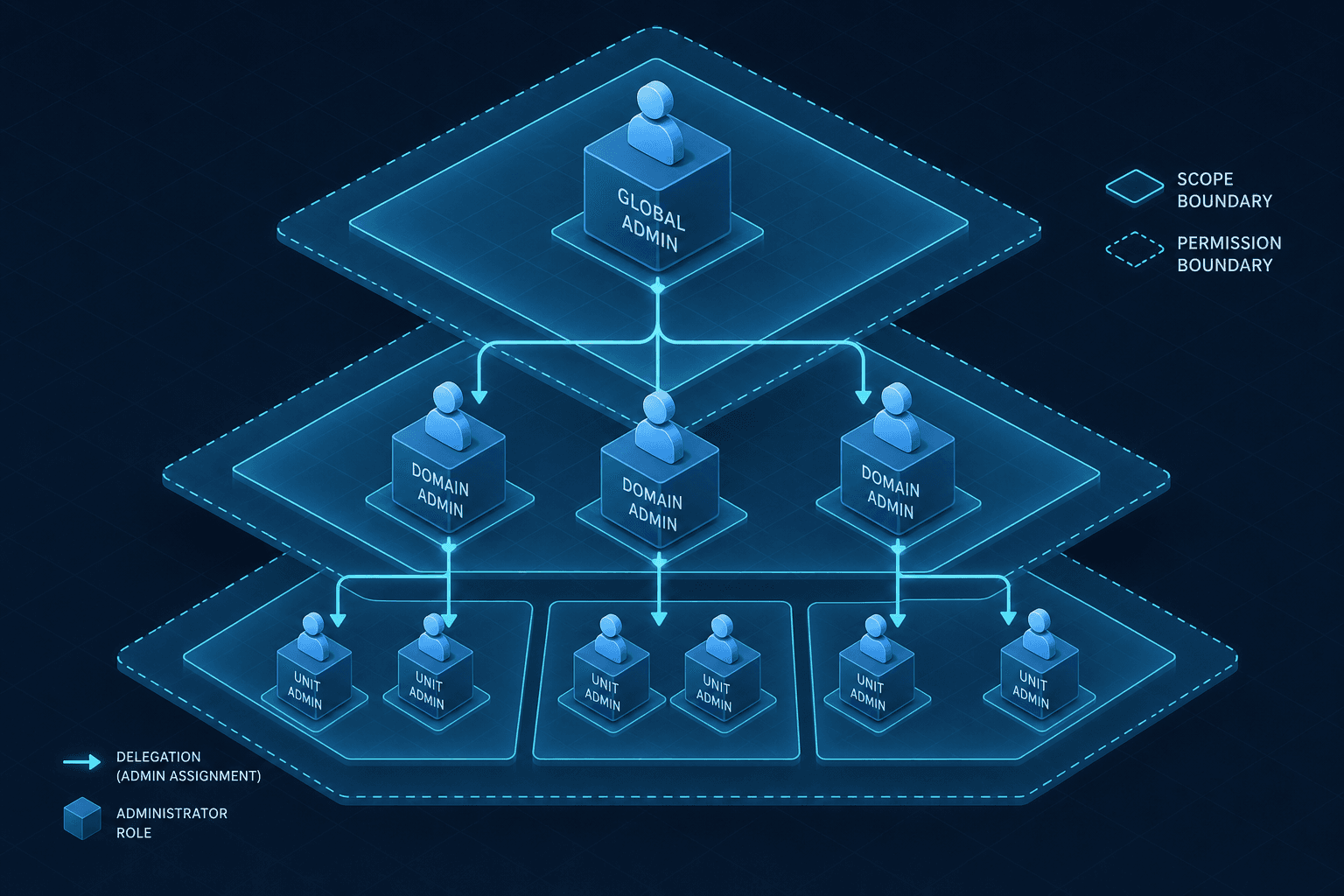
While scoping handles flat resource division, organizations often require hierarchical delegation to mirror their management structure. In this pattern, a Global Administrator delegates authority to a Domain Administrator, who in turn delegates to a Unit Administrator. The danger in this chain is permission accumulation. If the Global Admin grants "Full Access" to the Domain Admin, and the Domain Admin grants "Full Access" to the Unit Admin, the Unit Admin effectively holds Global Admin privileges, bypassing the intended hierarchy.
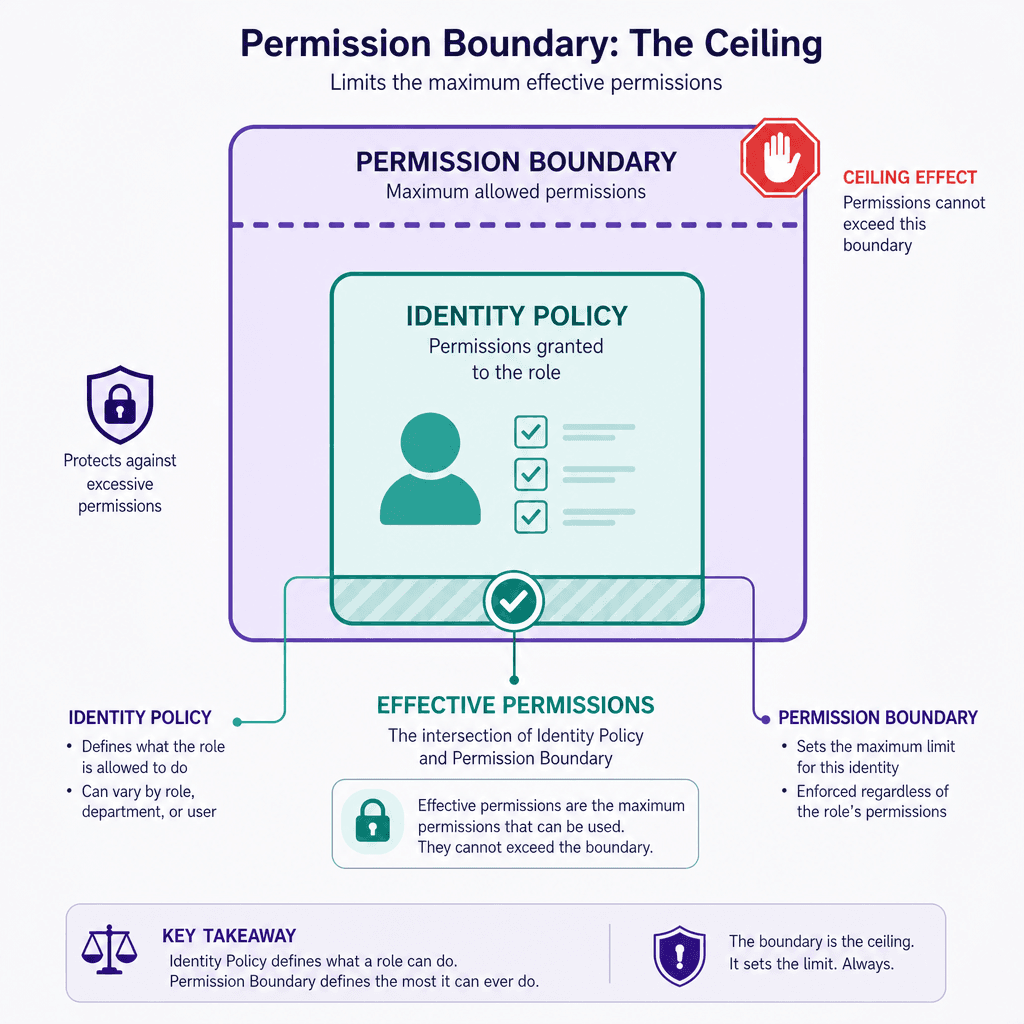
To implement this securely, the system must enforce "Permission Boundaries." A permission boundary is a policy attached to a role that defines the maximum permissions that role can ever have, regardless of what other policies are attached to it. This strictly limits actions (e.g., preventing iam:PassRole), not geographic scope. Geographic restrictions are instead enforced via condition keys in the identity policy or resource-based policies.
Imagine "Nexus Corp" implements this. The Global Admin creates a role called Domain-Admin but attaches a permission boundary policy that limits actions to specific IAM operations, such as preventing the creation of new roles or passing service-linked roles. Even if the Global Admin accidentally attaches a policy granting *:* (all actions on all resources) to Domain-Admin, the effective permissions are capped by the boundary. The system evaluates the intersection of the identity-based policy and the permission boundary policy.
# Example CLI command to attach a permission boundary (AWS CLI style)
aws iam put-role-permission-boundary \
  --role-name Domain-Admin-Role \
  --permission-boundary arn:aws:iam::123456789012:policy/Domain-Boundary
In this mechanism, the put-role-permission-boundary command does not grant new permissions; it establishes a ceiling. The authorization engine calculates EffectivePermissions = IdentityPolicy AND BoundaryPolicy. This ensures that a delegated administrator cannot exceed the scope of their delegation, even if they have the technical ability to modify their own policies. This is a critical defense against misconfiguration and insider threats.
However, relying solely on hierarchical delegation often leads to "privilege creep" over time. As domains grow, admins accumulate temporary permissions to solve immediate problems and forget to revoke them. A better approach combines hierarchy with Just-In-Time (JIT) access, where privileges are granted only for a specific duration and a specific reason, automatically expiring after the task is complete. This time-bound elevation of existing roles ensures that privilege management remains strict and temporary access does not become permanent.
Dynamic Attribute Enforcement and Runtime Context
Static roles and permission boundaries are necessary but insufficient for modern, dynamic environments. The most advanced form of delegated administration relies on dynamic attribute enforcement at the moment of access. This moves the decision logic from the identity store to the runtime policy engine.
Consider a scenario where a support team needs to access customer data to troubleshoot a billing issue. In a static model, you would create a "Billing Support" role and assign it to the team members. In a dynamic model, the system evaluates the request against a policy that includes real-time context.
The policy might state: "Allow Read access to BillingRecords IF request.time is within business hours AND request.source_ip is in the corporate network AND resource.customer_id matches the user's assigned support_ticket_customer."
This mechanism requires the IAM system to resolve attributes from multiple sources at runtime. The identity provider (IdP) provides the user's attributes (e.g., assigned_ticket_customer). The application provides the resource attributes (e.g., customer_id). The network layer provides context (e.g., source_ip). The policy engine fuses these inputs to make a decision.
# Pseudocode for a dynamic policy evaluation
policy:
  effect: ALLOW
  principal:
    role: "Support-Tier-2"
    attributes:
      assigned_ticket_customer: "${request.ticket.customer_id}"
  resource:
    type: "BillingRecord"
    attributes:
      customer_id: "${request.resource.customer_id}"
  condition:
    - key: "request.source_ip"
      operator: "in"
      values: ["10.0.0.0/8", "192.168.1.0/24"]
    - key: "request.time"
      operator: "between"
      values: ["09:00", "17:00"]
If the support agent attempts to access a record for a customer they are not assigned to, the assigned_ticket_customer attribute does not match the customer_id in the resource, and the condition fails. This is not just a role check; it is a data-level filter.
This approach aligns with the principle of least privilege by ensuring that access is granted only when the specific context justifies it. It reduces the attack surface because even if an attacker compromises a "Support" account, they cannot access arbitrary data; they are limited to the data associated with their specific active tickets.
Conclusion
Implementing delegated administration is an exercise in defining boundaries. It requires moving beyond the simple concept of "who has what role" to "who can do what, to which resources, under which conditions." The mechanisms of scoping, permission boundaries, and dynamic attribute enforcement work together to create a secure, scalable access model.
The choice between static RBAC and dynamic ABAC depends on the organization's complexity. For small teams, static roles may suffice. For large enterprises, the overhead of managing dynamic attributes is justified by the security posture. The key is to treat delegation not as a convenience feature, but as a rigorous control mechanism that enforces the separation of duties and limits the blast radius of any single compromised credential.
Common Pitfalls
When implementing delegated administration, organizations frequently encounter specific risks that can undermine security controls.
- Permission Accumulation: In deep delegation chains, permissions from multiple levels can stack unintentionally. If a Global Admin grants broad access to a Domain Admin, and that Domain Admin grants similar access to a Unit Admin, the resulting effective permissions may exceed the original intent, creating a de facto global admin.
- Privilege Creep: Over time, administrators often retain temporary permissions granted for specific tasks. Without a rigorous review process, these temporary elevations become permanent, expanding the attack surface and violating the principle of least privilege.
- Misconfiguration in Delegation Chains: Complex policies often lead to configuration errors. A single misconfigured condition key or an overly permissive boundary policy can inadvertently grant access to sensitive resources, bypassing the intended scope constraints.
Practical Takeaways
To successfully implement delegated administration, focus on these core strategies:
- Define Clear Boundaries: Always pair delegation with strict permission boundaries that limit the maximum actions a role can perform, separating action limits from geographic or resource constraints.
- Leverage Dynamic Context: Move beyond static roles by integrating runtime context (time, location, ticket ID) into your policy evaluations to ensure access is only granted when necessary.
- Automate JIT Access: Implement Just-In-Time access workflows to ensure that elevated privileges are temporary, time-bound, and automatically revoked, reducing the window of opportunity for privilege escalation.
FAQ
Q: How do permission boundaries differ from condition keys?
A: Permission boundaries set a hard ceiling on the actions a role can perform (e.g., preventing iam:PassRole), whereas condition keys in identity policies are used to filter when or where those actions are allowed (e.g., restricting access to specific IP ranges or regions).
Q: Can Just-In-Time (JIT) access replace static roles entirely? A: Not entirely. JIT is best used to elevate existing roles temporarily for specific tasks. Static roles should still define the baseline permissions required for day-to-day operations, while JIT handles the exceptional, high-privilege scenarios.
Q: What is the primary risk of hierarchical delegation without boundaries? A: The primary risk is permission accumulation. Without boundaries, permissions can cascade down the hierarchy, allowing lower-level administrators to effectively inherit the full power of the top-level administrator, bypassing the intended separation of duties.
Related posts
Least Privilege in Practice
A practical guide to implementing least privilege in AWS using IAM Access Analyzer, policy generation, and condition keys for secure access management.
Implementing Attribute-Based Access Control (ABAC) with Spring Security
A technical guide on implementing attribute-based access control (ABAC) using Spring Security and Open Policy Agent for dynamic policy enforcement.
RBAC vs ABAC: Static Roles vs. Dynamic Attributes
A detailed examination of Role-Based Access Control versus Attribute-Based Access Control, covering OPA, XACML, and authorization strategies.