Ragas, DeepEval, and TruLens Compared
A comparison of Ragas, DeepEval, and TruLens for RAG evaluation, helping ML engineers choose the right metric framework.
Evaluating Retrieval-Augmented Generation (RAG) systems has shifted from a niche concern to a critical engineering discipline. As LLMs become the backbone of enterprise applications, the "black box" nature of their outputs is no longer acceptable. However, choosing the right evaluation framework is confusing because tools like Ragas, DeepEval, and TruLens often appear interchangeable at a high level. They all claim to measure "quality."
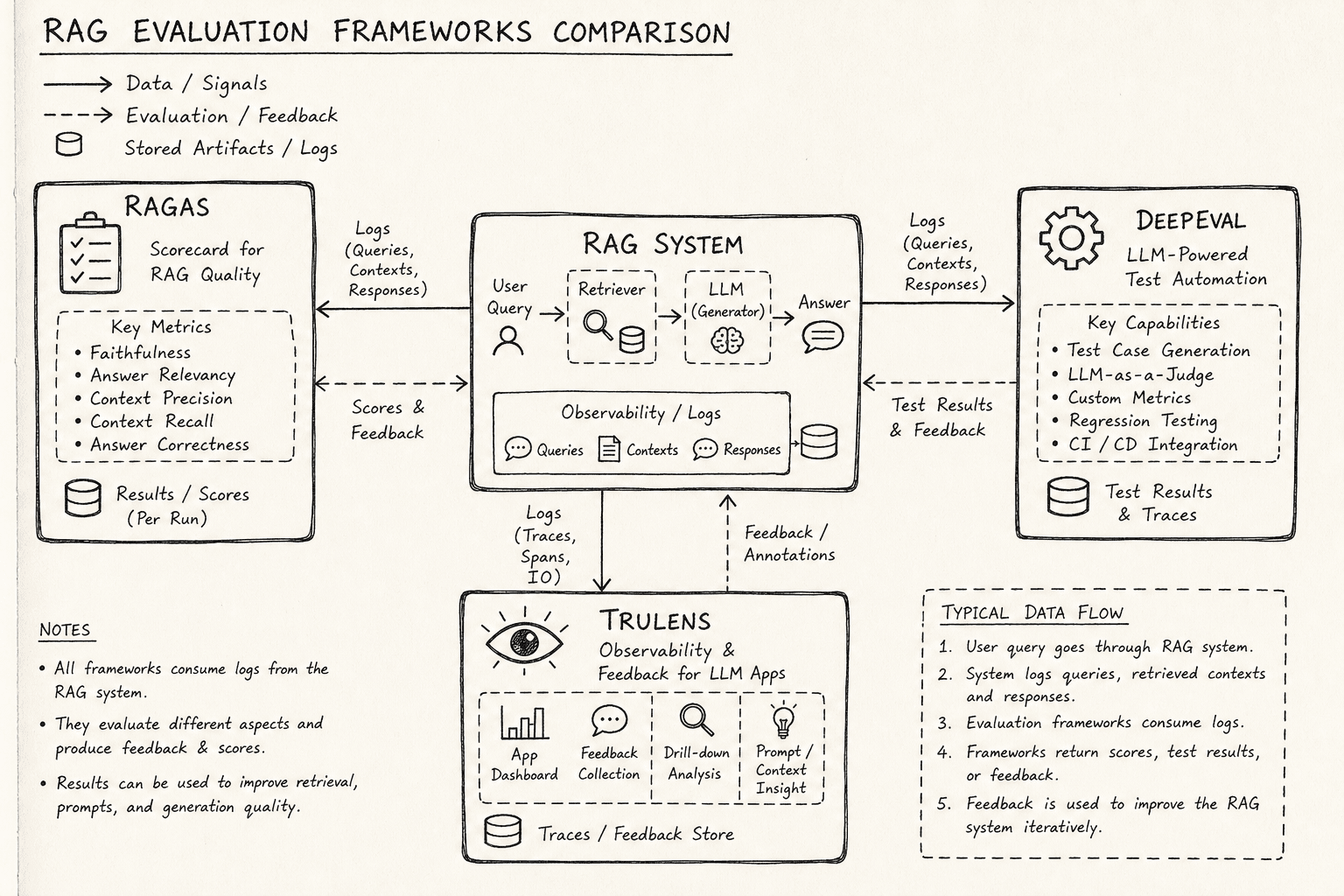
The confusion arises because they optimize for different stages of the ML lifecycle. Ragas is a metric library designed for offline validation using complex scoring algorithms. DeepEval is a testing framework designed to integrate RAG validation into CI/CD pipelines like unit tests. TruLens is an observability platform designed for continuous monitoring and human-in-the-loop feedback in production.
To choose correctly, you must understand the mechanism each tool uses to generate trust.
Ragas: The Metric-Centric Engine
Ragas (by Exploding Gradients) operates on the premise that RAG quality is a composite of retrieval and generation. Its core mechanism is LLM-as-a-Judge, but with a specific twist: it generates its own ground truth when human-labeled data is unavailable.
How It Works Mechanically
Ragas decomposes the evaluation process into distinct, measurable components to provide granular insight into system performance. By leveraging an LLM as a judge, it can assess nuanced qualities like faithfulness and relevance that simple string matching misses. This approach allows for a more holistic view of quality by breaking down the RAG pipeline into retrieval accuracy and generation correctness.
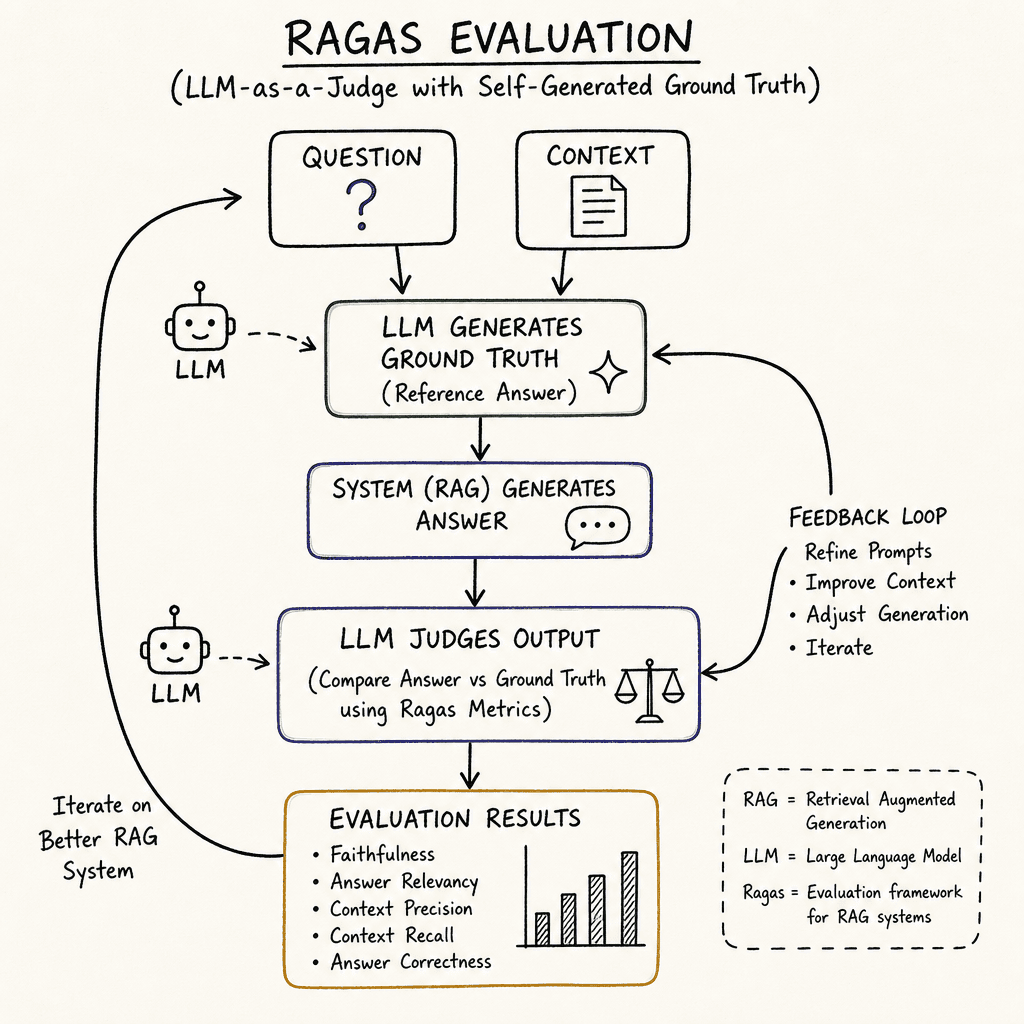
Ragas does not just ask an LLM "Is this answer good?" Instead, it decomposes the evaluation into four primary metrics:
- Context Precision: Measures if the retrieved chunks actually contain the answer.
- Context Recall: Measures if the ground truth answer can be fully supported by the retrieved chunks.
- Answer Relevance: Measures if the generated answer addresses the prompt.
- Faithfulness: Measures if the answer is factually supported by the context (hallucination check).
The key differentiator is Self-Generated Ground Truth. In a typical offline evaluation, you need a dataset of (question, ground_truth_answer, context) tuples. Ragas allows you to input only (question, context) and uses an LLM to generate the ground_truth_answer based on the context. It then evaluates the system's output against this synthetic ground truth.
from ragas import evaluate
from datasets import Dataset

# Assuming 'dataset' is your test set with 'question', 'contexts', and 'ground_truth'
result = evaluate(
    llm=llm,
    embeddings=embeddings,
    dataset=dataset,
    metrics=[context_precision, faithfulness, answer_relevancy]
)
Use Case: Ragas is best for offline benchmarking. If you are comparing two different embedding models or chunking strategies, Ragas provides the granular scores needed to make a data-driven choice. It is not designed for real-time monitoring; it is a diagnostic tool.
DeepEval: The Unit Testing Framework
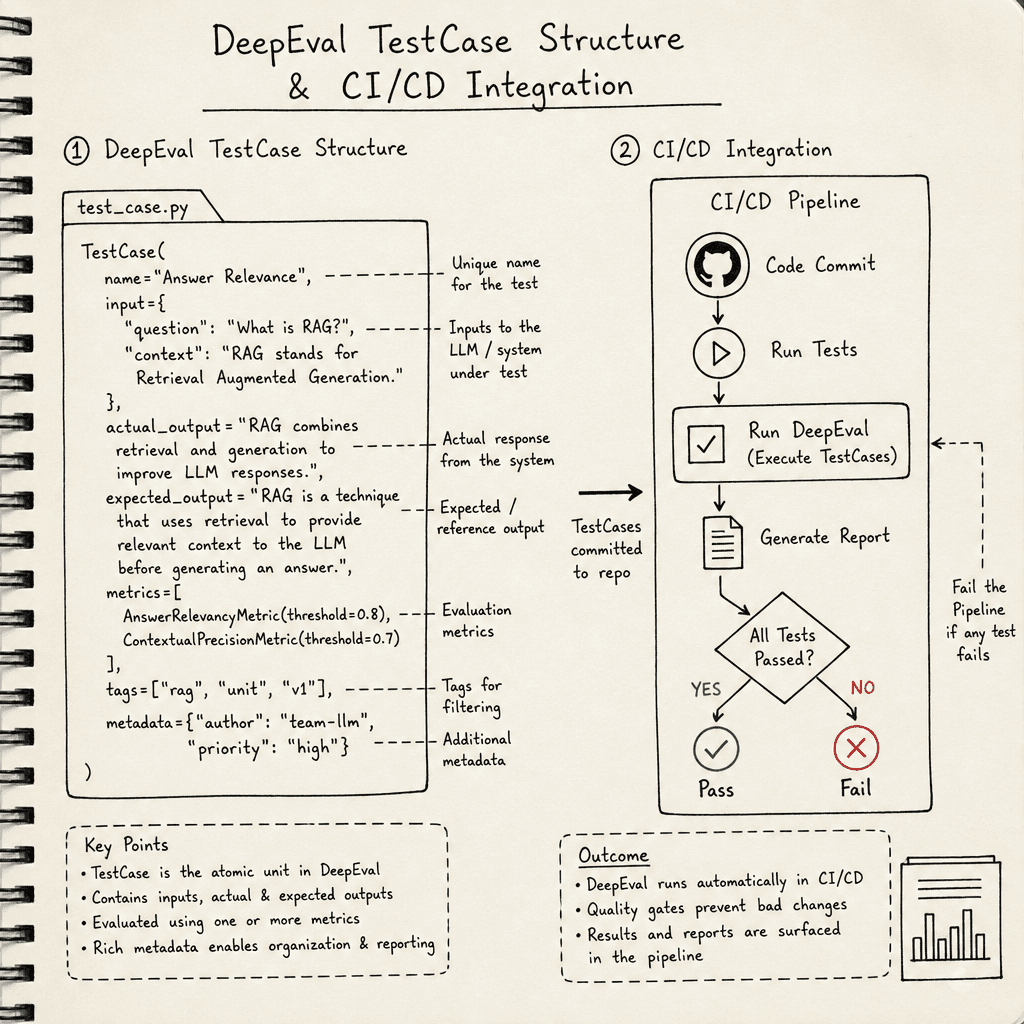
DeepEval (by Confident AI) takes a different philosophical approach. It treats RAG evaluation like software testing. Its mechanism is built around the concept of TestCase and TestSuite, mirroring the structure of pytest.
How It Works Mechanically
DeepEval structures evaluation by defining explicit inputs and expected outputs, allowing for rigorous validation of specific scenarios. It supports both deterministic metrics for speed and cost-efficiency, as well as LLM-based metrics for complex semantic understanding. This dual capability ensures that tests can run quickly in CI pipelines while still catching subtle semantic errors.
- Structured Test Cases: You define inputs and expected outputs explicitly.
from deepeval.test_case import LLMTestCase test_case = LLMTestCase( input="What is the capital of France?", actual_output="Paris", context=["Paris is the capital of France."] ) - Metric Integration: Metrics like
HallucinationMetric,AnswerRelevancyMetric, andContextualPrecisionMetricare applied to these cases. - CI/CD Native: Because it uses standard Python testing structures, you can run
deepeval test runor integrate it into GitHub Actions/Jenkins pipelines. If the RAG system's accuracy drops below a threshold, the build fails.
Key Mechanism Difference: Unlike Ragas, which often relies on LLM-judged scores for nuanced understanding, DeepEval offers both LLM-based metrics and deterministic metrics (e.g., string matching, BLEU scores) for faster, cheaper evaluation in CI/CD. It also has a strong focus on hallucination detection via the HallucinationMetric, which checks if the generated output contains information not present in the context.
Use Case: DeepEval is ideal for engineering teams that want to treat RAG quality as a non-functional requirement. If your team already uses pytest for backend logic, DeepEval allows you to extend that same workflow to LLM outputs without learning a new proprietary API.
TruLens: The Observability and Feedback Loop
TruLens (by TruEra) does not primarily focus on offline evaluation. It focuses on production observability and continuous improvement. Its mechanism is based on instrumentation and human feedback loops.
How It Works Mechanically
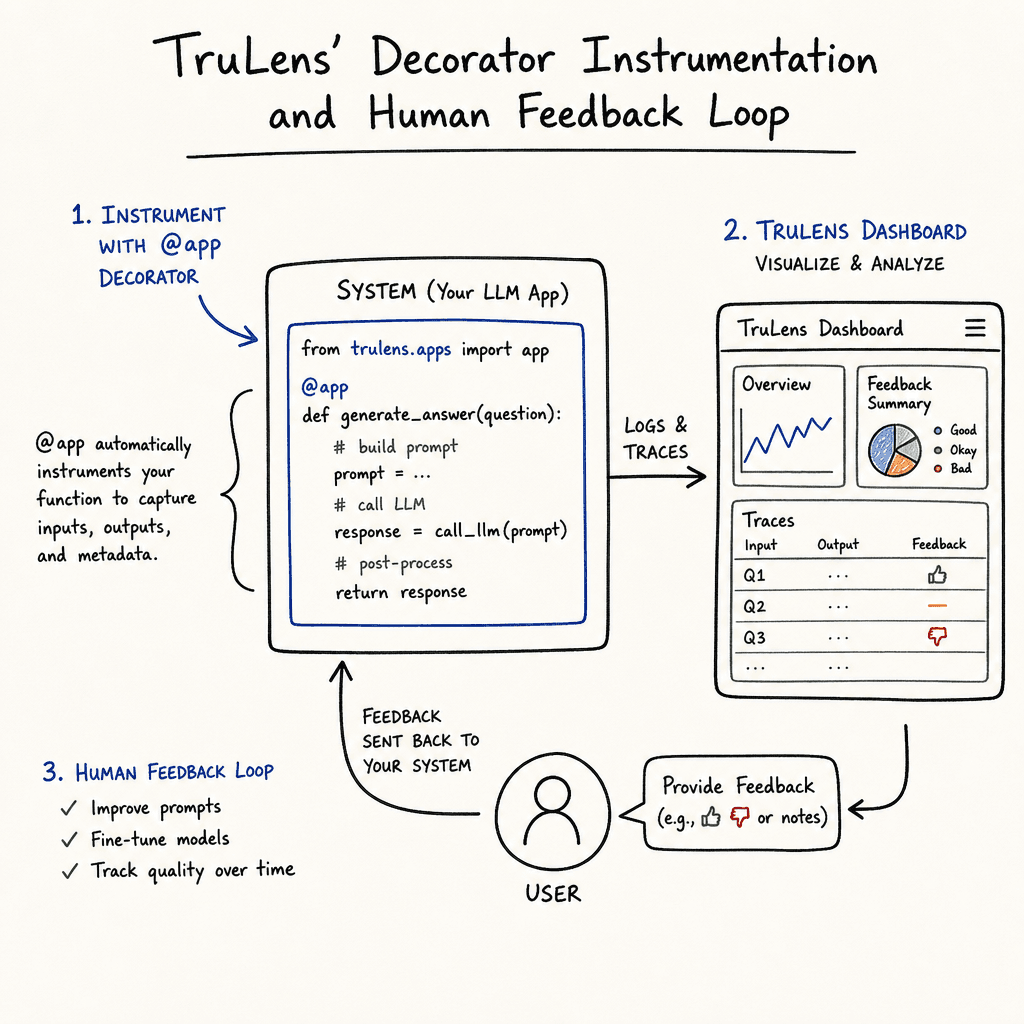
TruLens instruments applications by wrapping code with decorators, automatically capturing traces of inputs, outputs, and intermediate steps. This continuous logging creates a historical record of system behavior, enabling correlation between performance metrics and specific code changes or data drifts over time.
- Decorator-Based Instrumentation:
from trulens_eval import Tru from trulens_eval import Feedback from trulens_eval import OpenAI @app.get("/") def main(question: str): # TruLens automatically logs this call response = rag_chain.invoke(question) return {"response": response} - Feedback Functions: You define custom metrics (e.g., "Is this answer helpful?") that can be scored by an LLM or by humans.
- Human-in-the-Loop: TruLens provides a UI where users can flag bad outputs. These flags are stored and can be used to retrain models or adjust prompts.
Key Mechanism Difference: TruLens is stateful. It tracks the history of every query. While Ragas and DeepEval give you a snapshot of quality today, TruLens gives you a timeline of quality over time. It allows you to correlate drops in quality with specific code changes or data drifts.
Use Case: TruLens is best for production monitoring. If you have a live RAG application serving thousands of queries, TruLens helps you identify which queries are failing and why, and it provides the infrastructure to collect human feedback to improve the system iteratively.
Decision Matrix: Which Tool for Which Problem?
The choice between Ragas, DeepEval, and TruLens is not mutually exclusive, but they serve distinct roles in the ML engineering workflow.
| Feature | Ragas | DeepEval | TruLens |
|---|---|---|---|
| Primary Goal | Offline Metric Evaluation | CI/CD Testing | Production Observability |
| Core Mechanism | LLM-as-a-Judge + Self-Generated GT | TestCase + pytest Integration | Decorator Instrumentation + Feedback Loop |
| Best For | Comparing model/chunking strategies | Validating RAG in CI/CD pipelines | Monitoring live apps & collecting feedback |
| Human Feedback | Limited (mostly offline) | No (automated testing) | Yes (built-in UI & workflows) |
| Complexity | Medium (requires dataset prep) | Low (easy to integrate) | High (requires instrumentation) |
Opinion: The Hybrid Approach
In mature RAG systems, you will likely use all three.
- Development Phase: Use Ragas to benchmark different embedding models and chunk sizes. The granular metrics help you tune the retrieval layer.
- Engineering Phase: Use DeepEval to write unit tests for your RAG chain. Ensure that regressions in prompt engineering or retrieval logic do not break in production.
- Production Phase: Use TruLens to monitor the live system. Collect human feedback on bad outputs and use that data to create new test cases for DeepEval or retrain models.
Conclusion
There is no single "best" RAG evaluation tool. The landscape is fragmented because RAG evaluation itself is multi-dimensional.
- If you need to prove that your RAG system is better than a previous version, use Ragas for its nuanced, LLM-judged metrics.
- If you need to prevent your RAG system from breaking in production, use DeepEval for its CI/CD integration.
- If you need to improve your RAG system over time, use TruLens for its feedback loops and observability.
Understanding these mechanistic differences prevents the common mistake of trying to force a testing framework (DeepEval) into a production monitoring role (TruLens), or vice versa. Each tool solves a specific part of the trust problem in RAG.
Common Pitfalls
- Over-relying on LLM-as-a-Judge without human validation: Automated judges can be biased or inconsistent. Always validate a subset of LLM-judged scores against human annotations to ensure alignment.
- Ignoring CI/CD integration needs: Evaluating RAG systems only in isolation during development leads to regressions in production. Integrate evaluation metrics early in the deployment pipeline.
- Misinterpreting offline metrics as production health: High scores on a static test set do not guarantee good performance in production, where data drift and user intent variations occur. Use production observability tools to bridge this gap.
Practical Takeaways
- Ragas: Use for deep, offline analysis of retrieval and generation quality, especially when creating synthetic ground truth.
- DeepEval: Use for automated, repeatable testing in CI/CD pipelines to catch regressions before they reach production.
- TruLens: Use for ongoing production monitoring, collecting real-world user feedback, and tracking long-term model performance.
Related posts
Task-Specific Metrics for RAG, Agents, and Extraction
Examine faithfulness, groundedness, trajectory metrics, extraction accuracy, and task metrics for evaluating RAG, agents, and extraction systems.
Statistical Significance in LLM Evals
Learn how to apply statistical significance, confidence intervals, and bootstrap methods to validate LLM evaluation results with proper sample sizes.
Query Rewriting: The Underrated RAG Upgrade
Explore how query rewriting and expansion improve RAG recall by resolving coreference and enhancing conversational search capabilities.
