RBAC's Ceiling and Why ABAC
An examination of Role-Based Access Control limitations and the shift to Attribute-Based Access Control for complex authorization models.
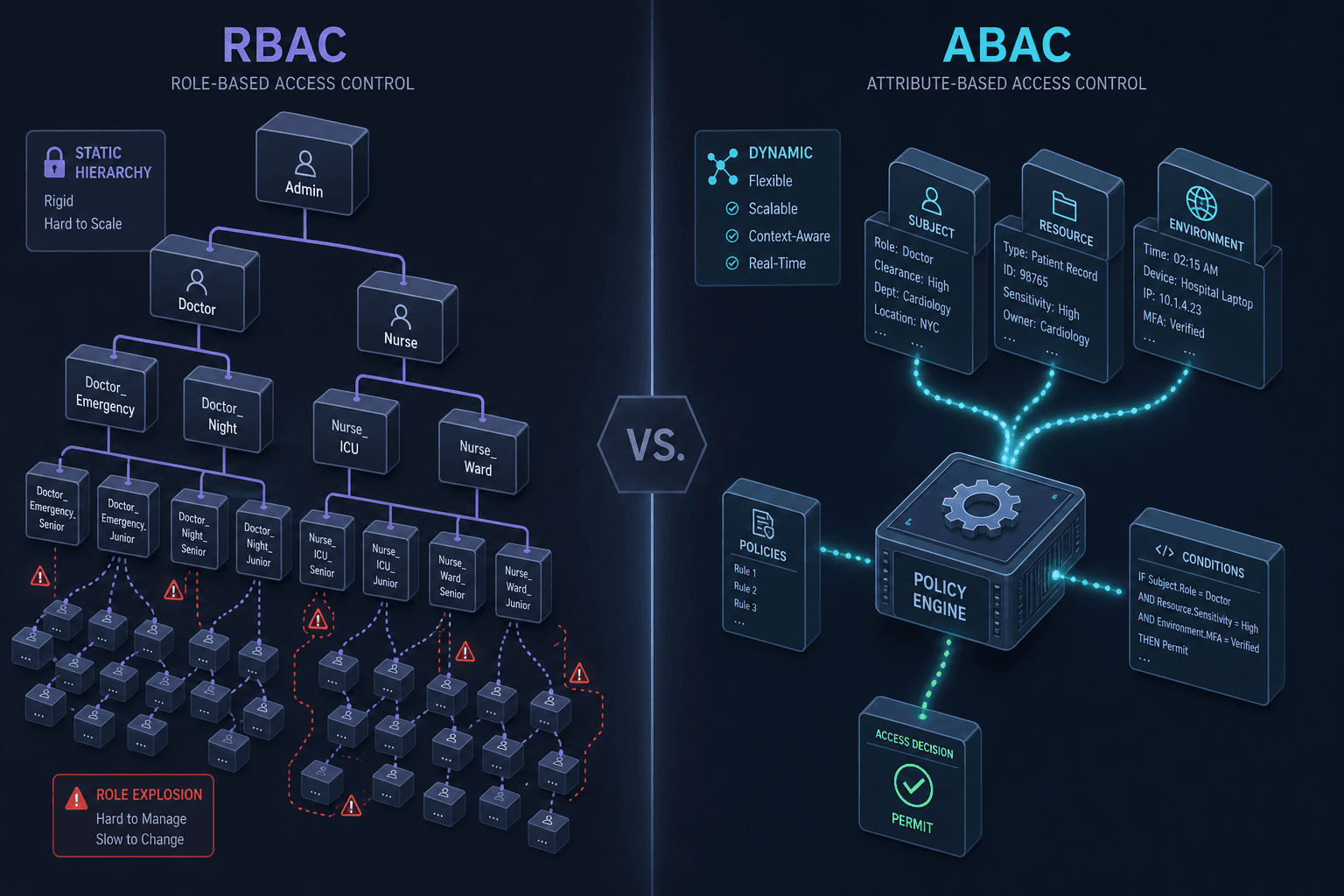
Role-Based Access Control (RBAC) serves as the default mental model for most backend engineers. We assign users to roles, and roles grant permissions. It is simple, intuitive, and works well for CRUD applications with flat hierarchies. However, as systems grow in complexity—introducing context, multi-tenancy, or granular data ownership—RBAC hits a hard ceiling known as "role explosion." This article examines the mechanism of that failure and explains why Attribute-Based Access Control (ABAC) is the necessary architectural evolution for modern authorization.
The Combinatorial Explosion of Roles
To understand why RBAC fails, we must look at its underlying mechanism: static membership. In an RBAC system, access decisions are made by checking if a user’s identifier is present in a list associated with a role, and if that role has a permission bitmask or list entry for a resource.
Consider a healthcare application. You have resources (Patient Records) and actions (Read, Write). You have users (Doctors, Nurses, Admins). Initially, you might define three roles: Doctor, Nurse, and Admin.
Now, introduce context. A Doctor should only see records for patients assigned to their specific department. A Nurse should only see records for patients under their care. An Admin might need access only during business hours for audit purposes.
If you try to model this in RBAC, you cannot simply add a "Department" attribute to the Doctor role because roles are static containers. You must create new roles for every combination of context.
Doctor_EmergencyDoctor_PediatricsDoctor_OnCallNurse_EmergencyNurse_Pediatrics
If you add a fourth dimension, such as "Time of Day" (Night Shift vs. Day Shift), the number of roles grows exponentially. You no longer have 3 roles; you have potentially hundreds. This is role explosion. The administrative overhead becomes unmanageable, highlighting key rbac limitations. The system becomes brittle because adding a new business rule requires creating a new role, not just updating a policy. This highlights the core rbac limitations in dynamic environments.
The ABAC Mechanism
When comparing abac vs rbac, the fundamental difference lies in how access decisions are made. Attribute-Based Access Control (ABAC) removes the static role layer entirely. Instead of asking "Does this user have this role?", ABAC asks "Does this request satisfy this policy?"
The mechanism relies on four core components:
- Subject: The entity requesting access (User, Device, Service Account).
- Resource: The object being accessed (Database Record, File, API Endpoint).
- Action: The operation requested (Read, Write, Delete).
- Environment: The contextual attributes surrounding the request (Time, IP Address, Department, Security Clearance Level).
ABAC uses a policy engine to evaluate a boolean expression against these attributes. The policy is decoupled from the user identity. This allows for fine-grained, dynamic authorization without proliferating roles. The comparison of abac vs rbac shows that ABAC scales better because policies remain static while attributes change.
For example, a policy might look like this:
IF Subject.Role == 'Doctor' AND Subject.Department == Resource.AssignedDepartment AND Time.IsNightShift == False THEN Allow
This single policy replaces dozens of RBAC roles. It is declarative, meaning the business logic is explicit in the policy, not hidden in the structure of role assignments.
Worked Scenario: The Senior Doctor Rule
Let’s compare the implementation of a specific business rule in both models.
Rule: A Senior Doctor can read a patient record only if the patient is in their department and it is not between 2 AM and 5 AM.
RBAC Implementation
In RBAC, you would need to create a specific role, e.g., SeniorDoctor_DayShift_DepartmentA. If the doctor moves to Department B, you must update their role or create a new one. If the time window changes, you might need another role SeniorDoctor_NightShift_DepartmentA if the policy allows exceptions, or you are forced to put the check in code, breaking the separation of concerns.
The authorization check looks like this:
def check_access(user, resource):
    if 'SeniorDoctor' in user.roles:
        if resource.department == user.department:
            if not is_night_shift():
                return True
    return False
This code is procedural and tightly coupled. It is hard to test, hard to audit, and impossible to manage dynamically without redeployment.
ABAC Implementation
In ABAC, you define a policy once. The attributes are fetched at runtime.
Policy (pseudo-XACML or Rego):
allow {
  input.subject.role == "Doctor"
  input.subject.level == "Senior"
  input.resource.department == input.subject.department
  input.environment.time < "02:00"
}

allow {
  input.subject.role == "Doctor"
  input.subject.level == "Senior"
  input.resource.department == input.subject.department
  input.environment.time >= "05:00"
}
The engine fetches the attributes:
- Subject:
{role: "Doctor", level: "Senior", department: "Cardiology"} - Resource:
{type: "PatientRecord", department: "Cardiology"} - Environment:
{time: "10:00"}
The engine evaluates the boolean expression. The result is Allow. If the time changes to 03:00, the same policy returns Deny without any code change or role reassignment.
Tradeoffs and Conclusion
ABAC is not a silver bullet. It introduces complexity. You must manage the policy language, the attribute sources, and the policy evaluation logic. You need a reliable policy engine (like OPA, Casbin, or AWS IAM Policies) to handle the evaluation efficiently.
However, for systems with complex, context-dependent authorization requirements, ABAC is the only scalable solution. It shifts the burden from managing static identity mappings to managing dynamic policies. As your system grows, RBAC will require more roles and more code to handle edge cases. ABAC requires only more attributes and more policy rules.
The shift from RBAC to ABAC is a shift from static membership to contextual evaluation. For architects building complex systems, this is not just an optimization—it is a necessity.
Related posts
Designing an Attribute Model for ABAC
A practical guide to designing an effective attribute model for Attribute-Based Access Control, covering subject, resource, and environment attributes.
RBAC vs ABAC: Static Roles vs. Dynamic Attributes
A detailed examination of Role-Based Access Control versus Attribute-Based Access Control, covering OPA, XACML, and authorization strategies.
Implementing Conditional Access Policies with Keycloak and ForgeRock
A technical examination of implementing conditional access policies using Keycloak and ForgeRock for context-aware access control.