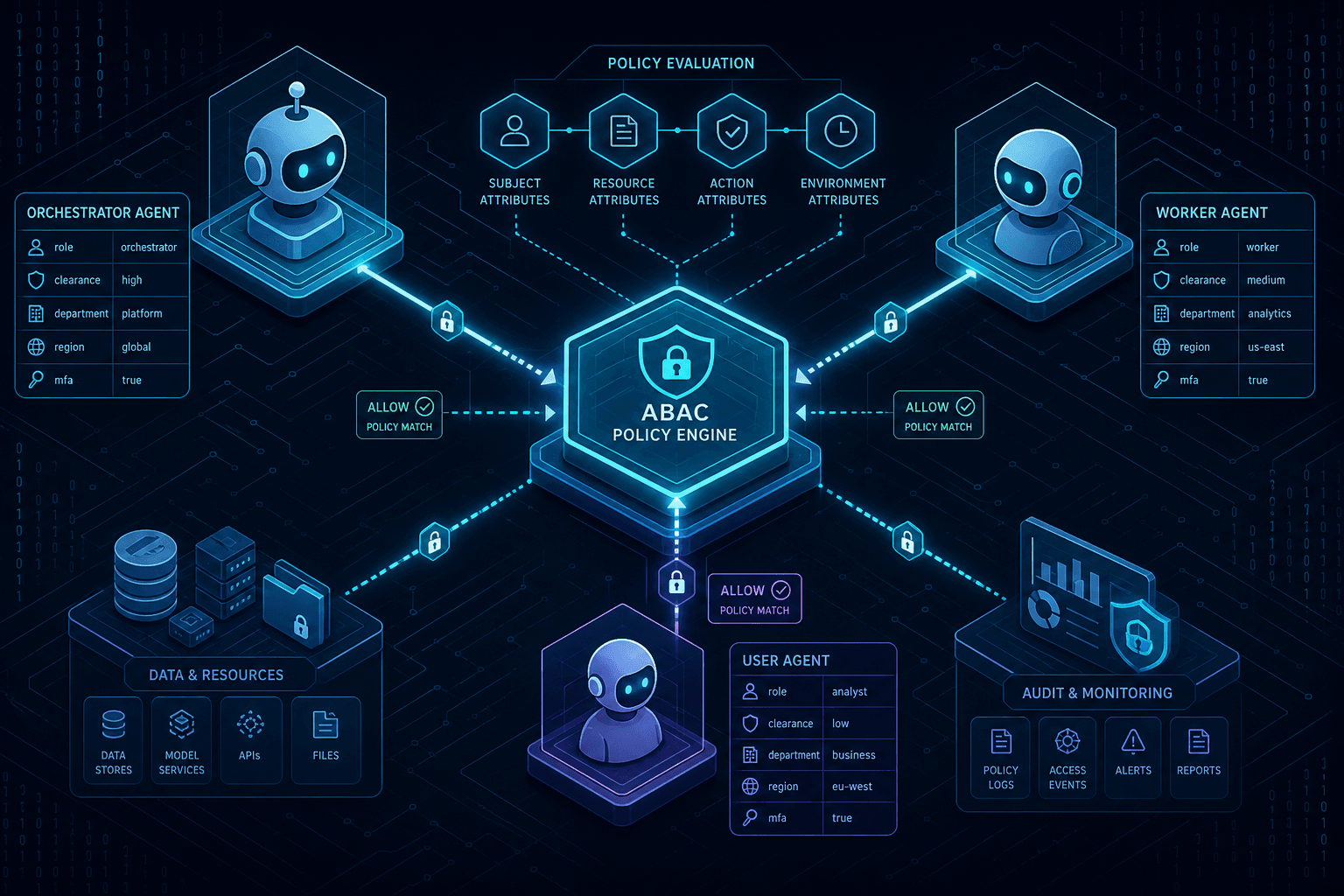
ABAC for AI Agents: Securing Autonomous Operations
Explore Attribute-Based Access Control (ABAC) for AI agents, focusing on task-scoped access, delegation, and downscoping to secure autonomous systems.
In this final installment of the Attribute-Based Access Control series, we address a critical gap in modern AI security: the inability of static role models to govern autonomous agents. As AI systems gain the ability to act independently, traditional Role-Based Access Control (RBAC) fails to provide the fine-grained, context-aware constraints necessary to prevent privilege escalation and data leakage. We explore how Attribute-Based Access Control (ABAC) enforces task-scoped access, secure delegation, and downscoping to protect autonomous operations.
The Limitation of Static Roles in Dynamic Systems
When you build an autonomous AI agent, you face a fundamental security contradiction. The agent needs access to tools and data to function, but granting broad permissions creates a massive attack surface. If you use Role-Based Access Control (RBAC), you typically assign the agent a role like data_analyst or admin. This role is static. It does not change based on what the agent is doing at any given second.
This is dangerous. If an agent with a broad role is compromised, or if it hallucinates a malicious intent, the damage is unbounded. For example, an agent tasked with "analyzing customer churn" might need read access to user profiles. Under RBAC, it might retain that access even after the analysis is complete, or it might inadvertently use that access to export data if the prompt is adversarial.
Attribute-Based Access Control (ABAC) solves this by decoupling access from static roles and tying it to dynamic attributes. Instead of asking "Is the agent a manager?", ABAC asks "Does the agent's current task, the user's request, and the resource's sensitivity level allow this interaction?" Implementing abac for agents requires this shift from static identity checks to dynamic, attribute-driven policy evaluation.
Task-Scoped Access: The Core Mechanism
The primary mechanism for securing agents is task-scoped access. This means permissions are not assigned to the agent identity alone, but to the combination of the agent, the user, the resource, and the action.
Consider a concrete scenario: An HR Assistant Agent (agent_id: hr_bot_v1) is asked by a Manager (user_id: mgr_123) to generate a report on salary bands for department engineering.
In an RBAC system, hr_bot_v1 might have a role hr_data_access that allows reading the salary table. The policy might look like:
{
  "effect": "allow",
  "principal": "role:hr_data_access",
  "action": ["read:salary"],
  "resource": "*"
}
This is too broad. The agent could read salaries for any department.
In an ABAC system, the policy evaluates attributes at runtime. The policy engine checks:
- Principal Attributes:
agent_id,user_id,user_department. - Resource Attributes:
department,sensitivity_level. - Action Attributes:
operation_type(e.g.,generate_report). - Environment Attributes:
time_of_day,request_context.
The ABAC policy might look like this (pseudo-logic):
if (
    principal.agent_id == "hr_bot_v1" and
    principal.user_department == resource.department and
    resource.sensitivity_level == "confidential" and
    action.operation_type == "generate_report"
):
    return ALLOW
else:
    return DENY
Here, the agent can only access salary data if the user requesting the report is from the same department as the resource being accessed. The access is scoped to the specific task (generating a report) and constrained by the attribute match (department alignment). This limits the blast radius. If the agent is compromised, it cannot arbitrarily scrape the entire salary database because the attribute check fails for mismatched departments. This is the essence of task scoped access: permissions are transient, tied strictly to the immediate operational context.
Delegation and Downscoping: Managing Inherited Privileges
Agents often need to perform sub-tasks. For example, an Orchestrator Agent might delegate a file processing task to a Worker Agent. How do we ensure the Worker Agent doesn't gain more power than necessary? This is where delegation and downscoping come in.
It is important to distinguish between orchestration and formal delegation. Orchestration refers to the structural flow where one agent calls another service or tool to complete a workflow. This is often implicit in the code structure. Formal delegation, however, refers to the explicit transfer or scoping of credentials and permissions. While agents frequently call other services (orchestration), formal delegation requires explicit permission grants that must be carefully managed.
Downscoping is the critical security mechanism that limits the delegated permissions. It ensures that the subordinate agent only receives the minimum attributes required for its specific sub-task, not the full set of privileges of the parent.
Let's extend the previous scenario. The HR Agent needs to send the report via email. It delegates this to an Email Agent.
- Initial State: HR Agent has
read:salaryandsend:emailprivileges. - Delegation Request: HR Agent asks Email Agent to send an email with an attachment.
- Downscoping Logic: The ABAC policy for the Email Agent should not grant it
read:salary. Instead, it grantswrite:email_attachmentwith a constraint that the attachment must be encrypted and limited to a specific recipient list.
The policy for the Email Agent might include:
if (
    principal.agent_id == "email_bot_v1" and
    action.operation_type == "send_email" and
    resource.recipient_list in allowed_recipients and
    resource.attachment_type == "pdf" and
    resource.encryption == "aes-256"
):
    return ALLOW
Notice that principal.agent_id is now email_bot_v1, and it has no attribute linking it to salary data. The HR Agent's privilege to read salaries is not delegated. The Email Agent only has the privilege to send emails with specific constraints. This is downscoping: the parent's broad capabilities are filtered down to a narrow, task-specific set of attributes for the child.
Proper agent authorization ensures that delegated permissions are strictly bounded. Without downscoping, the Email Agent might inherit the HR Agent's ability to read salaries, creating a privilege escalation vulnerability. By enforcing downscoping, you ensure that each agent in the chain only holds the keys it needs for its immediate function.
Implementation Considerations
Implementing ABAC for AI agents requires a policy engine capable of evaluating complex boolean expressions over attributes in real-time. You cannot rely on simple URL path matching.
- Attribute Sources: Attributes must be sourced from trusted identity providers (for user/agent identity), resource metadata stores (for data sensitivity), and the request context (for intent).
- Policy Language: Use a standard policy language like XACML or Rego (used by OPA) to define rules. These languages allow for fine-grained logic that RBAC cannot support.
- Auditability: Every decision made by the ABAC engine must be logged. Since AI agents can make decisions quickly, you need a detailed audit trail showing which attributes were evaluated and why a decision was allow or deny. This is crucial for debugging hallucinations or policy violations.
Effective agent authorization relies on these implementation details to ensure that the dynamic nature of AI workflows does not compromise security boundaries.
Conclusion
Securing AI agents requires moving beyond static roles. ABAC provides the necessary granularity to enforce task-scoped access, ensuring that agents only have the permissions they need for their immediate task. By combining task-scoped access with strict delegation and downscoping, you can build autonomous systems that are both functional and secure. The key is to treat every agent interaction as a dynamic policy evaluation, not a static role check. This approach minimizes the risk of privilege escalation and limits the impact of potential compromises.
Related posts
Implementing Attribute-Based Access Control (ABAC) with Spring Security
A technical guide on implementing attribute-based access control (ABAC) using Spring Security and Open Policy Agent for dynamic policy enforcement.
RBAC vs ABAC: Static Roles vs. Dynamic Attributes
A detailed examination of Role-Based Access Control versus Attribute-Based Access Control, covering OPA, XACML, and authorization strategies.
Spring Security ABAC: Implementing AuthorizationManager
A technical guide on implementing Attribute-Based Access Control in Spring Security using AuthorizationManager, MethodSecurity, and external PDPs.