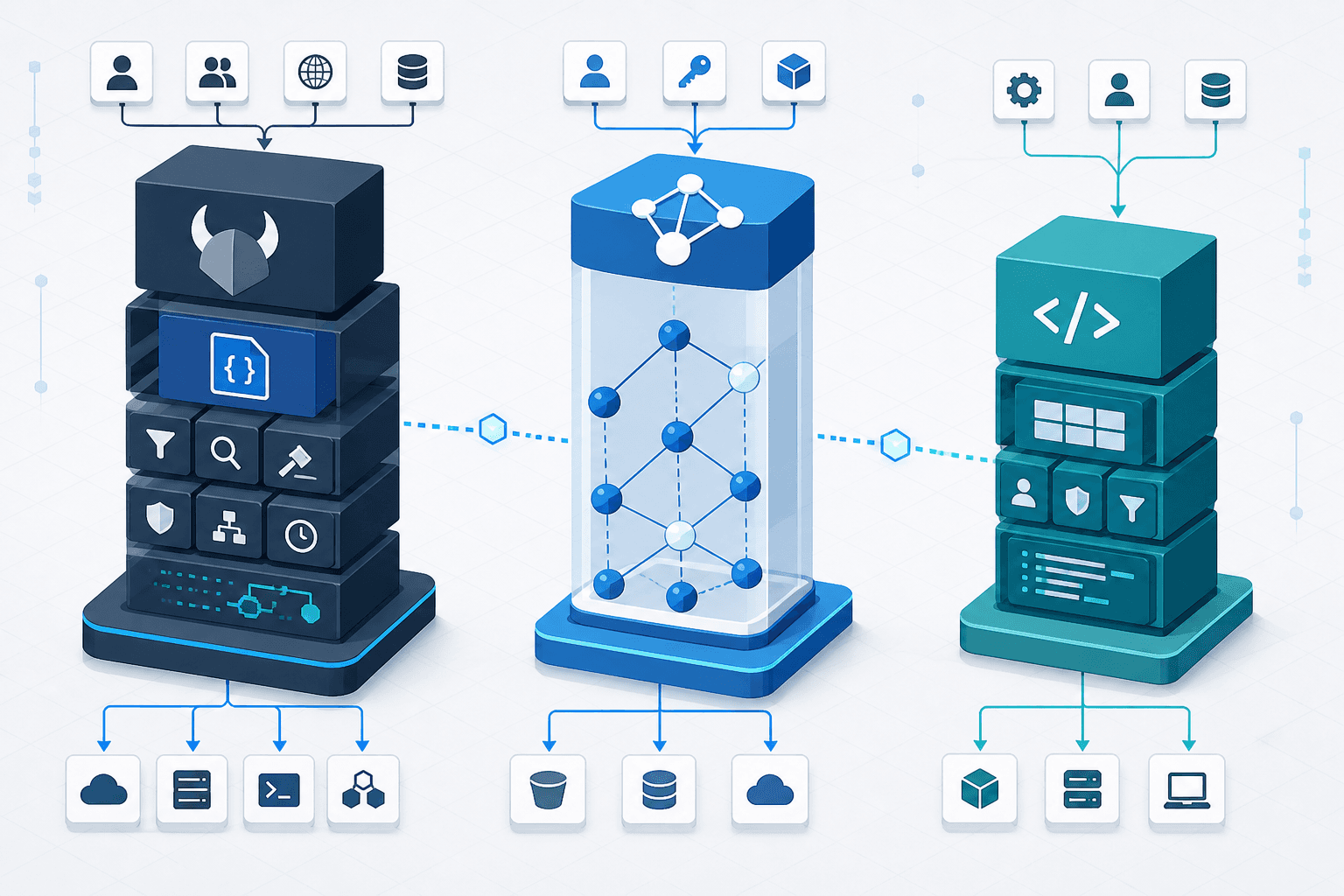
Policy Engines: OPA, Cedar, and Casbin
A technical comparison of OPA, Cedar, and Casbin for backend developers and platform engineers implementing external authorization.
In modern backend architecture, authorization logic often becomes a tangled knot of if/else statements scattered across controllers, services, and gateways. When permission rules change, developers must redeploy application code. This tight coupling creates latency in security updates and increases the risk of inconsistent enforcement.
The solution is the external authorization pattern: decoupling the decision (can user X do Y?) from the logic (how do we decide?). This is the role of a policy engine. While many tools claim this space, Open Policy Agent (OPA), Cedar, and Casbin represent three distinct architectural philosophies. Understanding their underlying mechanisms is critical for platform engineers choosing the right tool for the job.
The Core Mechanism: Evaluation Loop
Regardless of the engine, the fundamental mechanism is identical:
- Input: The engine receives a request context (e.g., user ID, resource ID, action).
- Policy: A set of rules defines what is allowed or denied.
- Decision: The engine returns a boolean (
allow/deny) or a structured decision document.
The difference lies in how the engine stores data, how it compiles policies, and how it optimizes evaluation.
OPA: The General-Purpose Policy Engine
Open Policy Agent (OPA) is the most widely adopted general-purpose policy engine. It treats everything as JSON.
Mechanism: Rego and JSON
OPA uses Rego, a declarative policy language. Unlike traditional programming languages, Rego is logic-based. You define rules that query a data store.
# Example: OPA Rego Policy
package example

default allow = false

allow {
    input.user.role == "admin"
}

allow {
    input.user.role == "editor"
    input.resource.type == "document"
    input.action == "read"
}
OPA evaluates these rules against a JSON input document. If any rule in the allow package evaluates to true, the decision is allow.
Key Characteristic: OPA’s strength is its flexibility. Because it accepts arbitrary JSON, it can integrate with any system that speaks JSON (Kubernetes, AWS, internal APIs). However, this flexibility comes at a cost. Evaluating complex Rego policies against large datasets can be slower than specialized engines because the engine must traverse generic data structures.
Performance Note: OPA uses its own interpreter (based on Go) for Rego evaluation. While OPA can be compiled to WASM for sandboxing in specific deployment scenarios (like OPA-Envoy or custom embeds), the standard OPA engine does not use WASM as its primary execution sandbox. For high-throughput scenarios, OPA recommends pre-compiling policies and caching results.
Cedar: The Specialized Graph Engine
Cedar, developed by AWS, takes a different approach. It is not a general-purpose engine; it is a specialized authorization engine designed for scale and speed.
Mechanism: Principal-Resource-Action Tuples
Cedar does not accept arbitrary JSON. It enforces a strict graph-based model. Every request is defined by four entities:
- Principal: Who is making the request?
- Action: What are they doing?
- Resource: What are they accessing?
- Context: Additional attributes (e.g., time, IP).
Cedar policies are written in a concise language that mirrors this model.
// Example: Cedar Policy
permit(
    principal == User::"alice",
    action == Action::"View",
    resource == Document::"doc123"
);
Key Characteristic: Cedar’s evaluation engine is optimized for this specific tuple structure. Because the input model is constrained, Cedar can perform fast evaluation (typically low-latency) even with thousands of policies. It also supports hierarchical policies, allowing you to define rules for groups or namespaces that automatically apply to members.
Why it matters: If you are operating at AWS scale or need to evaluate millions of decisions per second, Cedar’s specialized design provides a performance edge over general-purpose engines.
Casbin: The Embedded Go Engine
Casbin is fundamentally different from OPA and Cedar in its deployment model. While OPA and Cedar are typically deployed as sidecars or standalone services, Casbin is designed to be embedded directly into your application.
Mechanism: Adapter Pattern and Go
Casbin is written in Go and provides a simple API for embedding authorization logic. It supports multiple access control models (RBAC, ABAC, ACL, ReBAC) through a flexible model configuration system, with a pluggable adapter system for policy storage.
// Example: Casbin Go Code
e, _ := casbin.NewEnforcer("model.conf", "policy.csv")

allowed, err := e.Enforce("alice", "data1", "read")
if err != nil {
    // handle error
}
Key Characteristic: Casbin’s strength is simplicity and integration. Since it runs inside your application process, there is no network latency between your code and the policy engine for evaluation. However, using a database adapter for dynamic updates introduces network latency, which is a trade-off of the embedded model. It is ideal for microservices where you want to keep dependencies minimal and avoid managing a separate sidecar container.
However, this embedded model means you lose the ability to update policies without redeploying code (unless you use a dynamic file watcher or database adapter). It is less suited for centralized policy management across multiple heterogeneous services.
Comparative Tradeoffs
Choosing between OPA, Cedar, and Casbin depends on your system’s constraints.
| Feature | OPA | Cedar | Casbin |
|---|---|---|---|
| Primary Model | JSON / Rego | Graph / Principal-Resource-Action | RBAC/ABAC / Go API |
| Deployment | Sidecar / Standalone | Sidecar / Standalone | Embedded in App |
| Performance | Good (Go interpreter; WASM optional) | Excellent (specialized engine) | Good (in-process) |
| Learning Curve | High (Rego is unique) | Medium (Constrained model) | Low (Standard Go API) |
| Best For | Complex, heterogeneous systems | High-scale, AWS-integrated systems | Go-based microservices |
Opinion: The "Right" Choice
OPA is the safest default for most organizations starting with external authorization. Its flexibility allows it to handle Kubernetes, AWS, and custom APIs with a single engine. Cedar is the superior choice if you are deeply invested in the AWS ecosystem or require extreme evaluation throughput. Casbin is the best option for Go-centric teams that want low-latency, embedded authorization without the operational overhead of a sidecar.
Conclusion
Policy engines are not just libraries; they are architectural components that redefine how your system handles security. By externalizing authorization, you gain the ability to update rules independently of code deployments. However, this power requires careful selection. Understand whether your system needs the flexibility of OPA, the speed of Cedar, or the simplicity of Casbin. The mechanism you choose will dictate the scalability and maintainability of your authorization layer for years to come.
Related posts
Implementing Identity Governance with Custom Policy Engines
An examination of implementing identity governance using custom policy engines like OPA, Cedar, and XACML for policy-as-code.
Implementing Attribute-Based Access Control (ABAC) with Spring Security
A technical guide on implementing attribute-based access control (ABAC) using Spring Security and Open Policy Agent for dynamic policy enforcement.
RBAC vs ABAC: Static Roles vs. Dynamic Attributes
A detailed examination of Role-Based Access Control versus Attribute-Based Access Control, covering OPA, XACML, and authorization strategies.