Building Identity Abstraction Layer: Provider-Agnostic Authentication
An examination of building an identity abstraction layer to achieve provider-agnostic authentication across multiple identity platforms.
Building Identity Abstraction Layer: Provider-Agnostic Authentication
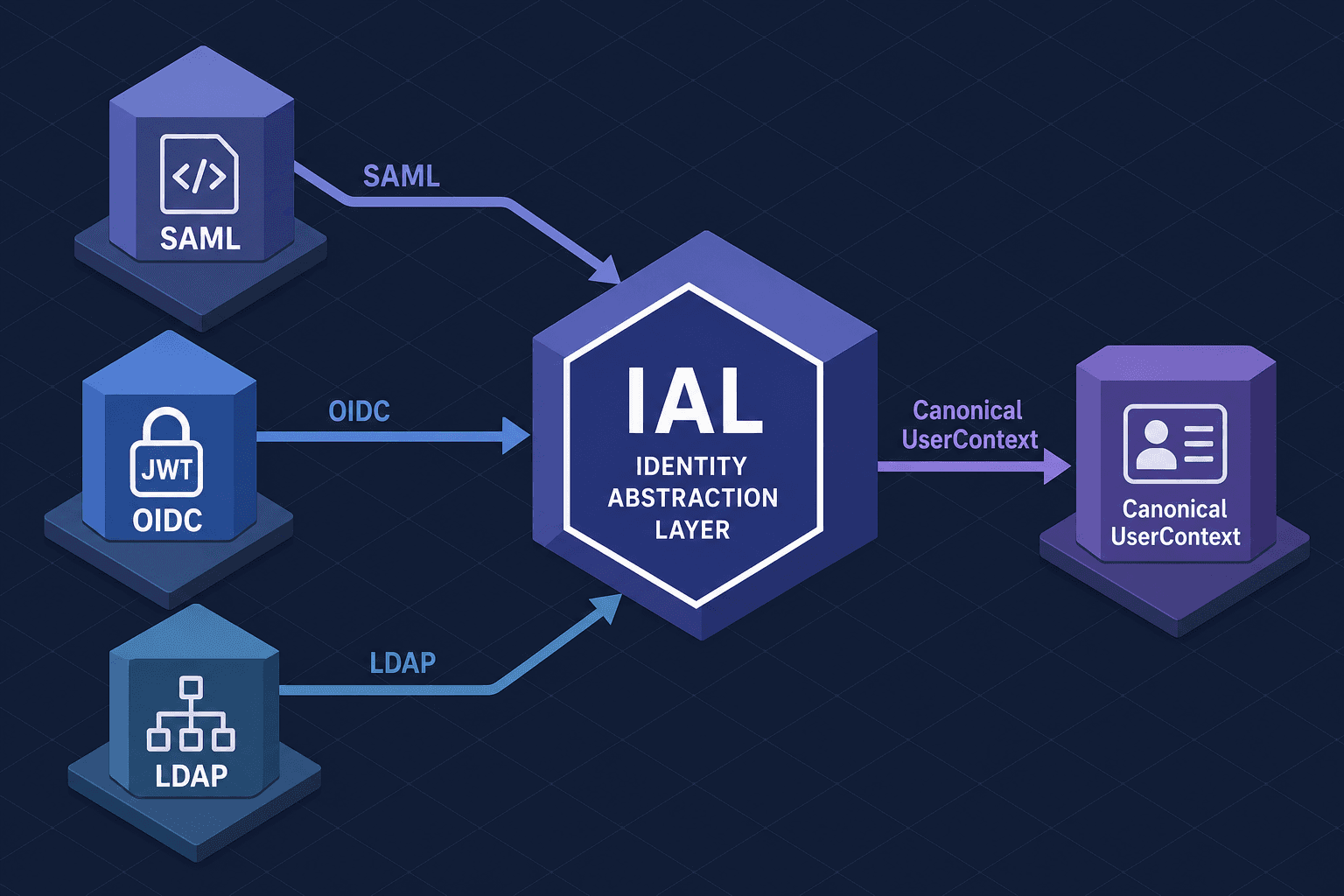
In distributed systems, integrating with an Identity Provider (IdP) is an architectural commitment, not a one-time config. Direct coupling to specific response formats—SAML XML, OIDC JSON, or LDAP hierarchies—makes applications hostage to provider evolution. Changes in claim names or deprecation of endpoints force cascading code changes across every service. The solution is structural decoupling: an Identity Abstraction Layer (IAL) that enforces a canonical internal model before business logic processes identity data.
Technical Foundations and Standards
The implementation of an IAL relies on strict adherence to established protocols. OpenID Connect (OIDC) is defined by RFC 7591 for authorization and RFC 7519 for JWTs, providing the standard JSON payload structure. SAML assertions follow the OASIS SAML v2.0 specification, utilizing XML for assertion transport. LDAP interactions are governed by RFC 4511 for directory access operations. Understanding these specifications is critical for the IAL to correctly parse, validate, and normalize the heterogeneous data streams from each protocol.
The Failure of Ad-Hoc Integration
The fundamental failure of ad-hoc integration lies in the lack of a normalization boundary. Consider a scenario where a frontend service authenticates via Auth0 (OIDC) while a legacy microservice authenticates via Active Directory Federation Services (SAML). If the backend logic reads auth0.user.email in one place and AD.userPrincipalName in another, the system is not just hard to maintain; it is logically incoherent. The state of the user is defined by two different schemas, creating ambiguity when calculating permissions or auditing actions. This fragmentation violates the principle of a single source of truth. The IAL must sit between the external world and the application core, acting as a strict protocol translator that guarantees every downstream service receives a deterministic object structure, regardless of the upstream transport.
The Normalization Mechanism
The core mechanism of this abstraction is the Claim Normalizer. This component is not a simple mapper; it is a stateful transformer that ingests heterogeneous identity tokens and outputs a canonical UserContext object. When a request arrives with a SAML assertion, the IAL extracts the NameID, email, and groups attributes, mapping them to the internal schema fields subject, email, and roles. Simultaneously, an incoming OIDC JWT is parsed, and its sub, email, and custom_roles claims are mapped to the exact same internal fields. The critical distinction is that the internal schema is immutable; it does not change when the IdP changes. If the IdP adds a new attribute, the IAL simply ignores it unless explicitly configured to persist it, preventing the downstream services from depending on transient provider features. This ensures that the business logic layer only ever interacts with a stable interface, effectively isolating the application from the volatility of identity protocols.
State Machine for Session Lifecycle
Beyond simple attribute mapping, the IAL must manage the divergent session lifecycles inherent to different protocols. OIDC relies on short-lived access tokens and long-lived refresh tokens, requiring a rotation mechanism to maintain session continuity. SAML, conversely, typically relies on signed assertions with embedded expiration times and browser-based redirects; it does not support a token refresh mechanism in the same manner as OIDC. Instead, SAML session extension often requires re-initiating the authentication flow or extending the browser session cookie via a new assertion. A naive implementation would force the application to handle these differences, leading to race conditions where a session expires on the IdP side but the application still believes it is valid.
The IAL resolves this by implementing a session state machine. Upon successful authentication, the IAL issues an internal session token (e.g., a signed JWT or a database-backed session ID) with a fixed TTL. Crucially, the IAL securely stores the external refresh token (for OIDC) or the session state (for SAML) associated with the user. When the internal token expires, the IAL uses the stored external credentials to obtain a new token from the IdP or re-initiate the SAML flow, then issues a fresh internal token. The IdP never interacts with the internal opaque token; the application only validates the internal token. This decouples the application's session management from the IdP's protocol specifics.
Handling Provider-Specific Edge Cases
This architecture introduces a critical edge case: handling provider-specific security constraints. For instance, some IdPs enforce strict clock skew limits on SAML assertions, while others allow for more lenient OIDC clock tolerances. If the application logic attempts to validate timestamps directly against the IdP, it inherits these inconsistencies. The IAL absorbs this risk by performing validation immediately upon ingestion. It verifies the signature, checks the issuer, and validates the timestamp against a configured tolerance window. If the assertion passes, the IAL stores the validated timestamp in the internal UserContext and discards the original raw payload, but retains the issuer/origin metadata for the originProvider field. The application then trusts the UserContext without needing to know the original protocol's clock constraints. This "fail-fast" approach at the boundary prevents subtle timing attacks and ensures consistent behavior across the system.
Security Trade-offs and Observability
However, centralizing identity logic introduces a single point of failure and a potential performance bottleneck. If the IAL is unavailable, the entire authentication flow halts, regardless of whether the IdP is healthy. To mitigate this, the IAL must be designed with high availability in mind, often deployed as a stateless service cluster behind a load balancer. Furthermore, the IAL must maintain detailed audit logs that preserve the original provider context. While the application sees a normalized user, the security team needs to know that a specific login originated from a SAML assertion from "Corporate-AD" and not "Google-Workspaces." The IAL should log the raw provider response (sanitized of secrets) alongside the normalized output, creating an audit trail that links the canonical identity back to the source of truth.
Opinion: While the IAL adds complexity to the initial deployment, the cost of maintaining multiple direct integrations grows exponentially over time. The "robustness" of a direct integration is an illusion; it is only robust as long as the IdP remains static. In reality, IdPs evolve constantly. The abstraction layer is the only mechanism that guarantees long-term stability for the application's security posture.
The final piece of the puzzle is the API contract exposed to the application. This contract must be strictly typed and immutable. It should not return raw tokens or provider-specific objects. Instead, it should expose methods like getUserProfile(), hasPermission(), and getRoles(). These methods query the internal UserContext and the associated policy engine. If the application needs to know the specific IdP used for a login (e.g., for compliance reporting), the IAL exposes a read-only field originProvider that is populated during the normalization phase. This allows the application to make decisions based on the origin without being coupled to the protocol mechanics.
Conclusion
By enforcing this layer, the system achieves true provider-agnosticism. The application code never imports an OIDC SDK or a SAML parser; it only interacts with the IAL. If the organization switches from Auth0 to Okta, or adds Azure AD as a secondary provider, the change is confined to the IAL's configuration and mapping rules. The downstream services remain untouched. This is not merely a convenience; it is a fundamental requirement for scalable, secure architecture in multi-tenant environments where identity sources are diverse and fluid. The mechanism of normalization transforms identity from a variable dependency into a constant foundation.
FAQ
Q: Does an Identity Abstraction Layer replace the need for an Identity Provider? A: No. The IAL sits between the IdP and your application. It does not authenticate users itself; rather, it translates the authentication results from various IdPs into a format your application understands. You still need a trusted IdP to issue the initial credentials.
Q: How does the IAL handle MFA (Multi-Factor Authentication)?
A: The IAL can be configured to pass through MFA challenges. If an IdP requires MFA, the IAL detects the challenge, prompts the user via the application, and then processes the final successful assertion. The IAL abstracts the MFA mechanism (e.g., TOTP vs. Push) but ensures the final UserContext reflects a verified identity.
Q: Can the IAL support hybrid cloud environments with on-premise AD?
A: Yes. The IAL is designed to aggregate sources. It can connect to cloud IdPs (like Azure AD or Okta) and on-premise directories (via LDAP or AD FS) simultaneously, normalizing attributes from both sources into a single UserContext for the application.
Practical Takeaways
- Immutable Schema: Design your internal
UserContextschema to be stable. Never allow IdP-specific fields to leak into your business logic. - Fail-Fast Validation: Perform all cryptographic signature and timestamp validations at the IAL boundary. If validation fails, reject the request immediately before any downstream processing.
- Opaque Internal Tokens: Ensure your application only ever sees the internal session token. The IdP should never see, touch, or validate this internal token.
Common Pitfalls
- Leaking Metadata: Storing raw IdP responses in the database without sanitization can expose secrets or PII if the database is compromised. Always sanitize before storage.
- Tight Coupling: Attempting to implement the IAL logic directly inside a business service module. The IAL must be a distinct service or middleware layer.
- Ignoring Clock Skew: Failing to configure a tolerance window for token validation can cause intermittent authentication failures, especially across different time zones or network latencies.
Related posts
Building Identity Orchestration: Connecting Multiple IdPs with Custom Workflows
An examination of building identity orchestration to connect multiple identity providers through custom authentication workflows.
Implementing Conditional Access Policies with Keycloak and ForgeRock
A technical examination of implementing conditional access policies using Keycloak and ForgeRock for context-aware access control.
Implementing Entitlement Management for Fine-Grained Authorization
An examination of entitlement management and fine-grained authorization using XACML and policy engines for secure access control.