CAS Protocol vs SAML vs OIDC: Legacy SSO Protocol Comparison
A technical comparison of CAS protocol, SAML, and OIDC for legacy authentication systems in university environments.
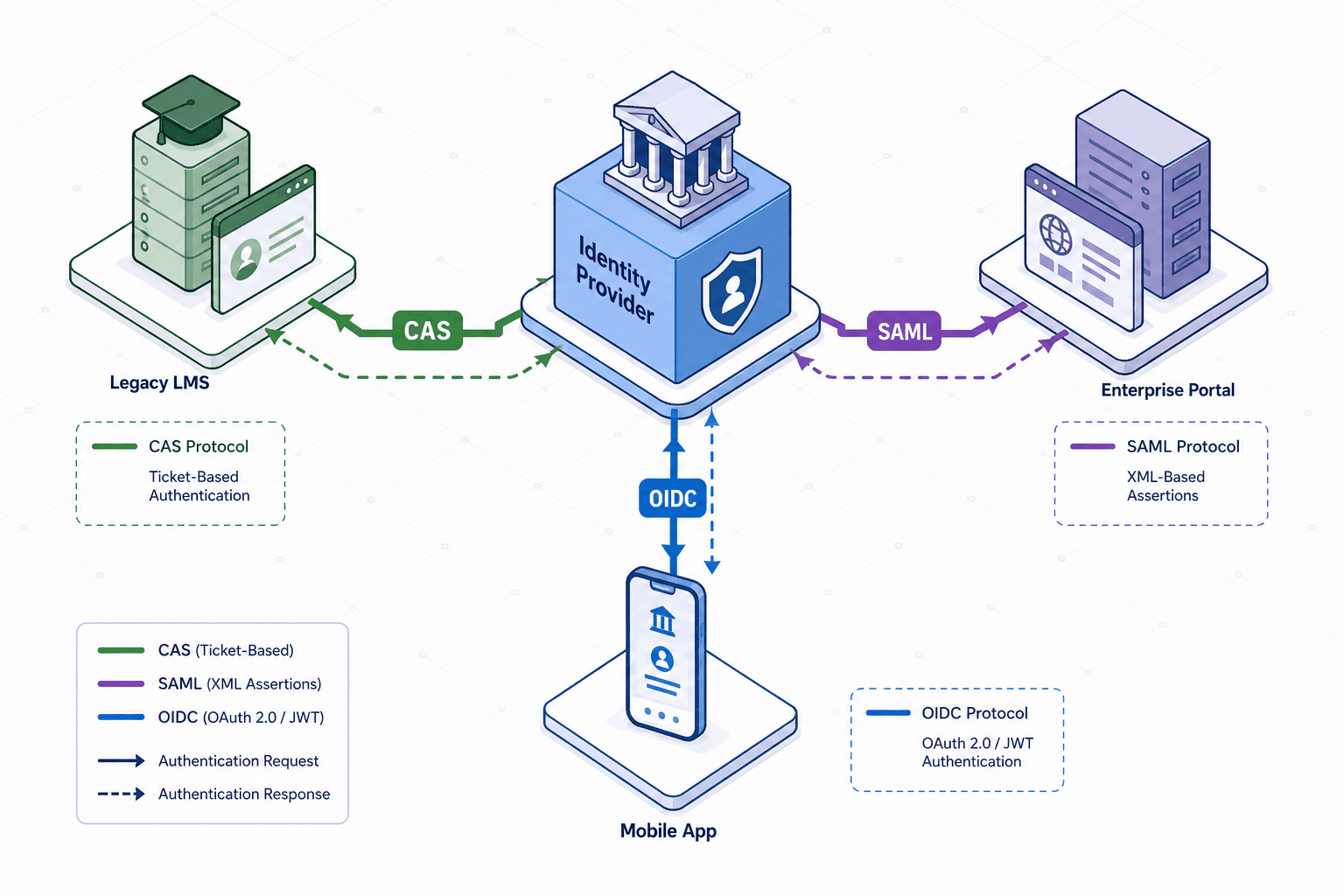
In university identity management, choosing between CAS, SAML, and OIDC defines the trust model for single sign-on (SSO). CAS uses a stateful ticket-redeeming model for tight coupling. SAML relies on stateless, signed XML assertions. OIDC shifts trust to the client via JSON Web Tokens (JWT). These mechanical differences dictate how legacy systems integrate with central Identity Providers.
The CAS Mechanism: The Ticket Redirection Loop
CAS (Central Authentication Service) functions as a proxy for authentication. Unlike other protocols where the IdP pushes data to the client, CAS requires the client (the Service Provider or SP) to pull the authentication status by validating a temporary credential.
Consider a scenario where a student at a university attempts to access a legacy course module in "Blackboard" (the SP). The SP detects no valid session and redirects the student's browser to the "UniversityIdP" (the IdP). The student logs in. Upon successful authentication, the UniversityIdP does not send user data directly to Blackboard. Instead, it generates a unique, time-limited string called a "service ticket" (e.g., ST-100-abcdef) and redirects the browser back to Blackboard with this ticket in the query string.
Blackboard cannot trust this ticket alone. It must act as a proxy. The SP's backend server must silently call the UniversityIdP's validate endpoint (e.g., https://idp.university.edu/cas/login?service=...&ticket=ST-...). This server-to-server request verifies the ticket's validity and retrieves the authenticated user's identity. The IdP responds with a simple XML or JSON payload confirming the username and attributes. Only then does Blackboard establish the local session.
This mechanism creates a specific dependency: the SP must be able to reach the IdP's internal network to validate tickets. In university environments, this often requires firewall rules allowing the LMS subnet to talk to the IdP subnet. The trust model is stateful; if the ticket is stolen, it is invalid after one use or expiration, but the initial redirect relies heavily on the browser's ability to traverse the loop.
The SAML Mechanism: Signed XML Assertions
SAML (Security Assertion Markup Language) replaces the ticket-redeeming loop with a stateless, signed assertion. The mechanism relies on public key cryptography (X.509) to verify the integrity of the data without requiring a server-side callback to the IdP.
In a typical SAML flow, the student accesses a "StudentPortal" (the SP). The Portal redirects the user to the "UniversityIdP" with a SAML AuthnRequest. The IdP authenticates the user and constructs a SAML Assertion—a structured XML document containing the user's identity and attributes (e.g., <Attribute Name="eduPersonPrincipalName">...).
Crucially, the IdP signs this entire XML document with its private key. The IdP then returns this signed XML to the StudentPortal via an HTTP POST binding (the browser submits the form automatically). The StudentPortal receives the XML, extracts the signature, and verifies it against the IdP's public certificate (which is pre-configured in the portal's metadata). If the signature is valid, the Portal trusts the assertion's contents. No further network call to the IdP is required.
This mechanism is reliable for enterprise environments where the SP and IdP may reside in different network zones, as the trust is embedded in the assertion itself. However, the complexity lies in parsing the XML and managing the certificate lifecycle. For a university, this means every time the IdP rotates its signing key, the StudentPortal must be manually updated with the new public certificate. The "stateless" nature of the assertion means the SP can verify it independently, but the XML parsing overhead is significantly higher than JSON-based protocols.
The OIDC Mechanism: JWT and Client-Side Validation
OIDC (OpenID Connect) was designed to simplify SAML for the modern web. It sits on top of OAuth 2.0 and uses JSON Web Tokens (JWT) instead of XML. The fundamental shift is that the client (the application) receives the identity token directly and validates it, rather than having the server validate a ticket or assertion.
Imagine a student accessing a new "MobileApp" built for the university. The app initiates an authorization request. The UniversityIdP authenticates the user and returns an authorization code. The MobileApp exchanges this code for an id_token (a JWT) and an access_token. The id_token is a compact JSON object signed by the IdP.
The MobileApp does not need to make a network call to the IdP to validate the user. It uses the IdP's public key (fetched from a well-known endpoint like /.well-known/openid-configuration) to verify the JWT signature locally. If the signature is valid and the token is not expired, the app grants access.
This mechanism is highly efficient for mobile and single-page applications (SPAs) because it eliminates the server-side callback overhead of CAS and the XML parsing complexity of SAML. However, it introduces a different security posture: the client must securely store the JWT and handle token refresh logic. In legacy university contexts, this often requires refactoring the application to support PKCE (Proof Key for Code Exchange) to prevent authorization code interception attacks, a requirement that older CAS or SAML implementations did not mandate.
Legacy University Context: Why CAS Persists
Despite OIDC's efficiency, many universities still run apereo cas for core legacy systems. The primary driver is the specific architectural dependency of older LMS platforms (like Blackboard Learn 9 or Moodle instances from 2010-2015). These systems were built with the assumption that the SP would perform a server-side ticket validation.
Refactoring a legacy LMS to support cas vs oidc often requires a complete rewrite of its authentication module, which is cost-prohibitive. Similarly, cas vs saml comparisons often favor SAML for high-assurance scenarios like granting access to library databases or financial systems where the saml protocol provides a rich, standardized attribute set that legacy systems can parse.
The decision matrix often looks like this:
- Legacy LMS: Use CAS. The ticket validation loop is deeply embedded in the LMS code.
- Enterprise Portals: Use SAML. The XML assertion allows for complex attribute mapping required by HR and Finance systems.
- New Student Apps: Use OIDC. The JWT flow supports mobile devices and modern SPAs without server-side proxies.
In practice, universities often run all three simultaneously. A single student might log into the portal via OIDC, access a library database via SAML, and click a link to a legacy course via CAS. The IdP must support all three protocols, maintaining separate metadata and key pairs for each, creating a complex operational overhead.
Common Pitfalls
When implementing these protocols, specific pitfalls can disrupt identity management workflows:
- CAS Network Dependencies: The CAS validation loop requires strict firewall rules allowing the Service Provider to reach the Identity Provider's internal network, which is often a bottleneck in segmented university networks.
- SAML Certificate Rotation: Managing the lifecycle of X.509 certificates in SAML can be operationally heavy; failure to update the public certificate on the SP side immediately causes authentication failures.
- OIDC Token Storage Risks: Storing JWTs on the client side (browser or mobile) introduces risks if the storage mechanism is compromised, requiring robust token refresh logic and secure storage practices.
Practical Takeaways
Selecting the right protocol depends on your current infrastructure and future goals:
- Stick with CAS if you are maintaining legacy Learning Management Systems where the ticket validation logic is hard-coded and cannot be easily refactored.
- Choose SAML when you need rich attribute exchange for complex enterprise systems like HR or finance portals that rely on standardized XML structures.
- Adopt OIDC for new student-facing applications, mobile apps, and SPAs where lightweight JSON processing and client-side validation improve performance.
FAQ
Q: Which protocol offers the best performance for mobile apps? A: OIDC is superior for mobile apps. It uses JSON Web Tokens (JWT) which are lightweight and allow the client to validate tokens locally without server-side callbacks, reducing latency compared to CAS or SAML.
Q: Is CAS more secure than OIDC? A: Neither is inherently more secure; they have different threat models. CAS relies on network security to protect the ticket validation loop, while OIDC relies on client-side security to protect the JWT. OIDC often requires additional measures like PKCE to mitigate interception risks.
Q: Can we migrate from CAS to OIDC without rewriting the LMS? A: Generally, no. Most legacy LMS platforms require significant code changes to replace the CAS ticket validation logic with OIDC token handling. Many universities maintain CAS as a bridge while layering OIDC for new services.
Conclusion
The choice between CAS, SAML, and OIDC is a trade-off between legacy compatibility and modern efficiency. CAS offers a simple, stateful ticket mechanism that works well for tightly coupled academic systems but requires strict network connectivity. SAML provides a reliable, stateless XML assertion model ideal for enterprise attribute exchange but introduces complexity in certificate management. OIDC delivers a lightweight, JSON-based flow perfect for modern applications but demands client-side security maturity. For a university, the path forward is not to replace CAS immediately, but to layer OIDC for new services while maintaining CAS as a bridge for the critical, unchangeable legacy infrastructure.
Related posts
Migrating from SAML to OIDC: A Practical Migration Guide
A practical guide for organizations migrating from SAML to OIDC to achieve identity modernization and adopt modern authentication standards.
SAML 2.0 Explained: The Complete Guide to Enterprise SSO
A walkthrough of SAML 2.0, covering how identity providers and service providers enable enterprise single sign-on using SAML assertions.
SAML Artifact Binding: Low-Latency SSO Architecture
An examination of SAML artifact binding for achieving low-latency SSO performance and reducing network overhead.