CAS vs SAML: Choosing Between Them
A technical comparison of CAS and SAML protocols for identity engineers and architects, covering service tickets, SSO implementation, and migration strategies.
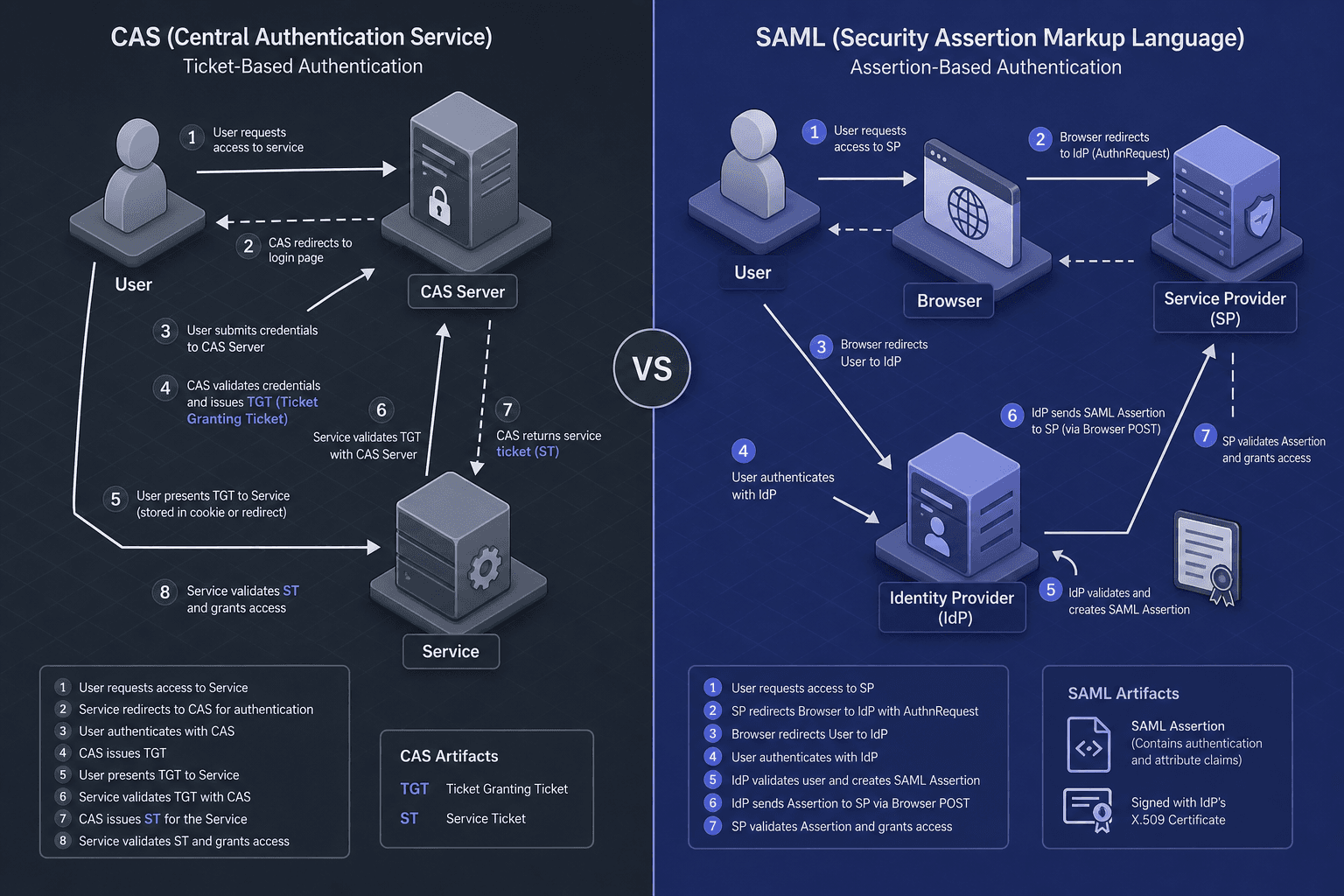
For identity engineers, the decision between Central Authentication Service (CAS) and Security Assertion Markup Language (SAML) is rarely about which protocol is "better." It is about matching the protocol’s trust boundary to your architecture’s domain boundary. SAML is designed for federated trust across organizational domains, leveraging XML assertions and cryptographic signatures to exchange attributes between independent entities. CAS is designed for internal trust within a single administrative domain, using a lightweight ticketing system to reduce latency and complexity for homogeneous web applications.
The SAML Mechanism: Federated Assertions
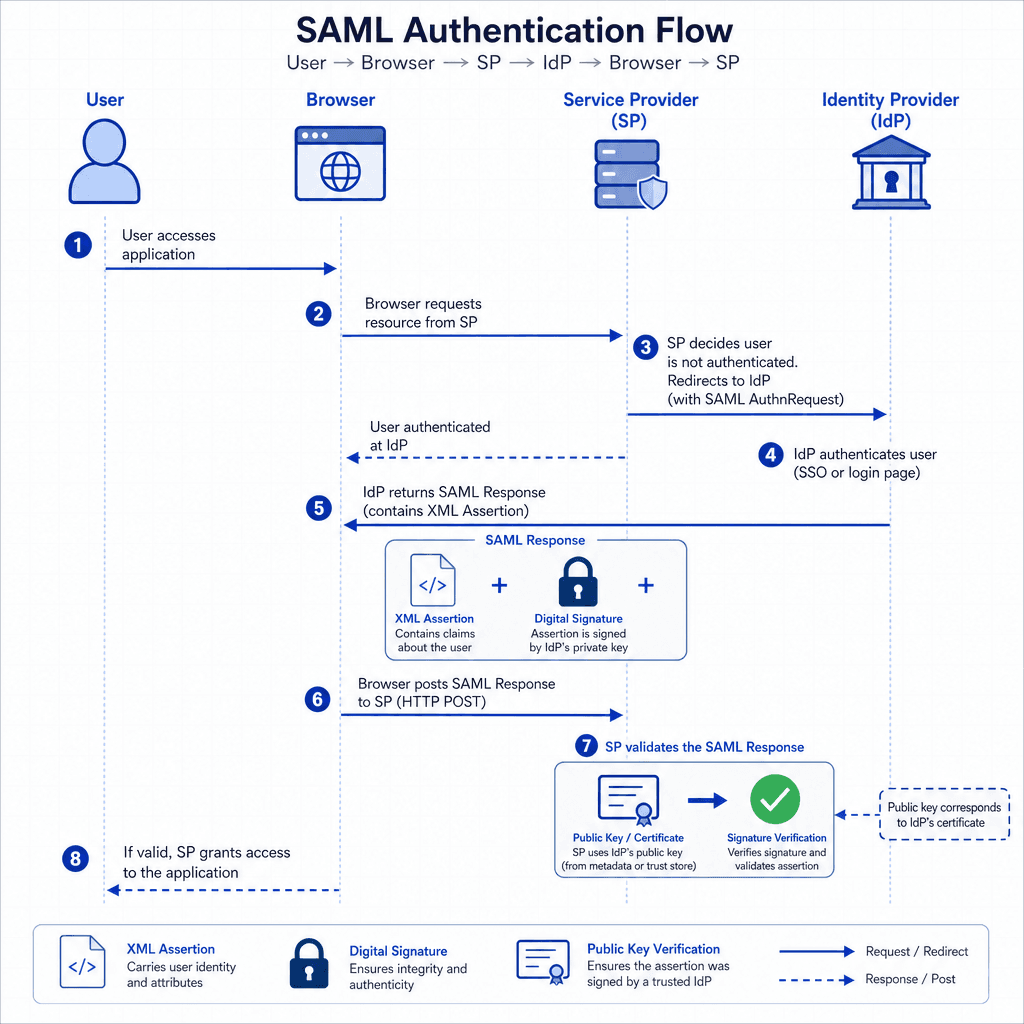
SAML is an XML-based framework that allows an Identity Provider (IdP) to send authentication assertions to a Service Provider (SP), as defined in the OASIS SAML Core specification. The core mechanism relies on the separation of authentication and authorization. When a user attempts to access a protected resource at the SP, the SP redirects the user’s browser to the IdP. This is typically done via the HTTP-Redirect or HTTP-POST binding.
The IdP authenticates the user (often via username/password, MFA, or another protocol) and then generates a SAML Assertion. This assertion is an XML document containing statements about the user, such as NameID, Email, or Groups. Crucially, this assertion is signed by the IdP’s private key. The SP receives this assertion, verifies the signature using the IdP’s public certificate, and trusts the claims within because they are cryptographically bound to the IdP.
This mechanism is effective for cross-domain scenarios because the trust is established via certificate exchange, not network proximity. The SP does not need to know the user’s password; it only needs to verify that the IdP issued the assertion. This makes SAML the de facto standard for Business-to-Business (B2B) SSO and enterprise SaaS integrations.
The CAS Mechanism: Ticket-Granting Cycles
CAS operates on a simpler, stateful model centered on two types of tickets: the Ticket-Granting Ticket (TGT) and the Service Ticket (ST), as documented in the Apereo CAS architecture. The TGT is stored server-side (usually in the CAS Server’s memory or a database) and represents the user’s authenticated session. The ST is a single-use token issued by the CAS Server to grant access to a specific Service.
The flow is as follows:
- The user accesses a CAS-enabled application (the Service).
- The Service redirects the user to the CAS Server’s login page.
- The user authenticates. The CAS Server creates a TGT and stores it.
- The CAS Server redirects the user back to the Service with an ST in the URL query parameter.
- The Service exchanges the ST for a user profile by making a direct server-to-server call back to the CAS Server (the "validate" or "proxy" endpoint).
- If the ST is valid, the CAS Server returns the user’s attributes.
This mechanism is highly efficient for internal networks because it avoids the heavy XML parsing and cryptographic overhead of SAML. However, it assumes that the CAS Server and the Service can communicate directly over a secure internal network. There is no native mechanism for an external entity to verify a CAS ticket without direct access to the CAS Server’s validation endpoint.
Data Flow and Trust Boundaries
The fundamental difference lies in how trust is established. In SAML, trust is explicit and certificate-based. The SP holds the IdP’s public key and validates every assertion. This allows an SP in Company A to trust an IdP in Company B, provided they have exchanged certificates. The data flow is asynchronous and decoupled; the IdP does not need to know the internal topology of the SP.
In CAS, trust is implicit and network-based. The Service must be configured with the CAS Server’s URL, and the CAS Server must whitelist the Service’s callback URL. This creates a tight coupling. If the CAS Server is behind a firewall, external services cannot validate tickets. Furthermore, while CAS lacks a universal standardized attribute schema like SAML’s NameID, implementations typically use common attributes like username or uid as defined in the Apereo CAS documentation. This makes integration with third-party systems difficult without custom mapping.
Consider a scenario where a university (IdP) provides access to a cloud-based learning platform (SP). Using SAML, the university signs assertions with its certificate, and the platform verifies them. The platform does not need to connect to the university’s internal network. If they used CAS, the platform would need to reach the university’s CAS Server to validate tickets, which is often blocked by firewalls and raises significant security concerns regarding exposing internal validation endpoints to the public internet, a practice discouraged by security best practices such as those outlined in NIST guidelines.
Migration Strategies: From CAS to SAML
Migrating from CAS to SAML is common as organizations expand beyond their internal network or integrate with more SaaS providers. The challenge is that CAS and SAML have different data models and trust mechanisms. A direct switch is rarely feasible without changes to the applications.
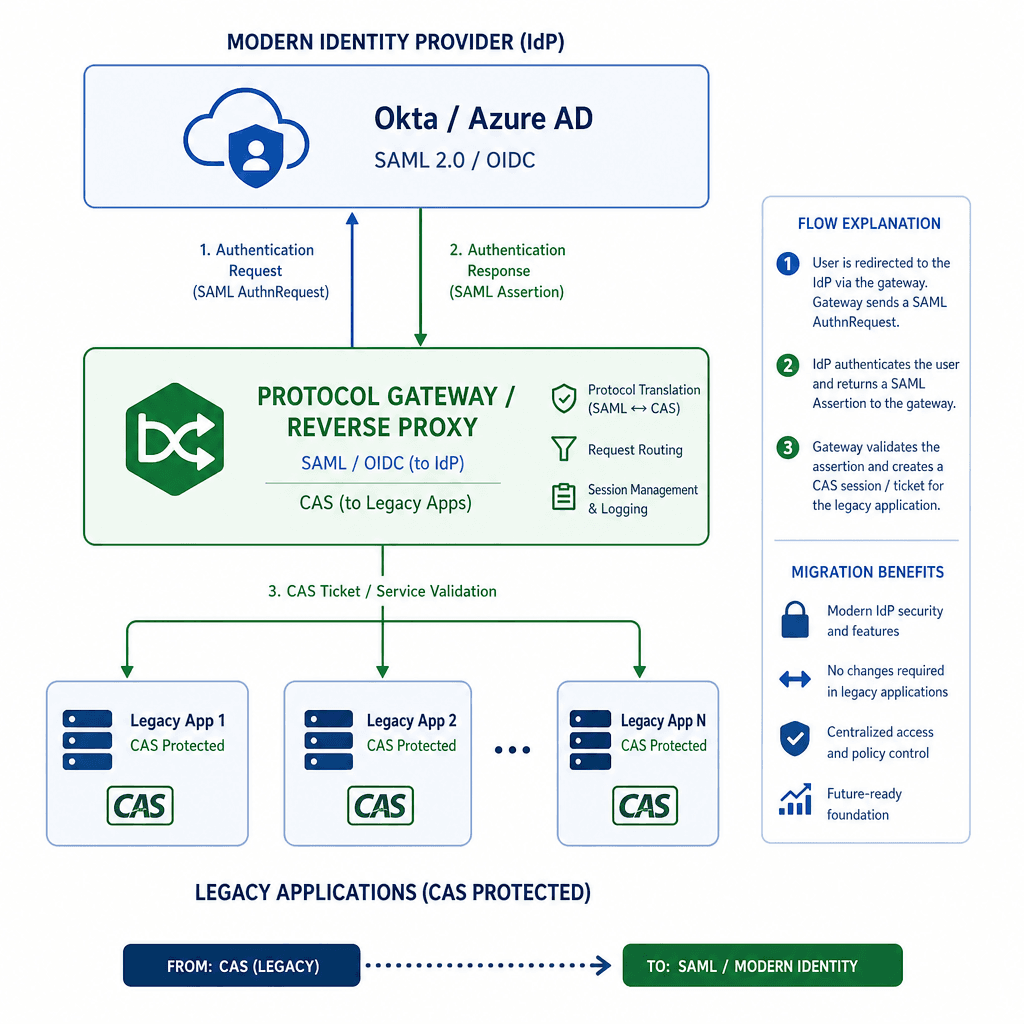
Step 1: Implement a Protocol Gateway. Deploy a gateway or reverse proxy that sits in front of your CAS-enabled applications. This gateway acts as a SAML Service Provider. When a user accesses the application, the gateway intercepts the request. If the user is not authenticated, the gateway redirects them to a modern IdP (like Okta, Azure AD, or Keycloak, see their respective integration docs) using SAML or OIDC. Once authenticated, the gateway validates the SAML assertion, extracts the necessary attributes, and then authenticates the user to the backend CAS-enabled application. This can be done by injecting a header or using a CAS ticket on behalf of the user.
Step 2: Attribute Mapping.
Map the attributes from the SAML assertion to the format expected by the CAS Server or the backend application. For example, map saml:NameID to the implementation-specific attribute used by the CAS Server, such as username. This requires careful testing to ensure that all critical user attributes (roles, groups, email) are correctly translated.
Step 3: Gradual Rollout. Do not flip the switch for all applications at once. Start with low-risk, internal-only applications. Monitor for authentication failures and attribute mapping errors. As confidence grows, expand the gateway to cover more applications. Eventually, you can decommission the CAS Server entirely if all applications support SAML or OIDC natively.
Opinion: While CAS is still used in legacy academic environments, new projects should avoid adopting CAS unless there is a strict requirement for minimal overhead in a closed, homogeneous cluster. For any scenario involving external users, B2B partnerships, or cloud-native architectures, SAML (or OIDC) is the only viable long-term strategy. The complexity of maintaining a CAS infrastructure while integrating with modern identity providers outweighs the initial simplicity of deployment.
Conclusion
Choose SAML when you need to establish trust across organizational boundaries, integrate with SaaS providers, or require a standardized attribute schema. Choose CAS only if you are operating a homogeneous cluster of internal applications behind a single firewall and need a lightweight, low-latency authentication mechanism. For most modern enterprises, the trajectory is clear: migrate away from CAS towards federated protocols that support explicit, cryptographic trust. A thorough sso comparison during the planning phase ensures that the chosen migration path aligns with both security requirements and operational scalability.
Related posts
SAML Single Logout: Implementation Patterns and Pitfalls
An examination of SAML single logout implementation patterns, covering session management and pitfalls in SP-initiated and IdP-initiated logout flows.
Troubleshooting SAML: Common Issues and Fixes
An examination of common SAML errors, debugging techniques, and signature validation fixes for advanced users.
Configuring SAML SSO: Service Provider Setup Guide
A practical guide to configuring SAML Service Provider settings, including Spring Security integration and metadata management.
