Annotation Pipelines and Inter-Rater Agreement
Explore annotation pipelines and inter-rater agreement metrics like Cohen's Kappa to ensure high-quality labeled data for LLM training.
In the architecture of Large Language Model (LLM) training, labeled data is the substrate. However, treating data annotation as a simple "labeling task" is a structural error. It is a distributed cognitive process subject to human variance. If the variance between annotators is high, the model learns noise rather than signal. To ensure data integrity, we must treat annotation pipelines as deterministic systems where Inter-Rater Agreement (IRA) acts as the feedback mechanism for quality control.
This article details the mechanism of building reliable annotation pipelines and using metrics like Cohen’s Kappa to enforce consistency. We will explore how labeling guidelines reduce entropy, how to calculate agreement that accounts for chance, and how adjudication resolves conflicts to improve the final dataset.
The Pipeline as a Deterministic System
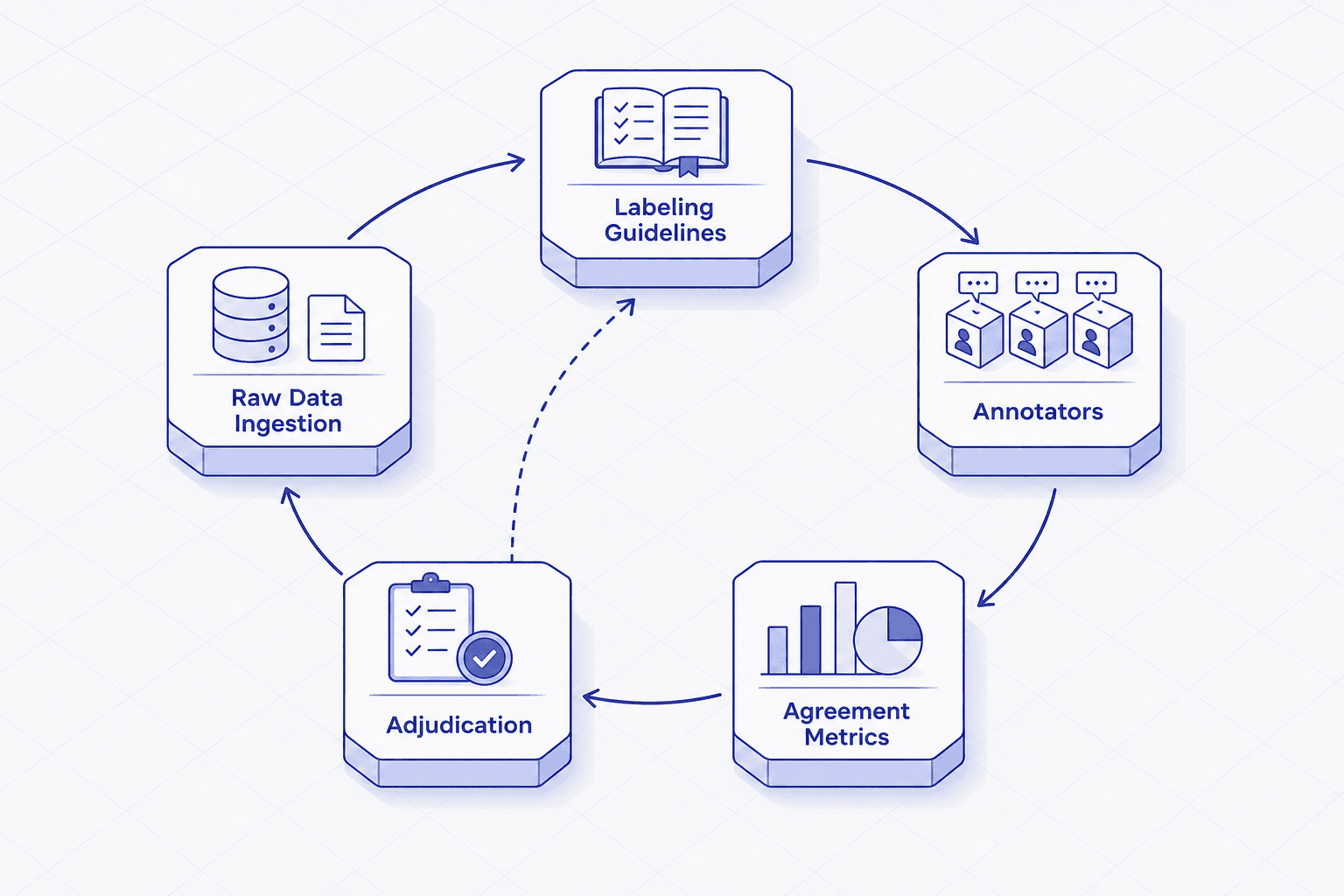
An annotation pipeline is not merely a workflow; it is a mechanism for reducing ambiguity. The core components are:
- Raw Data Ingestion: Unstructured text, code, or dialogue.
- Labeling Guidelines: The explicit ruleset that defines the mapping from raw data to labels.
- Annotators: Human agents executing the mapping.
- Agreement Metrics: Statistical checks on the consistency of the mapping.
- Adjudication: The resolution process for inconsistent mappings.
The critical lever here is the Labeling Guidelines. These are not suggestions; they are the function that an annotator applies to input . If the guidelines are ambiguous, the function is non-deterministic, leading to low inter-rater agreement. For example, a guideline stating "label sentiment as negative if the user is angry" is insufficient. A precise guideline specifies linguistic markers: "Label as negative if the input contains profanity, exclamation marks, or explicit expressions of frustration (e.g., 'I hate this')."
Without such precision, two annotators may process the same sentence differently, introducing noise into the training set. The pipeline’s goal is to minimize this variance by refining the guidelines until annotators converge on the same label for the same input.
Measuring Agreement: Beyond Raw Accuracy
A common mistake in annotation pipelines is using raw agreement (the percentage of times annotators agree) as the primary metric. This is misleading, especially in imbalanced datasets.
Consider a dataset where 95% of samples are labeled "Neutral" and 5% are "Critical." If two annotators simply guess "Neutral" for every sample, they achieve 95% raw agreement. Yet, they have learned nothing about the "Critical" class. This is the base rate fallacy.
To correct for this, we use Cohen’s Kappa (). Kappa measures the agreement between two raters while correcting for the agreement that would occur by chance.
The Mechanism of Cohen’s Kappa
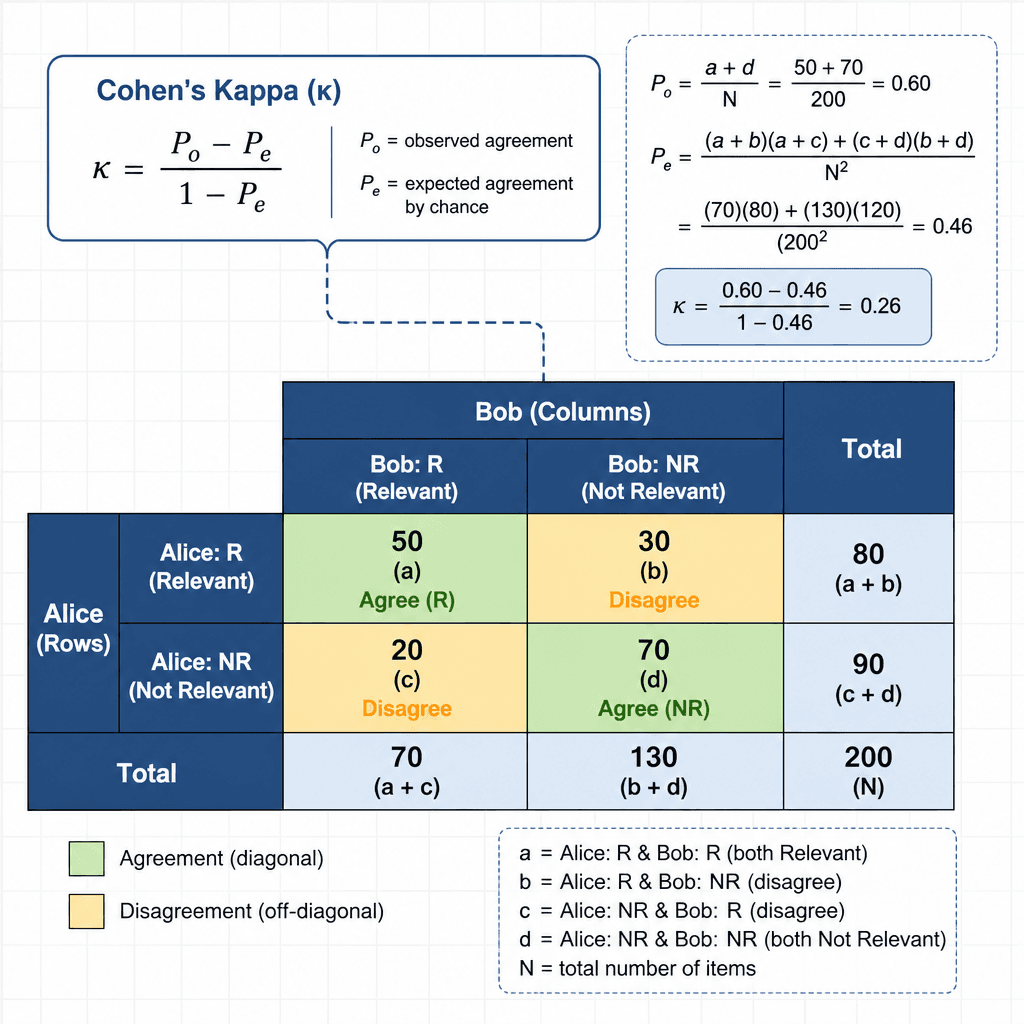
Cohen’s Kappa is calculated as:
Where:
- is the observed agreement (raw agreement).
- is the expected agreement by chance, calculated based on the marginal totals of each category.
Understanding Chance Agreement ()
The term represents the probability that two annotators would agree purely by random chance, given their individual labeling distributions. It is derived from the marginal totals of the confusion matrix. If Annotator A tends to label everything as "Positive" and Annotator B does the same, their marginal probabilities for "Positive" will be high, leading to a high . This means that even if they disagree frequently, the baseline chance of them aligning is high. Kappa penalizes this baseline, ensuring that the metric reflects true consensus rather than coincidental alignment.
Worked Scenario
Let’s assume we have 100 documents. Two annotators, Alice and Bob, label them as either "Relevant" (R) or "Not Relevant" (NR).
| Bob: R | Bob: NR | Total | |
|---|---|---|---|
| Alice: R | 40 | 10 | 50 |
| Alice: NR | 10 | 40 | 50 |
| Total | 50 | 50 | 100 |
- Observed Agreement (): Both agreed on 40 (R,R) and 40 (NR,NR). Total = 80. .
- Expected Agreement ():
- Chance of Alice choosing R: $50/100 = 0.5$. Chance of Bob choosing R: $50/100 = 0.5$. Joint probability: .
- Chance of Alice choosing NR: $0.5$. Chance of Bob choosing NR: $0.5$. Joint probability: .
- .
- Kappa Calculation:
A Kappa of 0.60 indicates substantial agreement. If we had used raw accuracy, we might have been satisfied with 80%, but Kappa reveals that 50% of that agreement was due to chance. In the context of LLM training, a threshold of 0.6–0.7 is often considered the minimum for complex tasks. A score of 0.60 suggests that while the annotators are consistent, there is significant room for improvement. Lower scores indicate that the guidelines are likely ambiguous or the task is inherently subjective, requiring tighter control or additional training before the data is suitable for model ingestion.
The Adjudication Loop
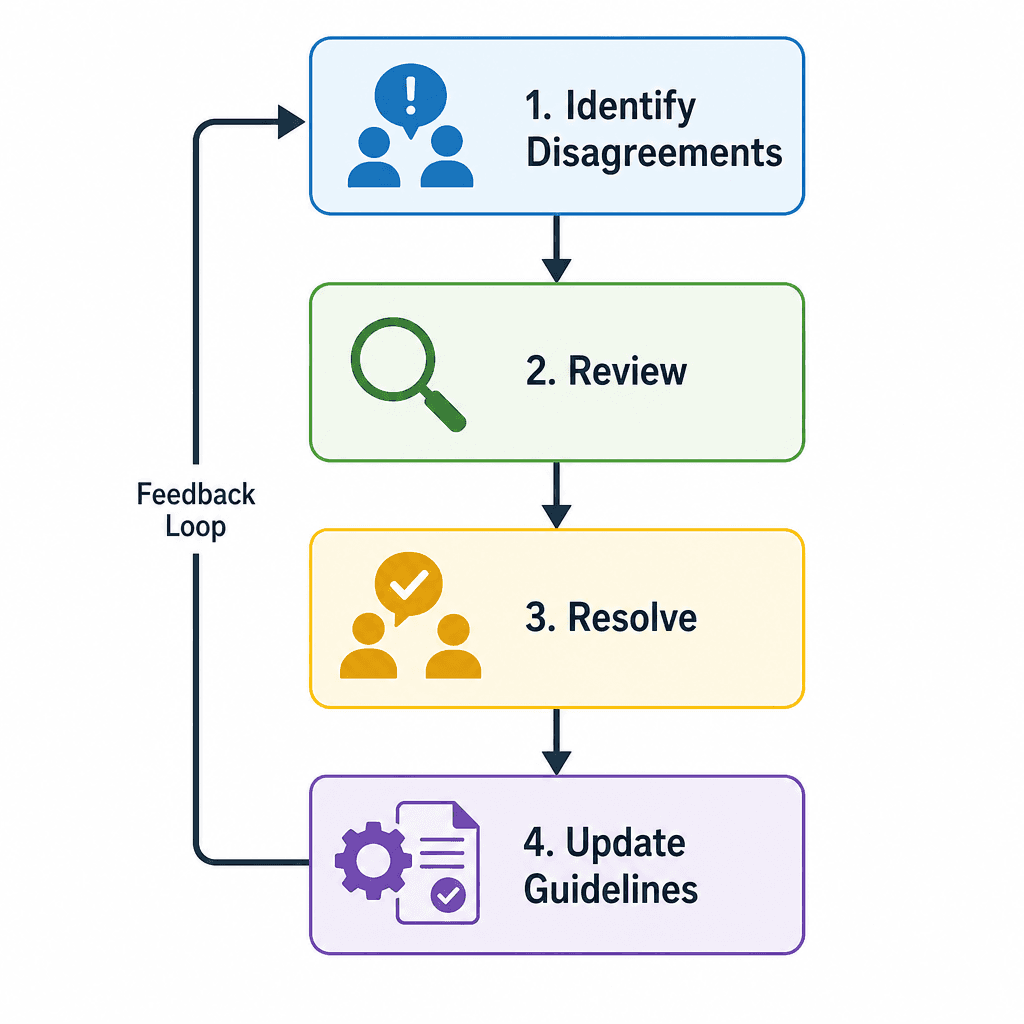
When Kappa falls below a predefined threshold (often 0.6–0.7 for complex tasks), the pipeline must trigger adjudication. This is not a failure state but a data enrichment step.
Adjudication involves a senior annotator or a panel reviewing the disagreements. The process works as follows:
- Identify Disagreements: Flag samples where annotators disagreed.
- Review: A senior expert reviews these samples.
- Resolve: The expert assigns the "ground truth" label.
- Update Guidelines: This is the most critical step. The expert analyzes why the annotators disagreed. Was the guideline ambiguous? Did it lack an edge case? The guideline is then updated to cover this scenario.
This creates a closed feedback loop. Each disagreement leads to a more precise guideline, which reduces future variance. Over time, the pipeline converges toward higher Kappa scores with fewer adjudications, indicating that the guidelines are stable and the annotators are well-trained.
For scenarios involving more than two annotators, Fleiss' Kappa is the appropriate extension of this metric. It generalizes Cohen's Kappa to allow for multiple raters, providing a single measure of reliability for the entire group. This is particularly useful in large-scale annotation projects where a diverse panel of reviewers is employed to mitigate individual bias.
Operationalizing Quality in LLM Training
For ML engineers and ops leads, the integration of IRA metrics into the CI/CD pipeline for data is non-negotiable. Automated scripts should calculate Kappa on every batch of labeled data before it is merged into the training corpus. If Kappa drops, the batch is rejected for review.
This approach ensures that the model is trained on consistent, high-quality signals. It transforms annotation from a cost center into a quality assurance mechanism that directly impacts model performance. By understanding the mechanics of Kappa and the importance of adjudication, teams can build annotation pipelines that produce reliable, reproducible, and high-quality training data.
In summary, high-quality LLM data requires more than volume; it requires rigorous agreement measurement and continuous guideline refinement. Cohen’s Kappa provides the statistical rigor to detect noise, and adjudication provides the mechanism to eliminate it. Together, they form the backbone of a stable annotation pipeline.
Conclusion
Building high-quality datasets for LLMs demands a shift from viewing annotation as a static task to treating it as a dynamic, feedback-driven system. By enforcing deterministic labeling guidelines, measuring agreement with Cohen’s Kappa to filter out chance consistency, and implementing a rigorous adjudication loop, teams can significantly reduce noise in their training data. This technical rigor ensures that the signals learned by the model are accurate, reproducible, and aligned with the intended ground truth.
Common Pitfalls
- Relying on Raw Agreement: As demonstrated, raw agreement can be artificially inflated by class imbalance, leading to a false sense of security regarding data quality. Always use Kappa or similar chance-corrected metrics.
- Ambiguous Labeling Guidelines: Vague instructions lead to high variance between annotators. Guidelines must be specific, providing clear examples and edge cases to minimize subjective interpretation.
- Skipping the Adjudication Feedback Loop: Treating adjudication as a mere correction step without updating guidelines misses the opportunity to improve the pipeline. The root cause of disagreement must be identified and addressed in the guidelines to prevent recurrence.
Practical Takeaways
- Define Precise Guidelines: Create labeling guidelines that act as deterministic functions, minimizing ambiguity through specific linguistic markers and examples.
- Use Kappa, Not Raw Accuracy: Implement Cohen’s Kappa (or Fleiss' Kappa for multiple raters) to measure true inter-rater agreement, accounting for chance alignment.
- Close the Loop with Adjudication: Use disagreements as a signal to refine guidelines. Ensure every adjudicated case results in a documented update to the labeling rules.
FAQ
What is a good Kappa score? For most complex NLP tasks, a Kappa score between 0.6 and 0.8 is considered "substantial" agreement. Scores above 0.8 indicate "almost perfect" agreement. Scores below 0.6 suggest the guidelines need refinement or annotators require additional training.
How does adjudication improve guidelines? Adjudication identifies specific instances where annotators diverged. By analyzing these cases, experts can pinpoint ambiguities or missing edge cases in the guidelines. Updating the guidelines to cover these scenarios ensures that future annotators can handle similar inputs consistently, thereby improving overall Kappa scores.
When should I use Fleiss' Kappa? Fleiss' Kappa is used when you have more than two annotators rating the same set of items. While Cohen’s Kappa is limited to pairs of raters, Fleiss' Kappa aggregates the agreement across all raters, providing a single reliability metric for the entire annotation team.
