
Deduplication, Decontamination, and Leakage
An examination of deduplication and decontamination techniques to prevent data leakage and benchmark contamination in large language model training pipelines.
In large language model (LLM) training, data quality is often conflated with data quantity. However, the integrity of a model’s generalization capabilities depends more critically on the distinctness of its training examples than on their sheer volume. Two distinct but related problems plague modern training pipelines: deduplication (removing redundant data within the corpus) and decontamination (removing test benchmarks from the training set). Failure to address these leads to data leakage, where the model memorizes answers rather than learning patterns, resulting in benchmark scores that are statistically inflated but practically useless.
The Mechanism of Leakage
Data leakage occurs when information from the evaluation dataset (test set) inadvertently enters the training dataset. In the context of LLMs, this is particularly insidious because models trained on large, uncurated web scrapes often ingest public benchmark datasets—such as MMLU, GSM8K, or HumanEval—before they are released for public evaluation.
The mechanism of failure is memorization. When a model encounters an exact sequence of tokens during training that matches a test question and answer, it learns to predict that specific answer with high probability. This does not indicate reasoning ability; it indicates pattern matching. As noted in later research on benchmark contamination, models can exhibit significantly higher performance on benchmarks when the training data includes leaked test sets, creating a false signal of capability.
For data engineers, this means that a model’s score on a standard benchmark is not a reliable indicator of its utility if the training pipeline has not explicitly filtered those benchmarks out.
Exact Deduplication: MinHash and LSH
The first step in ensuring data distinctness is removing duplicates. Web crawlers often collect overlapping content from mirrors, social media reposts, and aggregated news sites. Training on duplicate data wastes compute and increases the risk of overfitting to specific stylistic quirks of popular sources.
The Algorithmic Pipeline
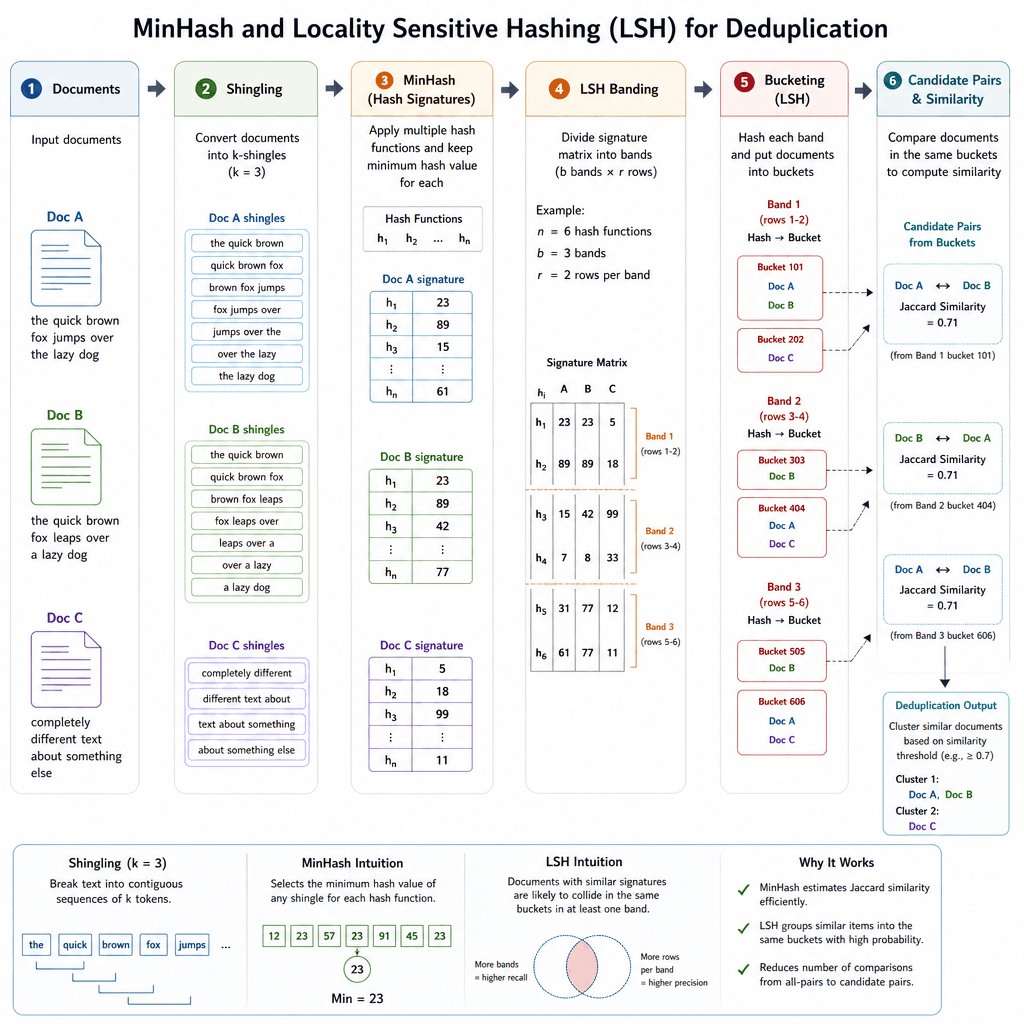
Exact string matching is computationally prohibitive for terabyte-scale corpora. Instead, the industry standard relies on MinHash and Locality Sensitive Hashing (LSH).
- Tokenization and Shingling: The document is broken into tokens. Then, it is converted into "shingles" (subsequences of tokens, typically or ). A document becomes a set of shingles.
- MinHashing: To estimate the Jaccard similarity between two sets of shingles without computing all pairs, we use MinHash. We apply independent hash functions to the shingles. The MinHash signature of a document is the minimum hash value observed for each of the functions.
- Mechanism: If two documents share many shingles, their MinHash signatures will be identical or very similar with high probability. The fraction of matching entries in the signatures approximates the Jaccard similarity.
- LSH Banding: We divide the MinHash signature into bands, each containing rows. We hash each band. Documents that share the same hash value for at least one band are placed in the same "bucket" and flagged as potential duplicates.
This approach reduces the complexity of pairwise comparison from to nearly linear time, allowing us to process billions of documents. The parameter tuning is critical: a higher sensitivity catches more near-duplicates but increases false positives; lower sensitivity misses subtle paraphrases but reduces computational load.
Implementation Considerations
Using libraries like datasketch or Spark’s built-in LSH implementations, engineers can build an index that maps document IDs to buckets. When a new document arrives, it is hashed against the index. If a collision is found, the document is compared to the candidate duplicates using a more precise similarity metric (e.g., cosine similarity on TF-IDF vectors) before removal.
Decontamination: Filtering Benchmarks
While deduplication removes redundancy within the corpus, decontamination ensures that the corpus does not contain data intended for evaluation. This is a stricter subset of deduplication, but with different goals: we are not just removing redundancy; we are removing knowledge that should remain hidden.
The Hashing Strategy
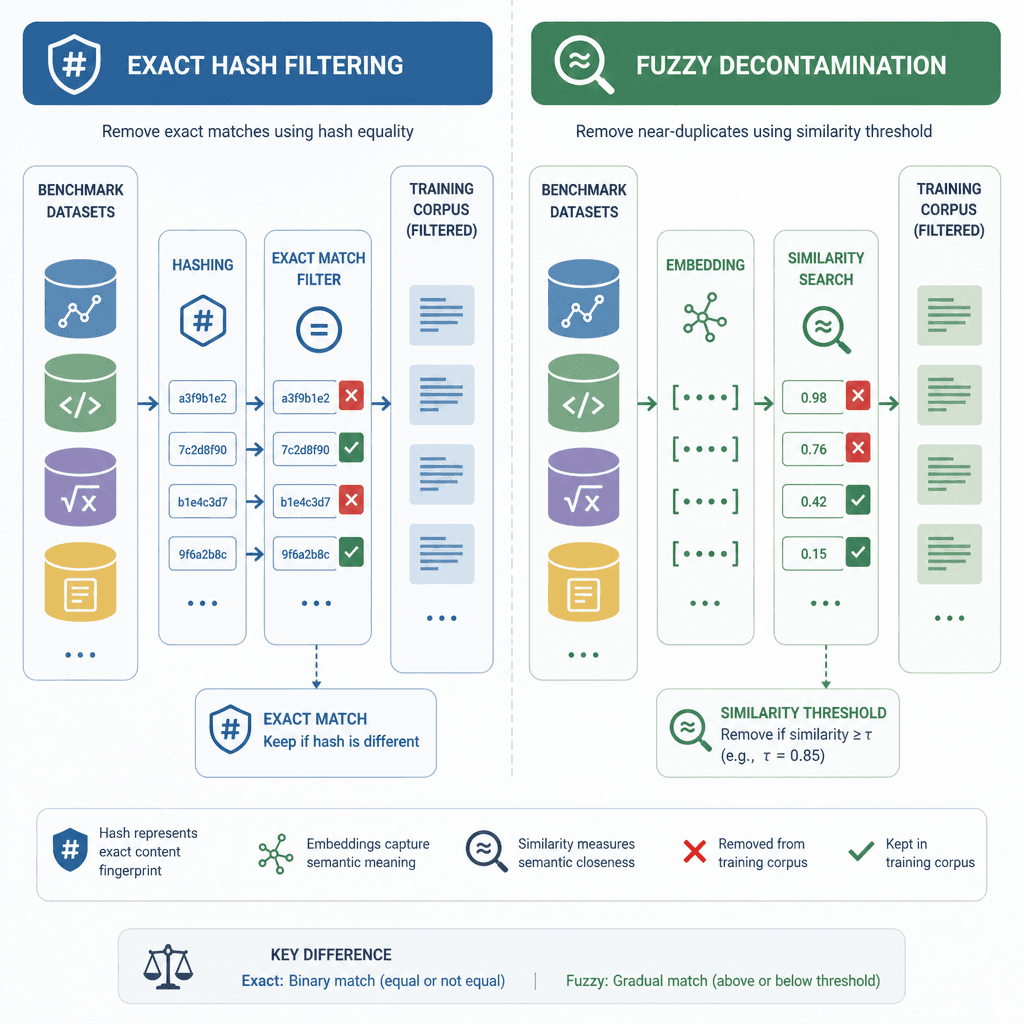
The most robust method for decontamination is exact hash filtering. Before training begins, every known benchmark dataset is processed through the same MinHash/LSH pipeline or simply hashed at the document level.
- Benchmark Indexing: Create a hash index of all test sets (e.g., MMLU, ARC, GSM8K).
- Corpus Filtering: Pass the training corpus through this filter. Any document whose hash matches a benchmark hash is excluded.
This method is effective for exact matches. However, benchmarks are often paraphrased or slightly modified in web content. Therefore, engineers often extend this to fuzzy decontamination:
- Use the same MinHash signatures derived from the benchmark data.
- Query the training corpus index with these signatures.
- If the Jaccard similarity exceeds a threshold (e.g., 0.8), flag the training document as "leaked."
The Trade-off: Precision vs. Recall
Aggressive decontamination carries a cost. Common knowledge facts (e.g., "Paris is the capital of France") appear in both benchmarks and general web text. Overly strict filtering may remove valid educational content, reducing the model’s factual grounding. Conversely, insufficient filtering leaves leakage artifacts.
A balanced approach involves:
- Exact Match Removal: Always remove exact duplicates of benchmark questions.
- Contextual Review: For fuzzy matches, inspect the surrounding context. If the document is a news article discussing a benchmark result, it may be safe to keep. If it is a direct copy of a test question, it must be removed.
Operational Workflow
A production-grade data pipeline for LLM training should integrate these steps sequentially:
- Ingestion: Raw data is collected from sources.
- Normalization: Text is cleaned (HTML tags removed, Unicode normalized).
- MinHash Generation: Compute MinHash signatures for all documents.
- Deduplication: Run LSH to identify and remove internal duplicates.
- Decontamination: Query the deduplicated corpus against benchmark hashes. Remove matches.
- Final Corpus: The remaining data is tokenized and stored in a format suitable for training (e.g., Parquet or HDF5).
This pipeline ensures that the model is exposed to diverse, non-redundant data that does not include the answers it is later tested on. By treating deduplication and decontamination as core engineering constraints rather than optional post-processing steps, teams can produce models with more reliable and generalizable performance.
Common Pitfalls
Even with robust algorithms, implementation errors can undermine data quality. Data engineers should watch for these common issues:
- Over-aggressive Deduplication: Setting the LSH sensitivity too high can cause the removal of valid, distinct documents that merely share common phrases or structural templates (e.g., standard legal clauses or code boilerplate). This reduces the diversity of the training data.
- Ignoring Fuzzy Decontamination Thresholds: Relying solely on exact hash matching fails to catch paraphrased benchmark data. However, setting the Jaccard similarity threshold for fuzzy matching too low can inadvertently flag and remove high-quality educational content that coincidentally overlaps with benchmark topics.
- Failing to Update Benchmark Indices: Benchmarks evolve. New versions of MMLU, GSM8K, or other evaluations are released periodically. Using a static index of old benchmarks leaves the model vulnerable to leakage from newer test sets.
Practical Takeaways
To ensure your LLM training pipeline remains robust and reliable, consider these core actions:
- Use MinHash/LSH for Scale: Avoid exact string matching for deduplication in large corpora. Implement MinHash and Locality Sensitive Hashing to achieve near-linear time complexity while maintaining high recall for duplicates.
- Implement Exact Hash Filtering for Benchmarks: Establish a definitive list of all known benchmark datasets and apply exact hash filtering to the training corpus before any other processing steps.
- Balance Precision/Recall in Decontamination: Do not rely solely on automated filtering. Combine exact matches with contextual review for fuzzy matches to avoid removing valid general knowledge while still catching leaked test questions.
FAQ
What is the difference between deduplication and decontamination? Deduplication removes redundant or duplicate data within the training corpus itself to improve efficiency and reduce overfitting. Decontamination specifically removes data that originates from external evaluation benchmarks (test sets) to prevent the model from memorizing answers rather than learning to reason.
Why is MinHash used instead of exact string matching? Exact string matching has a time complexity of for pairwise comparisons, which is computationally infeasible for terabyte-scale datasets. MinHash, combined with Locality Sensitive Hashing (LSH), allows for approximate nearest neighbor search, reducing the complexity to nearly linear time while accurately estimating similarity via the Jaccard index.
How do you handle paraphrased benchmark data? Paraphrased data is handled through "fuzzy decontamination." This involves generating MinHash signatures for benchmark datasets and querying the training corpus index. If the similarity score (Jaccard similarity) between a training document and a benchmark exceeds a specific threshold (e.g., 0.8), the document is flagged as potential leakage for further review or removal.
Related posts
Data Quality Beats Data Quantity: The Evidence
Evidence shows data quality outweighs quantity in model performance. Explore curation, filtering, and LIMA for better training data outcomes.
Dataset Versioning and Lineage with DVC
Explore dataset versioning and lineage using DVC to ensure reproducibility and provenance in LLM training pipelines.
Synthetic Data Generation That Doesn't Collapse
Explore methods for generating synthetic data that maintain diversity and prevent model collapse in LLM training pipelines.
