Synthetic Data Generation That Doesn't Collapse
Explore methods for generating synthetic data that maintain diversity and prevent model collapse in LLM training pipelines.
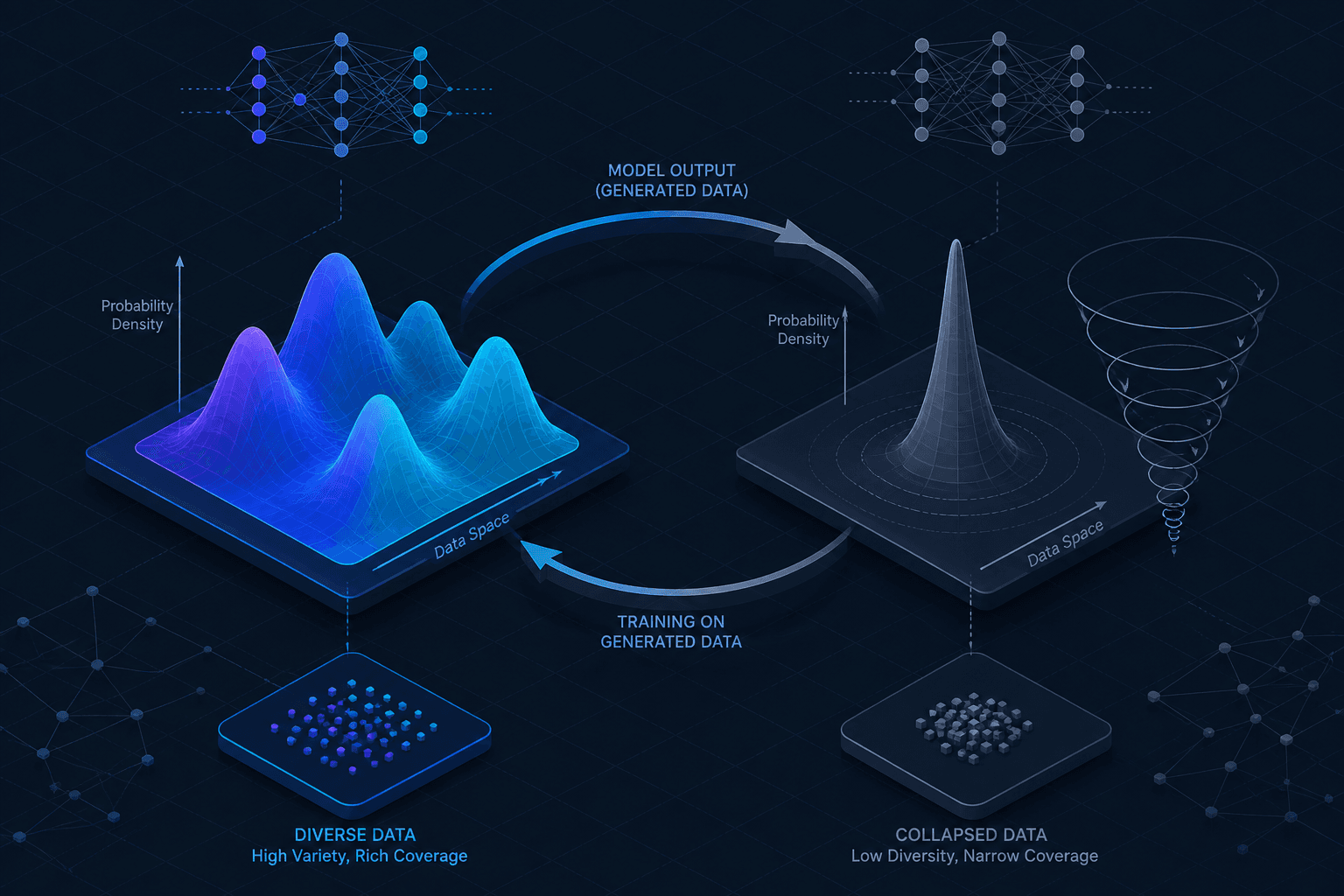
When training Large Language Models (LLMs), synthetic data offers a scalable path to instruction-following alignment. However, the mechanism behind this efficiency is also its primary failure mode: model collapse. If a model generates data to train itself, it inevitably converges on high-probability tokens, suppressing the rare, diverse patterns present in human data. This results in a degenerate distribution where the model becomes confident but incorrect, losing the ability to handle edge cases or creative reasoning. Preventing this collapse requires treating synthetic data generation not as a simple loop, but as a controlled entropy management problem.
This article is Part 2 of the Dataset Engineering for LLMs series.
The Mechanism of Collapse
Model collapse occurs when the training distribution diverges from the true data distribution due to repeated sampling from the model itself. In a self-instruct pipeline, an initial model generates instructions and responses, which are then used to fine-tune a subsequent version of the model. Without intervention, this process amplifies the most common linguistic patterns while starving the model of rare or complex examples.
The mechanism is rooted in information theory. As the model iterates, the variance of the generated data decreases. The model begins to output "average" responses, effectively smoothing out the tails of the distribution. This is known as mode collapse. The model becomes excellent at generating plausible-sounding but generic text, failing on tasks that require nuanced understanding or unconventional reasoning. Shumailov et al. (2023) demonstrate that even small amounts of self-generated data can lead to significant degradation in performance if not carefully managed.
Entropy Management in Sampling
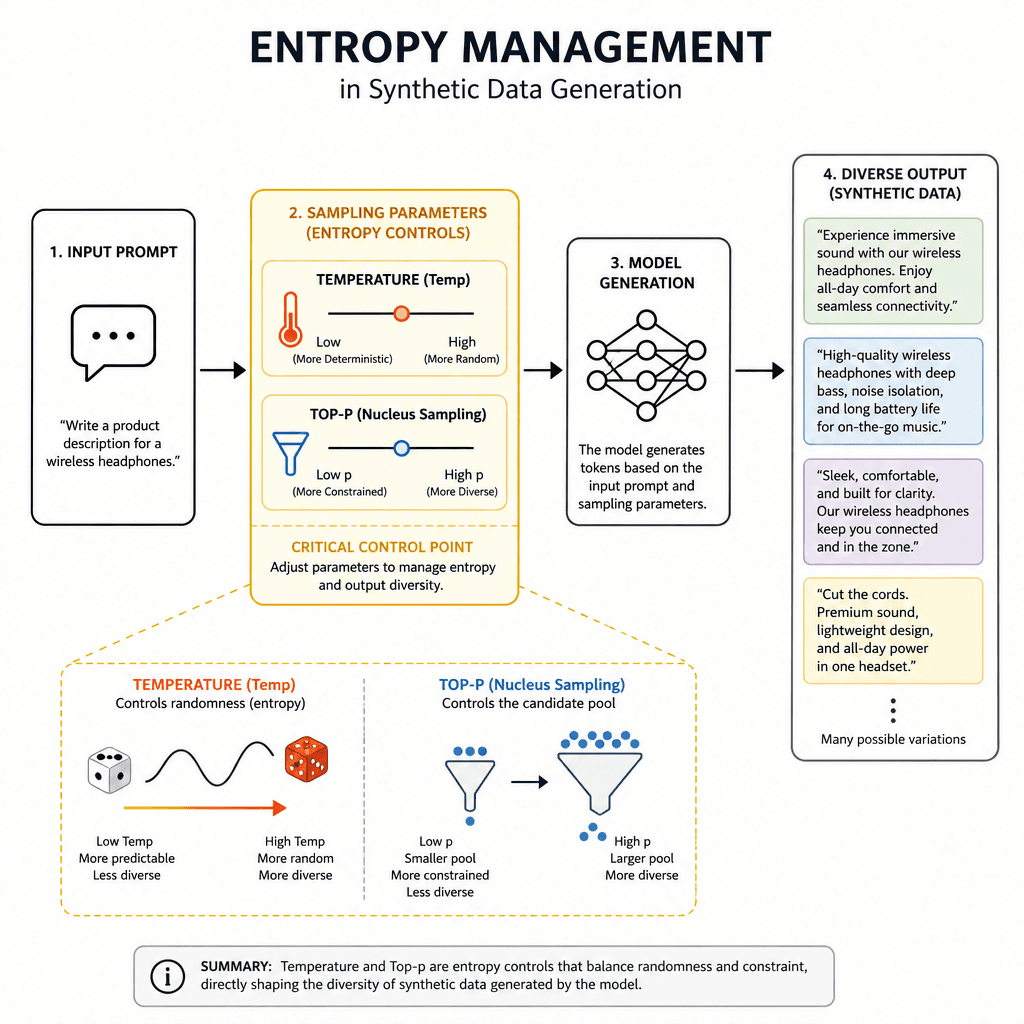
To counteract collapse, the generation process must actively preserve entropy. The most direct way to do this is by manipulating the sampling parameters during synthetic data creation. Greedy decoding, which always selects the highest-probability token, is the primary driver of collapse and should be avoided in synthetic loops.
Instead, use top-p (nucleus) sampling and temperature scaling to introduce controlled randomness. Top-p sampling restrictes the next token selection to the smallest set of tokens whose cumulative probability exceeds a threshold . This prevents the model from focusing solely on the most likely continuations, allowing it to explore less common but valid responses. Temperature scaling adjusts the probability distribution by dividing logits by a temperature parameter . A higher temperature flattens the distribution, increasing the likelihood of selecting less probable tokens.
For example, in a Python-based synthetic data generator, you might configure the Hugging Face transformers library as follows:
outputs = model.generate(
    input_ids,
    max_new_tokens=256,
    temperature=0.7,  # Higher temperature for diversity
    top_p=0.9,        # Nucleus sampling to avoid extreme outliers
    do_sample=True,   # Enable stochastic sampling
    pad_token_id=tokenizer.eos_token_id
)
This configuration ensures that the synthetic data retains a degree of variability that mirrors the natural diversity of human language. However, randomness alone is insufficient; without verification, high-entropy data can also include low-quality or nonsensical outputs.
Verification as a Filter, Not a Gate
Verification is the critical step that separates useful synthetic data from noise. The goal is not to reject all non-human-like data, but to filter out data that is factually incorrect, logically inconsistent, or stylistically degenerate.
One effective method is self-consistency checking. Instead of relying on a single generation, the model generates multiple responses to the same prompt and selects the one that is most consistent with the others or with a separate verifier model. This reduces the impact of random noise and ensures that the selected data is robust. Wang et al. (2022) show that self-consistency significantly improves reasoning performance by aggregating multiple reasoning paths.
Another approach is cross-model verification. Use a smaller, more specialized model or a rule-based system to validate the synthetic data. For instance, if the synthetic data includes code snippets, a compiler can verify syntax. If it includes mathematical problems, a symbolic solver can verify the solution. This multi-layered verification ensures that the synthetic data maintains a high standard of quality before it is added to the training set, a common practice in self-instruct pipelines.
Hybrid Data Strategies
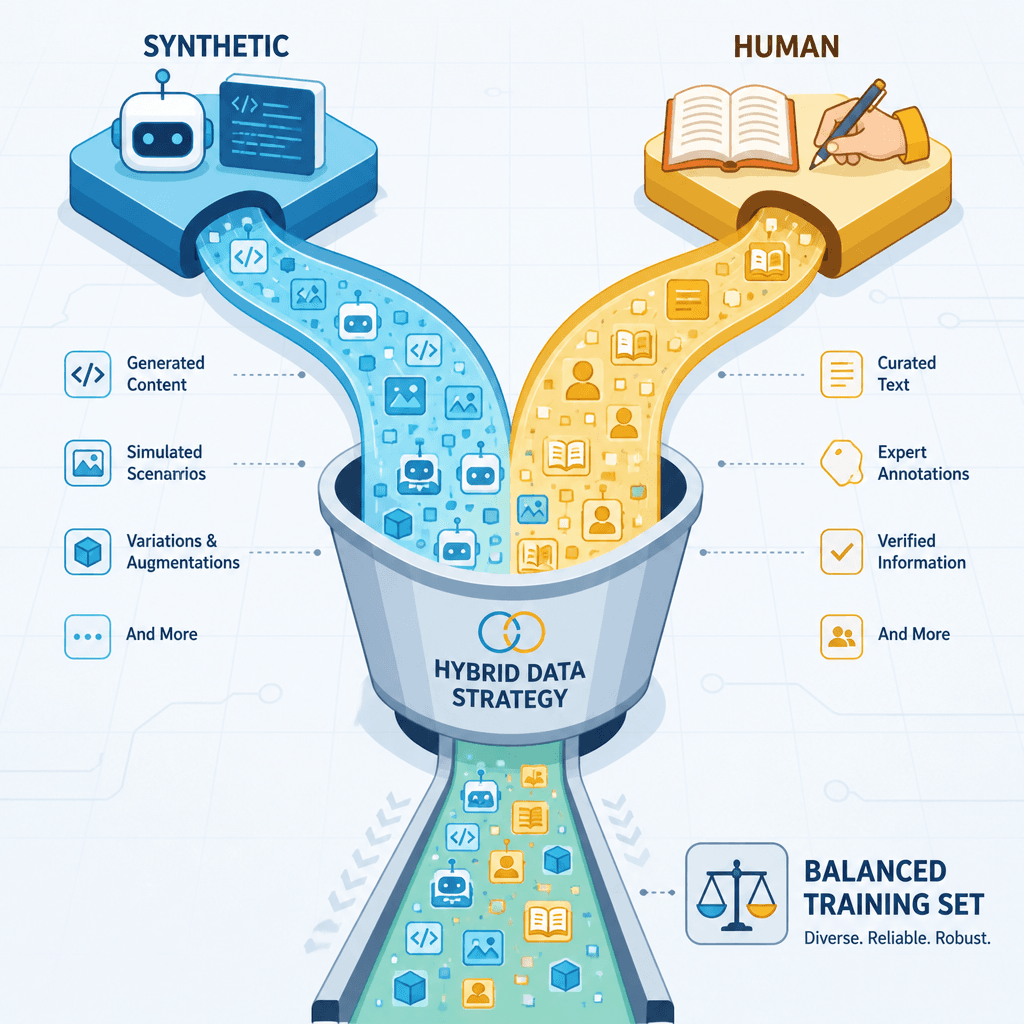
Even with careful entropy management and verification, synthetic data alone cannot fully replicate the richness of human-curated data. The best practice is to use hybrid strategies, mixing synthetic data with human-labeled or web-scraped data. This anchors the training distribution, preventing drift and ensuring that the model retains access to rare but important patterns.
A common ratio is 1:1 or 1:2 synthetic-to-human data, depending on the domain. In highly structured domains like code or math, synthetic data can dominate because the rules are well-defined and verifiable. In creative or open-ended domains, human data should play a larger role to preserve nuance and style. This balance is particularly crucial in self-instruct workflows, where the risk of distributional shift is highest. By integrating diverse human examples, you mitigate the homogenization effects inherent in self-instruct systems.
Conclusion
By combining these strategies—entropy management, rigorous verification, and hybrid data mixing—you can generate synthetic data that enhances rather than degrades your LLM's capabilities. This approach ensures that your model remains robust, diverse, and capable of handling the full spectrum of human language.
Related posts
Dataset Versioning and Lineage with DVC
Explore dataset versioning and lineage using DVC to ensure reproducibility and provenance in LLM training pipelines.
Deduplication, Decontamination, and Leakage
An examination of deduplication and decontamination techniques to prevent data leakage and benchmark contamination in large language model training pipelines.
Data Quality Beats Data Quantity: The Evidence
Evidence shows data quality outweighs quantity in model performance. Explore curation, filtering, and LIMA for better training data outcomes.
