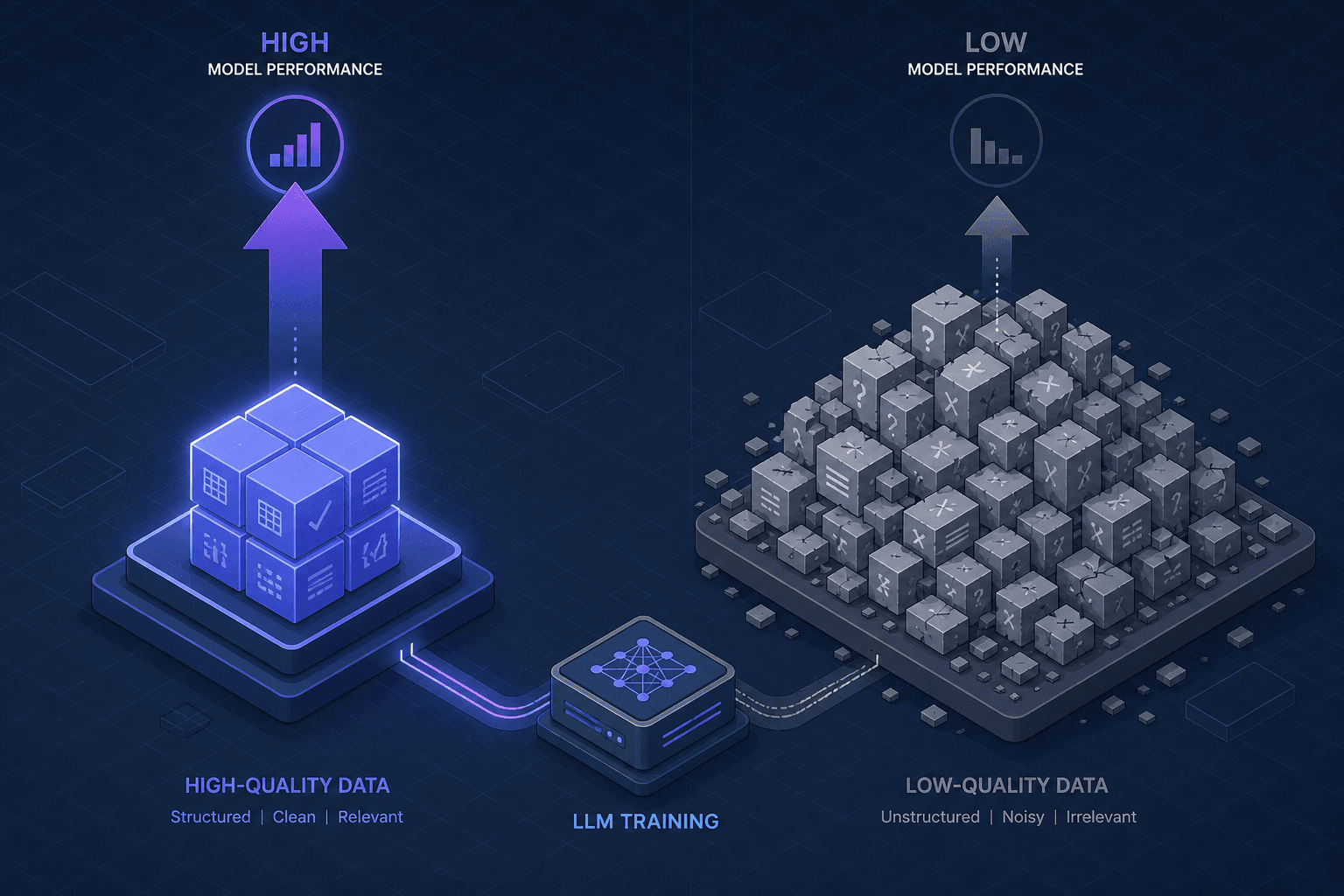
Data Quality Beats Data Quantity: The Evidence
Evidence shows data quality outweighs quantity in model performance. Explore curation, filtering, and LIMA for better training data outcomes.
In the early days of large language model (LLM) development, the prevailing wisdom was simple: scale is all you need. If you threw enough text at a transformer, it would learn to speak, reason, and eventually align. However, as the field matures, a counter-intuitive reality has emerged. High-quality, curated datasets often outperform massive, raw collections. This is not just a theoretical preference; it is a mechanistic necessity driven by how neural networks optimize loss functions.
For ML engineers, this shifts the bottleneck from data collection to data curation. The evidence suggests that the marginal gain from adding noisy data is negative, while the gain from removing it is positive. This post explores why data quality outweighs quantity, using the LIMA approach and specific filtering techniques as evidence.
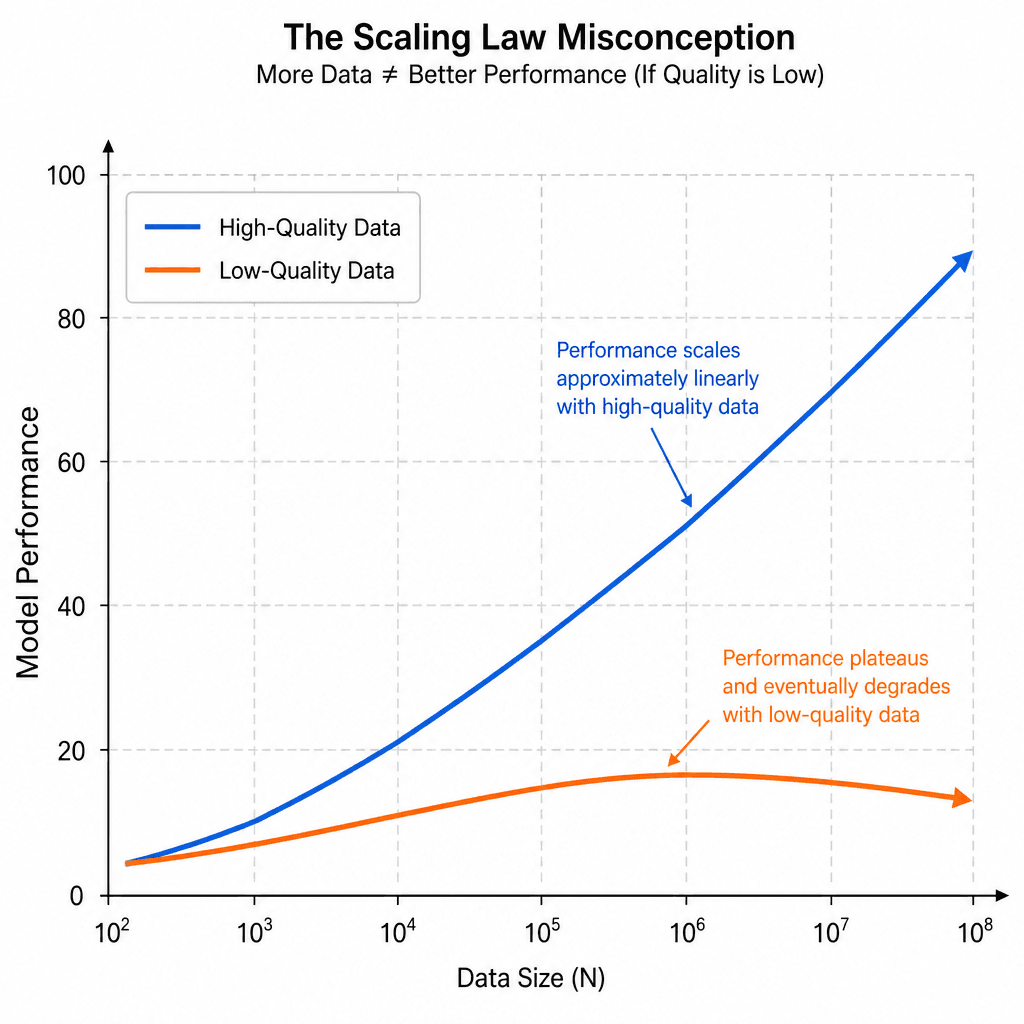
The Scaling Law Misconception
The original scaling laws (Kaplan et al., 2020) established a power-law relationship between model performance and compute, data, and parameters. However, these laws assumed homogeneous, high-quality data. When data quality drops, the scaling curve flattens and can even invert. This is precisely where dataset engineering becomes critical: it addresses the misconception that more raw data automatically yields better models by focusing on the signal-to-noise ratio.
Consider the optimization landscape. A neural network learns by minimizing a loss function across a high-dimensional parameter space. Each training example contributes a gradient vector. In a massive, uncurated dataset (e.g., Common Crawl), the majority of data is noisy, duplicated, or irrelevant. These examples introduce gradient noise.
- Signal Dilution: High-signal examples (e.g., clear logical reasoning, accurate code) provide strong, consistent gradient directions. Low-signal examples (e.g., spam, broken HTML, contradictory statements) provide weak or conflicting gradients.
- Optimization Noise: When low-signal data dominates, the optimizer spends epochs correcting for noise rather than learning underlying patterns. This leads to slower convergence and lower final accuracy.
This mechanism explains why simply increasing dataset size does not linearly improve performance. If the signal-to-noise ratio (SNR) decreases as increases, the effective information content saturates quickly. For robust llm training, prioritizing data quality over volume is essential to avoid wasting compute on filtering out noise post-hoc or struggling with poor convergence.
The LIMA Case Study: Less Is More for Alignment
The most compelling evidence for data quality over quantity comes from the "LIMA: Less Is More for Alignment" paper (Zhou et al., 2023). LIMA demonstrated that a model trained on just 1,000 carefully curated instruction-response pairs could outperform models trained on thousands of hours of large-scale web data.
How LIMA Worked
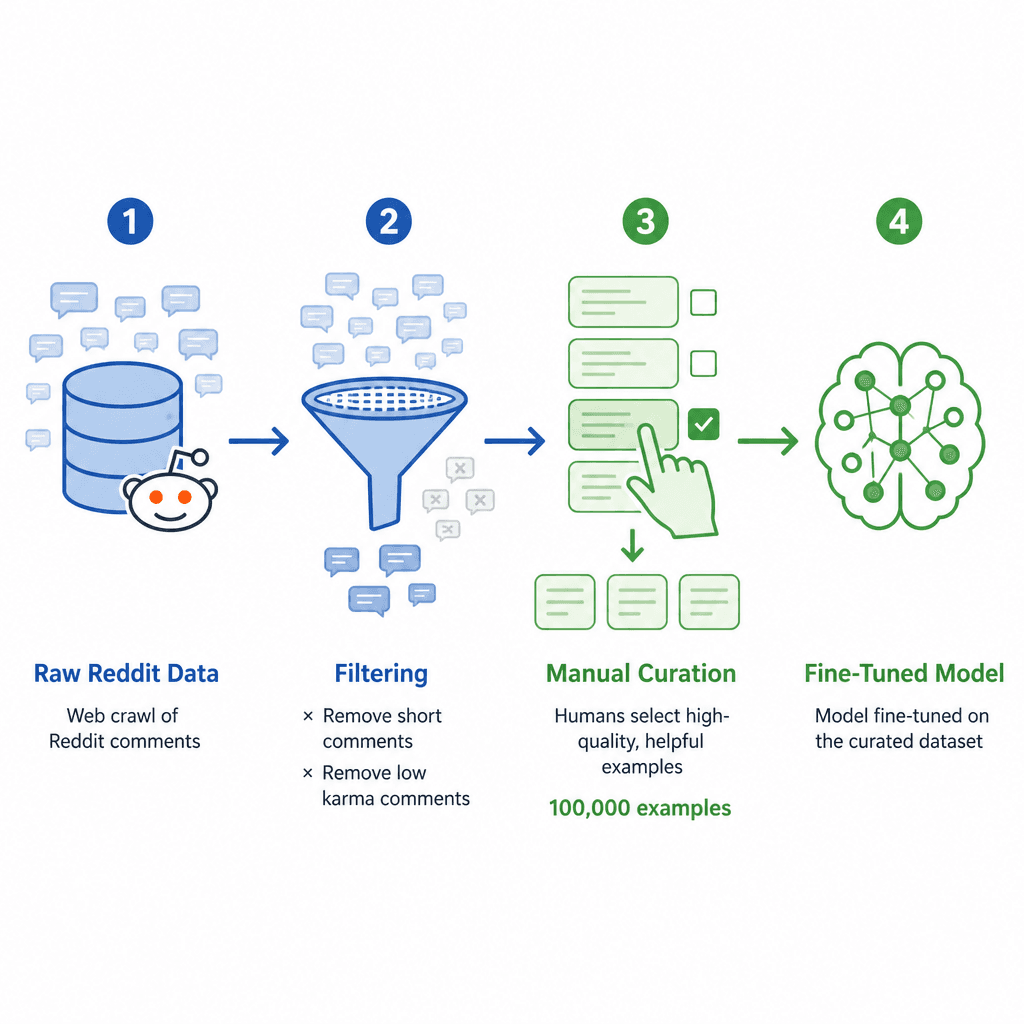
LIMA did not use complex reinforcement learning from human feedback (RLHF) pipelines. Instead, it used a simple supervised fine-tuning (SFT) approach on a small, curated set of instruction-response pairs from diverse sources.
- Data Source: They compiled examples from diverse sources, including Stack Exchange, wikiHow, and Reddit forums, along with prompts and responses written manually by the authors.
- Filtering: They applied strict filters to remove low-quality posts (e.g., short comments, low karma, non-English).
- Curation: They manually selected approximately 1,000 high-quality instruction-response pairs that covered diverse topics and reasoning types.
- Training: They fine-tuned a 65B parameter model on this curated dataset.
The Mechanism of Success
Why did ~1,000 examples beat thousands of hours of data? It is crucial to attribute this success to the data curation strategy rather than the training method alone. While SFT was the technique used, the "Less Is More" thesis relies heavily on the diversity and quality of the training data.
- Diversity of Intent: The 1,000 examples were manually selected to cover a wide range of intents (creative writing, logical reasoning, coding). This forced the model to learn generalizable reasoning patterns rather than memorizing specific phrasings from large corpora.
- Reduced Overfitting: Large datasets increase the risk of memorizing spurious correlations. A small, diverse dataset forces the model to generalize.
- Gradient Clarity: Every gradient step in LIMA’s training was high-signal. There was no noise from irrelevant or low-quality data to confuse the optimizer.
Filtering Mechanics: Engineering for Quality
For ML engineers, the challenge is operationalizing this insight. You cannot manually curate every dataset. Instead, you must build automated filtering pipelines that approximate human judgment. Here are three key mechanisms for improving data quality:
1. Deduplication
Duplicate data is not just redundant; it is harmful. It artificially inflates the frequency of certain patterns, leading the model to overestimate their importance.
- Mechanism: MinHash or SimHash algorithms identify near-duplicate documents.
- Impact: Removing duplicates reduces the dataset size by 10–30% but improves training efficiency and reduces memorization.
2. Perplexity Filtering
Perplexity (PPL) measures how well a probability model predicts a sample. Low-PPL documents are likely coherent and grammatically correct. High-PPL documents may be gibberish, machine-translated poorly, or contain errors.
- Mechanism: Train a small language model (e.g., GPT-2 small) on a reference corpus. Compute PPL for each document in the target dataset. Filter out documents with PPL above a threshold.
- Impact: Removes low-quality text without requiring human labels.
3. Toxicity and Bias Filtering
Models trained on unfiltered internet data inherit biases and toxic patterns. Filtering for toxicity ensures the model learns safe and helpful behaviors.
- Mechanism: Use classifiers (e.g., Perspective API, Detoxify) to score each document for toxicity, hate speech, or sexual content. Remove documents exceeding thresholds.
- Impact: Improves alignment and reduces the need for post-hoc safety tuning.
Practical Engineering Workflow
Implementing a data curation pipeline involves several steps. Here is a practical workflow for ML engineers:
- Ingestion: Collect raw data from sources (web crawls, APIs, user-generated content).
- Preprocessing: Clean HTML, remove boilerplate, normalize text.
- Filtering: Apply automated filters (deduplication, PPL, toxicity).
- Sampling: Use stratified sampling to ensure diversity of topics and intents.
- Validation: Manually review a small subset of the curated dataset to ensure quality.
- Training: Train the model on the curated dataset.
Trade-offs
- Computational Cost: Filtering requires compute. However, this cost is often offset by faster training times and better model performance.
- Data Loss: Aggressive filtering may remove valid but rare patterns. Engineers must balance coverage and quality.
Conclusion
The evidence is clear: data quality beats data quantity. For ML engineers, this means shifting focus from collecting more data to curating better data. By understanding the mechanisms of optimization noise, gradient clarity, and signal dilution, engineers can build more efficient and effective training pipelines. The LIMA case study proves that less can indeed be more, provided the "less" is high-quality and diverse.
As the field moves forward, the competitive advantage will lie not in who can collect the most data, but in who can curate the best data.
Related posts
Deduplication, Decontamination, and Leakage
An examination of deduplication and decontamination techniques to prevent data leakage and benchmark contamination in large language model training pipelines.
Dataset Versioning and Lineage with DVC
Explore dataset versioning and lineage using DVC to ensure reproducibility and provenance in LLM training pipelines.
Synthetic Data Generation That Doesn't Collapse
Explore methods for generating synthetic data that maintain diversity and prevent model collapse in LLM training pipelines.
