Catastrophic Forgetting: Diagnosing and Preventing It
An examination of catastrophic forgetting in machine learning, covering diagnosis methods and prevention strategies like replay and regularization.
When a neural network learns a new task, it often performs significantly worse on tasks it mastered earlier. This phenomenon is known as catastrophic forgetting. It is not a software bug in the traditional sense; it is a fundamental geometric property of how deep learning models optimize parameters. In this post, we will dissect the mechanism of forgetting, how to diagnose it using capability regression, and two primary prevention strategies: regularization and replay.
The Mechanism of Forgetting
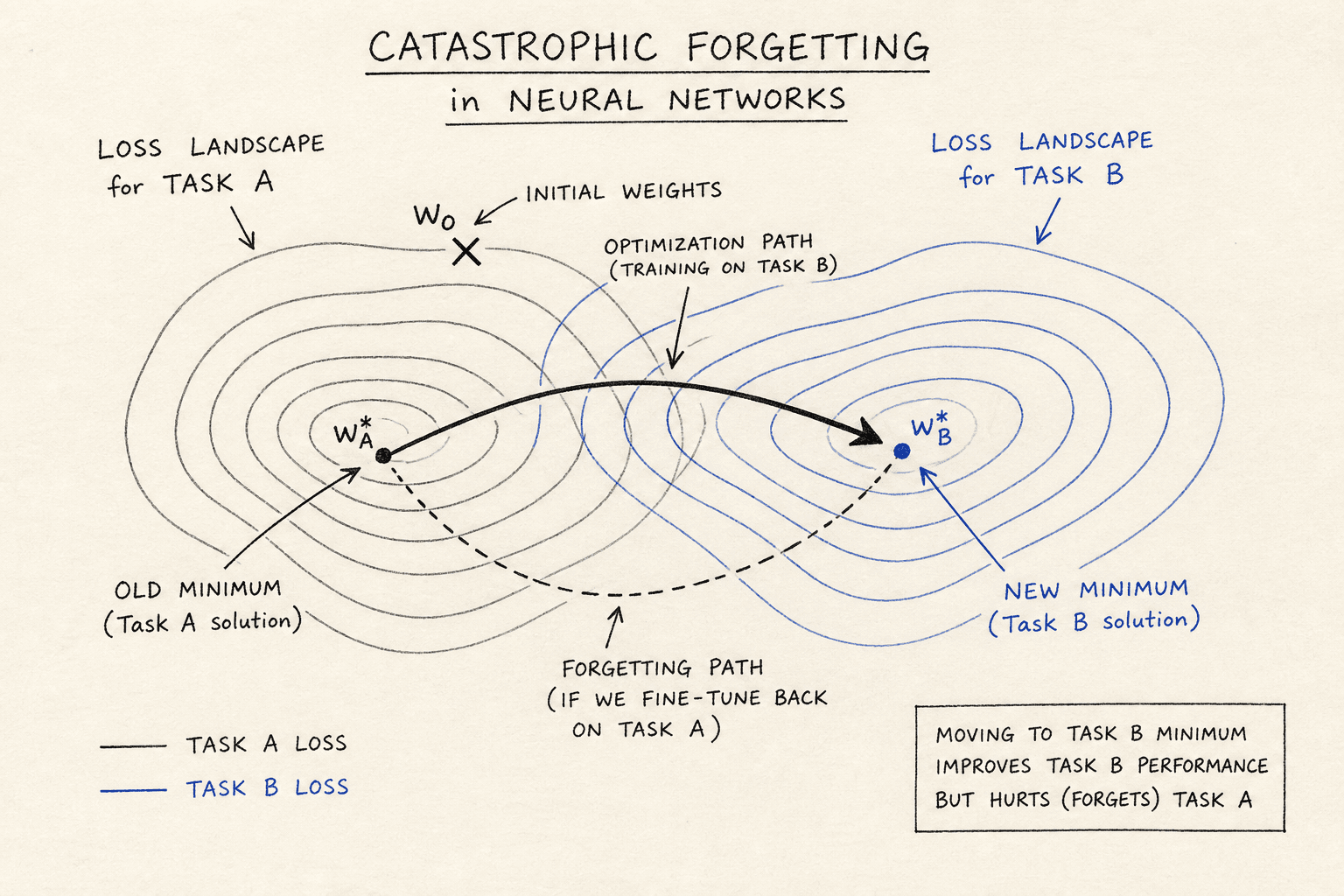
To understand why forgetting happens, we must look at the loss landscape. A neural network minimizes a loss function by adjusting its weights via gradient descent. When you train on Task A, the network finds a set of weights that minimize error for A. These weights represent specific synaptic configurations.
When you switch to Task B, the optimization process moves the weights in a new direction to minimize error for B. Because the loss landscape for Task A and Task B are often misaligned, the gradient for Task B points in a direction that increases the loss for Task A. The network does not have an explicit memory of Task A; it only has weights. If the weight updates for Task B are large enough, they overwrite the critical weights needed for Task A.
This is distinct from "interference," where new data simply confuses the model. Catastrophic forgetting is structural: the new task’s optimal solution occupies a region of the parameter space that is incompatible with the old task’s solution. Without intervention, the network converges to a local minimum that solves the current task but fails the previous one entirely.
Diagnosing Forgetting: Capability Regression
You cannot prevent what you cannot measure. The standard way to diagnose catastrophic forgetting is through capability regression analysis. This involves tracking the performance of the model on old tasks as it trains on new tasks.
Imagine a scenario where you have a model trained on digits 0-4. You then train it on digits 5-9. During the training epochs for digits 5-9, you periodically evaluate the model on digits 0-4.
Plotting the accuracy on digits 0-4 against the training epochs for digits 5-9 reveals the forgetting curve. A steep drop in accuracy indicates severe catastrophic forgetting. A flat line indicates perfect continual learning.
We can quantify this using a "mixing ratio" or retention score. Let be the accuracy on old tasks after training on new tasks, and be the accuracy before training on new tasks. The retention score is:
If approaches 0, the model has forgotten. If remains near 1, it has retained. This metric allows you to compare different architectures or hyperparameters objectively. For example, a model using simple fine-tuning might show , while a model using replay might show .
Prevention Strategy 1: Regularization (EWC)
One approach to preventing forgetting is to constrain how much the weights can change. This is the core idea behind Elastic Weight Consolidation (EWC).
EWC modifies the loss function by adding a penalty term. The total loss becomes:
Where:
- is the loss for the current task.
- is a hyperparameter controlling the strength of regularization.
- is the Fisher Information for weight .
- is the current weight.
- is the weight after training on the old task.
The Fisher Information measures how sensitive the loss function is to changes in weight for the old task. If is high, it means that weight is critical for Task A. The penalty term forces the optimizer to keep close to , effectively "locking" important weights in place.
This method works because it distinguishes between important and unimportant weights. Weights that don’t matter for the old task can still change to learn the new task. Weights that do matter are stabilized. This allows the network to learn Task B without destroying the solution for Task A.
Prevention Strategy 2: Experience Replay
Another powerful strategy is experience replay. Instead of constraining the weights, we constrain the data. The model is periodically exposed to a small sample of old data while learning the new task.
In practice, this involves maintaining a replay buffer. When the model encounters a new sample from Task B, it also samples examples from the replay buffer of Task A. The loss is computed on both sets, and gradients are backpropagated.
This forces the model to revisit the decision boundaries it established for Task A. It acts as a form of data augmentation that keeps the old task active in the optimization process. The replay buffer does not need to store all old data, which would be memory-prohibitive. A small buffer (e.g., 100-1000 examples) is often sufficient to maintain performance.
However, replay has limitations. If the old data distribution shifts or if the buffer is too small, the model may still forget. Additionally, storing old data may raise privacy concerns in some applications.
Conclusion
Catastrophic forgetting is a natural consequence of navigating misaligned loss landscapes during optimization. By understanding the mechanism—weight updates that destroy previous solutions—you can diagnose it using capability regression and mitigate it using regularization or replay. EWC provides a mathematical constraint on weight movement, while replay provides a data-level constraint. Both are essential tools in the continual learning toolkit.
Related posts
Scaling Laws and What They Predict
An examination of scaling laws in machine learning, covering Chinchilla compute optimality, overtraining risks, and forecasting future model performance.
Unsloth: Fine-Tuning 2x Faster on One GPU
Learn how Unsloth accelerates fine-tuning by 2x using Triton kernels and LoRA, enabling efficient model training on a single GPU.
OWASP Top 10 for LLM Applications, Applied
A practical examination of the OWASP Top 10 for LLM Applications, covering security checklists, mitigations, and appsec review processes for developers.
