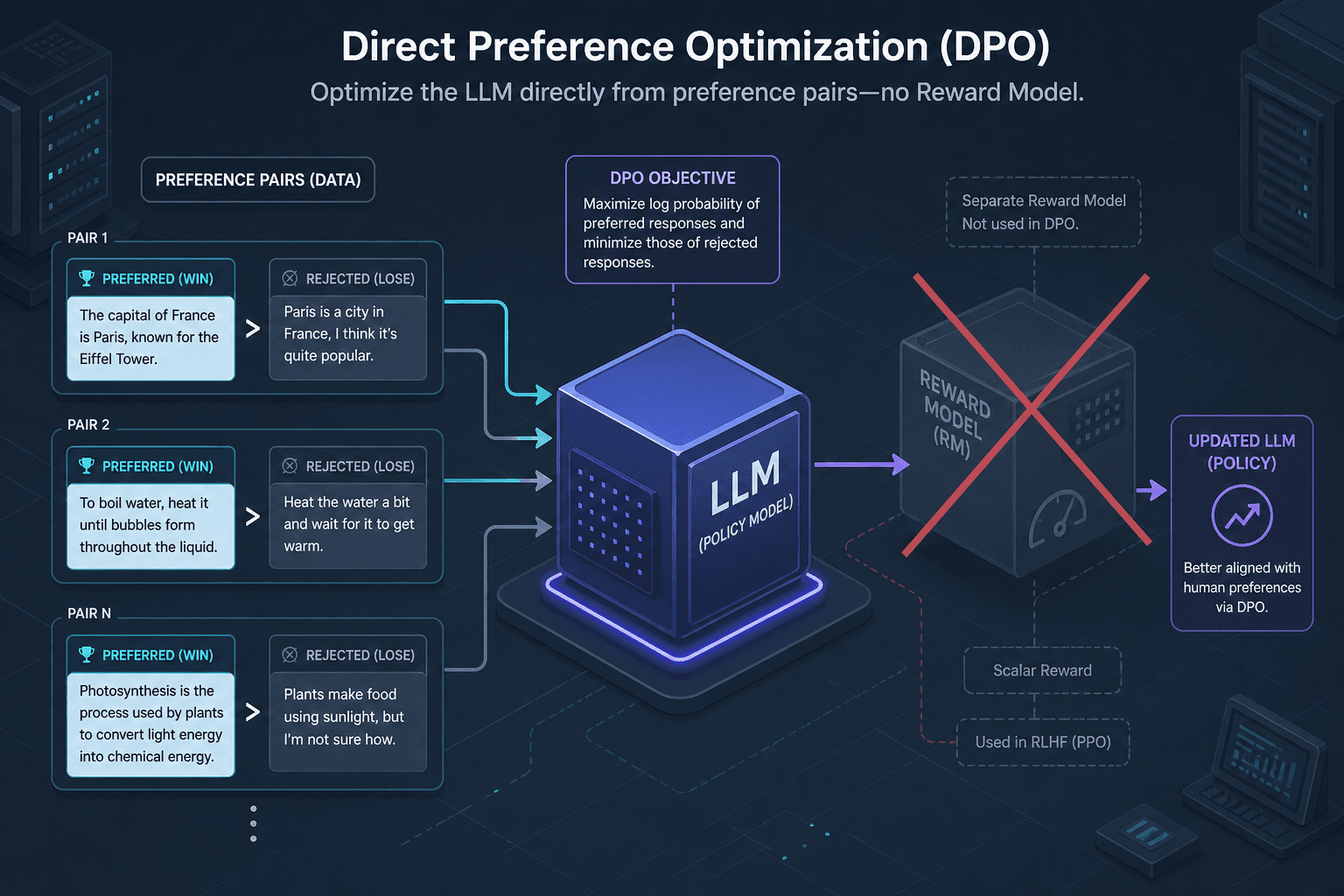
DPO: Preference Optimization Without a Reward Model
An examination of Direct Preference Optimization (DPO) as a method for aligning language models using preference pairs without training a separate reward model.
Direct Preference Optimization (DPO) represents a structural simplification in the alignment of Large Language Models (LLMs). It replaces the complex, unstable reinforcement learning loop of RLHF with a stable supervised learning procedure. The core insight is that the reward model used in RLHF is not strictly necessary if we can mathematically express the optimal policy directly in terms of preference data.
The RLHF Bottleneck
Standard RLHF involves three distinct stages. First, a model is trained on human-written text via SFT. Second, a separate Reward Model (RM) is trained to predict human preferences. Third, Proximal Policy Optimization (PPO) is used to align the LLM with the RM while keeping it close to the original SFT model. For implementation details on the PPO algorithm and its stability challenges, see the original PPO paper or Hugging Face's Transformers documentation on PPO.
This approach has two major mechanical flaws:
- Instability: Training the LLM and RM simultaneously creates a moving target. The RM evaluates the LLM, but the LLM’s distribution changes, potentially invalidating the RM’s gradients.
- Complexity: The PPO algorithm requires careful tuning of multiple hyperparameters (learning rate, KL penalty, value function loss) and significant computational overhead due to the separate forward passes for the policy and value networks.
DPO removes the second stage entirely. Instead of training a reward model and then optimizing the policy against it, DPO optimizes the policy directly against the preference data.
The Implicit Reward Mechanism
The key to DPO lies in the analytical relationship between the optimal policy and the reward function. In RLHF, we seek a policy that maximizes expected reward subject to a KL-divergence constraint relative to a reference policy :
Rafailov et al. (2023) derived the closed-form solution for this optimization problem. The optimal policy is related to the reward function by:
where is the partition function (normalization constant) dependent only on . This equation tells us that if we know the reward function, we can compute the optimal policy directly. Conversely, if we assume the optimal policy is known, we can invert this equation to find the implicit reward function:
This inversion is critical. It means we don’t need to train a separate neural network to estimate . We can use the LLM itself (as ) and the SFT model (as ) to define the reward. The term acts as the implicit reward signal.

The DPO Objective Function
With the implicit reward defined, we can formulate a loss function that encourages the model to assign higher probabilities to preferred responses () and lower probabilities to rejected responses ().
In RLHF, we would train the RM to output a higher score for than . In DPO, we train the LLM directly. The DPO loss is a binary cross-entropy loss applied to the log-probability ratios:
Here, is the sigmoid function. The term inside the sigmoid is the difference in log-probability ratios between the winning and losing responses. This difference serves as the "reward margin." By maximizing this margin, the model implicitly maximizes the reward defined by the preference data.
Note that the partition function cancels out in the difference, so we do not need to compute it. This makes the objective computationally tractable and stable.
The Beta Parameter and KL Regularization
The parameter controls the strength of the KL penalty. In the derivation, appears in the denominator of the exponent in the optimal policy formula. In the loss function, it scales the log-probability ratio.
Mechanically, prevents the model from deviating too far from the reference policy . If is too high, the model is overly constrained and may not learn useful preferences. If is too low, the model may overfit to the preference data, leading to mode collapse or generating nonsensical outputs that have high probability under the preference criterion but low probability under the language model prior.
In practice, is typically set between 0.1 and 0.5. This range ensures that the model aligns with human preferences while maintaining linguistic coherence and diversity. Tuning is essentially balancing the trade-off between following the data and staying within the manifold of the pre-trained model. A common pitfall is "reward hacking," where the model finds shortcuts to maximize the implicit reward without genuinely improving helpfulness. Careful monitoring of the KL divergence between the policy and reference model during training is essential; if KL divergence spikes, it often indicates that is too low or the data is too noisy.
Variants and Stability
While DPO simplifies RLHF, it is not without issues. It assumes that the preference data is accurate and that the implicit reward function is well-calibrated. Noise in the preference labels can lead to suboptimal policies.
Several variants have been proposed to address these limitations:
- IPO (Identity Preference Optimization): Azar et al. (2023) proposed IPO, which adds a squared regularization term to the loss function. This stabilizes training when the preference data is noisy or when the implicit reward function is not perfectly aligned with the true human reward.
- ORPO (Odds Ratio Preference Optimization): ORPO combines the SFT and DPO-style preference objectives into a single training step, simplifying the pipeline. Unlike DPO, it does not require a separate reference model to compute log-probability ratios during training, since the odds-ratio penalty is computed directly from the policy model being trained. It effectively removes the need for the reference model checkpoint.
Practical Observation: In my experience aligning models on noisy datasets, IPO often provides more robust convergence than standard DPO. When preference labels contain even 5-10% noise, standard DPO can exhibit erratic loss curves, whereas IPO's squared regularization term dampens the impact of outliers, leading to smoother optimization trajectories.
Conclusion
DPO is not a new reinforcement learning algorithm. It is a supervised learning objective derived from the analytical solution of the RLHF problem. By eliminating the reward model, DPO reduces the complexity of alignment from a multi-stage, unstable optimization problem to a single-stage, stable fine-tuning procedure. For ML engineers, this means faster iteration cycles, lower computational costs, and more stable training dynamics, making preference optimization accessible without the overhead of PPO.
Common Pitfalls
- Over-reliance on noisy preference data: DPO assumes high-quality labels. Noisy data leads to poor implicit rewards. Always clean your preference pairs rigorously.
- Ignoring the reference model's quality: The reference model () anchors the policy. If the SFT model is poor, DPO cannot fix it. Ensure your base model is well-aligned before applying DPO.
- Misconfiguring beta leading to mode collapse: Setting too low can cause the model to collapse into a few high-probability modes that satisfy the preference data but lack diversity. Monitor KL divergence closely.
Practical Takeaways
- Treat DPO as Supervised Learning: Remember that you are fine-tuning, not reinforcing. This mental model helps in choosing appropriate learning rates and batch sizes similar to SFT.
- Beta is Your Stability Knob: Use to control the trade-off between adherence to preferences and deviation from the base model. Start with and adjust based on KL divergence metrics.
- Data Quality Trumps Algorithm Complexity: No variant (IPO, ORPO, etc.) will save you from bad data. Invest time in curating high-quality preference pairs before experimenting with different loss functions.
FAQ
Is DPO better than RLHF? DPO is generally easier to implement and more stable than RLHF (specifically PPO-based RLHF) because it removes the need for a reward model and the complexity of reinforcement learning loops. However, RLHF can sometimes achieve higher performance if the reward model is well-calibrated and the training is carefully managed.
How do I choose beta? Start with and monitor the KL divergence between the policy and the reference model. If the divergence is too low, the model isn't learning much; if it's too high, the model is diverging too far. Adjust to keep KL divergence within a reasonable range (e.g., 10-20% deviation from the reference).
Can DPO be used with any model? DPO can be applied to any transformer-based language model that supports fine-tuning. However, the model should already have some baseline alignment (via SFT) to serve as a good reference policy. Using a raw pre-trained model as the reference may lead to poor results.
Related posts
Reward Hacking and How to Catch It
An examination of specification gaming, sycophancy, and length bias in LLMs to help ML engineers improve model alignment.
GRPO and the Rise of Verifiable Rewards
An examination of Group Relative Policy Optimization (GRPO) and how verifiable rewards improve reasoning training in large language models.
RLHF, Step by Step
A step-by-step breakdown of Reinforcement Learning from Human Feedback (RLHF), covering reward modeling, PPO, and KL penalties for ML engineers.
