Event-Driven Security: Automating Response with Idempotency
Explore event-driven security architecture, focusing on automated response, SOAR integration, and idempotency for resilient security event handling.
Event-Driven Security Architecture: Automating Response with Idempotency
Security operations have historically relied on polling models where SIEM dashboards query databases or scripts check APIs at fixed intervals. This approach introduces latency and creates blind spots during network partitions. The solution lies in an Event-Driven Architecture (EDA) integrated with Security Orchestration, Automation, and Response (SOAR) platforms. In this model, security tools emit events into a centralized stream, and automated agents react immediately. The critical engineering challenge is ensuring these automated reactions are idempotent, meaning repeated execution does not corrupt system state or create false positives.
The Shift from Polling to Streaming
Event driven security principles replace traditional pull-based polling with push-based streaming. Traditional security monitoring involves a central collector periodically querying endpoints or logs. This creates a window of vulnerability between an event occurring and the next poll cycle.
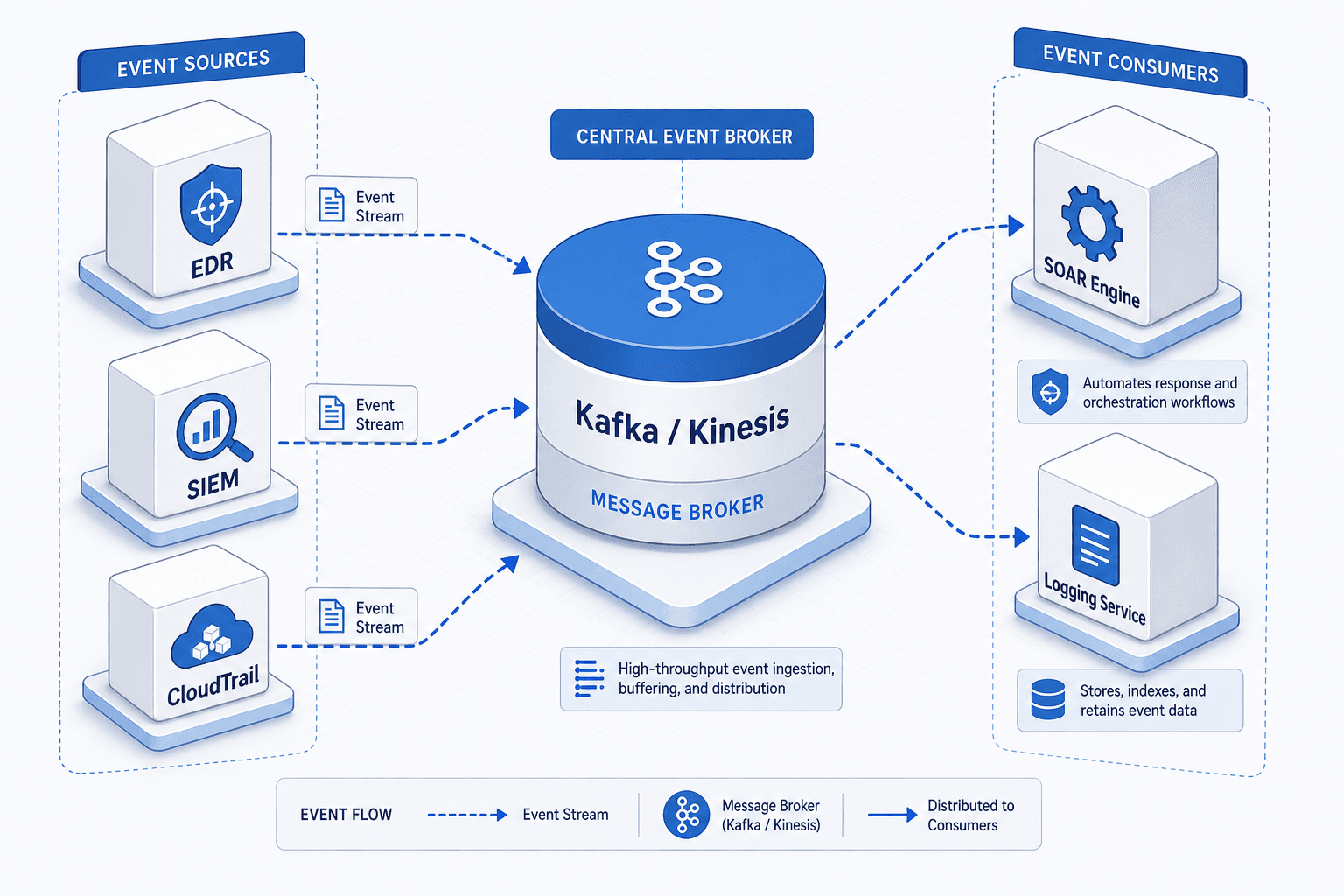
Security Information and Event Management (SIEM) systems, Endpoint Detection and Response (EDR) agents, and cloud infrastructure providers generate events. These events are normalized using a standard schema, such as the Open Cybersecurity Schema Framework (OCSF), and published to a message broker like Apache Kafka or Amazon Kinesis. The message broker acts as the source of truth, decoupling the producer (the security tool) from the consumer (the automation engine).
This architecture enables real-time processing. When a malicious process executes on an endpoint, the EDR agent emits an event. The message broker distributes this event to all subscribed consumers. One consumer might be a logging service; another is the SOAR engine. By using a stream processor, the system can filter, enrich, and route events with sub-second latency.
SOAR Integration: The Automation Engine
The SOAR platform serves as the consumer in this event-driven security model. It subscribes to specific event types from the message broker. When an event arrives, the SOAR engine parses the payload, extracts key fields (such as actor_id, action_type, and severity), and evaluates it against predefined playbooks.
Playbooks are workflows defined as code or visual graphs. They represent the logic of a security analyst. For example, a "Phishing Investigation" playbook might include steps to:
- Enrich the sender's IP address with threat intelligence feeds.
- Check the sender's domain against a blocklist.
- If the domain is malicious, isolate the affected user's endpoint.
- Send a notification to the security team.
The integration relies on APIs. The SOAR engine uses REST or gRPC calls to interact with other tools. For instance, to isolate an endpoint, the SOAR engine sends a request to the EDR vendor's API. The response from the EDR confirms whether the isolation was successful. This feedback loop is essential for audit trails and for triggering subsequent events, such as "Endpoint Isolated Successfully."
Idempotency in Security Automation
Idempotency is a property where an operation can be applied multiple times without changing the result beyond the initial application. In distributed systems, network failures and retries are common. If a SOAR engine receives an event to "block IP address 192.0.2.1" and the execution fails midway, the system may retry. Without idempotency, the second attempt might fail because the IP is already blocked, or worse, it might trigger a duplicate action that confuses downstream systems.
In event driven security, idempotency prevents state corruption and false positive escalation. Consider a playbook that "deletes a file." If executed twice, the second execution might fail harmlessly, or it might delete a different file if the first deletion changed the filesystem state. More critically, consider a playbook that "revokes user tokens." If this happens twice, the user might be locked out unexpectedly, or the system might generate redundant audit logs that obscure the actual incident.
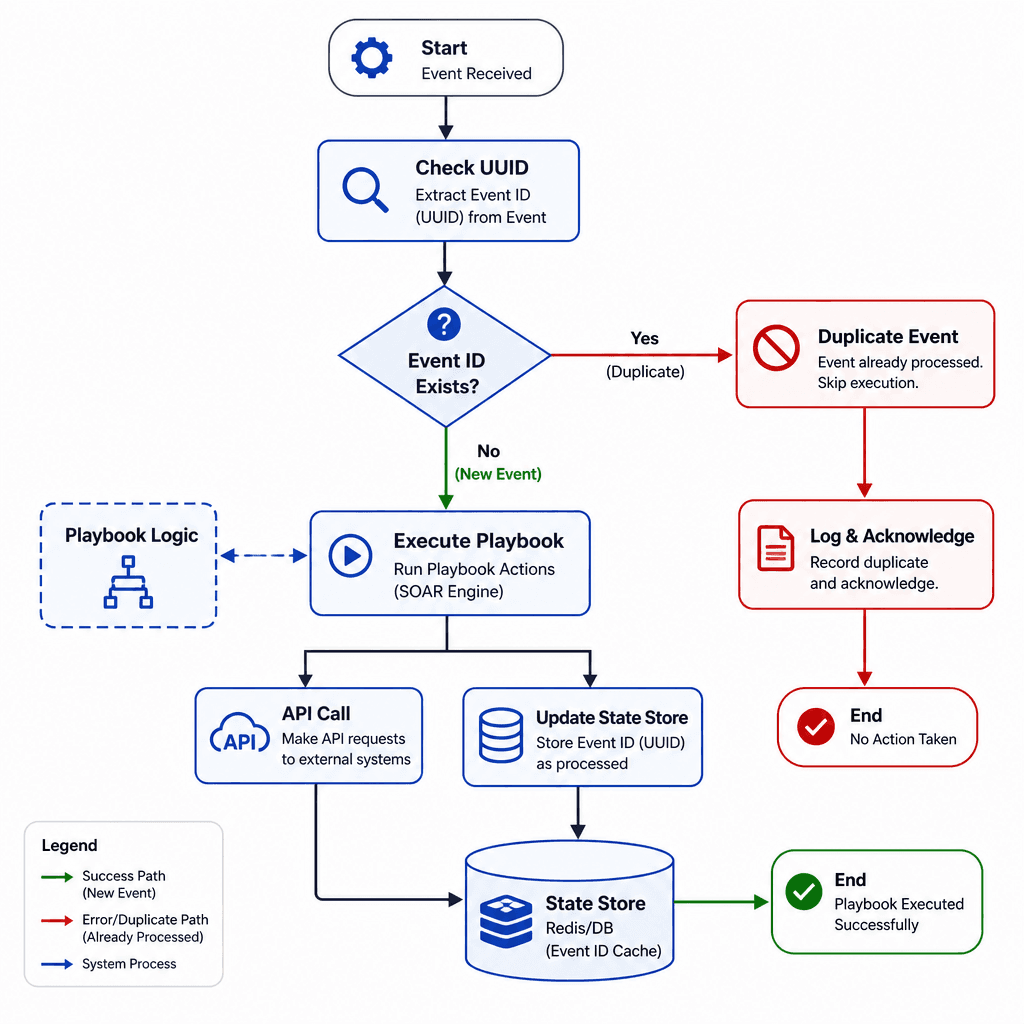
To implement idempotency, each security event must have a unique identifier (UUID). The SOAR engine maintains a state store, such as a Redis cache or a database, that tracks which event IDs have been processed. Before executing a playbook, the engine checks the state store. If the event ID exists, the engine skips execution. This ensures that even if the message broker delivers the same event twice due to at-least-once delivery semantics, the action is performed only once.
Another layer of idempotency exists in the external systems. APIs should support idempotent methods. For example, the Stripe API uses the Idempotency-Key header to ensure that duplicate requests do not create duplicate charges or payments. Security tools should adopt similar patterns. If a SOAR engine calls an API to "block an IP," the API should return a success status regardless of whether the IP was already blocked.
{
  "event_id": "evt-12345",
  "type": "security.email.malicious",
  "payload": {
    "sender": "attacker@example.com",
    "recipient": "user@company.com",
    "url": "http://malicious-link.com"
  }
}
Case Study: Automated Phishing Response
Consider a scenario where a user receives a phishing email. The email gateway detects a malicious link and sends an event to the message broker. The event schema includes the sender's email, the recipient's email, and the URL.
- Event Emission: The email gateway publishes an event with ID
evt-12345to thesecurity.email.malicioustopic. - SOAR Subscription: The SOAR engine listens to this topic. It receives the event and checks its state store.
evt-12345is not found, so it proceeds. - Enrichment: The SOAR engine queries a threat intelligence API to check the URL reputation. The API returns a score of 95/100, indicating high confidence of malware.
- Action Execution: The SOAR engine decides to isolate the recipient's endpoint. It calls the EDR API to isolate the machine associated with the recipient's email.
- State Update: The SOAR engine records
evt-12345in its state store as "completed" and logs the action. - Retry Scenario: Due to a network glitch, the message broker delivers
evt-12345again. The SOAR engine checks the state store, sees thatevt-12345is "completed," and ignores the duplicate event. The endpoint is not isolated twice, and no redundant alerts are sent.
This workflow demonstrates the value of event-driven design. The response is immediate, the state is consistent, and the system is resilient to delivery failures.
Challenges and Tradeoffs
Building an event-driven security architecture introduces complexity. First, schema evolution is a concern. As security tools update their event formats, the SOAR engine must adapt. Using a standard schema like OCSF helps mitigate this by providing a common language. Second, error handling must be robust. If a SOAR engine fails to process an event, the message broker must retain the message until it is successfully consumed. Dead-letter queues can capture messages that fail after multiple retries for manual review.
Third, security teams must monitor the automation itself. Automated responses can cause outages if misconfigured. For example, a playbook that blocks an IP might accidentally block a legitimate partner's IP. To mitigate this, implement a "human-in-the-loop" step for high-severity actions, or use canary deployments to test playbooks in a sandbox environment before full production rollout. Integrating these practices into the devsecops lifecycle ensures that security automation is tested and validated alongside application code, reducing the risk of production incidents.
Conclusion
Event-driven security architecture transforms security operations from reactive monitoring to proactive automation. By leveraging message brokers and SOAR platforms, organizations can respond to threats in real-time. However, the success of this architecture depends on rigorous implementation of idempotency and error handling. Without these safeguards, automation can introduce new risks, such as state corruption and false positives. By treating security events as immutable data streams and automations as idempotent functions, security engineers can build robust, scalable, and reliable security operations.
Related posts
Building Your Own Identity Provider: What It Really Costs
An examination of the hidden costs, maintenance burden, and security risks involved in building a custom identity provider versus buying a solution.
Switching Identity Providers Without Breaking Auth Flows
A technical guide for identity engineers on migrating identity providers using parallel runs and credential migration strategies to maintain auth continuity.
Generating a Keycloak Admin API Client From OpenAPI
Learn how to generate a typed Keycloak Admin API client from OpenAPI specifications to improve type safety and reduce boilerplate code.
