Device Certificates vs Passwords: The Shift to Hardware-Backed Machine Identity
Examines device certificates versus passwords for secure enrollment and hardware-backed identity management in modern infrastructure.
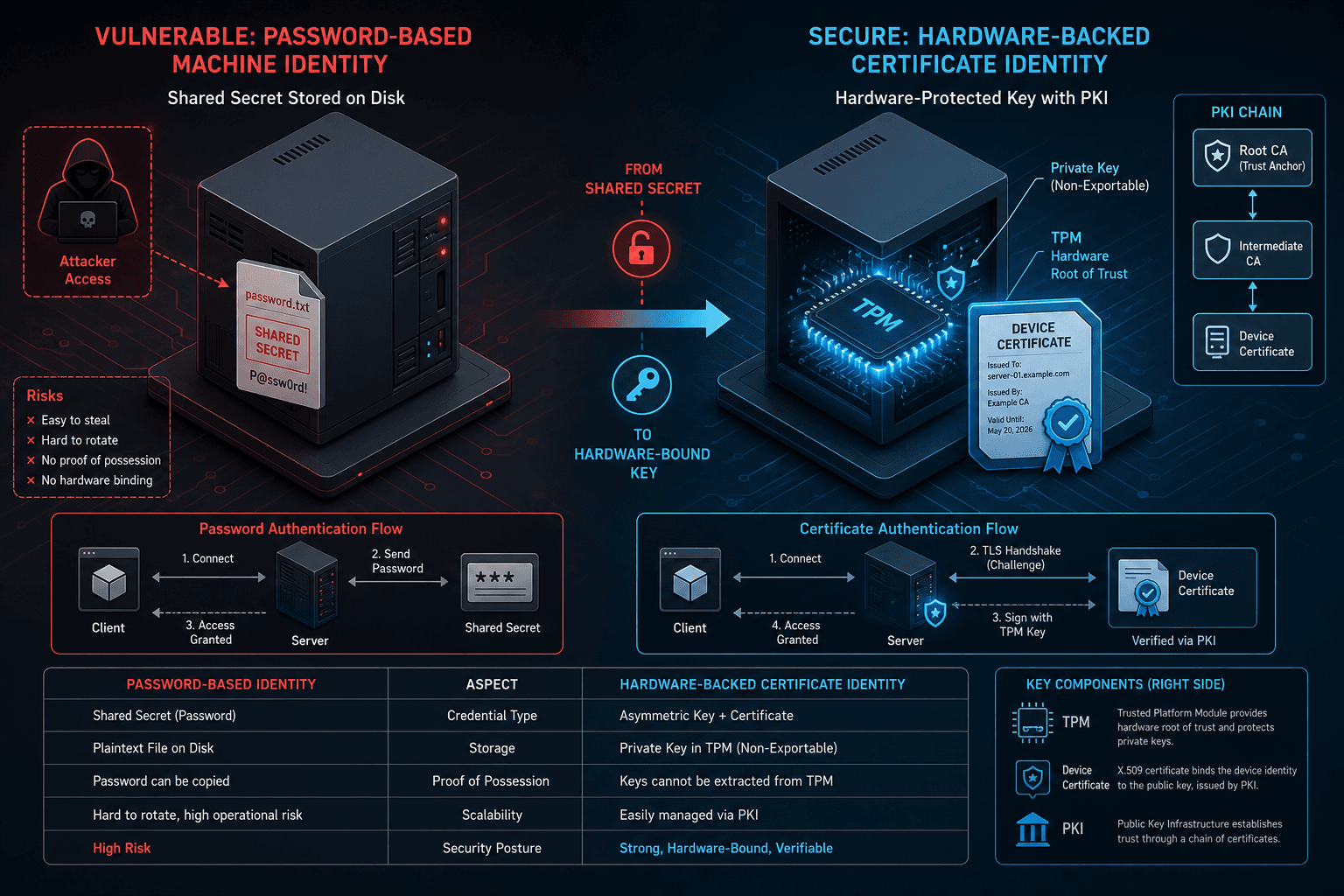
In modern infrastructure, the distinction between human identity and machine identity is often blurred by legacy authentication practices. Administrators frequently apply password-based authentication to servers, IoT devices, and edge nodes, treating them as if they possess the cognitive capacity to protect a secret. This is a fundamental architectural error. Passwords are shared secrets; they rely on the assumption that the entity holding the secret will not disclose it. Machines, however, are deterministic systems that process data streams. They do not have intent, and they cannot distinguish between a legitimate authentication request and a malicious memory dump or network sniffer.
The industry is shifting toward device certificates backed by hardware security modules (HSMs), Trusted Platform Modules (TPMs), or Secure Elements (SEs). This shift is not merely about replacing one credential type with another; it is a move from shared secrets to public key infrastructure (PKI)-based identity, where the private key is cryptographically bound to the physical device.
The Failure of Shared Secrets for Machines
A password is a string of characters known only to the user. In a machine context, this password must be stored somewhere: in a configuration file, an environment variable, or a key-value store. Because machines operate automatically, any process with read access to that storage can extract the password. Once extracted, the password is indistinguishable from the original credential. It can be replayed, shared, or sold.
Consider a web server. If it authenticates to a database using a password stored in plain text in its config file, any compromise of the server’s file system grants the attacker the ability to impersonate the server indefinitely. The attacker does not need to reverse-engineer the application logic; they simply copy the credential. This violates the principle of least privilege and makes lateral movement trivial.
Furthermore, passwords are static. While rotation is possible, it introduces operational friction. In automated environments, rotating a password requires updating every service that consumes it, creating a window of vulnerability during the transition. Machines cannot "remember" to change their passwords periodically. They execute code. If the code contains a static password, that password is static forever, unless explicitly programmed otherwise.
Hardware-Backed Keys: The Cryptographic Boundary
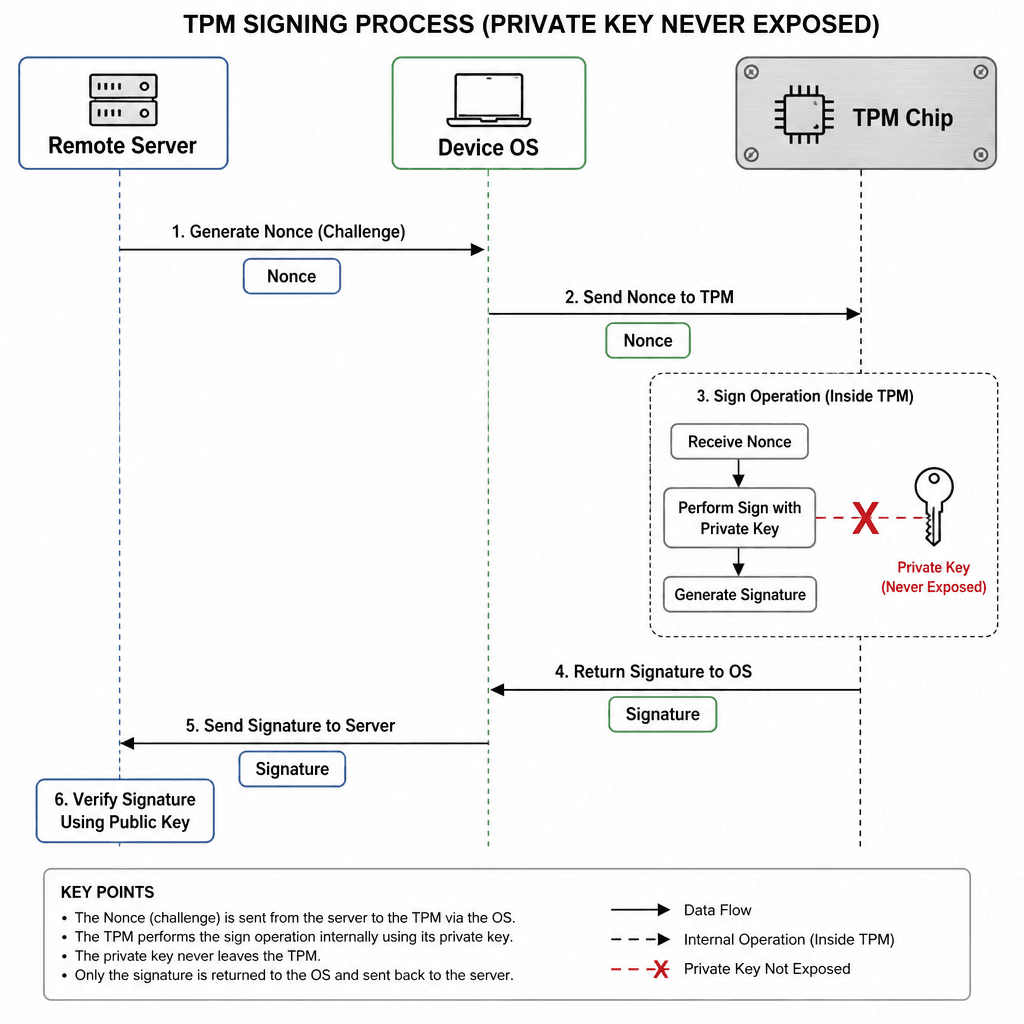
Device certificates solve the shared secret problem by leveraging asymmetric cryptography. A certificate binds a public key to an identity, verified by a Certificate Authority (CA). The corresponding private key never needs to be transmitted or stored in accessible memory. Instead, it is generated and stored within a hardware security boundary.
A Trusted Platform Module (TPM) is a dedicated microcontroller designed to secure hardware through integrated cryptographic keys. Modern TPMs (version 2.0) support the generation of RSA or ECC keys in a way that the private key material never leaves the chip. The TPM performs the cryptographic operation internally. For example, when a device needs to sign a challenge from a remote server, the server sends a random nonce. The device sends this nonce to the TPM. The TPM signs the nonce using the private key and returns the signature. The remote server verifies the signature using the public key from the certificate.
This mechanism ensures that the private key is never exposed to the operating system, the application, or any software running on the host. Even if the operating system is fully compromised, the attacker cannot extract the private key. They can only request signatures, which the TPM will provide only if the key is properly authorized and the usage policy allows it.
Secure Elements (SEs) function similarly but are often found in mobile devices and IoT modules. They provide a tamper-resistant environment for key storage and cryptographic operations. The key difference between software-stored keys and hardware-backed keys is the attack surface. Software keys can be dumped via memory forensics or extracted via debugger probes. Hardware keys require physical access and sophisticated side-channel attacks, which are impractical at scale.
Real-World Context: In a recent incident involving a major cloud provider, a misconfigured automation script leaked API keys stored in environment variables across thousands of instances. The attacker used these static credentials to pivot laterally and exfiltrate data. Had the services relied on hardware-backed machine certs, the private keys would have remained inside the TPM, rendering the leaked metadata useless for impersonation. This highlights the critical gap between "secret in transit" and "secret in use."
Secure Enrollment: From Bootstrap to Identity
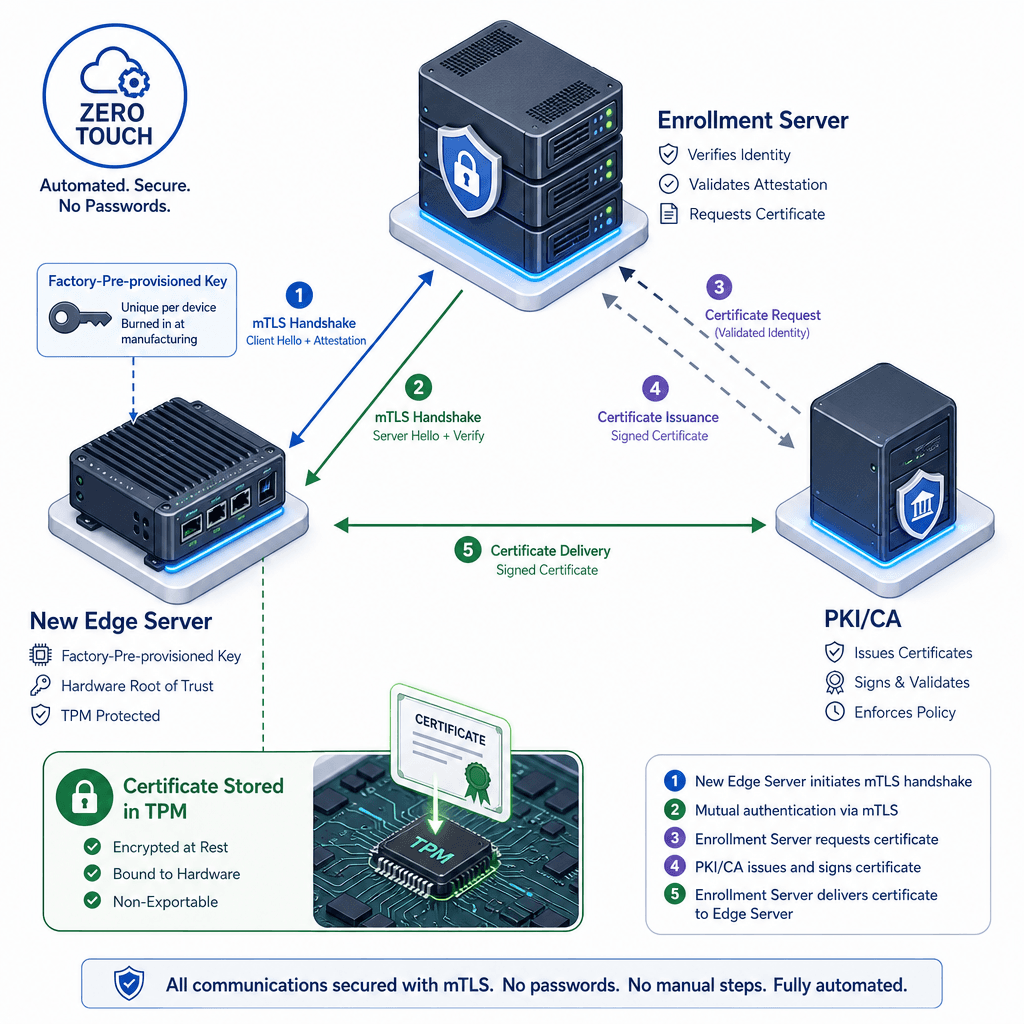
The transition from password-based authentication to certificate-based identity requires a secure enrollment process. This is where the concept of "Zero Touch Provisioning" becomes critical. In a password-based model, a new device must be manually configured with an initial password, which is then changed. In a certificate-based model, the device bootstraps its identity automatically.
Consider a scenario where a new edge server is deployed in a data center. The server has a pre-installed TPM with a unique key pair generated at the factory. The public key is registered with the organization’s PKI. When the server boots, it initiates a connection to the enrollment server using its hardware-backed identity.
# Example: Device initiates enrollment using TPM-backed TLS via PKCS#11
openssl s_client -connect enrollment.internal:443 \
  -cert device.crt \
  -key engine:tpm_pkcs11 \
  -engine tpm_pkcs11 \
  -cipher AES256-GCM-SHA384
The enrollment server presents its certificate. The device verifies the server’s certificate against a trusted root CA. Then, the device presents its own certificate. The server verifies the device’s certificate chain, confirming that the device is a legitimate member of the infrastructure. This mutual TLS (mTLS) handshake establishes a secure channel without any passwords.
Once authenticated, the enrollment server issues a long-lived device certificate, signed by the organization’s intermediate CA. This certificate is stored in the TPM or returned securely to the OS for use by applications. The device now has a persistent, verifiable identity that can be used for all subsequent communications.
This process eliminates the need for human intervention. There are no passwords to type, no initial credentials to share, and no risk of credential reuse. The identity is bound to the hardware, making it unique and non-replicable.
Operational and Security Implications
The shift to device certificates has profound implications for security engineering and operations.
1. Non-Repudiation Passwords are shared secrets. If a password is leaked, it is impossible to determine who used it. With certificates, each device has a unique private key. If a specific device is involved in a malicious activity, the certificate provides cryptographically strong evidence of that device’s involvement. This enables precise auditing and incident response. As noted in NIST SP 800-57 Part 1, proper key management and unique identity binding are essential for maintaining trust in cryptographic systems.
2. Automated Lifecycle Management Certificates have expiration dates. This forces a regular renewal process, which can be automated. If a certificate expires, the device can automatically request a new one from the enrollment server. This ensures that identities remain current and valid. In contrast, passwords often expire silently or are forgotten, leading to account lockouts or the use of weak, static passwords. Automated renewal aligns with Zero Trust principles, where trust is continuously validated rather than assumed.
3. Revocation If a device is compromised, its certificate can be revoked immediately via a Certificate Revocation List (CRL) or Online Certificate Status Protocol (OCSP). All services that check the revocation status will reject requests from that device. Passwords, once leaked, are compromised forever. Changing a password after a leak requires updating all systems that use it, which is often slow and error-prone. RFC 5280 defines the standards for X.509 certificate validation, including revocation checking mechanisms.
4. Granular Access Control Certificates can include extensions that define specific scopes of access. For example, a certificate might be valid only for accessing a specific API endpoint or performing a specific action. This aligns with the principle of least privilege. Passwords typically grant broad access to an account or system, making it difficult to limit the impact of a compromise.
Conclusion
Passwords are a human-centric authentication mechanism that fails when applied to machines. They rely on shared secrets that can be easily extracted and replayed. Device certificates, backed by hardware security modules, provide a cryptographically verifiable identity that is bound to the physical device.
The transition to hardware-backed device identity is not just a technical upgrade; it is a fundamental shift in how we think about machine trust. By moving from "what you know" (passwords) to "what you are" (hardware-bound certificates), organizations can achieve stronger security, simpler operations, and better auditability. The mechanisms are well-established, the tools are widely available, and the benefits are clear.
Action Step: Audit your current machine identity practices. Identify any services still relying on shared passwords or static API keys, and begin migrating them to a hardware-backed certificate enrollment workflow. Review your TPM enrollment policy to ensure it supports automated, zero-touch provisioning.
Related posts
acr_values and amr: Requesting Authentication Strength
Explore how acr_values and amr claims define authentication strength in OpenID Connect, enabling step-up authentication and MFA enforcement.
OIDC Dynamic Client Registration (RFC 7591)
A technical examination of RFC 7591, covering dynamic client registration, initial access tokens, and automated client management for backend systems.
CORS Configuration That Doesn't Break Your Auth
Learn how to configure CORS in Spring Boot securely, handling preflight requests and allow-credentials without compromising authentication.
