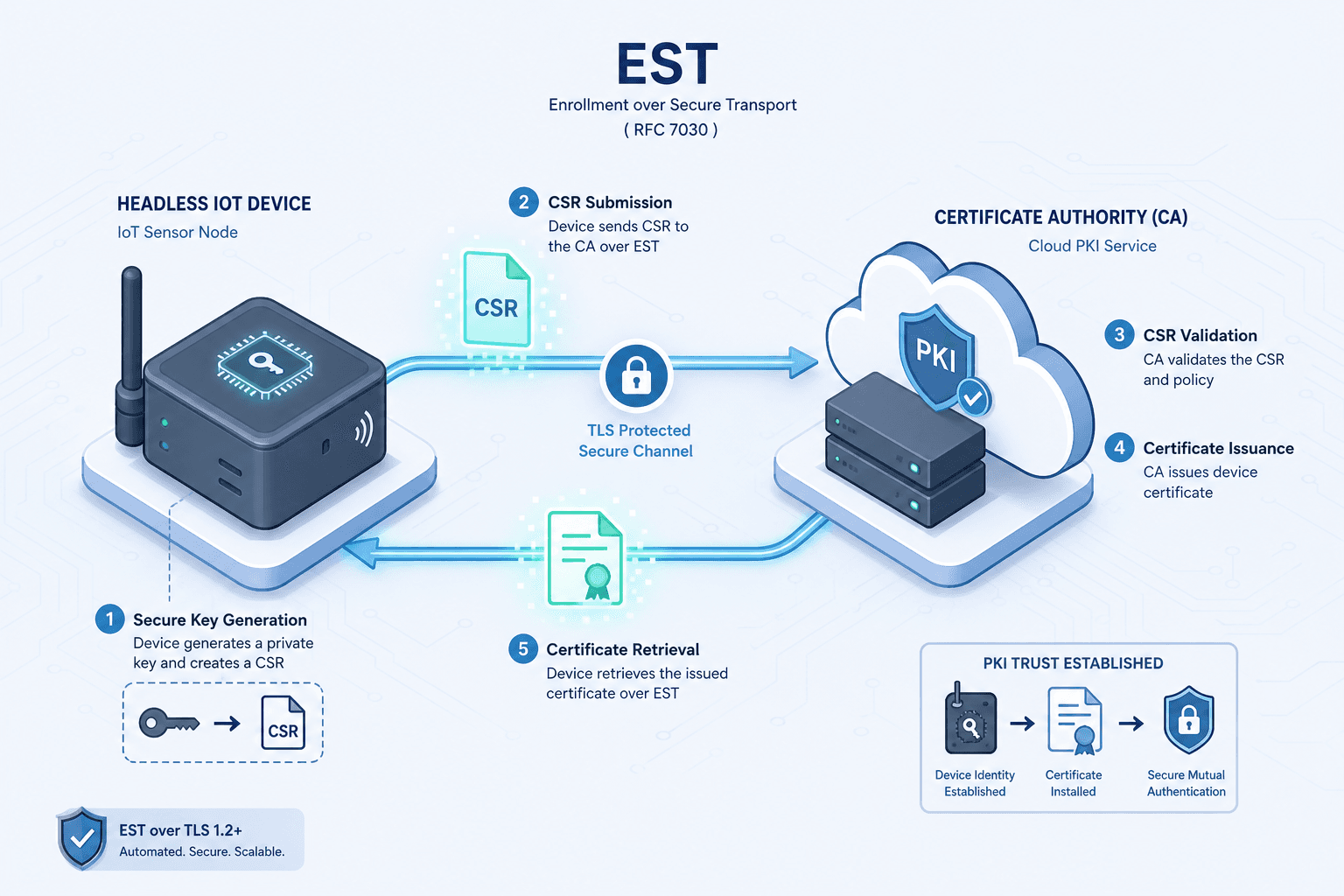
Certificate-Based Access for Headless Devices
Explore certificate enrollment protocols like EST and SCEP for secure headless device authentication in IoT environments.
In Internet of Things (IoT) architectures, headless devices—systems without direct human interaction interfaces like keyboards or screens—face a unique security paradox. They must authenticate themselves to network services securely, yet they cannot manually input passwords or approve multi-factor authentication challenges. For years, engineers relied on hardcoded shared secrets or static API keys. However, as attack surfaces expand, this approach becomes untenable. If a single device is compromised, the shared secret is exposed, requiring a manual or semi-automated rotation across thousands of devices.
The mechanism that resolves this scalability problem is X.509 certificate-based authentication. By leveraging Public Key Infrastructure (PKI), each device holds a unique private key and a corresponding public certificate. This enables Mutual TLS (mTLS), where both the client and server verify each other’s identities. The critical challenge, however, is not just using certificates, but enrolling them automatically at boot time. This is where enrollment protocols like SCEP (Simple Certificate Enrollment Protocol) and EST (Enrollment over Secure Transport) come into play. These protocols automate the generation of key pairs, Certificate Signing Requests (CSRs), and the secure retrieval of signed certificates from a Certificate Authority (CA).
The Limitations of Static Credentials
To understand why enrollment protocols are necessary, we must look at the failure mode of static credentials. In a typical shared-secret model, every device in a fleet shares the same cryptographic key. If an attacker extracts this key from one device, the entire fleet’s integrity is compromised. Rotating these keys requires pushing new configuration files to every device, often over the same insecure channel that was exploited.
Certificates solve this by providing unique identities. A certificate binds a public key to a device identity, signed by a trusted CA. When a device connects, it proves possession of the private key corresponding to the certificate presented. If one device is compromised, only that specific certificate needs to be revoked. The rest of the fleet remains secure because their private keys remain isolated. However, this introduces a new problem: how does a brand-new device, with no prior trust anchor, obtain a valid certificate from the CA? It cannot simply "download" it; it must prove its legitimacy. This is the domain of enrollment protocols.
SCEP: The Legacy Standard
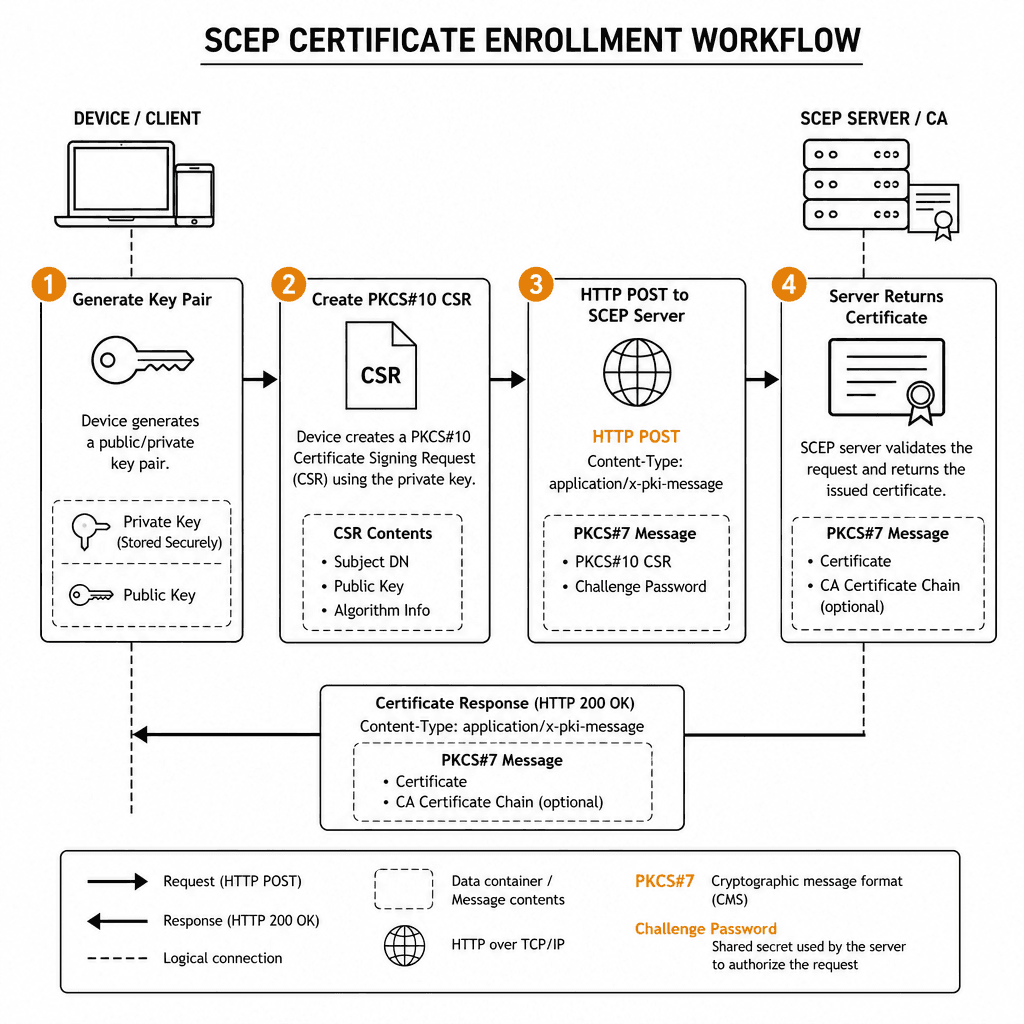
The Simple Certificate Enrollment Protocol (SCEP), defined in RFC 8894, was one of the first standardized methods for automating certificate enrollment. It was designed for simplicity, particularly for devices with limited computational resources.
SCEP operates over HTTP, using PKCS#7 messages to encapsulate the CSR and the returned certificate. The workflow is straightforward:
- The device generates a key pair locally.
- It creates a PKCS#10 CSR.
- It sends the CSR to the SCEP server via an HTTP POST request.
- The server validates the request, signs the certificate, and returns it in a PKCS#7 response.
While simple, SCEP has significant security limitations. Although SCEP technically supports PKI-based client authentication, many legacy implementations default to using a pre-shared "challenge password" to authorize the request. This password is typically distributed out-of-band or hardcoded, reintroducing the single-point-of-failure problem that certificates were meant to solve. Furthermore, SCEP lacks support for modern features like certificate revocation lists (CRLs) in the enrollment flow, making it difficult to handle compromised devices dynamically.
Despite these flaws, SCEP remains prevalent in legacy IoT deployments and older embedded systems due to its low overhead and wide support in existing infrastructure. However, for new deployments requiring strong security guarantees, SCEP is generally considered insufficient.
EST: Modern Enrollment over Secure Transport
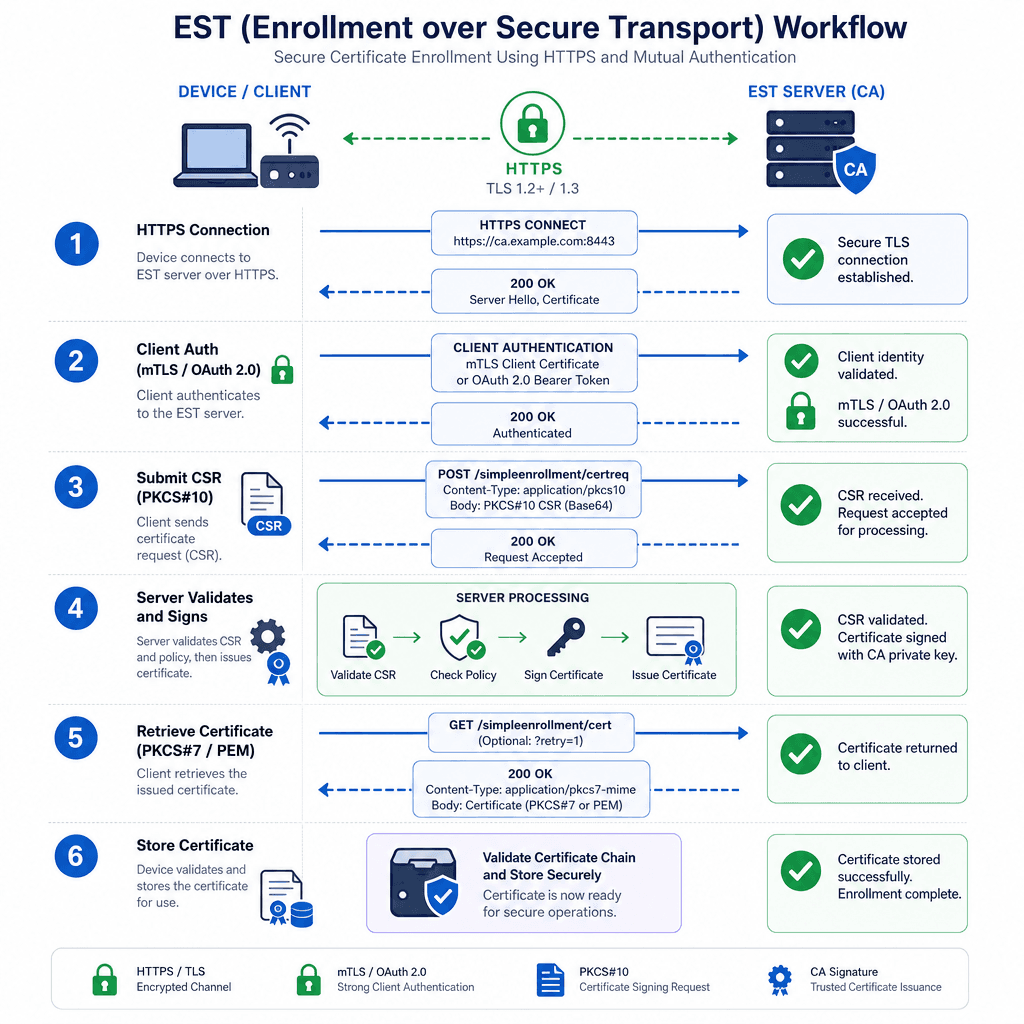
The Enrollment over Secure Transport (EST) protocol, defined in RFC 7030, was developed to address the security shortcomings of SCEP. EST leverages HTTPS, providing transport-level security and enabling modern authentication mechanisms.
EST introduces a RESTful API structure, which aligns better with modern web services and microservices architectures. The key improvements include:
- Transport Security: All communications occur over HTTPS, protecting the CSR and the resulting certificate from eavesdropping and tampering.
- Client Authentication: EST supports various client authentication methods, including mTLS, OAuth 2.0 bearer tokens, and pre-shared keys. This ensures that only authorized devices can enroll.
- Certificate Management: EST focuses on certificate enrollment and renewal; revocation checking relies on the CRL Distribution Point and OCSP responder information referenced in the issued certificate, using standard PKIX mechanisms rather than dedicated EST endpoints.
The EST workflow is more structured:
- The device initiates a secure HTTPS connection to the EST server.
- It authenticates using the agreed-upon method (e.g., presenting a bootstrap certificate).
- It submits the CSR via a
POST /.well-known/est/simpleenrollrequest. - The server validates the CSR, signs it, and returns the certificate directly in the response body.
- The device stores the certificate and private key for future mTLS sessions.
This mechanism ensures that the enrollment process itself is authenticated and encrypted, preventing man-in-the-middle attacks during the critical bootstrap phase.
Operational Workflow: A Concrete Scenario
Consider a smart water meter deployed in a remote location. The device boots up with only a minimal set of factory-installed credentials, such as a unique Device ID and a short-lived bootstrap token.
- Key Generation: Upon boot, the device’s secure element generates an RSA or ECC key pair. The private key never leaves the secure element.
- CSR Creation: The device constructs a PKCS#10 CSR, including the Device ID and relevant subject fields.
- Enrollment Request: The device sends an HTTP POST request to the EST server’s
/.well-known/est/simpleenrollendpoint. The request includes the CSR and an OAuth 2.0 bearer token for authentication. - Server Validation: The EST server verifies the OAuth token, checks the Device ID against its registry, and ensures the device is not already enrolled. It then signs the CSR using its CA private key.
- Certificate Retrieval: The server returns the signed certificate. The device verifies the certificate’s signature against the trusted CA root certificate.
- mTLS Session: With the valid certificate, the device establishes an mTLS session with the backend IoT platform. The platform verifies the device’s certificate, granting access to data streams.
If the device is later found to be compromised, the backend platform can revoke the certificate via the CA. The next time the device attempts to connect, the mTLS handshake will fail, and the device will be denied access. The device can then request a new certificate via EST, provided it can re-authenticate securely.
Tradeoffs and Implementation Considerations
Choosing between SCEP and EST depends on the constraints of the IoT environment. SCEP is lighter on resources and easier to implement on extremely constrained devices, but it offers weaker security guarantees. EST provides strong security but requires more computational power and memory, which may be a constraint on very small microcontrollers.
Another critical consideration is the root of trust. For EST to work securely, the device must have a trusted root CA certificate pre-installed. This bootstrap trust must be managed carefully. If the root CA key is compromised, all devices trusting that root are vulnerable. NIST SP 800-193 recommends Platform Firmware Resilience measures to protect the root of trust during updates.
Additionally, certificate lifecycle management is crucial. Devices should periodically check for certificate expiration and renew before they expire. EST supports this via its renewal endpoints, allowing devices to update their credentials without full re-enrollment.
Conclusion
In conclusion, certificate-based access via EST or SCEP is not just a security best practice but a necessity for scalable IoT deployments. These protocols automate the complex process of key management and authentication, enabling headless devices to establish secure, verifiable identities in the network. As IoT environments grow in complexity, the shift from static secrets to automated, certificate-based enrollment will continue to define secure system design.
Next Steps
Start by auditing your current device rotation policy. If you are still relying on shared secrets or hardcoded keys, prioritize migrating to an automated enrollment protocol. Try the linked EST implementation snippet locally to simulate the bootstrap process before deploying to production.
Common Pitfalls
- Insecure Challenge Password Distribution: In SCEP, relying on a challenge password that is hardcoded or distributed via unencrypted channels negates the security benefits of PKI. Always use out-of-band, secure methods for any shared secrets if SCEP is unavoidable.
- Missing CRL Checks: Many implementations fail to check Certificate Revocation Lists (CRLs) or OCSP responses during the mTLS handshake. This allows revoked certificates to remain valid until expiration, leaving the system vulnerable to compromised devices.
- Weak Bootstrap Trust: Installing a CA root certificate without verifying its integrity during the manufacturing process can allow an attacker to inject a malicious CA. Ensure the bootstrap trust anchor is protected by hardware-backed secure elements.
Practical Takeaways
- Prefer EST for New Deployments: EST’s reliance on HTTPS and support for mTLS/OAuth provides significantly stronger security than SCEP’s HTTP-based, password-dependent model.
- Respect Resource Constraints: If device memory or CPU is extremely limited, SCEP may still be necessary, but implement it with caution and plan for migration.
- Automate Lifecycle Management: Do not rely on manual certificate renewal. Use EST’s renewal endpoints or similar automated mechanisms to ensure continuous connectivity and security.
FAQ
Q: Can I use SCEP in a new IoT deployment? A: It is generally discouraged. SCEP lacks modern authentication and transport security features. Use EST unless you are constrained by legacy hardware that cannot support TLS.
Q: How do I handle challenge passwords in SCEP securely? A: Challenge passwords should never be hardcoded. Use a secure provisioning process to distribute unique, random passwords to each device before enrollment, or migrate to a protocol that supports PKI-based authentication.
Q: What is the role of the bootstrap trust in EST? A: The device must have a trusted CA root certificate pre-installed to verify the EST server’s certificate. This trust anchor must be securely provisioned during manufacturing to prevent man-in-the-middle attacks during enrollment.
Q: Does EST support certificate revocation? A: EST itself does not define dedicated endpoints for CRLs or OCSP; instead, devices check revocation status using the CRL Distribution Point and OCSP responder information referenced in the certificate, via standard PKIX mechanisms.
Related posts
RFC 8628: The Device Authorization Grant
An examination of RFC 8628, the Device Authorization Grant, which enables users on devices without browsers to authenticate with OAuth 2.0 providers.
acr_values and amr: Requesting Authentication Strength
Explore how acr_values and amr claims define authentication strength in OpenID Connect, enabling step-up authentication and MFA enforcement.
OIDC Dynamic Client Registration (RFC 7591)
A technical examination of RFC 7591, covering dynamic client registration, initial access tokens, and automated client management for backend systems.
