OAuth2 Security Best Practices Checklist: 2025 Edition
A detailed examination of OAuth2 security best practices, audit requirements, and security review protocols for the 2025 landscape.
The security of modern identity systems depends on strict adherence to evolving standards rather than mere implementation. By 2025, the baseline has shifted from the broad flexibility of RFC 6749 to the hardened constraints of the OAuth 2.1 draft and RFC 8628. The primary vulnerability vector is not broken cryptography, but the misalignment of client behavior with the protocol's intended data flow.
The Authorization Code Flow and PKCE Mechanism
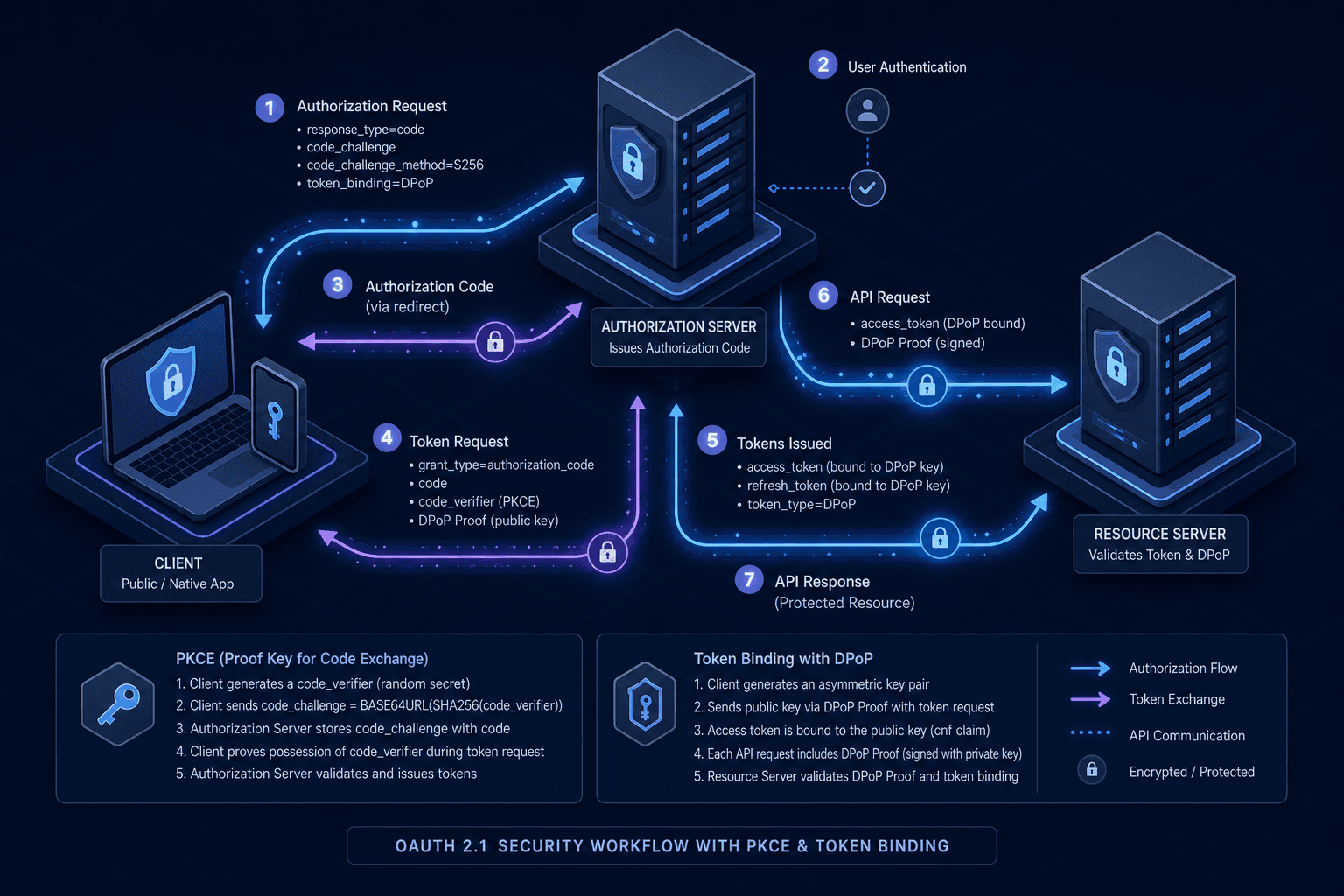
The most critical mechanism in any OAuth2 deployment is the authorization code exchange. In legacy systems, the client secret was often the sole line of defense, assuming the client could keep it confidential. This assumption fails immediately in Single Page Applications (SPAs) or mobile apps where the secret is embedded in the client-side bundle or extracted via reverse engineering. The 2025 standard mandates the use of Proof Key for Code Exchange (PKCE) to mitigate this, even for public clients.
PKCE operates by introducing a transient cryptographic challenge. When a user initiates a login, the client generates a random string called the code_verifier. It then hashes this verifier using SHA-256 to create a code_challenge. This challenge is sent to the authorization server during the initial request. Crucially, the server stores this challenge but does not validate it yet. The validation occurs only when the client presents the authorization code for an access token. At that moment, the client must send the original code_verifier. The server hashes the verifier and compares it against the stored code_challenge. If they do not match, the token request is rejected.
This mechanism prevents an attacker who intercepts an authorization code (via a malicious extension or network sniffing) from exchanging it for an access token, because they cannot generate the correct code_verifier without the original secret generated on the client device.
# Example: PKCE Challenge Generation (SHA-256)
# Client Side
code_verifier = "random_high_entropy_string_12345"
code_challenge = base64url_encode(sha256(code_verifier))

# Authorization Request
GET /authorize?client_id=...&redirect_uri=...&response_type=code&code_challenge=...&code_challenge_method=S256

# Token Request
POST /token
body: code=AUTH_CODE&grant_type=authorization_code&code_verifier=random_high_entropy_string_12345
The state parameter remains essential for Cross-Site Request Forgery (CSRF) protection, but it is no longer sufficient on its own. The state value must be a high-entropy random string generated by the client and validated upon return. Any deviation from this entropy requirement allows an attacker to predict the state and force a user into a fraudulent authorization flow.
Token Lifecycle and Binding Strategies
Once an access token is issued, the security model shifts to token lifecycle management. In 2025, the practice of issuing long-lived access tokens is considered a critical failure unless specific binding mechanisms are employed. The core mechanism for securing tokens is the separation of concerns between the access_token and the refresh_token.
Access tokens should be short-lived, typically 15 minutes or less. This minimizes the window of opportunity for an attacker to use a stolen token. However, short-lived tokens create a usability friction point: frequent re-authentication. The solution is the refresh token, which is long-lived but strictly bound to the specific client and session. The security review process must verify that the authorization server enforces a rotation policy. Every time a refresh token is used to obtain a new access token, the server must invalidate the old refresh token and issue a new one. This "rotation" ensures that if a refresh token is leaked, the window for replay attacks is limited to the duration between the leak and the next legitimate rotation.
Furthermore, the concept of token binding is gaining traction in 2025. While not yet universally standardized in all deployments, the mechanism involves cryptographically binding the access token to the client's identity or device key. This prevents a stolen token from being used by a different device, even if the attacker possesses the token string. The c_hash (client hash) and at_hash (access token hash) claims in the ID token provide a lightweight form of this binding for OpenID Connect, ensuring the token was intended for the specific client.
{
  "access_token": "new_short_lived_token_xyz",
  "expires_in": 900,
  "token_type": "Bearer",
  "refresh_token": "new_long_lived_token_abc",
  "scope": "read write"
}
The risk of token leakage is exacerbated in public clients. The 2025 best practice dictates that public clients (like SPAs) should never store refresh tokens. Instead, they rely on the short expiration of access tokens and the user's active session. If a refresh token is absolutely necessary for a public client, it must be stored in a secure, non-scriptable storage like a secure HTTP-only cookie, not in localStorage or sessionStorage, which are accessible to any script running in the page.
The 2025 Audit Protocol: Data Flow Verification
A security audit for OAuth2 in 2025 cannot simply check if the protocol is implemented. It must trace the data flow through the authorization server, resource server, and client. The audit checklist begins with the rejection of deprecated flows. The Implicit Grant flow, which returns tokens directly in the URL fragment, is obsolete. It exposes tokens to browser history, server logs, and referrer headers. An audit must confirm that the authorization server rejects requests for response_type=token and enforces response_type=code exclusively.
Next, the audit must verify the normalization of redirect URIs. Attackers often attempt to register a redirect URI that differs from the registered one by a single character (e.g., example.com vs example.com.evil.com). The authorization server must perform strict string matching or, better yet, CIDR-based matching for IP whitelisting. The redirect_uri parameter in the authorization request must exactly match a pre-registered value in the client metadata.
The aud (audience) claim is another critical data point. When a client requests a token, the aud claim in the resulting ID token must match the intended Resource Server (or the client ID if the client acts as a resource server). Crucially, the azp (authorized party) claim must match the client_id to ensure the token was issued to the correct client. This dual-claim validation prevents token confusion attacks where an attacker uses a valid token from a low-privilege context to access a high-privilege resource.
Finally, the audit must verify the handling of scope. Scopes should be granular. The principle of least privilege dictates that a client should only request the minimum scope required. The authorization server must validate that the requested scope is a subset of the scopes the client is authorized to request based on client metadata. Furthermore, the final granted scope is the intersection of the requested scope and the scope explicitly granted by the user. If a client requests a scope it does not own or if the user denies it, the request must be rejected. This prevents privilege escalation through scope manipulation.
Common Pitfalls
Despite the maturity of the protocol, several common implementation errors persist in 2025:
- Improper State Parameter Handling: Developers often reuse state values across sessions or fail to bind the state to the specific user session. This allows attackers to replay old state parameters to hijack sessions or perform CSRF attacks.
- Weak PKCE Implementation: Some implementations generate
code_verifiervalues with insufficient entropy or fail to enforce theS256method, rendering the PKCE protection ineffective against code interception attacks. - Insecure Redirect URI Storage: Storing redirect URIs in a database without strict normalization (e.g., case sensitivity, trailing slash handling) allows attackers to register similar URIs that bypass validation logic.
Emerging Threat Vectors: Private Key JWT and Client Assertions
In service-to-service scenarios (Client Credentials flow), the use of a client secret is increasingly viewed as a vulnerability. Secrets are static and hard to rotate without downtime. The 2025 best practice is to replace client secrets with Private Key JWT (RFC 7523).
The mechanism here involves asymmetric cryptography. The client holds a private key and signs a JWT assertion with it. This assertion includes the iss (issuer), sub (subject), aud (audience), iat (issued at), and exp (expiration) claims. The authorization server validates the signature using the client's public key, which is pre-registered. This eliminates the need to transmit a shared secret over the network and provides a cryptographic proof of identity.
If a private key is compromised, it can be revoked and replaced without affecting other clients. This is a significant improvement over the "secret rotation" problem in symmetric authentication. The audit must verify that the client is indeed using a signed assertion and that the authorization server is validating the signature before issuing a token.
Additionally, the jti (JWT ID) claim should be unique for each token request to prevent replay attacks. Replay protection requires the Authorization Server to validate the nbf (not before) and exp (expiration) claims strictly. The server must also cache the jti or a nonce value for the duration of the token's validity to detect and reject duplicate requests, adhering to RFC 8693 and RFC 7523 requirements.
Practical Takeaways
To align with the 2025 security baseline, organizations should prioritize the following actions:
- Enforce PKCE Universally: Mandate PKCE with the S256 method for all clients, including public ones, and reject any requests lacking a valid
code_verifier. - Implement Token Rotation: Configure the authorization server to invalidate refresh tokens immediately upon use and issue new ones, ensuring short-lived access tokens are the norm.
- Audit Claim Validation: Verify that the
azpclaim matches the client ID and theaudclaim matches the resource server to prevent token confusion attacks.
FAQ
Q: Can I still use client secrets in 2025? A: Client secrets are deprecated for public clients and increasingly discouraged for confidential clients in favor of Private Key JWT. If used, they must be rotated frequently and stored securely.
Q: Why is the azp claim necessary if I have the client_id in the request?
A: The client_id is a parameter sent in the request, which can be spoofed. The azp claim is a signed assertion within the ID token that cryptographically binds the token to the specific client that received it.
Q: How do I handle scope conflicts if a user grants less scope than requested? A: The authorization server must issue the token with the intersection of the requested scopes and the scopes granted by the user. The client must be designed to handle the reduction in scope gracefully.
Conclusion: The Mechanism is the Control
Security in OAuth2 is not a configuration setting; it is the result of correctly implementing the underlying mechanisms of the protocol. The shift to OAuth 2.1 and the strict enforcement of PKCE, token rotation, and Private Key JWT represent a maturation of the standard. The 2025 security review must focus on the data flow: how the code_verifier is generated, how the refresh_token is rotated, and how the aud claim is validated.
Organizations that continue to rely on implicit grants, long-lived access tokens, or client secrets without rotation are operating outside the 2025 security baseline. The cost of a breach is no longer just a technical failure; it is a loss of trust in the identity infrastructure itself. The checklist for 2025 is simple: ensure every step of the flow is bound by a cryptographic or strict logical constraint that cannot be bypassed by a passive observer or an active attacker.
Related posts
OAuth 2.0 Security Best Practices: Preventing Common Vulnerabilities
An examination of OAuth 2.0 security best practices to prevent common vulnerabilities like CSRF and token leakage while hardening authentication flows.
OAuth 2.0 vs JWT: Understanding the Relationship
An examination of the relationship between OAuth 2.0 and JSON Web Tokens, covering opaque tokens, token format selection, and JWT best practices.
Angular OAuth2/OIDC: loadDiscoveryDocumentAndTryLogin
Learn how to use loadDiscoveryDocumentAndTryLogin and strict discovery document validation in Angular for secure OAuth2/OIDC authentication.