OIDC Back-Channel Logout: Secure Session Termination
Explore OIDC back-channel logout mechanisms, logout tokens, and sid validation for secure session termination across distributed systems.
OIDC Back-Channel Logout: Killing Stale Sessions at the Source
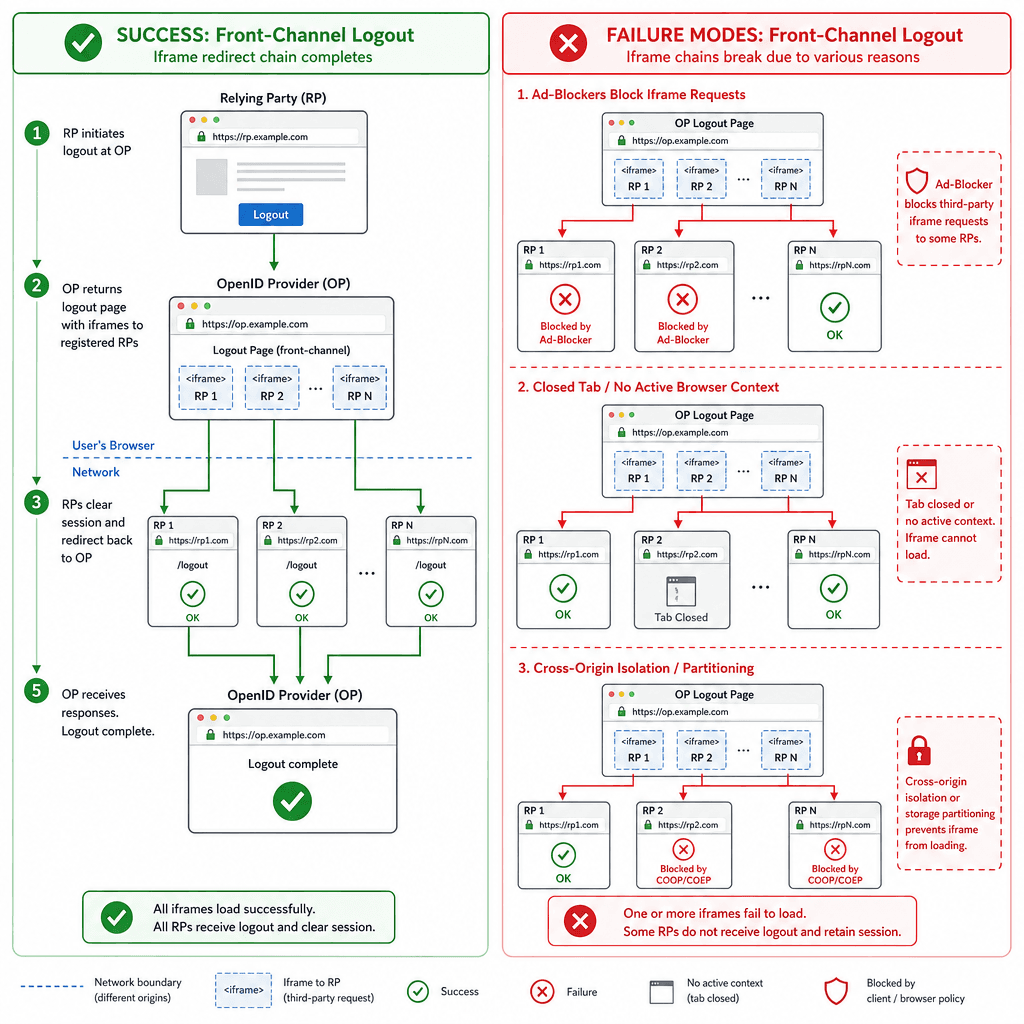
In a Single Sign-On (SSO) ecosystem, "logout" is rarely a single action; it is a propagation event. When a user clicks "Logout" on an Identity Provider (OP), every Resource Provider (RP) that holds an active session for that user must invalidate their local state. The traditional method, Front-Channel Logout, relies on the browser to relay this message. It is fragile. Ad-blockers, network partitions, and closed browser tabs break the chain, leaving stale sessions vulnerable to replay attacks or unauthorized access.
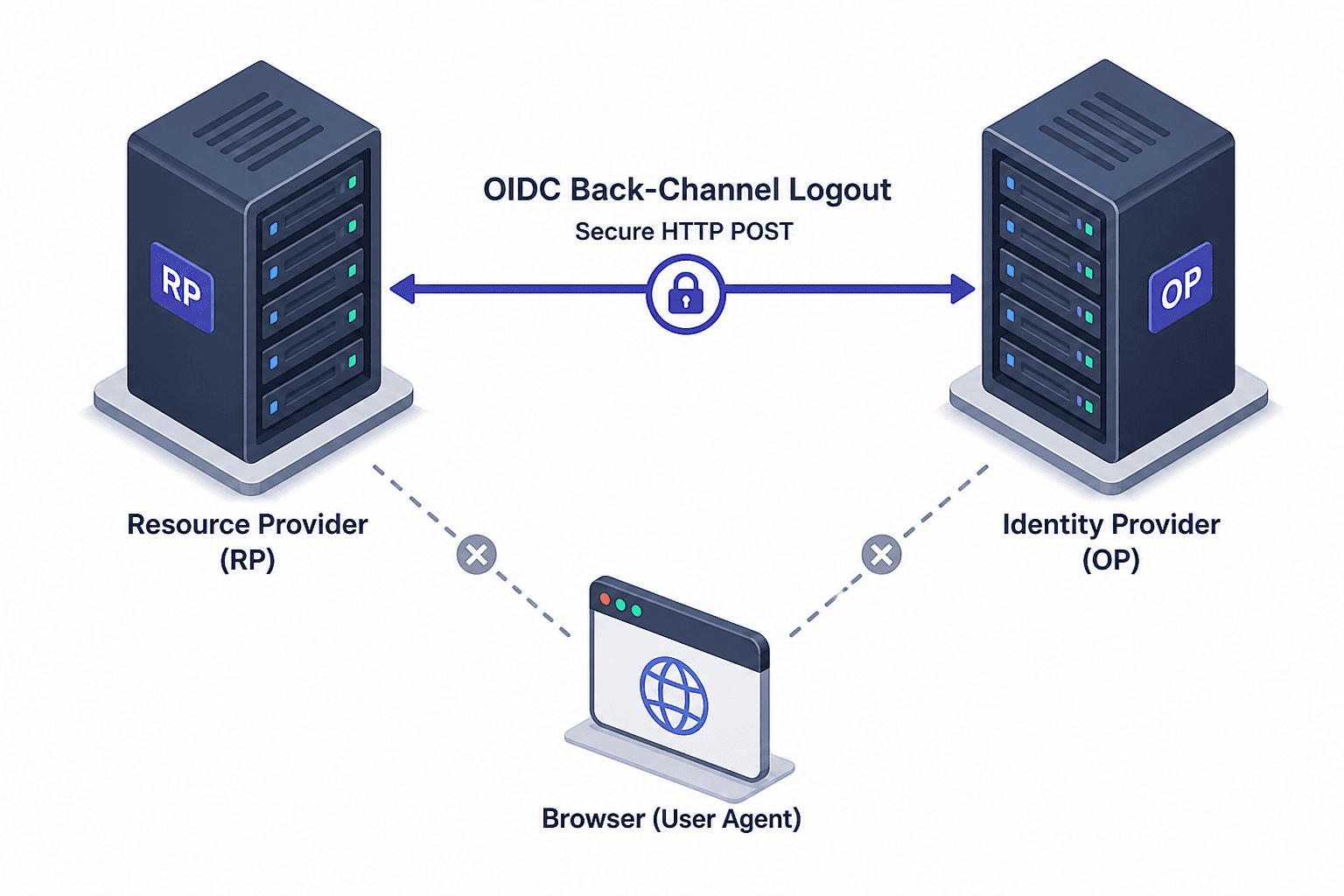
Back-Channel Logout (BCL) removes the browser from the critical path. It establishes a direct, authenticated HTTP channel between the RP and the OP, ensuring that session termination is not a request for information, but a guaranteed command.
The Fragility of Front-Channel Notification
To understand BCL, we must first diagnose why Front-Channel Logout fails. The standard OIDC Front-Channel Logout flow has the OP render a hidden HTML iframe for each RP with an active session, pointing to that RP’s registered frontchannel_logout_uri. Loading this iframe sends a request directly to the RP, allowing it to clear its local session cookie while the browser is still present.
This mechanism has three fatal flaws in distributed systems:
- Cross-Origin Isolation: If the RP and OP are on different domains, the iframe request to the RP’s
frontchannel_logout_uristill relies on the browser sending the RP’s session cookie in a third-party context. If the user’s browser enforces strictSameSitecookie policies or the page is loaded inside a sandboxed environment (like a mobile app webview), that cookie may never be sent, and the RP never learns the session ended. - User Behavior: If the user closes the tab immediately after clicking logout, the browser may abort the page load before the iframe request to the RP’s logout endpoint completes.
- Ad-Blockers: Many browser extensions block requests to known tracking domains or specific URL patterns. If the RP’s logout endpoint is flagged, the logout request is silently dropped.
The result is a "zombie session." The user believes they are logged out, but the RP’s server still holds a valid JWT or session cookie. An attacker who intercepts the session ID can continue to use it until it expires naturally.
The Back-Channel Mechanism
Back-Channel Logout shifts the responsibility from the client to the server. Instead of the browser telling the RP to logout, the OP proactively notifies the RP. The OIDC specification defines Back-Channel Logout as a strictly OP-initiated push mechanism. The RP does not initiate the back-channel logout request; it only responds to incoming POST requests from the OP.
Let’s look at the OP-initiated Push model, which is the gold standard for security. When a user logs out at the OP, the OP does not just redirect the user. It simultaneously sends an HTTP POST request to every RP that has registered a backchannel_logout_uri during discovery or registration.
The Logout Token
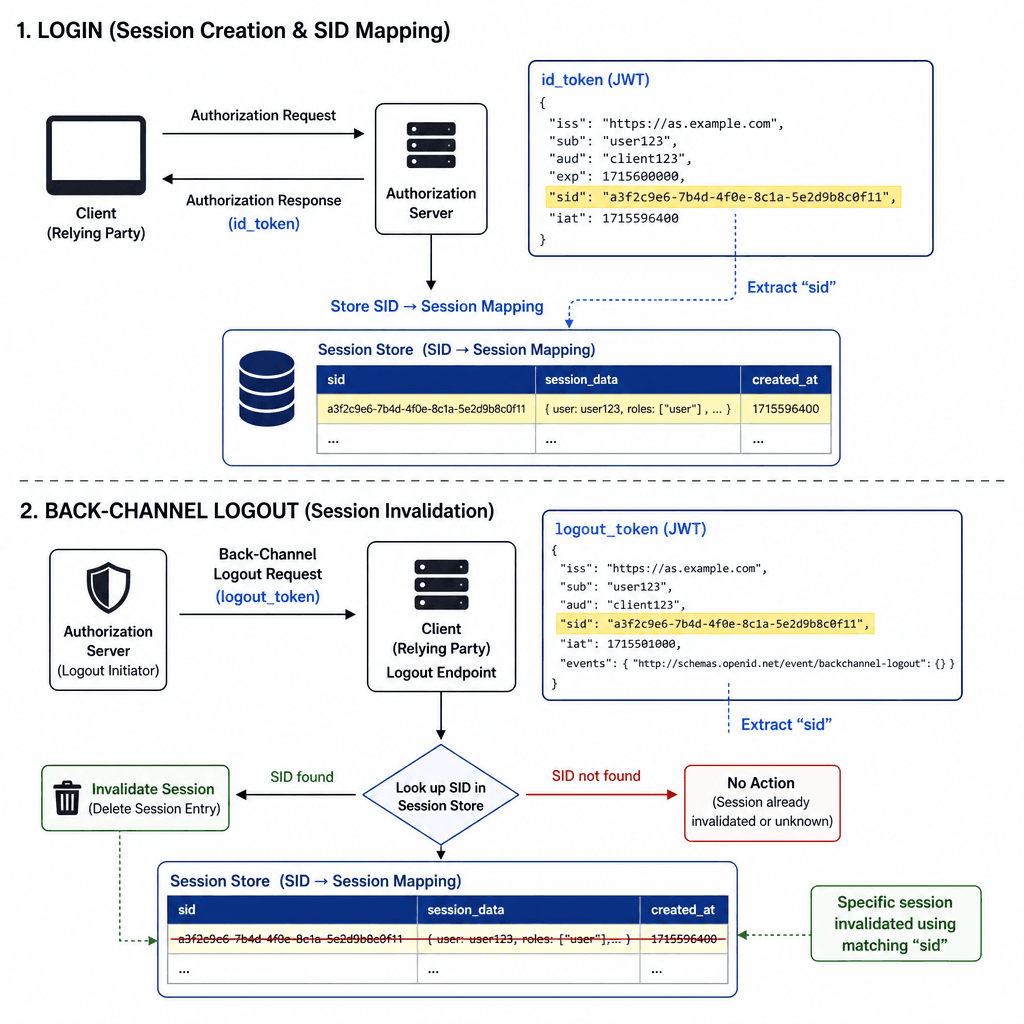
The payload of this HTTP request is not arbitrary JSON. It is a signed JWT called a logout_token. This token contains critical metadata:
iss: The issuer (OP) identifier.aud: The audience (RP) identifier.jti: A unique ID for the logout request (to prevent replay attacks).sid: The Session ID. This is the crucial link.events: A JSON object indicating{"http://schemas.openid.net/event/backchannel-logout": {}}.
The RP receives this POST request. It does not trust the HTTP layer alone. It must verify the JWS signature of the logout_token using the OP’s public keys, fetched via the JWKS URI discovered during the initial OIDC handshake. Only after cryptographic verification does the RP proceed to terminate the session.
POST /backchannel_logout HTTP/1.1
Host: rp.example.com
Content-Type: application/x-www-form-urlencoded

logout_token=eyJhbGciOiJSUzI1NiIsInR5cCI6ImxvZ291dF90b2tlbiJ9...
The Critical Role of sid
The sid (Session ID) is the anchor of Back-Channel Logout. In the initial OIDC Authorization Code Flow, the OP issues an id_token that contains the sid claim. This value is unique per browser/device combination for a given user.
{
  "sub": "user-123",
  "sid": "a1b2c3d4e5f6",
  "iss": "https://op.example.com",
  ...
}
The RP must extract this sid and store it in its local session store, mapping it to the active session ID. When the logout_token arrives later, the RP extracts the sid from the token and looks up the corresponding session. If found, it invalidates that specific session.
This granular mapping allows for partial logouts. If a user is logged in on three devices (three different sid values), a logout from one device only invalidates that specific sid. The other sessions remain active. This is a feature, not a bug, respecting user intent across multiple contexts.
Implementation Tradeoffs and Operational Cost
Implementing BCL is not free. It requires a shift in how RPs manage state.
- Statefulness: Front-Channel Logout is stateless regarding the delivery of the logout event; the browser handles the notification relay, so the RP doesn't need to track sessions specifically for receiving that signal. However, if the RP validates the
sidclaim in theid_token, it must store it regardless of the logout mechanism. The key difference with BCL is that the RP must actively maintain thissidmapping to process the incoming OP push notification correctly. In a distributed system using Redis or a database, this adds lookup latency and storage overhead. - Network Dependencies: The RP must be publicly accessible (or have a secure internal route) to receive the OP’s HTTP POST requests. Firewalls, NAT, and service mesh configurations must allow inbound traffic on the
backchannel_logout_uri. - Clock Skew and Replay Protection: The
jtiin the logout token must be tracked. If an attacker captures alogout_tokenand replays it, the RP must reject it. This requires a short-lived cache of usedjtivalues.
Despite these costs, the security benefit is absolute. By removing the browser from the loop, you eliminate the attack surface of client-side interception and network failure.
Conclusion
Back-Channel Logout is not a minor optimization; it is a fundamental requirement for secure SSO in modern distributed architectures. It transforms session termination from a hopeful browser-based notification into a cryptographically verified server-to-server command. For identity engineers, the takeaway is clear: if you are building an RP that handles sensitive data, you must support sid validation and back-channel logout endpoints. The cost of implementation is low compared to the cost of a compromised session.
Pitfalls
- Clock Skew: If the OP and RP clocks are not synchronized, the
exp(expiration) claim in thelogout_tokenmight be rejected prematurely or accepted too late. Ensure NTP synchronization across all services. - JTI Cache Eviction: The cache for
jtivalues must have a TTL slightly longer than thelogout_token's validity period. If evicted too early, legitimate replay attempts (within the token's window) might be processed incorrectly, or memory might grow unbounded if not managed. - Missing SID Storage: If the RP does not store the
sidfrom the initial loginid_token, it cannot map the incominglogout_tokento a specific session. This results in silent failures where sessions remain active despite the logout request.
Takeaways
- Back-Channel Logout is an OP-initiated push mechanism that eliminates browser dependency.
- The
sidclaim is essential for mapping logout tokens to specific user sessions. - RPs must validate JWS signatures and track
jtivalues to prevent replay attacks.
Related posts
Implementing Back-Channel Logout in OIDC: Reliable Session Termination
An examination of back-channel logout implementation in OpenID Connect to ensure reliable session termination and secure logout token handling.
OIDC Session Management and Front-Channel Logout
A technical examination of OIDC session management, focusing on front-channel logout mechanisms, check_session_iframe, and session state validation for identity engineers.
SAML 2.0 in One Diagram
A visual walkthrough of the SAML 2.0 Single Sign-On flow, covering bindings, profiles, and how it compares to OIDC.