Building Resilient Authentication: Failover and Disaster Recovery for IAM
Examines strategies for IAM disaster recovery, authentication failover, and Keycloak HA to ensure identity resilience and DR planning.
When an authentication system fails, the entire application stack often stops functioning because every request requires a valid identity assertion. In a standard deployment, if the Identity Provider (IdP) goes down, the application cannot verify tokens, leading to a total service outage. To prevent this, we must shift from viewing IAM as a simple login portal to treating it as a critical infrastructure component with defined failure modes and recovery procedures. The core mechanism for resilience is not just redundancy, but the architectural separation of stateful session data from stateless verification logic, allowing the system to survive node failures without losing user context.
The Failure Mode of Monolithic Auth
Consider a scenario where a web application relies on a single Keycloak instance for all authentication. The application validates incoming JWTs (JSON Web Tokens) against the public key hosted by that specific instance. If that instance crashes, the application cannot verify the signature of existing tokens, or worse, it attempts to re-validate against a non-existent server and times out. This is a classic single point of failure. The mechanism here is the tight coupling between the token issuer and the validator.
The solution lies in adopting a stateless token architecture. In this model, the identity assertion (the JWT) contains all necessary claims and is signed by the IdP. The application does not need to query the IdP to validate the token's validity unless the token has been explicitly revoked. This decoupling allows the application to continue serving users even if the IdP is temporarily unreachable, provided the public key remains available. However, this assumes the IdP can generate new tokens and handle refresh requests, which brings us to the cluster level.
Keycloak HA Clustering Mechanics
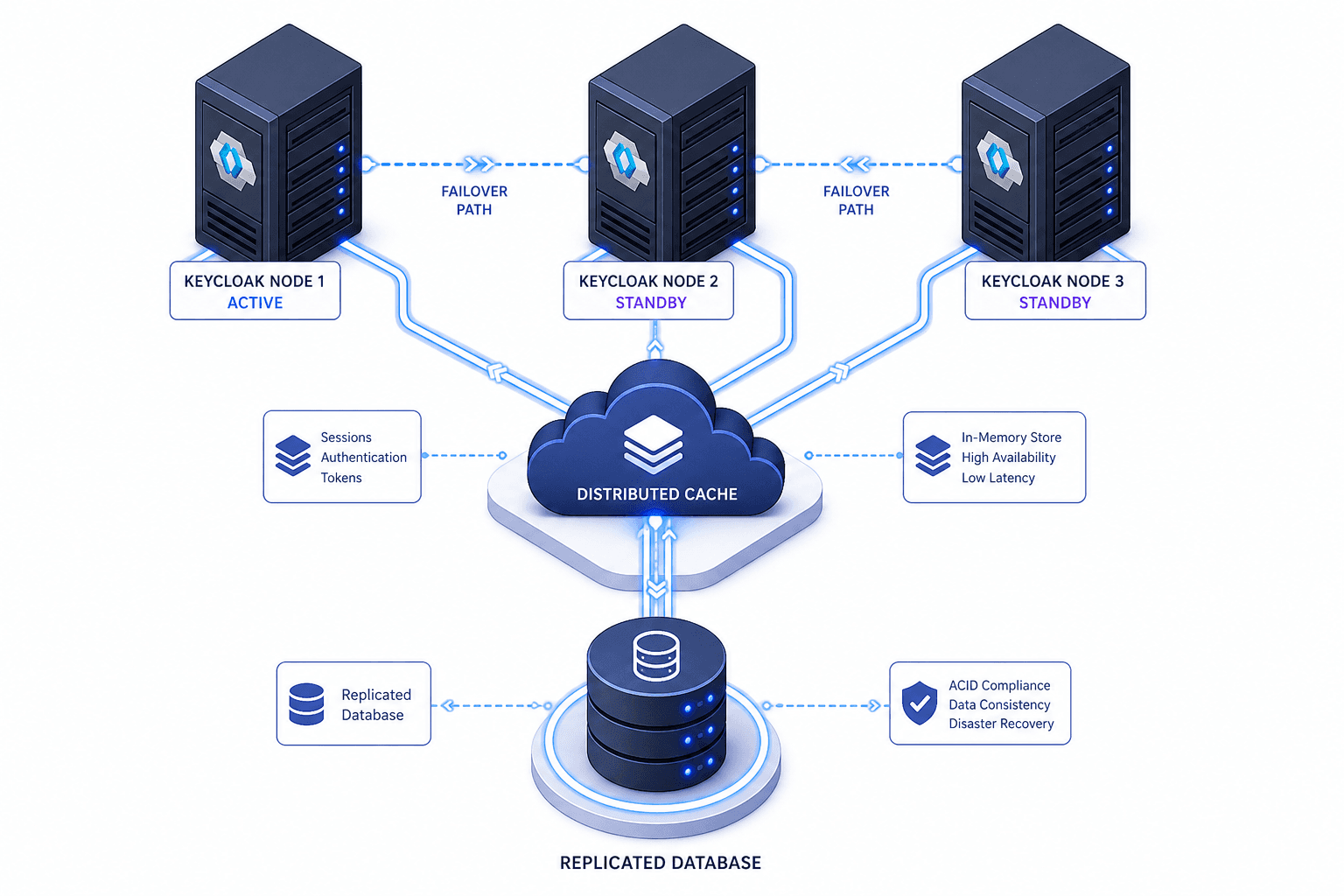
To ensure the IdP itself remains available, we deploy Keycloak in a High Availability (HA) cluster. The mechanism enabling this is the distributed cache provided by Infinispan. When a user logs in, the session state (cookies, user attributes, authentication state) is stored in this shared cache, not on the local disk of the specific node that handled the login.
Imagine three Keycloak nodes: Node A, Node B, and Node C. A user authenticates on Node A. The session data is written to the Infinispan cluster and replicated to Nodes B and C. If Node A suddenly loses power, the load balancer detects the failure and routes the user's subsequent request to Node B. Because the session data was already replicated, Node B possesses the full context of the user's login. The user experiences no interruption. This is implemented via Gossip protocols and JGroups transport, not Raft consensus, to ensure eventual consistency across the cluster.
However, this mechanism requires careful configuration. If the network partition separates Node A and B, but they both believe they are the primary, a "split-brain" scenario occurs where both nodes might accept writes, leading to data corruption. Keycloak mitigates this using JGroups protocols to detect partitions and enforce strict write quorums, preventing split-brain writes.
Disaster Recovery Strategies
While HA handles node failures, it does not protect against site-wide disasters like a data center power outage. Here, we must implement a Disaster Recovery (DR) strategy. There are two primary patterns: Active-Active and Active-Passive.
In an Active-Active setup, traffic is distributed across multiple geographically separated sites. The mechanism here relies on database replication. Keycloak typically uses a relational database (like PostgreSQL or MySQL) to persist user accounts and configuration. For DR, this database must be configured for synchronous or asynchronous replication to a secondary site. If the primary site fails, the secondary site takes over. The challenge is latency. Synchronous replication ensures data integrity but adds network latency to every write operation. Asynchronous replication is faster but risks losing recent transactions if the primary site fails before the data replicates.
For authentication failover, we also need to consider the DNS layer. When the primary site goes down, the DNS records for the IdP domain must point to the secondary site. This DNS propagation delay can cause a brief period where users cannot reach the IdP. To mitigate this, we use a low Time-To-Live (TTL) value for the DNS records, allowing rapid switching.
In an Active-Passive setup, the secondary site sits idle, ready to be spun up only when the primary fails. This is simpler to manage but introduces a Recovery Time Objective (RTO) gap while the secondary site initializes and synchronizes data. For critical systems, Active-Active is preferred, but it requires complex synchronization logic to handle conflicting writes if the split-brain scenario occurs during a network partition.
Operational Recovery Workflows
Even with HA and DR plans, human error or catastrophic data corruption can occur. The mechanism for recovery here is the restoration of the identity state from a known good backup. Keycloak stores user data in the database and configuration in the database or file system. A robust DR plan involves regular, immutable backups of the database and the Keycloak data directory.
Suppose a ransomware attack encrypts the database on the primary site. The recovery workflow begins by isolating the infected environment. Engineers then spin up a new Keycloak cluster in the DR site. They restore the database from the last known clean snapshot. Crucially, they must verify that the restored data is consistent with the cluster topology. If the cluster was using distributed caching, the new nodes must join the cluster and sync their local caches with the restored database.
A common pitfall in this mechanism is the handling of refresh tokens. If a user's refresh token was issued by the primary site and the database is restored to a state before that token was issued, the token becomes invalid. This forces the user to re-authenticate, which is an acceptable trade-off for security. However, if the backup is too old, the user loses access to recent sessions. This is why backup frequency and retention policies are critical components of the DR strategy.
Finally, we must address the "split-brain" risk during recovery. If the primary site recovers and reconnects to the cluster, it might have stale data. The cluster leader must fence the recovered node before allowing it to rejoin, preventing it from writing stale data until the leader synchronizes the cluster state. This ensures that the cluster never operates with inconsistent state, preserving the integrity of the identity store.
Common Pitfalls
Implementing IAM disaster recovery introduces specific complexities that often trip up engineering teams. First, stale data after split-brain can occur if fencing mechanisms fail; a recovered node might reintroduce corrupted user states if the leader does not strictly enforce synchronization before allowing writes. Second, DNS propagation delays remain a hidden failure mode; even with low TTLs, cached DNS records at the client or ISP level can delay failover by minutes, causing authentication storms. Third, backup restoration race conditions happen when the database is restored but the application or cache layer still holds references to the old cluster topology, leading to connection errors or data inconsistency until the entire system is cold-started.
Practical Takeaways
Building resilient IAM systems requires shifting mental models from simple uptime to state consistency. First, treat the signing key as a shared secret that must be backed up independently of the database; if the key is lost, all previously issued tokens become unverifyable regardless of database state. Second, adopt the rule that stateless validation does not equal stateless management; while the app validates tokens without a live IdP, the lifecycle of those tokens (refresh, revoke, issue) is deeply stateful and requires consistent storage. Finally, assume network partitions are inevitable; design your failover logic to handle partial connectivity gracefully rather than assuming a clean breakover.
FAQ
Q: How does Keycloak HA handle token revocation during a site outage? A: Token revocation is a stateful operation stored in the database or distributed cache. If the primary site goes down, revocation events pending replication may be lost if using asynchronous replication. Upon failover, the new primary will only know about revocations that were successfully replicated. This is why short-lived access tokens and frequent refresh token rotation are recommended for high-resilience scenarios.
Q: What happens to active user sessions if I restore a backup from yesterday? A: Active sessions tied to that backup will technically remain valid from a cryptographic perspective, but any tokens issued after the backup timestamp (e.g., new refresh tokens) will be invalid because the database state has reverted. Users with those newer tokens will be forced to re-authenticate, while older sessions might continue working if the signing key hasn't changed.
Q: Why is "fencing" necessary for a recovering node? A: Fencing prevents a recovered node from rejoining the cluster and writing data before the cluster leader has verified its state. Without fencing, a node that recovered from a crash might still have stale data in its local memory or cache, potentially overwriting newer data from other nodes and causing a split-brain scenario.
Conclusion
Building resilient authentication is not about adding more servers; it is about understanding the data flow and failure points within the identity ecosystem. By leveraging stateless tokens, distributed caching via Infinispan (which utilizes Gossip protocols as documented in the Infinispan User Guide), and robust database replication, we can ensure that identity services survive node failures and site outages. The key is to treat the IAM system as a distributed system with strict consistency requirements, where every failover decision is backed by a tested recovery procedure. Without these mechanisms, the "resilience" is merely a theoretical concept that fails the moment the lights go out. For specific implementation details on Keycloak clustering and JGroups configuration, refer to the official Keycloak Documentation on Clustered Deployments.
Related posts
Implementing Conditional Access Policies with Keycloak and ForgeRock
A technical examination of implementing conditional access policies using Keycloak and ForgeRock for context-aware access control.
Building Identity Abstraction Layer: Provider-Agnostic Authentication
An examination of building an identity abstraction layer to achieve provider-agnostic authentication across multiple identity platforms.
Building Resilient Multi-Region IAM with Keycloak and AWS Global Accelerator
This guide covers designing a resilient multi-region IAM architecture using Keycloak and AWS Global Accelerator for high availability and disaster recovery.