SAML Metadata Signature Validation: Preventing Metadata Spoofing
How to validate SAML metadata signatures to stop attackers from spoofing identity providers and securing identity supply chains.
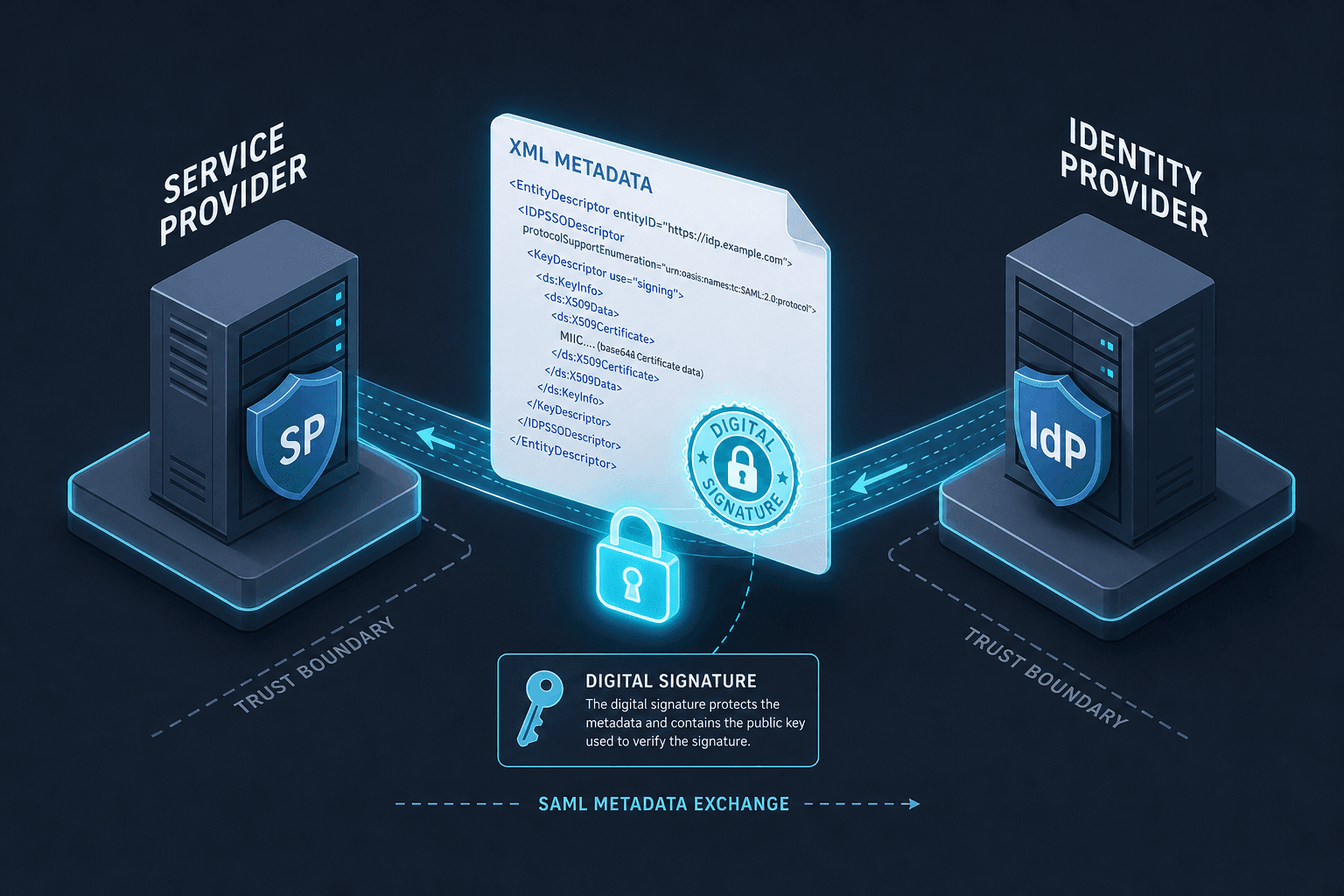
In a federated identity architecture, the Service Provider (SP) does not inherently know who the Identity Provider (IdP) is. It relies entirely on a configuration artifact: the SAML metadata file. This XML document acts as the bootstrap for the entire trust relationship, containing the IdP's entity ID, endpoints, and—most critically—the public keys the SP will use to verify incoming SAML assertions. If an attacker can replace this metadata file with one pointing to their own malicious server, they effectively hijack the identity supply chain. The mechanism that prevents this is not application logic, but the cryptographic validation of the XML Digital Signature embedded within the metadata file itself. Without validating this signature, the SP is trusting a file that could be arbitrarily modified in transit or on disk.
The Trust Boundary and Data Flow
The vulnerability begins at the moment the SP loads its configuration. When a user attempts to log in, the SP redirects them to the IdP. To do this, the SP must know the IdP's Single Sign-On (SSO) URL. This URL is not hardcoded in the application logic; it is parsed from the metadata XML.
Consider a standard metadata structure. The <EntityDescriptor> element wraps the entire configuration. Inside it, the <IDPSSODescriptor> contains the <SingleSignOnService> endpoint. Crucially, the <KeyDescriptor> element holds the public key used to sign SAML responses.
<EntityDescriptor entityID="https://idp.example.com">
  <IDPSSODescriptor protocolSupportEnumeration="urn:oasis:names:tc:SAML:2.0:protocol">
    <SingleSignOnService Binding="urn:oasis:names:tc:SAML:2.0:bindings:HTTP-Redirect"
                           Location="https://idp.example.com/sso"/>
    <KeyDescriptor use="signing">
      <KeyInfo>
        <X509Data>
          <X509Certificate>MIID... (Base64 encoded cert)</X509Certificate>
        </X509Data>
      </KeyInfo>
    </KeyDescriptor>
  </IDPSSODescriptor>
</EntityDescriptor>
If an attacker can swap this file with a new version where the Location points to https://evil.com/sso and the X509Certificate contains the attacker's key, the SP will blindly redirect users to the attacker and decrypt/verify assertions using the attacker's private key. The SP has no intrinsic knowledge of the IdP's true identity; it only knows what the file says. The only guarantee that the file represents the legitimate IdP is a digital signature covering the XML content.
The Mechanism of XML Digital Signatures
SAML metadata files are signed using the XML Digital Signature standard, defined in the W3C specification (XMLDSig) and integrated into the SAML standard (SAML Core). This is not a simple hash check; it is a complex cryptographic binding that ensures integrity and authenticity. This process is the foundation of trust establishment between the SP and the IdP.
When an IdP publishes metadata, it generates a signature over the XML content. The process involves three distinct steps that the SP must replicate to validate:
- Canonicalization: The XML parser must normalize the document (removing insignificant whitespace, fixing namespace declarations) to ensure the byte stream being signed matches the byte stream being verified. If the SP uses a different canonicalization method than the IdP, the digests will not match, even if the content is identical.
- Digest Calculation: A cryptographic hash (usually SHA-256 or SHA-1) is computed over the canonicalized XML content. This digest represents the "fingerprint" of the metadata.
- Signature Verification: The SP uses the IdP's signing certificate (or a pre-trusted root CA) to decrypt the signature blob. It then compares the decrypted value against its own calculated digest. If they match, the metadata has not been tampered with since the IdP signed it.
The signature is typically placed in a <Signature> element within the metadata, wrapping the signed content or referencing it via an ID attribute. The SP must verify that the signature covers the specific <EntityDescriptor> or the <KeyDescriptor> containing the keys it intends to trust.
The Attack Vector: Metadata Spoofing
A metadata spoofing attack occurs when the signature validation step is bypassed or when the attacker manages to sign the metadata themselves. This is a supply chain compromise.
Imagine an attacker gains access to the network segment where the SP retrieves metadata, perhaps via a DNS spoofing attack (DNS Cache Poisoning) or by compromising a shared file system. The attacker intercepts the request for idp-metadata.xml and serves a malicious version.
In this malicious file:
- The
SingleSignOnServicelocation points to the attacker's server. - The
KeyDescriptorcontains the attacker's public key. - The
<Signature>element is either missing, or it is a valid signature generated by a key the attacker controls (e.g., if the IdP's private key was stolen, or if the SP is configured to trust a certificate authority that the attacker has compromised).
If the SP is misconfigured to accept unsigned metadata (a common mistake in development environments), it accepts the attacker's file. The SP now believes the attacker's server is the legitimate IdP. When a user logs in, the attacker captures the credentials, authenticates the user against their own database, and generates a valid SAML assertion signed with the attacker's private key. The SP, trusting the metadata, verifies this assertion using the attacker's public key and grants access. The user thinks they logged in to the real service, but the session is entirely controlled by the attacker.
This is distinct from a standard "man-in-the-middle" on the SSO protocol flow. In a standard MITM, the attacker tries to alter the SAML assertion itself. In a metadata spoofing attack, the attacker alters the configuration that defines the rules of engagement. They change the trust anchor before the session even begins.
Implementation and Configuration
Preventing this requires the SP to enforce signature validation as a hard requirement. Most modern SAML libraries default to rejecting unsigned metadata, but this behavior can be overridden for debugging, leading to production vulnerabilities.
In a Java-based stack using Spring Security, for example, the MetadataGenerator or the SamlMetadataResolver must be configured to strictly validate signatures. The resolver should not simply load the XML; it must invoke the XML signature validation logic.
// Conceptual example of enforcing signature validation
SamlMetadataResolver resolver = new FileSystemMetadataResolver(new File("/path/to/idp.xml"));
resolver.setRequireSigned(true); // Critical: Reject unsigned metadata
resolver.setSignatureValidator(new X509SignatureValidator(trustStore));
If the requireSigned flag is false, the application accepts the file regardless of whether a signature exists. If a signature exists but is invalid, the library must throw an exception and halt the federation setup.
Similarly, in Shibboleth SP configuration, the <MetadataProvider> section must specify a SignatureValidation constraint. If the metadata is fetched from a remote URL, the connection must also be protected (HTTPS), and the signature of the metadata file must be verified against a known, trusted key.
It is crucial to understand that the SP does not need to trust the IdP's application logic; it only needs to trust the signature of the file. The signature proves that the file originated from the holder of the private key corresponding to the signing certificate. If the signing certificate itself is self-signed and not trusted by the SP's trust store, the validation will fail unless the SP is explicitly configured to trust that specific certificate for signing metadata.
Common Pitfalls
Even with the correct libraries, configuration errors frequently undermine security. Three critical pitfalls must be avoided:
- Allowing Unsigned Metadata in Production: The most common failure is leaving the
requireSignedflag set tofalseor relying on default settings that permit unsigned metadata for ease of testing. In production, accepting unsigned metadata renders the SP vulnerable to immediate spoofing. - Failing to Update the Trust Store During Key Rotation: When an IdP rotates keys, administrators often update the metadata file but forget to update the SP's trust store with the new signing certificate. This results in valid signatures being rejected, causing outages, or worse, leaving the system in a state where the old key is still trusted but no longer valid.
- Relying on Network Security Alone: Assuming that HTTPS or network segmentation alone protects against metadata spoofing is dangerous. While HTTPS prevents interception during transit, it does not validate the content of the file once received. An attacker with access to the file system or a compromised internal DNS can serve a malicious file over a secure channel. Signature validation is the only layer that guarantees content integrity.
Operational Hardening and Key Rotation
The complexity of SAML metadata validation often leads to operational friction during key rotation. When an IdP rotates its signing keys, it must publish a new metadata file signed with the new key. The SP must be able to handle this transition.
A common failure mode is the "stale trust" issue. If the IdP rotates keys but the SP's trust store still contains the old metadata file (which is no longer valid because the keys have changed), the SP will reject valid assertions. Conversely, if the SP updates the metadata file but the update process fails to validate the new signature, it might accept a rogue file.
To mitigate this, organizations should implement a "grace period" where the SP trusts both the old and new signing keys, or use a metadata refresh mechanism that validates the new file's signature against a pre-distributed trusted certificate. This pre-distribution is the standard mechanism to add the specific signing certificate to the SP's trust store, ensuring the SP can validate the new metadata file. This out-of-band verification is the only way to prevent the "chicken and egg" problem: how do you trust the new metadata if you don't trust the new key?
The solution is to distribute the IdP's signing certificate via a secure channel (e.g., a physical USB drive, a signed commit in a private repository, or a separate PKI trust store) that is independent of the metadata file's transport mechanism. Once the SP trusts the signing certificate, it can automatically validate any metadata file signed by that certificate, ensuring that even if the metadata file is spoofed, the signature check will catch it.
Disabling signature validation is a critical security misconfiguration. It is equivalent to disabling TLS for a banking website; it exposes the system to trivial supply chain attacks. The cost of implementing strict signature validation is negligible compared to the cost of a compromised identity infrastructure.
Practical Takeaways
To maintain robust identity security, adhere to these mental models:
- Never trust a file you cannot verify cryptographically: If a configuration file lacks a verifiable signature, treat it as untrusted data.
- The trust anchor is the certificate, not the URL: The URL points to the data, but the certificate (and its signature) proves the data's origin. Never trust a URL without validating the signature.
- Unsigned metadata is a production vulnerability, not a debugging convenience: Disabling signature validation for "ease of testing" creates a permanent hole in your security posture if not rigorously enforced during deployment.
FAQ
What happens if the IdP certificate expires? If the IdP's signing certificate expires, the SP will fail to validate new metadata files signed by that certificate. This will break federation until the IdP publishes new metadata signed by a fresh certificate, and the SP's trust store is updated to include the new certificate.
Can I use a self-signed certificate for the IdP? Yes, you can use a self-signed certificate for the IdP's metadata signature. However, the SP must be explicitly configured to trust that specific self-signed certificate (by adding it to its trust store). You cannot rely on a public Certificate Authority in this scenario.
Does HTTPS prevent metadata spoofing? No. HTTPS protects the metadata file in transit from being intercepted or altered by a network attacker. However, it does not prevent an attacker who has compromised the file system, DNS, or the IdP itself from serving a malicious metadata file over HTTPS. Only XML Digital Signature validation can detect if the file content has been tampered with.
Conclusion
SAML metadata signature validation is the gatekeeper of the identity supply chain. It transforms the metadata file from a piece of text that can be edited by anyone into a cryptographically bound artifact that proves the identity of the IdP. By enforcing the verification of XML Digital Signatures, Service Providers ensure that the trust anchor they use to decrypt and verify user assertions is genuine. Without this mechanism, the entire federation is vulnerable to metadata spoofing, where an attacker can seamlessly inject themselves into the authentication flow, capturing credentials and impersonating users without detection. The mechanism is rigorous, relying on canonicalization and cryptographic hashing, but it is the only defense against the most dangerous class of federation attacks.
Related posts
SAML Artifact Binding: Low-Latency SSO Architecture
An examination of SAML artifact binding for achieving low-latency SSO performance and reducing network overhead.
Understanding HTTP Strict Transport Security (HSTS) for Identity Applications
An examination of HTTP Strict Transport Security (HSTS) implementation for identity applications using Spring Boot to enhance web security.
Implementing Cryptographic Agreements in Identity: ECDH and Key Agreement Protocols
An examination of ECDH and key agreement protocols within elliptic curve cryptography for secure identity verification and TLS handshakes.