Risk-Based Authentication With ML Scoring
Explore how machine learning enhances risk-based authentication by generating dynamic risk scores for adaptive identity verification.
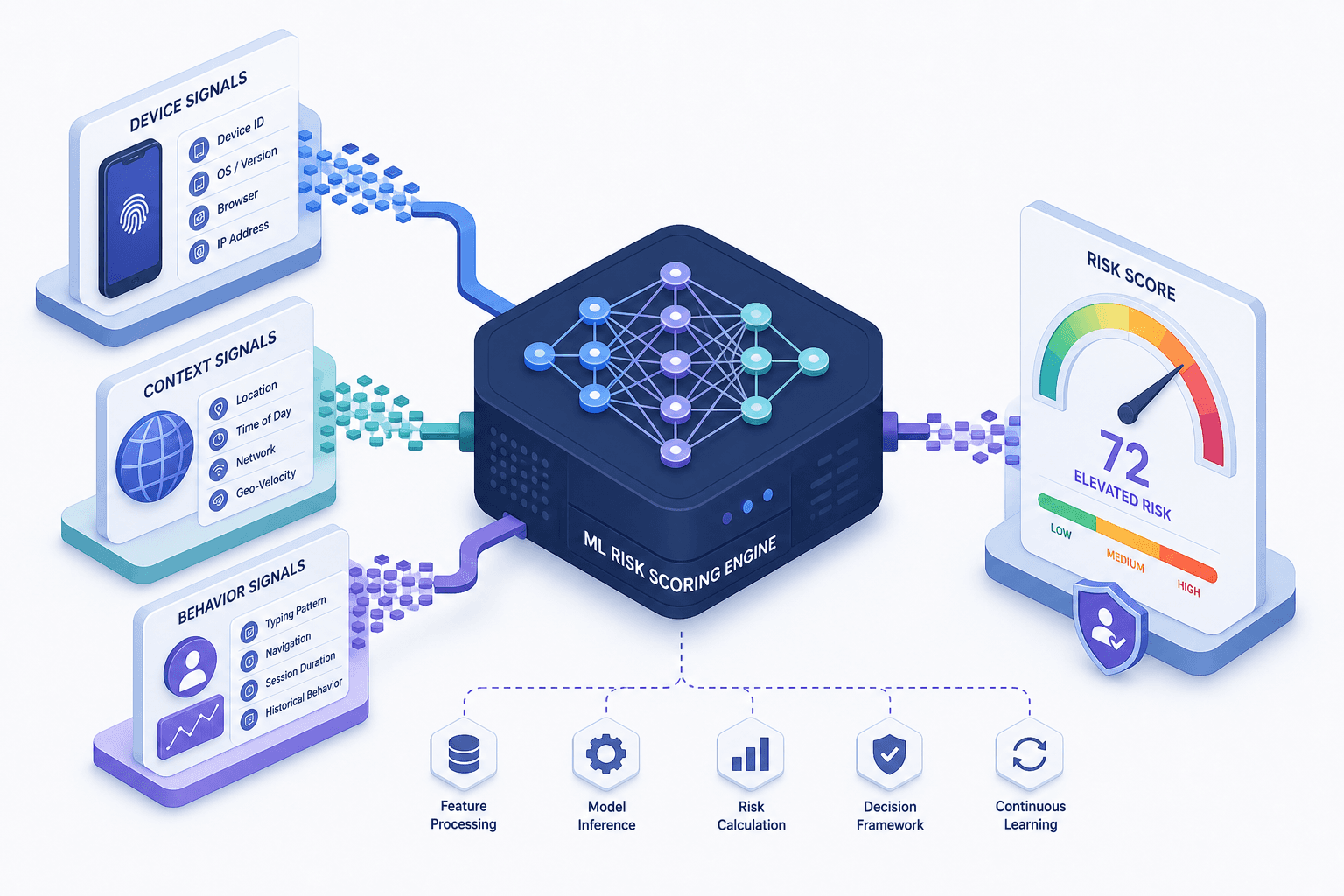
Static rule-based authentication systems suffer from a fundamental limitation: they treat all deviations from the norm as equally dangerous. A login attempt from a new device, a different time zone, or an unusual IP address triggers the same binary response—deny or challenge. This rigidity creates high friction for legitimate users and insufficient protection for sophisticated attackers who mimic normal behavior patterns. Machine Learning (ML) enhances Risk-Based Authentication (RBA) by shifting from binary rules to probabilistic scoring. The system ingests multi-dimensional telemetry, calculates a dynamic risk score, and adapts the authentication challenge in real-time. By assessing ai identity risk through these complex signal interactions, organizations can distinguish between benign anomalies and genuine threats with far greater precision than static rules allow.
Signal Ingestion and Normalization
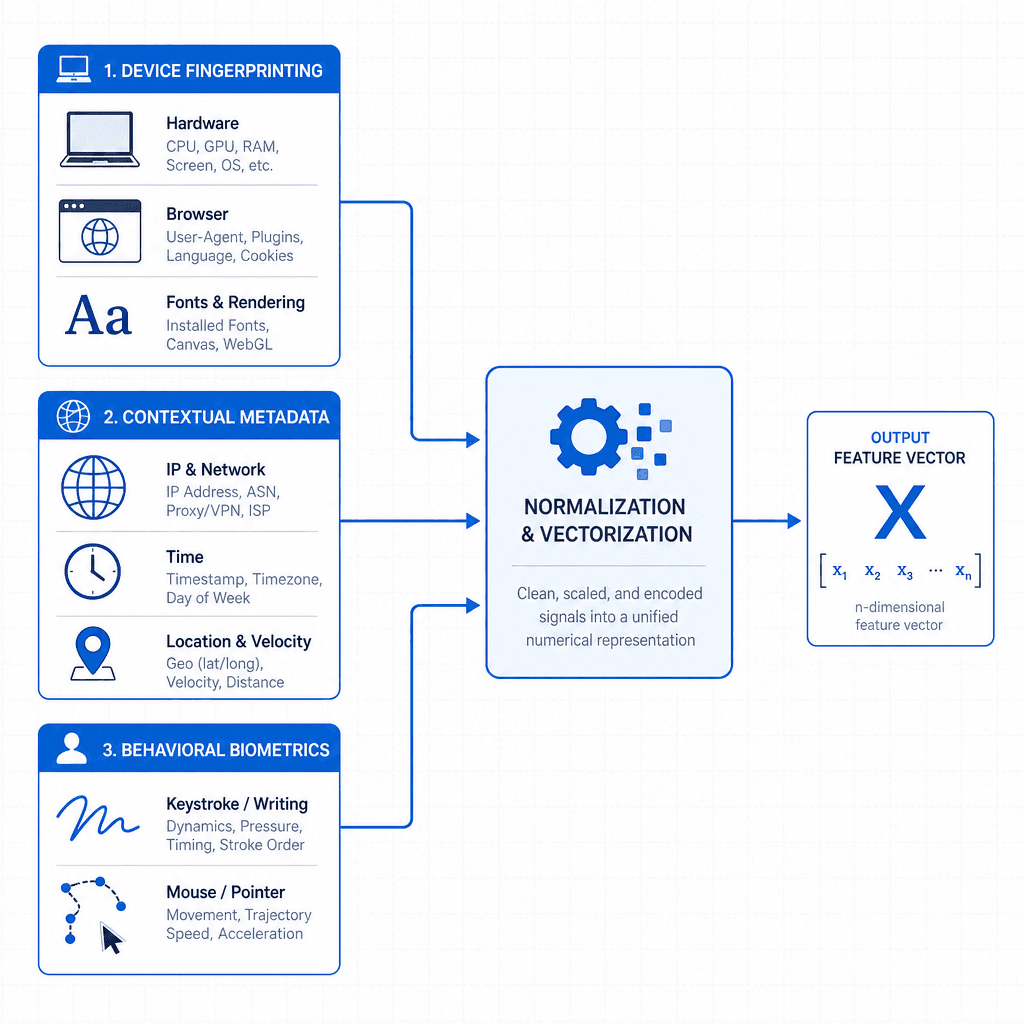
The foundation of an ML-driven RBA system is not the model itself, but the quality and structure of the input features. Raw telemetry must be transformed into a consistent vector space. Consider a login event from actor Alice at timestamp T. The system collects three categories of signals:
- Device Fingerprinting: Hardware identifiers, browser headers, screen resolution, and installed fonts create a probabilistic hash of the client environment. If
Alice’s device fingerprint has never been seen before, the feature value isnew_device: 1. If it matches a known good profile,new_device: 0. - Contextual Metadata: This includes IP reputation (is the IP associated with a data center or a residential ISP?), geolocation velocity (did the login originate from a location physically impossible to reach given the previous login time?), and time-of-day anomalies relative to the user’s historical patterns.
- Behavioral Biometrics: Keystroke dynamics, mouse movement trajectories, and touch pressure (on mobile) provide continuous signals. These are aggregated into statistical distributions (mean, variance) over the session duration.
These raw values are normalized using techniques like min-max scaling or z-score normalization to ensure that features with larger magnitudes (e.g., IP reputation scores) do not dominate the model’s decision boundary. The result is a feature vector X representing the login attempt.
Model Architecture and Training
The core engine is typically a supervised learning classifier, such as a Gradient Boosting Decision Tree (GBDT) or a Random Forest, trained on historical labeled data. The training set consists of past login events labeled as fraud or legitimate. The label fraud is derived from ground truth sources: chargebacks, user-reported unauthorized access, or subsequent malicious actions within the same session.
A critical challenge is class imbalance. Fraudulent logins often constitute less than 0.1% of total traffic. If the model predicts "legitimate" for every request, it achieves 99.9% accuracy but zero utility. While techniques like SMOTE (Synthetic Minority Over-sampling Technique) exist for generating synthetic examples of the minority class, they are not the only solution. In high-dimensional fraud detection, SMOTE can sometimes amplify noise by creating unrealistic samples in sparse regions. Consequently, engineers often prefer class weighting (assigning higher misclassification penalties to false negatives) or anomaly detection approaches (training on only legitimate traffic and flagging outliers) to maintain signal integrity without introducing synthetic artifacts.
The model learns non-linear interactions between features. For example, it may learn that new_device + high_velocity_login is highly predictive of fraud, whereas new_device + low_velocity_login + known_geolocation is not. This ability to capture complex correlations is what distinguishes ML-based RBA from rule-based systems.
Dynamic Scoring and Adaptive Actions
Once trained, the model outputs a risk score S for each login attempt, typically normalized between 0 and 1. This score represents the probability that the login is fraudulent. The system then maps S to an adaptive authentication action:
{
  "score_range": {
    "low_risk": "< 0.2",
    "medium_risk": "0.2 - 0.7",
    "high_risk": ">= 0.7"
  },
  "actions": {
    "low_risk": "Silent Pass-Through",
    "medium_risk": "Step-Up Authentication (MFA)",
    "high_risk": "Deny or Escalate (CAPTCHA/Biometrics)"
  }
}
This dynamic approach reduces friction for low-risk events while maintaining security for high-risk ones. For instance, if Alice travels to a new country, her initial login might score 0.6, triggering a step up authentication request. Once she verifies her identity, the system updates her profile, lowering the risk score for subsequent logins from that location. The step up challenge serves as both a security gate and a learning signal, confirming the user's legitimacy to the model.
Feedback Loop and Continuous Learning
An ML-based RBA system is not static; it evolves through a continuous feedback loop. User actions after the authentication decision serve as implicit labels. If a user completes an MFA challenge, the system infers that the login was legitimate, reinforcing the model’s prediction. If a user denies a transaction immediately after authentication, it suggests the account was compromised, providing a strong signal for future training.
This feedback must be carefully managed to avoid poisoning the model. Automated attacks may attempt to "train" the model by generating large volumes of low-risk-looking requests. Engineers mitigate this by using delayed labeling (confirming fraud only after chargebacks or user reports) and by isolating new, unverified traffic in sandboxed environments. A key implementation detail for delayed labeling is the use of a "pending" state in the feature store; when a chargeback occurs days later, a background job re-labels the historical feature vector and triggers a retraining pipeline, ensuring the model corrects its drift without impacting real-time inference latency.
Implementation Considerations
Implementing ML-driven RBA requires careful consideration of latency, privacy, and explainability. Authentication decisions must be made in milliseconds to avoid degrading user experience. This often involves pre-computing risk scores for common scenarios or using lightweight models for real-time inference.
Privacy regulations like GDPR restrict the collection of certain biometric data, requiring anonymization or on-device processing. For compliance, developers should refer to the GDPR Article 9 regarding special categories of personal data and NIST SP 800-63B guidelines on digital identity assurance levels. Finally, explainability is crucial for trust; the system should be able to provide reasons for high-risk scores (e.g., "Login from unrecognized device in new location") to help users understand and resolve authentication challenges.
Conclusion
In summary, ML-enhanced Risk-Based Authentication transforms identity verification from a rigid gate into a dynamic, context-aware process. By leveraging machine learning to interpret complex signals, organizations can significantly reduce fraud while maintaining minimal friction for legitimate users.
Related posts
Identity Analytics: Which Algorithms Actually Work
An examination of effective algorithms for identity analytics, focusing on anomaly detection, peer group analysis, and handling imbalanced data in security contexts.
Unsloth: Fine-Tuning 2x Faster on One GPU
Learn how Unsloth accelerates fine-tuning by 2x using Triton kernels and LoRA, enabling efficient model training on a single GPU.
OWASP Top 10 for LLM Applications, Applied
A practical examination of the OWASP Top 10 for LLM Applications, covering security checklists, mitigations, and appsec review processes for developers.
