Detecting Account Takeover and Credential Stuffing
Strategies for detecting account takeover and credential stuffing attacks using bot detection and login anomaly analysis.
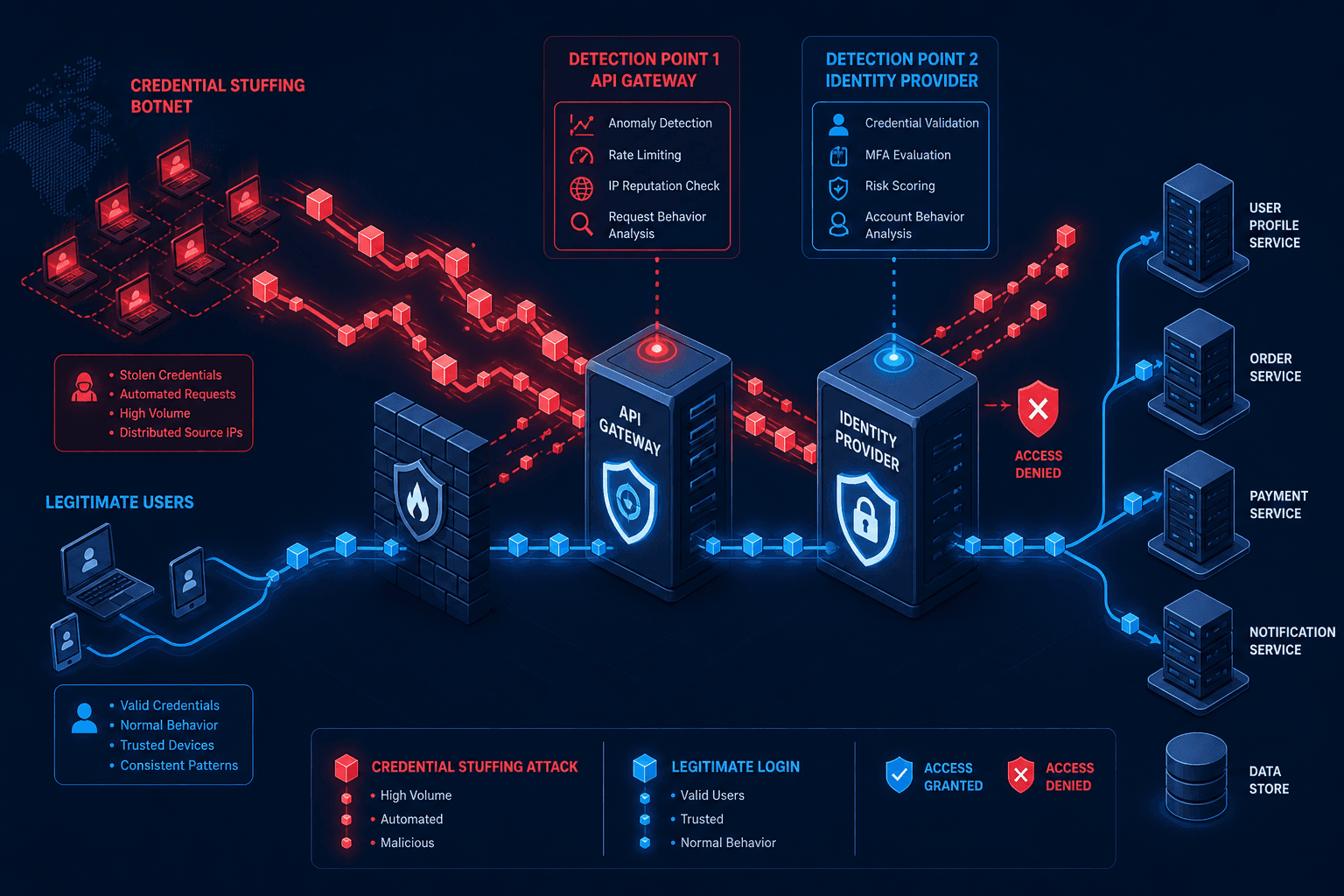
Credential stuffing and account takeover (ATO) represent two sides of the same coin in modern identity security. Credential stuffing is the attack vector—automated attempts to log in using credentials stolen from other breaches. Account takeover is the outcome—the attacker successfully assumes control of a victim’s account. For security engineers and backend developers, the challenge is not just blocking the initial request, but distinguishing legitimate users from bots at scale without introducing unacceptable friction. Effective ato defence requires distinguishing between these two concepts to apply the right countermeasures.
The Mechanics of Credential Stuffing
Unlike brute-force attacks, which attempt millions of password guesses against a single username, credential stuffing relies on the reuse of credentials. Attackers acquire large datasets of username-password pairs from past data breaches (e.g., LinkedIn, Adobe, or more recently, various SaaS platforms). They then automate the login process across target services.
The mechanism is deceptively simple:
- Input: A list of
username:passwordpairs. - Iteration: A bot script iterates through the list, submitting POST requests to the authentication endpoint.
- Validation: If the server returns a
200 OKor specific success token, the credential is valid. - Extraction: The attacker now has a valid session.
The volume is the primary threat. A single botnet can generate hundreds of thousands of requests per minute. Traditional rate limiting (e.g., "5 attempts per minute per IP") fails because sophisticated botnets distribute requests across millions of residential IPs, proxy servers, or compromised IoT devices. This makes the traffic appear as legitimate, geographically diverse user activity.
Bot Detection: Beyond IP Blacklists
Bot detection is the first line of ato defence against automated attacks. To detect credential stuffing, you must analyze the client making the request, not just the request itself. Modern bot detection operates on three layers: network, protocol, and behavioral.
1. Network and Protocol Fingerprinting
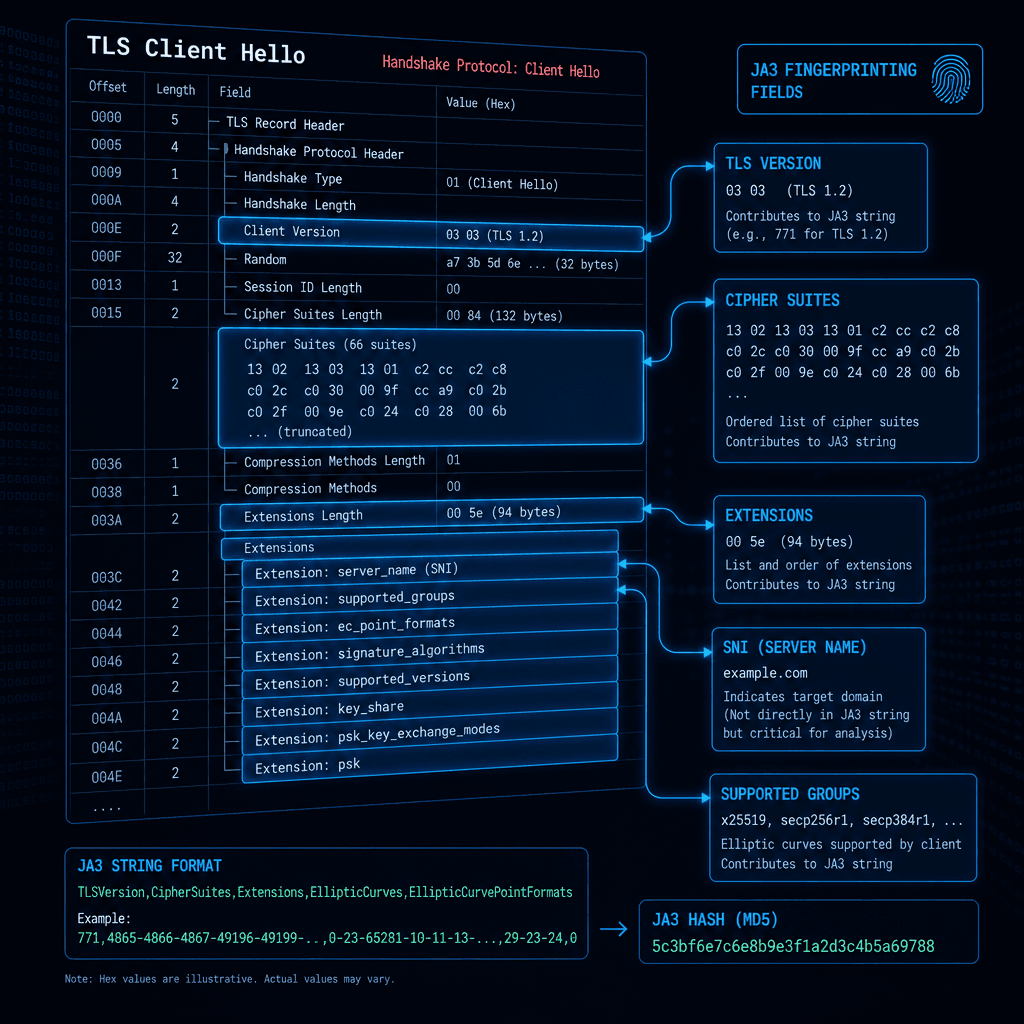
Every HTTPS client has a unique TLS handshake signature. Tools like JA3 and JA4 hash the TLS Client Hello message, creating a fingerprint of the client’s library, version, and OS.
- Standard Browsers: Chrome, Firefox, and Safari have consistent, well-documented JA3 fingerprints.
- Headless Browsers: Tools like Puppeteer or Selenium often have distinct, recognizable fingerprints unless heavily obfuscated.
- Custom Scripts: Python
requestsor Gonet/httplibraries have specific cipher suites and header orders that differ from headless browsers and regular browsers.
If your application receives a login request from an IP address with a JA3 fingerprint matching a known headless browser profile, it is likely a bot. However, bots can spoof headers. Therefore, fingerprinting must be combined with other signals.
2. Behavioral Analysis
Human users exhibit non-linear, stochastic behavior. Bots, even those using human-like emulators, often fail to replicate subtle interaction patterns.
- Timing: Humans take variable amounts of time to type passwords (keystroke dynamics). Bots often submit forms instantly or with uniform delays.
- Mouse/Touch Events: Legitimate logins involve mouse movements, scrolls, or touch gestures before submitting the form. A request that jumps straight to the
POSTsubmission without precedingmousemoveortouchstartevents is suspicious. - Canvas Fingerprinting: While less common now due to privacy restrictions, rendering inconsistencies in HTML5 canvas can help identify headless environments.
Implementing these checks requires a JavaScript challenge (like Cloudflare’s Turnstile or hCaptcha) that runs in the browser. This ensures the request originates from a real browser environment, not a server-side script.
Login Anomaly Analysis: Detecting ATO
This analysis is a critical component of comprehensive ato defence. Once a login attempt occurs, you must assess whether the credentials are valid and if the login is anomalous. This is where Account Takeover detection begins. Even if the bot uses valid credentials, the context of the login may reveal malicious intent.
1. Impossible Travel and Geolocation
If a user logs in from New York at 10:00 AM and from London at 10:15 AM, the login is physically impossible. This is a clear indicator of ATO. However, simple geolocation IP lookup is unreliable due to CDNs and corporate proxies. You should use a reputable IP intelligence provider (e.g., MaxMind, IP2Location) to estimate location, but treat it as a signal, not a definitive fact.
2. Device and Session Anomalies
- New Device: If a user logs in from a device never seen before, flag it.
- New User Agent: A change in browser or OS version can indicate a different device.
- Session Hijacking: If a valid session cookie is used from a different IP or user agent, it may indicate cookie theft (XSS) or man-in-the-middle attacks.
3. Behavioral Anomalies Post-Login
After authentication, monitor for sudden changes in user behavior:
- Password Change: A bot that gains access often immediately changes the password or email to lock out the victim.
- High-Risk Actions: Initiating a wire transfer, changing shipping addresses, or exporting data.
- Abnormal Volume: A user who typically buys one item per month suddenly purchases ten items.
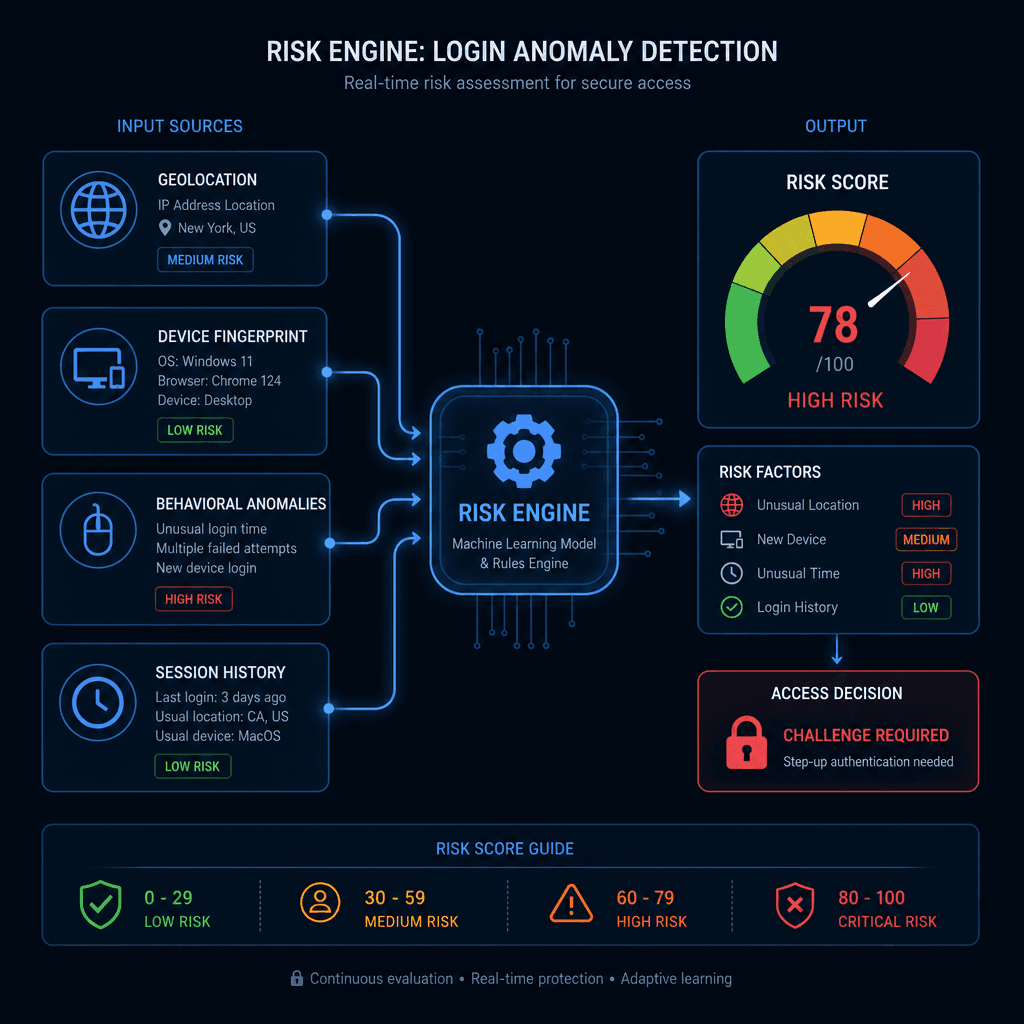
These signals should feed into a risk engine. The engine assigns a risk score to each login attempt. Based on the score, the system can:
- Allow: Low risk.
- Challenge: Medium risk (require MFA or CAPTCHA).
- Block: High risk (deny access and alert the user).
Mitigation and Response Strategies
Detection is only half the battle. You must have automated responses to contain the threat.
1. Force Re-Authentication
If a login is flagged as high-risk, do not allow the session to proceed. Instead, redirect the user to a re-authentication flow. This flow should require a second factor (MFA) if the user has it enabled. If MFA is not enabled, consider forcing a password reset via email. This ensures that even if the attacker has the password, they cannot proceed without the second factor.
2. Invalidate Sessions
If you detect that a session has been compromised (e.g., a valid session token is used from a suspicious location), immediately invalidate all existing sessions for that user. This forces the attacker and the legitimate user to re-authenticate. Implement this by revoking the session identifier or rotating the session token in the session store.
3. Alerting and User Notification
Notify the user via email or SMS when a suspicious login is detected. Provide a link to review active sessions and revoke unauthorized ones. This empowers the user to take action and increases awareness.
4. Monitor for Lateral Movement
Attackers who gain access often move laterally within the application. Monitor for:
- API Abuse: Automated scripts scraping data via API endpoints.
- Privilege Escalation: Attempts to access admin roles or sensitive endpoints.
- Data Exfiltration: Unusual download volumes or export actions.
Conclusion
Detecting credential stuffing and account takeover requires a layered approach. Simple rate limiting is insufficient against distributed botnets. You must implement bot detection through TLS fingerprinting and behavioral analysis to filter out automated traffic. Simultaneously, login anomaly analysis allows you to detect ATO by evaluating the context of each authentication attempt. By combining these techniques with automated response strategies, you can protect user accounts while maintaining an uninterrupted experience for legitimate users.
The key is continuous adaptation. As bots evolve, so must your detection mechanisms. Regularly review logs, update bot signature databases, and refine your risk models based on new threat intelligence.
Related posts
Credential Stuffing and Account Takeover Prevention
An examination of credential stuffing and account takeover prevention strategies for advanced login security.
Zero Trust Architecture: A Practical Implementation Guide
A practical walkthrough of implementing zero trust architecture, covering identity security, least privilege, micro-segmentation, and continuous verification.
Identity Analytics: Which Algorithms Actually Work
An examination of effective algorithms for identity analytics, focusing on anomaly detection, peer group analysis, and handling imbalanced data in security contexts.
