LoRA Explained: Rank by Rank Guide for ML Engineers
A technical breakdown of Low Rank Adaptation (LoRA) for ML engineers, explaining how rank and alpha parameters affect fine-tuning efficiency and model performance.
LoRA Explained, Rank by Rank
Fine-tuning large language models (LLMs) traditionally requires updating every parameter in the model, a process that demands massive GPU memory and computational resources. Low-Rank Adaptation (LoRA) solves this by freezing the pre-trained weights and injecting trainable rank decomposition matrices into each layer of the Transformer architecture. This approach drastically reduces the number of trainable parameters while maintaining performance comparable to full fine-tuning. Understanding LoRA requires dissecting three core components: the rank parameter (), the scaling parameter (), and the selection of target modules.
This is Part 3 of the Fine-Tuning LLMs Hands-On series.
The Mechanism of Rank Decomposition
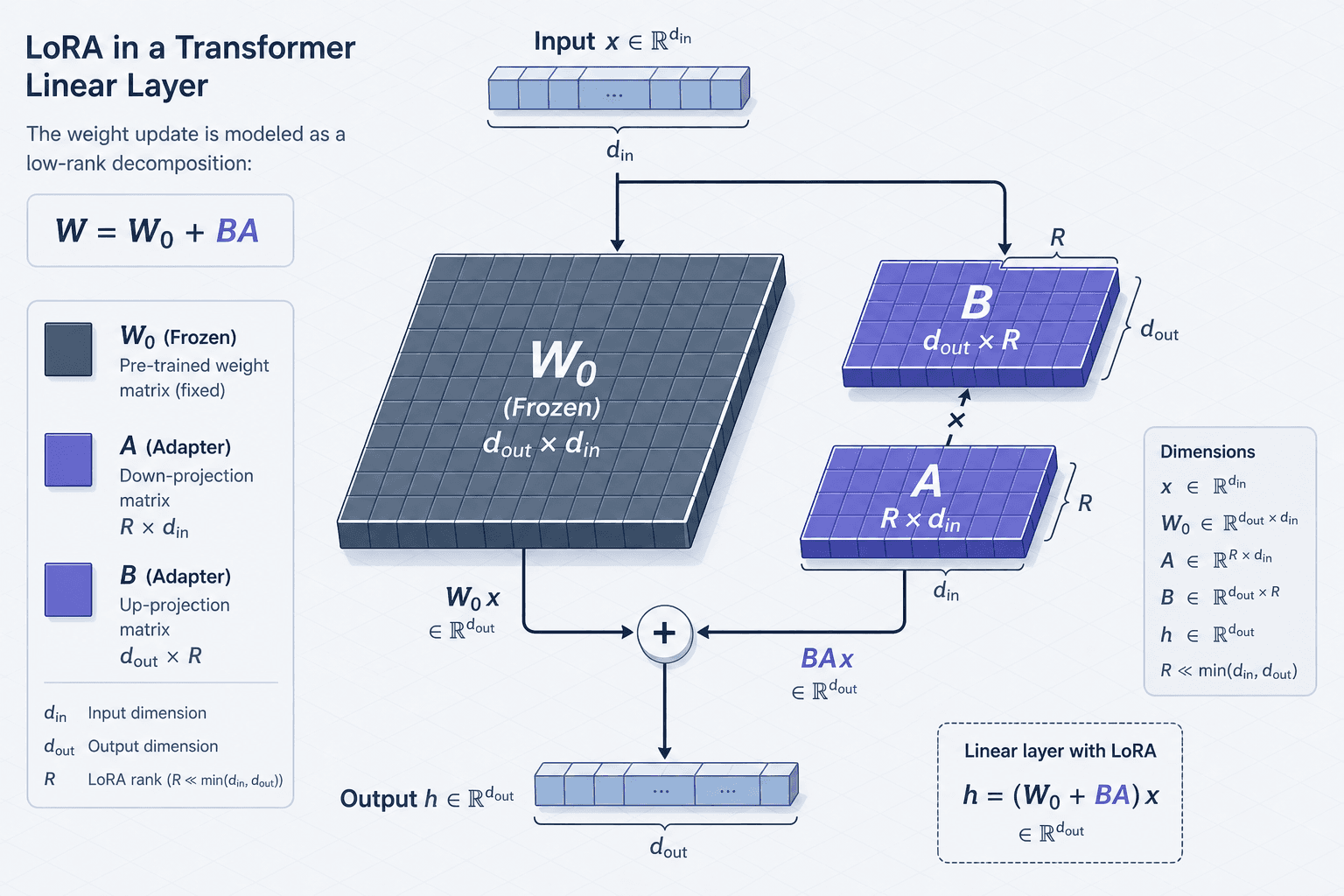
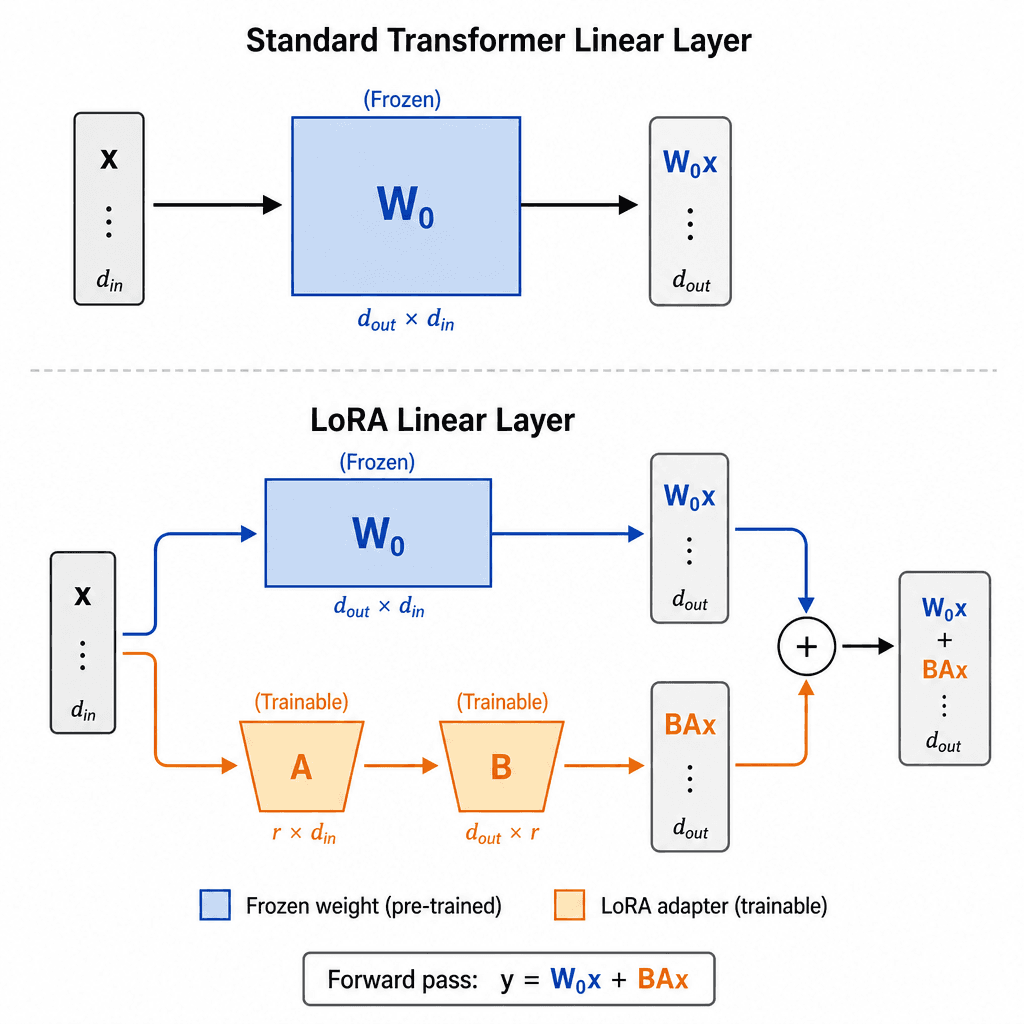
At its core, LoRA exploits the observation that the changes required to adapt a pre-trained model to a new task often lie in a low-dimensional subspace. Instead of updating the full weight matrix , LoRA represents the update as a product of two smaller matrices: and , where .
The forward pass for a layer with input becomes:
Here, is the frozen pre-trained weight matrix. The term is the LoRA adaptation. The rank determines the capacity of this adaptation. If , the update is a simple outer product of two vectors, representing a minimal change. If is large, the update can approximate more complex transformations.
For example, in a typical LLM layer where and , a full update would require $16,777,216$ parameters. With , LoRA requires only parameters, a reduction of over 99% in trainable parameters for that layer.
The Role of Alpha ()
The parameter serves as a scaling factor for the LoRA weights. In the original LoRA formulation, the update is initialized as and . To ensure that the initial state of the model remains unchanged (identity mapping), the output of the LoRA branch is scaled by .
The modified forward pass is:
This scaling is critical. The ratio effectively controls the learning rate of the LoRA weights relative to the base model. If is set equal to , the scaling factor is 1. If , the updates are dampened; if , they are amplified.
In practice, engineers often tune independently of . A common heuristic is to set or . However, this is not a universal rule. A higher can accelerate convergence but may lead to instability if the learning rate is not adjusted accordingly. Conversely, a lower can act as a regularizer, preventing overfitting on small datasets. The key insight is that and are coupled: changing without adjusting changes the effective scale of the update, necessitating re-tuning of the learning rate or itself.
Target Modules and Placement
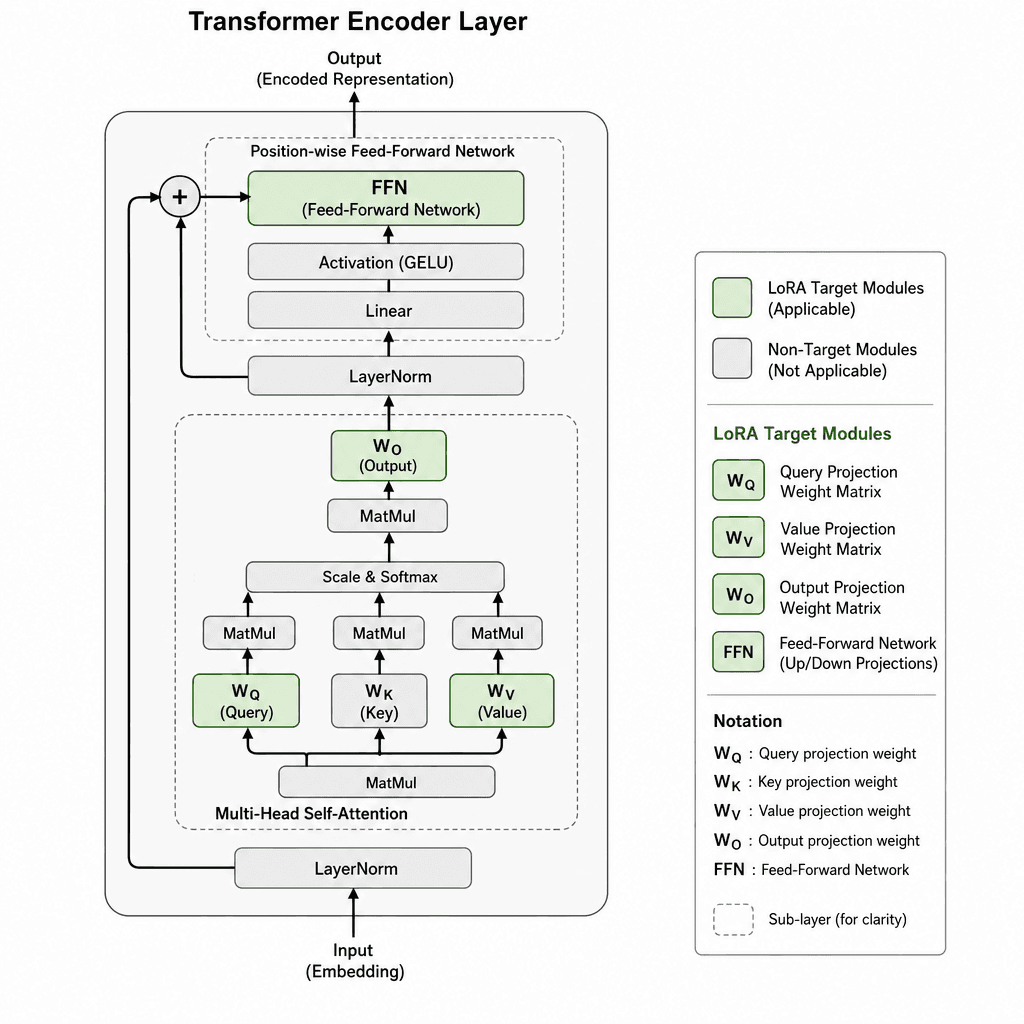
LoRA does not apply to every layer in the model. Applying it to all linear layers increases memory usage and training time without significant performance gains. Instead, LoRA is typically applied to specific "target modules" within the Transformer block.
The most common targets are the query () and value () projection matrices in the self-attention mechanism. These layers are responsible for projecting inputs into the latent space where attention is computed. Changes here directly influence how the model attends to different parts of the sequence, making them highly sensitive to task-specific nuances.
Other common targets include the output projection () and the feed-forward network (FFN) layers. The FFN layers, which process the attended information, also benefit from adaptation because they encode domain-specific knowledge. For example, in instruction-tuning tasks, updating the FFN layers helps the model learn new formatting rules and response patterns.
The choice of target modules affects both performance and efficiency. A minimal configuration might target only and , while a more comprehensive configuration might include , , and even embedding layers. The trade-off is between memory savings and model capacity. Targeting more layers increases the number of trainable parameters but can improve performance on complex tasks.
Practical Trade-offs and Workflow
When implementing LoRA, ML engineers must balance rank, alpha, and target modules against hardware constraints and task complexity.
Memory Efficiency: LoRA significantly reduces the memory footprint for training. Since only and matrices are updated, the optimizer states (e.g., Adam's momentum and variance) are stored only for these small matrices. This allows training larger models on smaller GPUs or using larger batch sizes. For inference, LoRA weights can be merged back into the base weights, resulting in no additional latency. Alternatively, they can be kept separate and added at runtime, which incurs a small computational overhead but preserves the ability to switch adapters dynamically.
Convergence Behavior: Higher ranks () allow for more expressive updates but require more data and compute to converge. Lower ranks () are sufficient for many tasks and converge faster. For instance, on instruction-tuning benchmarks, often performs comparably to when combined with sufficient training data.
Hyperparameter Tuning: A typical starting point for LoRA hyperparameters might be:
- Rank (): 8, 16, or 32
- Alpha (): 16, 32, or 64 (often $2r$)
- Learning Rate: $1e-4$ to $5e-4$ (often higher than full fine-tuning due to fewer parameters)
- Dropout: 0.05 to 0.1 to prevent overfitting
Engineers should monitor validation loss closely. If the model overfits quickly, consider lowering the learning rate or increasing dropout. If it underfits, consider increasing the rank or adding more target modules.
Common Pitfalls
When configuring LoRA, several pitfalls can degrade performance or stability:
- Excessive Alpha: Setting too high relative to (e.g., ) can cause training instability and divergence. The effective learning rate becomes too large, causing the model to overshoot optimal weights.
- Ignoring Learning Rate Adjustments: Changing the rank changes the scale of the update. If you increase without adjusting the learning rate, you may need to reduce the learning rate to maintain stability, as the magnitude of increases.
- Over-targeting Layers: Applying LoRA to every linear layer (including output projections and embeddings) can negate memory benefits and introduce noise. Stick to , , and optionally or FFN unless benchmarking shows a clear gain.
Practical Takeaways
To optimize your LoRA implementation:
- Start Simple: Begin with and ($2r$). This is a robust baseline for most instruction-tuning tasks.
- Monitor Validation Loss: Use validation loss to detect overfitting early. If loss plateaus or rises, reduce learning rate or dropout.
- Merge for Inference: For production deployment, merge LoRA weights into the base model to eliminate runtime overhead and simplify deployment.
- Iterate: If performance is insufficient, increase or add target modules (like FFN) before adjusting other hyperparameters.
FAQ
What is the difference between rank and alpha? Rank () determines the dimensionality of the low-rank subspace, controlling the model's capacity to learn new patterns. Alpha () is a scaling factor that controls the magnitude of the update relative to the rank. They are coupled: the effective learning rate is proportional to .
Can LoRA be used for inference? Yes. LoRA weights can be merged into the base model weights before inference, resulting in zero latency overhead. Alternatively, they can be kept separate and applied dynamically at runtime, which allows for multi-adapter switching but adds slight computational cost.
How do I choose target modules? Start with the Query () and Value () matrices in attention layers, as they are most critical for semantic understanding. If performance is insufficient, add Output () or Feed-Forward Network (FFN) layers. Avoid targeting all layers unless necessary, as it increases memory usage without proportional gains.
Conclusion
LoRA provides a efficient and effective method for fine-tuning LLMs by leveraging low-rank decomposition. By understanding the interplay between rank, alpha, and target modules, engineers can optimize their training workflows for both performance and resource efficiency. The key is to start with minimal configurations and iteratively adjust based on empirical results, ensuring that the model adapts to the new task without unnecessary computational overhead.
Related posts
Unsloth: Fine-Tuning 2x Faster on One GPU
Learn how Unsloth accelerates fine-tuning by 2x using Triton kernels and LoRA, enabling efficient model training on a single GPU.
LoRA Adapters at Serve Time with vLLM Multi-LoRA
Learn how to serve multiple LoRA adapters concurrently in vLLM for efficient multi-tenant inference.
OWASP Top 10 for LLM Applications, Applied
A practical examination of the OWASP Top 10 for LLM Applications, covering security checklists, mitigations, and appsec review processes for developers.
