
Should You Fine-Tune? A Decision Framework
A decision framework for ML engineers and managers to determine when to fine-tune large language models versus using prompting techniques.
The question "Should I fine-tune?" is rarely about whether a model can perform a task. Modern large language models (LLMs) can perform almost any task via prompting if given enough context and guidance. However, the core trade-off lies between the flexibility of prompting and the performance or cost efficiency of fine-tuning. Engineering leaders need a structured decision process to navigate this choice effectively. To decide between these approaches, you must understand the mechanical differences in how they interact with the model’s architecture.
Part 1 of the Fine-Tuning LLMs Hands-On series.
Fine-tuning is not a magic bullet for accuracy; it is a mechanism for reducing the computational burden of inference and enforcing structural constraints. To decide between fine-tuning and advanced prompting, you must understand the mechanical differences in how these techniques interact with the model’s architecture.
The Mechanism of Prompting: Context as State
Prompting relies on in-context learning (ICL), which serves as the primary alternative to fine tuning. When you provide examples or instructions in the prompt, you are not changing the model’s weights. Instead, you are manipulating the attention mechanism to focus on specific patterns within the provided context window.
The model processes every token in the prompt during every inference step. This creates a quadratic scaling problem for compute in the attention mechanism: doubling the context length roughly quadruples the computation required for the attention matrix (optimization techniques like FlashAttention improve memory efficiency but do not change this underlying complexity).
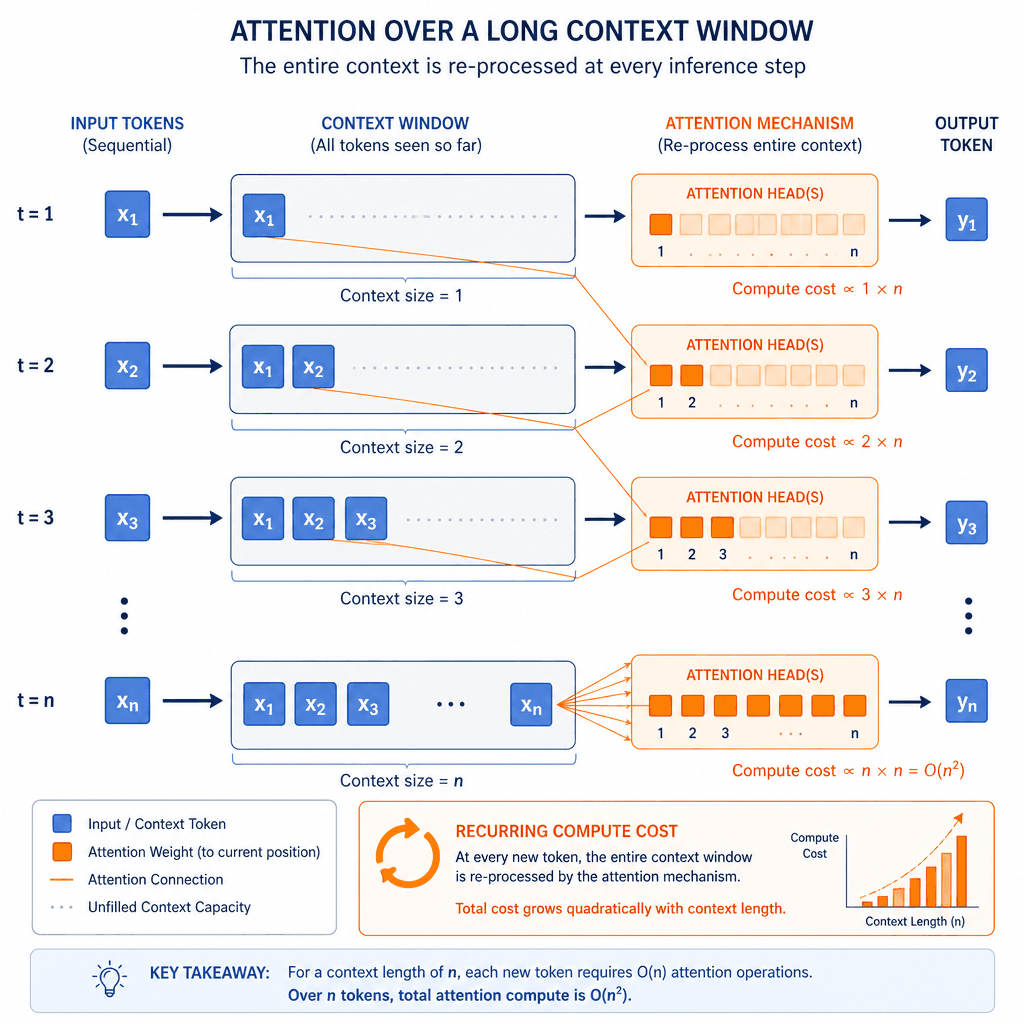
Worked Scenario: The Legal Analyst Imagine you build a system that summarizes legal contracts. You use a base model like Llama 3 or GPT-4o. Your prompt includes:
- A system instruction defining the role.
- Few-shot examples of contract clauses and their summaries.
- The target contract text.
If your few-shot examples are extensive to ensure high accuracy, you consume a large portion of the context window. Every time a user submits a new contract, the model must re-compute attention over all those examples and instructions. This is recurring compute cost.
When Prompting Fails:
- Format Adherence: If you need strict JSON output with specific nested structures, prompting often fails because the model prioritizes generating plausible text over adhering to rigid schema constraints, especially in longer contexts.
- Latency: Long prompts increase time-to-first-token (TTFT) because the model must encode the entire context before generating a single output token.
The Mechanism of Fine-Tuning: Weights as Bias
Fine-tuning uses backpropagation to adjust the model’s weights. It doesn’t add information; it reweights existing knowledge to make certain behaviors more probable.
When you fine-tune, you are essentially teaching the model a new "prior." Instead of asking the model to "remember" a format from the prompt, you bake the format into the model’s parameters. This shifts the model’s behavior at the fundamental level.
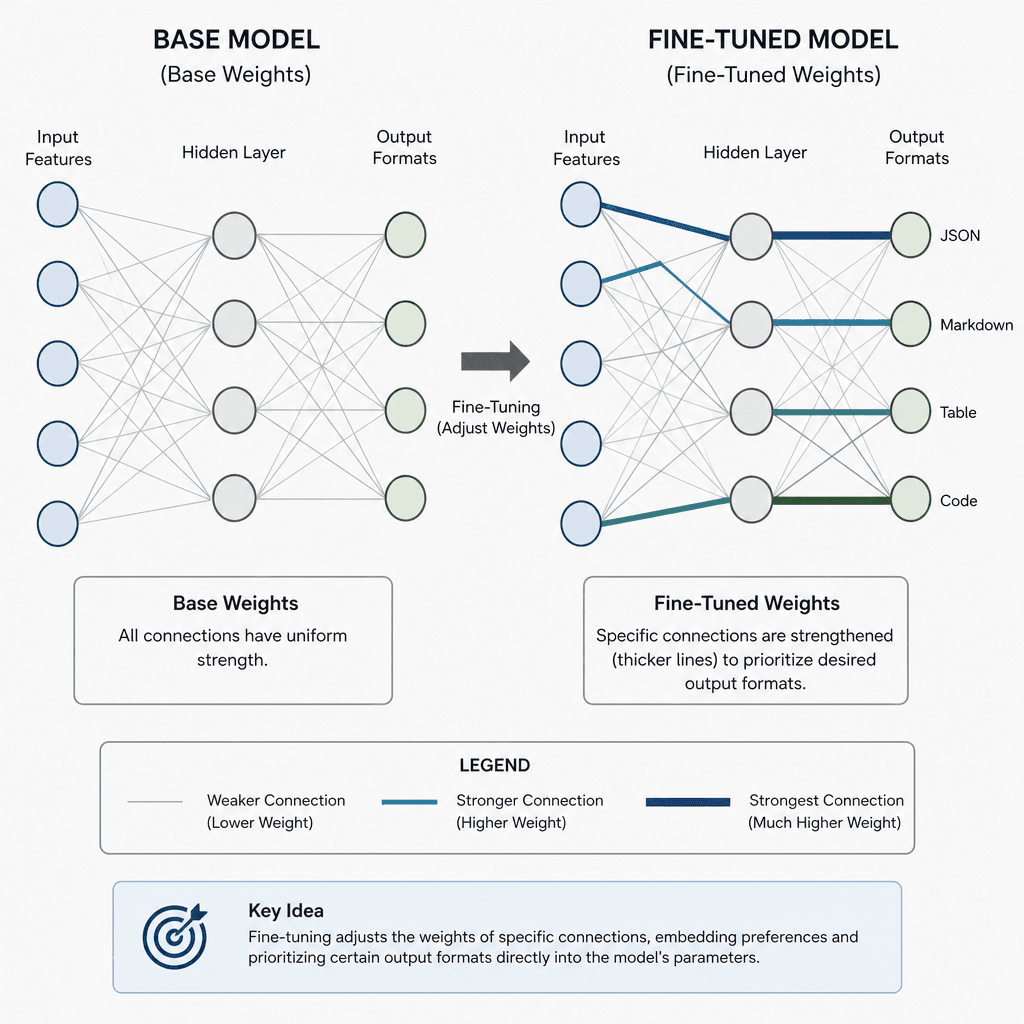
Worked Scenario: The Same Legal Analyst You fine-tune Llama 3 on 1,000 examples of contract clauses and their JSON summaries. The model’s weights now inherently understand that legal summaries should be structured as JSON.
During inference, your prompt is minimal:
{"task": "summarize", "input": "Contract text here..."}The model generates the output without needing to re-process dozens of examples. The "memory" of the format is stored in the weights, not the context window.
The Decision Matrix: Data, Cost, and Reliability
This decision framework outlines the key factors in the comparison of prompting versus fine-tuning, helping you determine the optimal approach based on your specific constraints.
1. Data Availability and Quality
- Prompting: Best when you have zero or very few examples (zero-shot or few-shot). It leverages the model’s pre-trained general knowledge.
- Fine-Tuning: Best when you have hundreds to thousands of high-quality examples specific to your domain. If your data is noisy or small, fine-tuning will likely overfit, degrading performance compared to prompting.
2. Format and Structure Constraints
- Prompting: Struggles with strict structural outputs (e.g., valid JSON, SQL queries, specific XML tags) in complex scenarios. The model may hallucinate formatting errors.
- Fine-Tuning: Excels at format consistency. By training on structured outputs, the model learns to generate valid syntax reliably. If your downstream pipeline breaks due to malformed output, fine-tuning is the solution.
3. Cost and Latency Trade-offs
- Prompting: High recurring inference cost. You pay for every token in the prompt. If your prompt is 4,000 tokens long, you pay for those 4,000 tokens on every single request.
- Fine-Tuning: High one-time training cost, but lower recurring inference cost. Since the prompt is shorter (no need for few-shot examples), you save on token usage per request. Over thousands of requests, fine-tuning becomes cheaper.
Example Calculation: Assume an API charges $0.01 per 1,000 input tokens.
- Prompting: 4,000 input tokens/request × 10,000 requests = 40 million tokens → $400.
- Fine-Tuning: 500 input tokens/request × 10,000 requests = 5 million tokens → $50. Note: Fine-tuning training cost might be $50–$100, making it profitable after roughly 1,500–3,000 requests.
Practical Implementation Steps
- Start with Prompting: Always begin with advanced prompting techniques (chain-of-thought, few-shot). This is the lowest effort and fastest iteration loop.
- Evaluate Failure Modes: If the model produces inconsistent formats, ignores instructions in long contexts, or requires excessive prompt length, consider fine-tuning. Understanding when to fine tune is critical here; look for signs of diminishing returns in prompt length versus accuracy gains.
- Prepare Data: Collect 100–1,000 high-quality input-output pairs. Ensure the output matches your desired format exactly.
- Fine-Tune: Use parameter-efficient methods like LoRA (Low-Rank Adaptation) to reduce computational resources. LoRA allows you to fine-tune a large model by training only a small subset of parameters, leaving the base model unchanged. (Source: https://arxiv.org/abs/2106.09685)
- Test Rigorously: Evaluate fine-tuned models against the base model using the same test set. Measure both accuracy and format adherence.
Conclusion
Fine-tuning is a structural optimization, not a performance panacea. Use it when you need to enforce strict formats, reduce recurring inference costs, or improve reliability in a specific domain with sufficient data. Use prompting when you need flexibility, have limited data, or want to iterate quickly.
The choice is not binary; many production systems use a hybrid approach: fine-tuned models for core task execution, combined with dynamic prompting for additional context or user-specific instructions. Ultimately, this decision framework provides the structured approach needed to select the right tool for the job.
Related posts
Axolotl Configs Explained Line by Line
A detailed breakdown of Axolotl YAML configuration files for fine-tuning models with DeepSpeed and custom dataset formats.
Hyperparameters That Actually Matter
A practical examination of key hyperparameters like learning rate, batch size, and epochs for ML engineers fine-tuning LLMs.
Building a Supervised Fine-Tuning Dataset
A practical guide to constructing high-quality SFT datasets for instruction tuning, covering chat templates, loss masking, and data quality standards.
