Risk-Based vs Adaptive Auth: Policy Design
An examination of risk-based and adaptive authentication mechanisms, focusing on policy design and step-up verification for identity engineers.
Risk-Based vs Adaptive Authentication: Engineering the Policy Layer
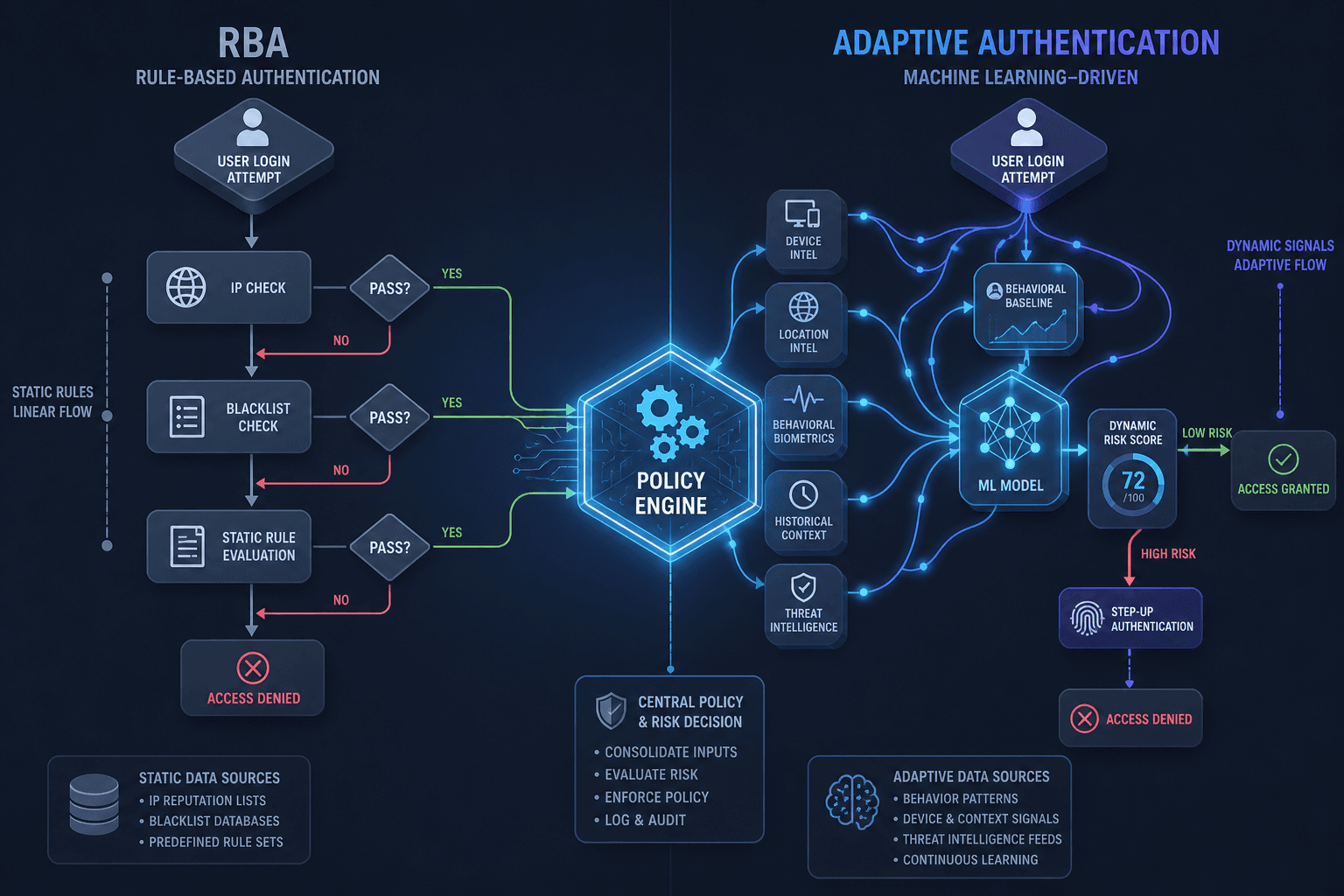
For identity engineers, the distinction between Risk-Based Authentication (RBA) and Adaptive Authentication is often blurred in marketing materials, but the engineering implications are stark. RBA is a rule-based system that evaluates discrete signals against static thresholds to make an immediate access decision. Adaptive Authentication is a broader framework that incorporates machine learning, continuous monitoring, and behavioral analysis to adjust authentication requirements dynamically over time. The core difference lies in determinism versus probability, and static evaluation versus continuous context. Understanding this difference is critical for designing effective security architectures.
The Mechanics of Risk-Based Authentication
RBA operates on a deterministic logic engine. When a user attempts to authenticate, the system collects explicit signals—IP address, device ID, geolocation, and time of login—and maps them against predefined rules.
Consider a typical RBA workflow. A user logs in from an unrecognized IP. The system checks a whitelist of trusted IPs. If the IP is not found, it checks a blacklist of known malicious ranges. If the IP is clean, the system applies a rule:
IF ip_address NOT IN trusted_ips THEN require_mfa
This is a binary decision tree. The "risk score" in traditional RBA is often a weighted sum of these flags, but the weights are static and manually configured by administrators.
The limitation of pure RBA is its inability to handle nuance. It treats all "unrecognized device" events equally, regardless of whether the user is traveling for business or if their account has been compromised. It lacks memory of past behavior and cannot distinguish between a legitimate new device usage and a brute-force attack vector without complex, manually maintained rules.
Adaptive Authentication: Context and Probability
Adaptive authentication extends RBA by integrating probabilistic models and behavioral biometrics. Instead of relying solely on explicit signals, it analyzes implicit data points: typing rhythm, mouse movements, touch pressure, and navigation patterns. These signals are fed into machine learning models that build a baseline of "normal" behavior for each user.
When a login attempt occurs, the adaptive system calculates a risk score based on the deviation from this baseline. For example, if a user typically logs in from New York at 9 AM and types at 60 words per minute, a login from London at 3 AM with erratic typing patterns triggers a high-risk score, even if the IP address is not on a blacklist. The system then adapts the authentication challenge. It might require step-up verification (e.g., a push notification approval) or block the login entirely.
The key mechanism here is continuous learning. The system updates the user’s profile in real-time. If the user successfully completes the step-up challenge, the system may lower the risk score for future logins from that context, recognizing the behavior as legitimate. This reduces false positives over time, a significant advantage over static RBA rules.
Step-Up Verification: The Engine of Adaptivity
The primary operational output of adaptive authentication is step-up verification. This is the dynamic selection of authentication factors based on the calculated risk. The policy engine determines which factor is required:
- Low Risk: Password only.
- Medium Risk: Password + SMS OTP or Push Notification.
- High Risk: Password + Biometric Verification or Hardware Key.
From an engineering perspective, implementing step-up verification requires a flexible policy language. The system must support conditional logic that can evaluate multiple signals simultaneously. For instance, a policy might state:
IF risk_score > 0.8 AND device_trust_level == 'low' THEN require_biometric
The challenge is designing these policies to minimize friction. Overly aggressive step-up requirements lead to user fatigue and increased support tickets. Overly permissive policies leave the system vulnerable to credential stuffing and account takeover. The engineer’s task is to tune the thresholds that trigger step-up verification.
Policy Design Strategies
Effective policy design requires balancing security with user experience. Here are key considerations for identity engineers:
Signal Selection and Weighting
Not all signals are created equal. IP reputation is a strong signal, but it is easily spoofed. Device fingerprinting is more robust but raises privacy concerns. Behavioral biometrics are highly accurate but require significant data collection and processing power. Engineers must prioritize signals based on their predictive value and privacy impact.
Threshold Tuning
Static thresholds are ineffective in adaptive systems. Instead, engineers should use machine learning models to dynamically adjust thresholds based on historical data. For example, if a user frequently travels, the system should learn to lower the risk score for logins from different geographic locations. This requires a feedback loop where successful authentications reinforce the model’s understanding of legitimate behavior.
Handling Edge Cases
Edge cases, such as new device registration or account recovery, require special handling. In these scenarios, the lack of historical data makes risk scoring unreliable. Engineers must define fallback policies for these situations, such as requiring additional identity verification steps (e.g., email confirmation or security questions) until a behavioral baseline is established.
Conclusion
Adaptive authentication is not a replacement for risk-based authentication but an evolution of it. By incorporating machine learning and behavioral analysis, adaptive systems provide a more nuanced and secure approach to identity management. The engineering focus should shift from maintaining static rules to designing flexible policies that can adapt to changing threat landscapes and user behaviors. This approach aligns with modern standards such as NIST SP 800-63B for digital identity guidelines and FIDO2 specifications for passwordless authentication, ensuring compliance while reducing friction. The ultimate goal is to create a smooth security experience that protects users without imposing unnecessary friction.
Common Pitfalls
- Over-reliance on Single Signals: Relying solely on IP reputation or device fingerprinting can lead to high false-positive rates. A multi-signal approach is essential for accuracy.
- Ignoring User Feedback: Failing to incorporate user feedback on false positives can degrade the model's performance over time. Regularly review and adjust policies based on support tickets and user reports.
- Neglecting Privacy Compliance: Collecting behavioral data must comply with regulations like GDPR and CCPA. Ensure transparent data handling practices and obtain necessary consents.
Practical Takeaways
- Start with RBA: Implement basic risk-based rules before moving to adaptive systems. This provides a foundation for understanding user behavior and threat patterns.
- Tune Thresholds Continuously: Use historical data to refine risk thresholds. Regularly review and adjust policies to balance security and user experience.
- Leverage Standards: Align your authentication policies with industry standards like NIST and FIDO2 to ensure best practices and compliance.
FAQ
Q: What is the main difference between RBA and Adaptive Authentication? A: RBA uses static rules and explicit signals for immediate decisions, while Adaptive Authentication uses machine learning and behavioral data to dynamically adjust authentication requirements over time.
Q: How does adaptive authentication reduce false positives? A: By continuously learning from user behavior and adjusting risk scores based on historical data, adaptive systems can distinguish between legitimate anomalies and actual threats more accurately.
Q: Is adaptive authentication suitable for all organizations? A: While beneficial for many, adaptive authentication requires significant data collection and processing capabilities. Organizations should assess their resources and privacy requirements before implementation.
Related posts
acr_values and amr: Requesting Authentication Strength
Explore how acr_values and amr claims define authentication strength in OpenID Connect, enabling step-up authentication and MFA enforcement.
Validating a SAML Assertion Correctly
A technical walkthrough on validating SAML assertions, covering audience restrictions, timestamp checks, and replay prevention for secure identity flows.
SAML Single Logout (SLO): The Mechanics of Session Termination
A technical examination of SAML Single Logout (SLO) mechanisms, covering front-channel and back-channel flows, session index handling, and protocol compliance for identity engineers.
