Shadow Traffic for LLM Deployments
Explore how shadow traffic and traffic mirroring enable safe comparison of candidate LLM models in production without impacting user experience.
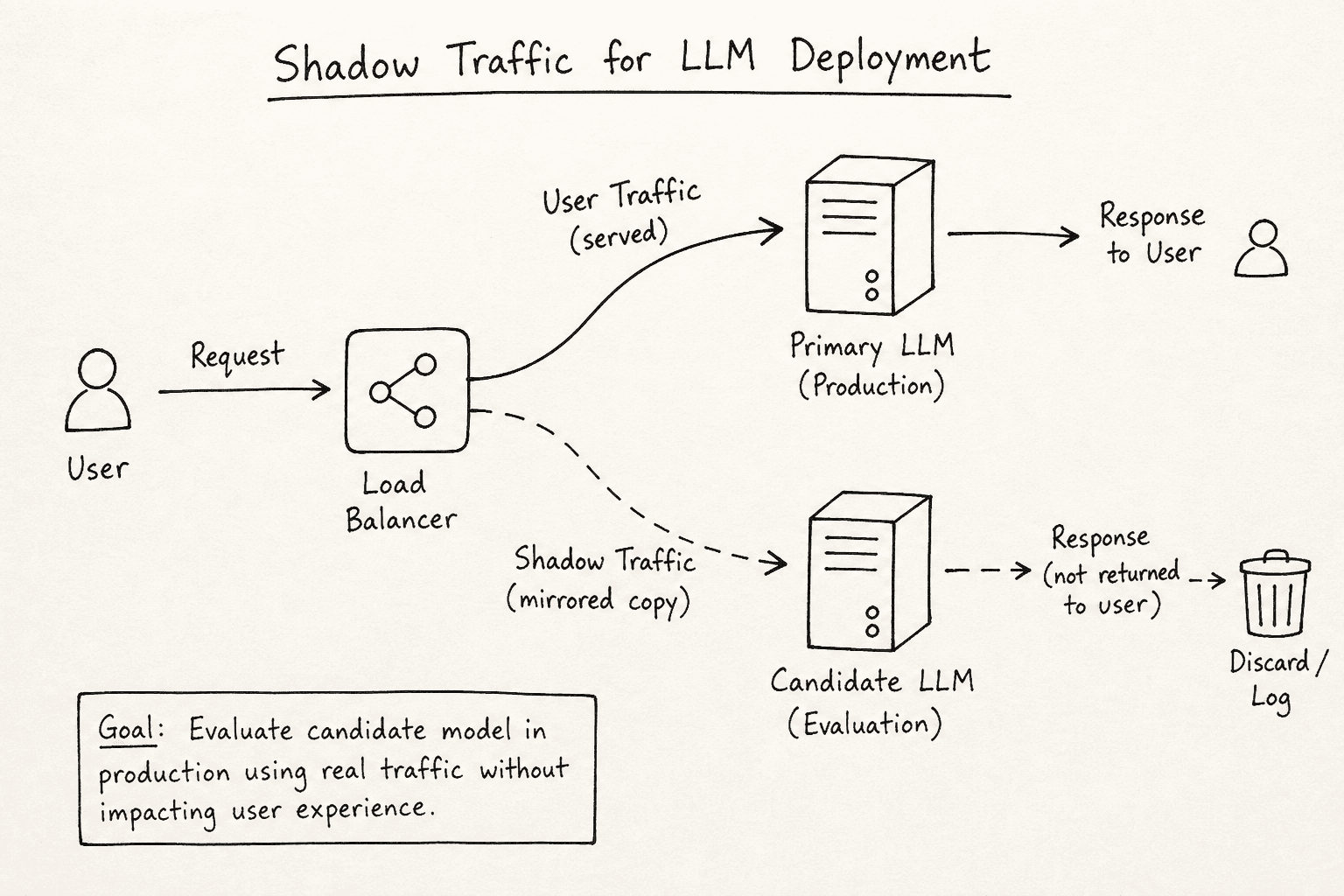
Deploying a Large Language Model (LLM) into production is fundamentally different from deploying traditional stateless microservices. An LLM’s output is probabilistic, computationally expensive, and sensitive to subtle prompt engineering changes. A regression in an LLM might not cause a 500 error; it might return a confidently incorrect answer, introduce a security vulnerability via prompt injection, or violate brand tone. Traditional A/B testing requires routing live traffic to the new model, meaning any defect immediately impacts users. Shadow traffic (or traffic mirroring) solves this by allowing you to send a copy of production traffic to a candidate model in parallel, without exposing the user to its results.
The Mechanism of Mirroring
Traffic mirroring operates at the network or service mesh layer. When a request arrives at the ingress point—whether an API Gateway, Load Balancer, or Sidecar proxy—the system performs two actions simultaneously:
- It forwards the original request to the primary model (the one currently serving users).
- It creates a duplicate packet or message and sends it to the candidate model (the one being evaluated).
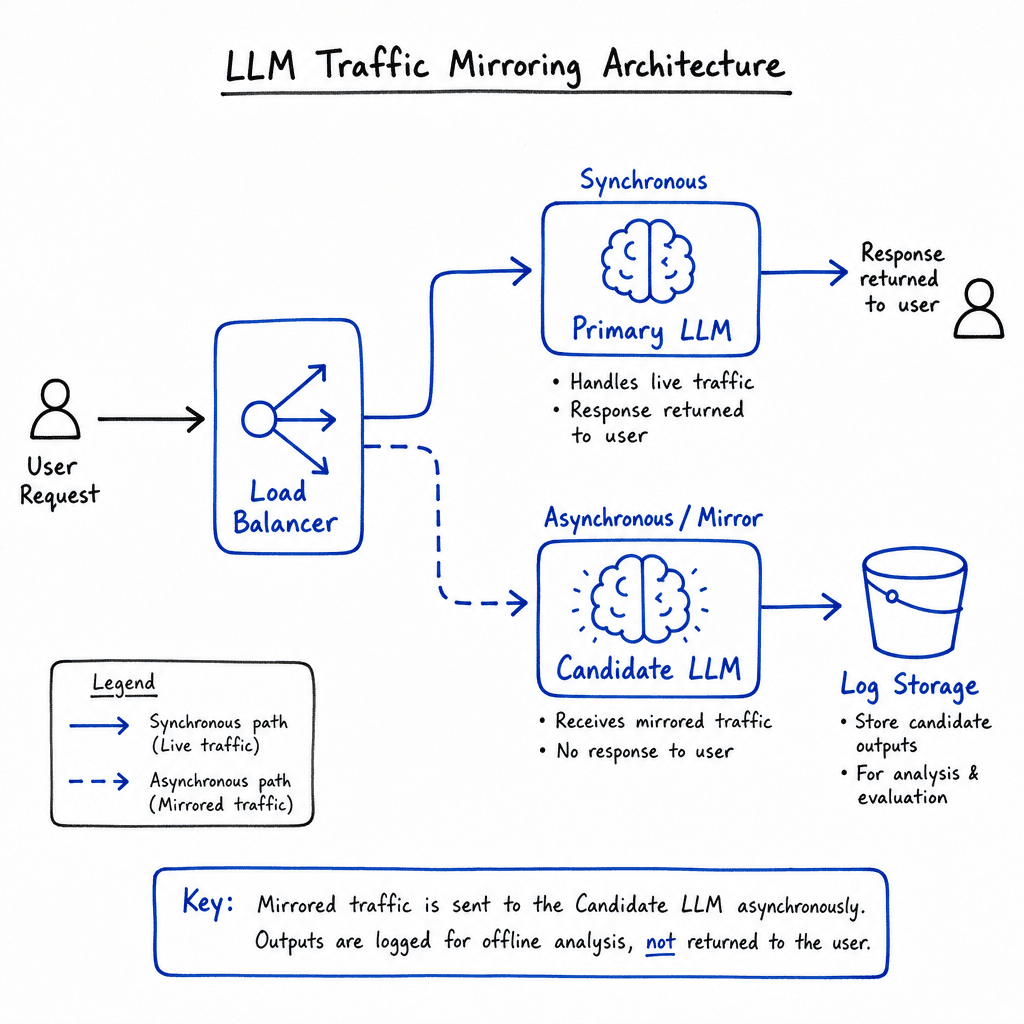
The critical architectural constraint is that these two paths are independent. The candidate model operates in a "shadow" mode. It receives the full payload, performs inference, and generates a response, but this response is never returned to the client. Instead, it is captured in a log or a message queue for asynchronous analysis.
For example, in a Kubernetes environment using Istio, this can be configured via a VirtualService with a mirror field. The primary service handles the synchronous response, ensuring the user’s latency is determined solely by the primary model’s performance. The mirrored traffic is handled by a separate deployment, often scaled independently to manage the additional load.
# Simplified Istio VirtualService for traffic mirroring
apiVersion: networking.istio.io/v1beta1
kind: VirtualService
metadata:
  name: llm-service
spec:
  hosts:
  - api.example.com
  http:
  - route:
    - destination:
        host: primary-llm-service
    mirror:
      host: candidate-llm-service
    mirrorPercentage:
      value: 100.0
In this configuration, 100% of traffic is mirrored. In production, you might start with mirrorPercentage: 1.0 (1%) to minimize resource consumption while still gathering statistically significant samples over time.
The Asynchronous Evaluation Loop
The value of shadow traffic lies in what happens after the candidate model responds. Since the user never sees the candidate’s output, the evaluation must be automated and offline. This requires a comprehensive observability pipeline.
When the candidate model generates its response, the system logs the following artifacts:
- Input Prompt: The exact text sent to the model.
- Candidate Output: The generated text.
- Primary Output: The text returned to the user (for comparison).
- Latency: Time taken for the candidate to respond.
- Metadata: Model version, temperature settings, and token counts.
These logs are then processed by an evaluation engine. For LLMs, simple success/failure metrics are insufficient. You need semantic evaluation. For instance, if the primary model answers "The capital of France is Paris," and the candidate answers "Paris is the capital of France," a string match might fail, but a semantic similarity score would indicate equivalence. Conversely, if the candidate hallucinates "The capital of France is London," the evaluation engine flags this as a critical defect.
Frameworks like RAGAS (Retrieval Augmented Generation Assessment) or TruEra can analyze these logs to compute metrics such as faithfulness, answer relevance, and context precision. These metrics allow you to perform model comparison against the primary model on a per-request basis, aggregating results to determine if the candidate model is statistically better, worse, or equivalent.
LLM-Specific Challenges
While traffic mirroring is a well-established pattern for microservices, applying it to LLMs introduces unique complexities.
1. Compute Cost and Scaling
LLM inference is resource-intensive. Mirroring 100% of production traffic means you are effectively doubling your compute costs during the evaluation period. If your primary model runs on expensive GPU instances, the candidate model must have equivalent capacity. However, you can mitigate this by:
- Sampling: Mirroring only a fraction of traffic (e.g., 1-5%).
- Dedicated Hardware: Running the candidate model on separate, potentially smaller, GPU instances if the candidate is a smaller model (e.g., comparing Llama-3-8B against Llama-3-70B).
- Batching: If the candidate model supports batched inference, you can process mirrored requests in batches to improve throughput and reduce cost.
2. Non-Determinism and Consistency
LLMs are non-deterministic. Even with the same prompt and temperature, the model may produce slightly different outputs on different runs. This makes direct comparison tricky. To ensure fair evaluation, you should:
- Lock Seed Values: If possible, set a fixed random seed for the candidate model during evaluation to ensure reproducibility.
- Aggregate Metrics: Evaluate over thousands of requests rather than individual ones. Small variations average out, revealing true performance trends.
3. Data Privacy and Security
Mirroring traffic means copying potentially sensitive user data (PII) to the candidate model’s environment. If the candidate model is hosted in a different region or by a third-party provider, this could violate GDPR, HIPAA, or other compliance standards. Mitigation strategies include:
- On-Premise Deployment: Run the candidate model in the same secure environment as the primary model.
- Data Anonymization: Strip PII from the mirrored requests before sending them to the candidate. This can be done using regex patterns or dedicated NLP models for entity recognition and redaction.
- Access Controls: Restrict access to the mirrored logs so that only authorized evaluation pipelines can read the data.
Operational Tradeoffs and Safety
Shadow traffic is an effective tool, but it is not without risks. The primary risk is that the candidate model, under heavy load, might exhibit unexpected behavior. For example, a memory leak in the candidate’s serving infrastructure could cause it to crash, taking down the entire node and affecting the primary model if they share resources.
To mitigate this, always deploy the candidate model in a separate namespace or cluster with independent resource limits. Use Kubernetes Horizontal Pod Autoscaler (HPA) to scale the candidate model based on queue depth, not just CPU usage, to handle bursty mirrored traffic.
Additionally, implement circuit breakers. If the candidate model’s error rate exceeds a threshold (e.g., 5% of requests fail or timeout), automatically stop mirroring traffic. This prevents the evaluation process from overwhelming the infrastructure or skewing the logs with noise, which is a critical safety consideration for any llm deployment.
Conclusion
Shadow traffic enables safe, data-driven LLM deployment. By decoupling evaluation from user experience, you can test new models against real-world production load without risking user satisfaction. The key is to treat the mirrored traffic as a first-class citizen in your observability stack. Invest in automated evaluation pipelines that can handle the semantic complexity of LLM outputs, and manage the computational cost through careful scaling and sampling. With this approach, you can iterate on LLM versions with confidence, knowing exactly how they perform before they ever touch a user’s screen.
Related posts
Online Evals: A/B Tests, Canaries, and Guarded Rollouts
Learn how to implement online evaluations using A/B tests, canary releases, and guardrail metrics to safely deploy LLM features.
Building an LLM Load Test That Reflects Real Traffic
A guide to building LLM load tests that reflect real traffic patterns using capacity planning, arrival rates, and saturation metrics.
Zero-Downtime Model Rollouts: Strategies for Continuous ML Availability
Explore strategies for zero-downtime model rollouts, including blue-green deployments, rolling updates, and readiness probes to ensure continuous availability.
