
Forgetting on Purpose: Decay, Conflict, and Consolidation
Explore how agent memory systems use decay, conflict resolution, and consolidation to manage data effectively and ensure GDPR compliance.
In traditional software engineering, data persistence is absolute. In AI agent systems, persistence is a liability. As agents accumulate interaction history, context windows overflow, retrieval latency spikes, and semantic drift corrupts decision-making. The solution is not infinite storage; it is intentional forgetting. Effective agent memory architectures treat forgetting as a first-class citizen, utilizing decay, conflict resolution, and consolidation to maintain a lean, consistent, and compliant knowledge base.
The Mechanics of Decay
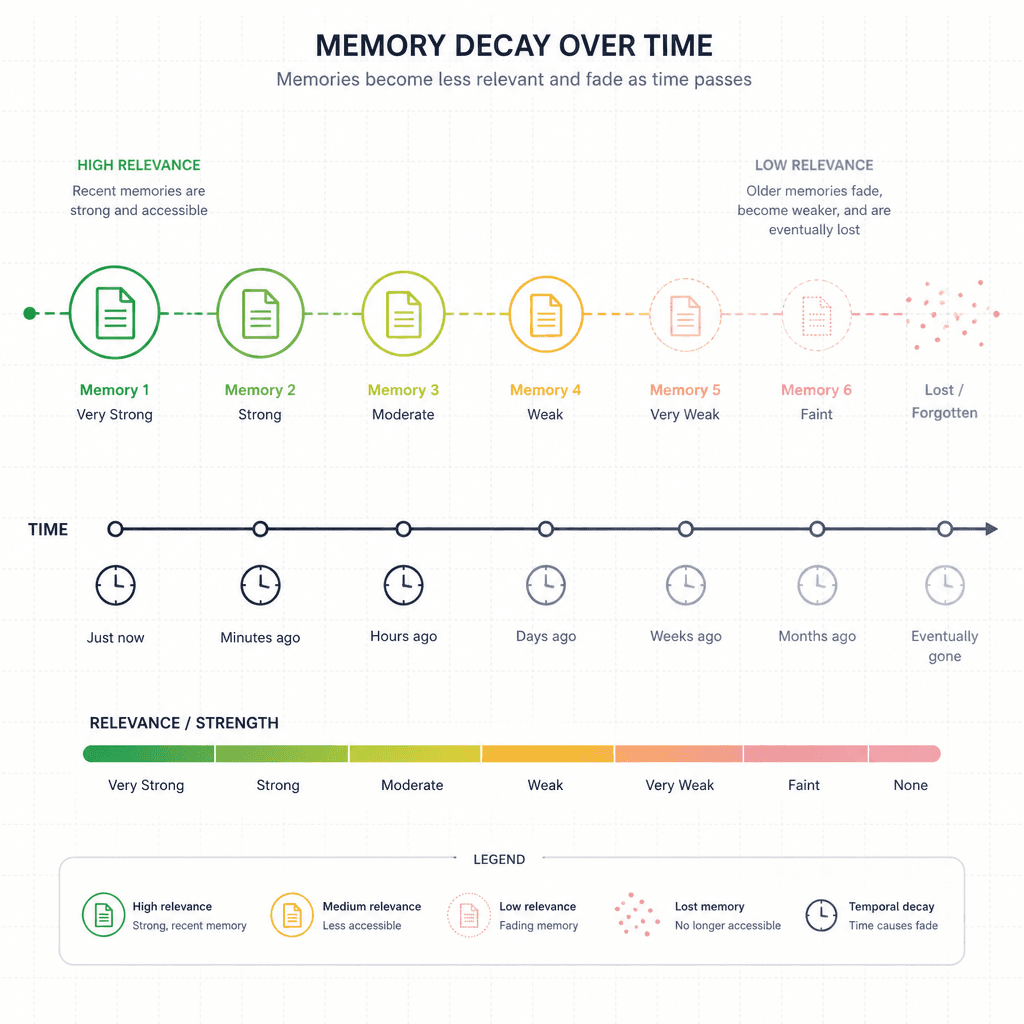
Memory decay prevents the unbounded growth of an agent’s state. Without decay, every past interaction competes equally with current context for limited attention resources. Decay functions assign a temporal or relevance-based weight to memory entries, ensuring that older or less pertinent information gradually loses influence over the agent’s behavior.
Two primary mechanisms drive this process:
- Temporal Decay: Memories are assigned a timestamp upon creation. A decay function, typically exponential, reduces the memory’s "activation energy" over time. In vector search systems, this often translates to boosting the score of recent vectors or demoting older ones during retrieval.
- Relevance Decay: Beyond time, memories decay if they are not accessed. If a specific fact (e.g., a user’s preferred coffee type) is never referenced in subsequent interactions, its utility diminishes. Some systems implement "use-it-or-lose-it" policies where memories with zero retrieval hits are pruned after a threshold period.
Consider an agent managing a customer support ticket. The initial query ("My internet is down") has high immediate relevance. The resolution ("Restarted router") becomes relevant only during the troubleshooting phase. Once the ticket is closed, the specific technical steps decay in priority, leaving only the high-level outcome ("Resolved: Router restart") in long-term semantic memory. This ensures the agent does not clutter its context with obsolete procedural details.
Conflict Resolution
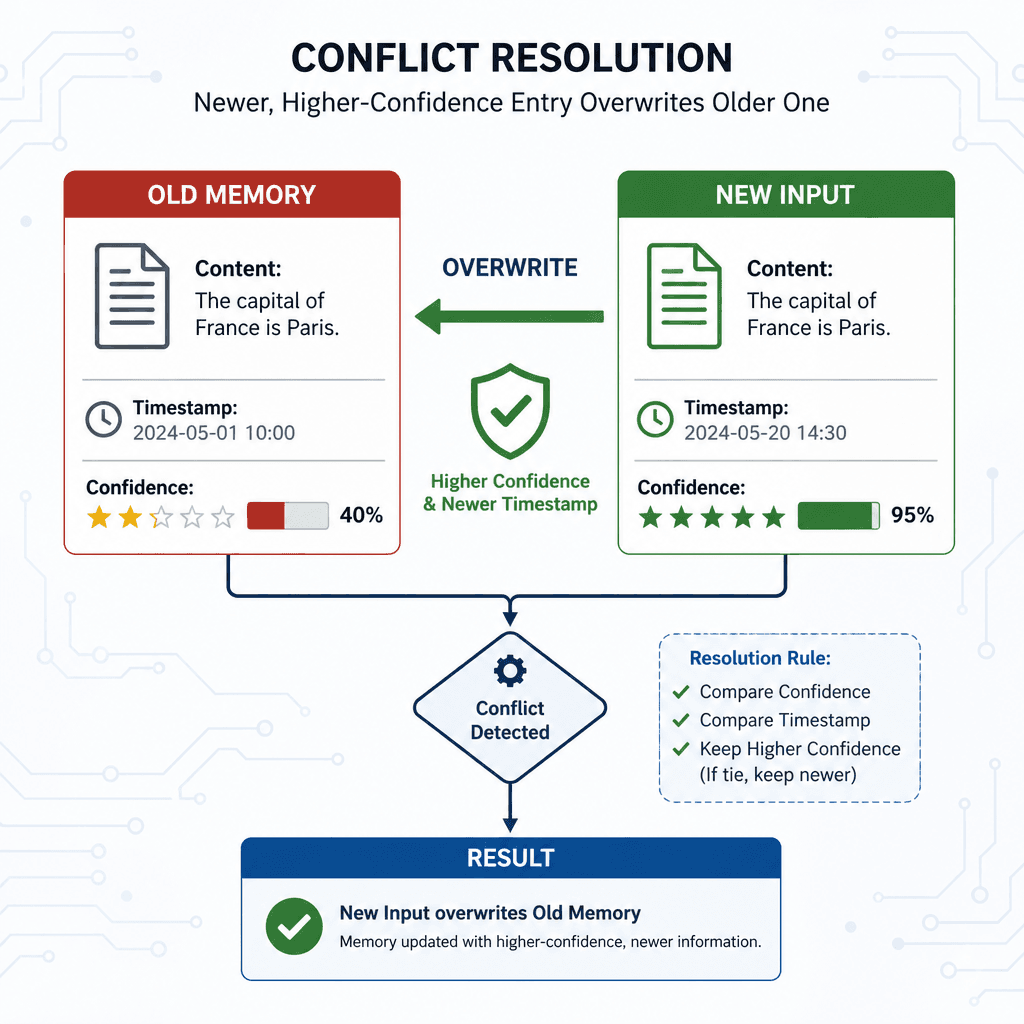
As agents learn, they inevitably encounter contradictory information. A user might update their address, or a previous assumption might be proven false by new evidence. Naive systems might store both versions, creating ambiguity. Conflict resolution strategies determine how the agent reconciles these discrepancies.
The most common approach is confidence-weighted overwriting. When a new input contradicts an existing memory, the system evaluates the confidence score of both the new input and the old memory. If the new input has higher confidence (e.g., derived from a verified source or a more recent, explicit statement), it overwrites the old entry.
Alternatively, versioned memory can be employed. Instead of overwriting, the system maintains a history of changes. However, this increases storage costs and complexity. For most scalable agent systems, versioned memory is reserved for high-stakes domains (like healthcare), while general-purpose agents use aggressive overwriting based on recency and confidence.
Example scenario:
- Memory A: "User lives in New York." (Created 6 months ago, low confidence due to vague input)
- Input B: "I moved to London last week." (High confidence, explicit statement)
The conflict resolution engine detects the contradiction between Memory A and Input B. Since Input B is recent and explicit, it overwrites Memory A. The old "New York" record is either deleted or marked as invalid. This prevents the agent from sending marketing emails to the wrong city.
Consolidation

Decay removes old data; consolidation compresses it. While decay handles the quantity of memories, consolidation handles the structure. Raw episodic memories (e.g., "User asked about Python lists on Tuesday") are inefficient for long-term reasoning. Consolidation transforms these episodic traces into semantic knowledge (e.g., "User is learning Python").
This process mimics biological memory consolidation, where the brain transfers information from short-term to long-term storage during sleep. In AI agents, consolidation typically occurs during idle periods or at defined intervals.
The mechanism involves:
- Clustering: Grouping related memories using vector similarity.
- Abstraction: Generating a summary or rule that captures the essence of the cluster.
- Pruning: Deleting the individual episodic memories, retaining only the abstracted semantic node.
For example, if an agent stores five separate interactions about "Python list comprehensions," consolidation might replace them with a single memory node: "User prefers concise Python code examples." This reduces the token footprint and improves retrieval efficiency by focusing on intent rather than specific historical instances.
GDPR and the Right to be Forgotten
Intentional forgetting is also a legal necessity. Under GDPR Article 17, individuals have the right to erasure of their personal data. For AI agents, this means providing a mechanism to permanently delete personal data upon request. Simple logical deletion (marking records as is_deleted=true) is insufficient if the data is still included in vector index calculations or model fine-tuning datasets.
Technical implementation requires cryptographic erasure or index invalidation. In vector databases, this involves removing the specific vector IDs from the index so they are no longer retrievable. For instance, in Pinecone, one might use the delete() method with specific IDs, or in Milvus, execute a delete expression. If the data is embedded in a model’s weights (via fine-tuning), complete erasure is technically challenging. Recent research into machine unlearning suggests methods such as gradient ascent on the training data to reverse the influence of specific samples, as described in recent machine unlearning research. However, these techniques are still evolving and may not guarantee perfect removal.
For most practical applications, agents should maintain a separate "PII Registry" that maps user IDs to their memory entries. Upon a deletion request, the system invalidates all references in the vector index and deletes the PII registry entries. This ensures that even if residual data exists in logs, it is inaccessible to the agent’s retrieval mechanisms.
Conclusion
Forgetting is not a failure of memory; it is a feature of intelligence. By implementing decay, conflict resolution, and consolidation, agent systems can maintain a lean, relevant, and legally compliant knowledge base. These mechanisms ensure that agents do not merely store data, but actively curate it, leading to more accurate, efficient, and trustworthy interactions. Current industry trends point toward the integration of standardized "Right to be Forgotten" APIs within memory frameworks, aligning technical architecture with emerging privacy regulations like the EU AI Act.
Related posts
Building a PII Redaction Layer for LLM Logs
Implement a PII redaction layer for LLM logs to ensure GDPR compliance and protect sensitive data during tokenization and retention.
Durable Execution for Agents with Temporal
Explore how Temporal enables durable execution for AI agents, ensuring resilience through checkpointing and replay mechanisms.
Computer-Use Agents: Architecture and Limits
An examination of computer-use agent architecture, focusing on GUI agents, screenshot processing, accessibility trees, and browser automation limits.
