Long-Term Memory: Episodic, Semantic, and Procedural
Explore episodic, semantic, and procedural memory types in AI agents to enhance long-term memory capabilities for ML engineers and developers.
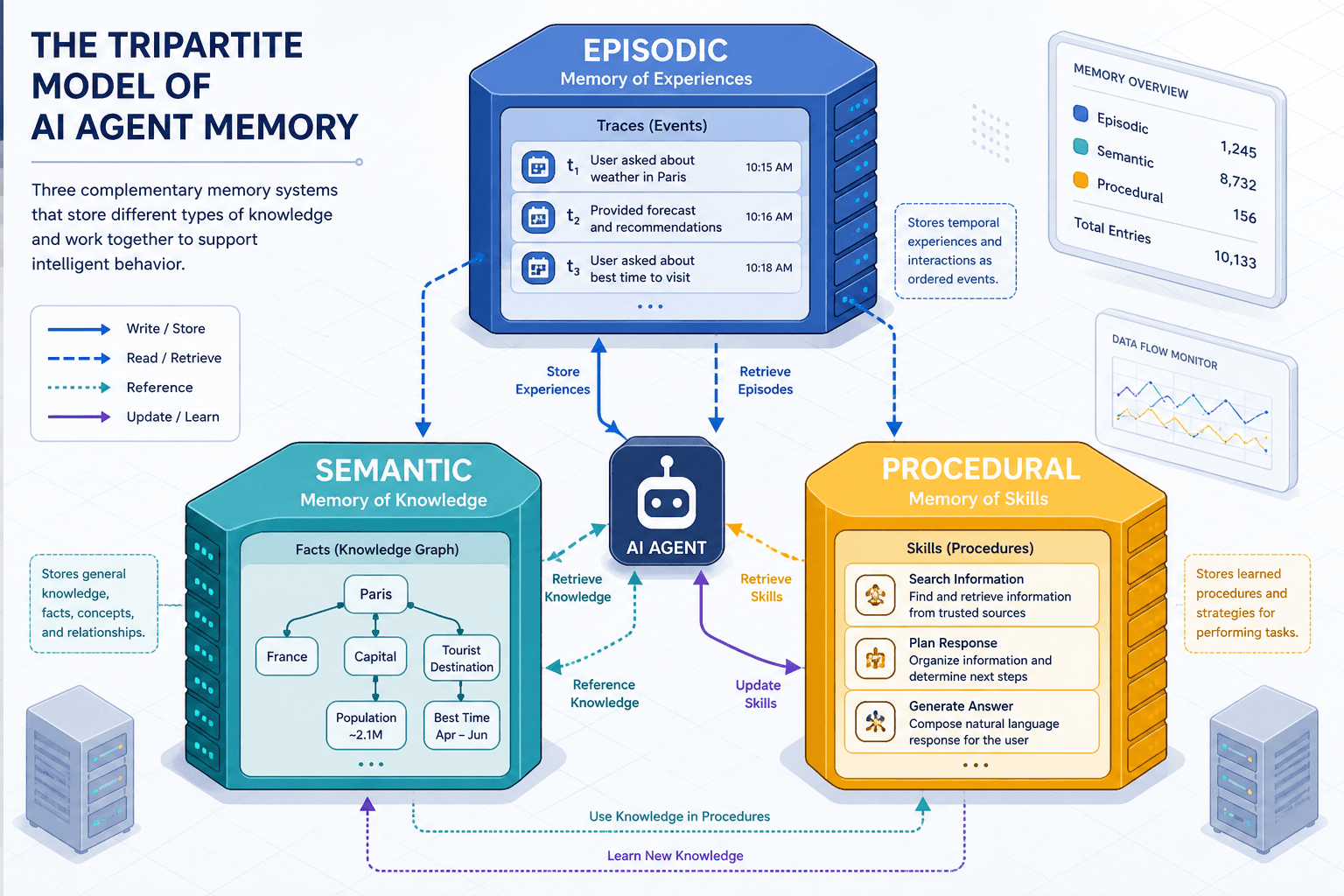
In large language model (LLM) agents, "memory" is often conflated with simple context window expansion or vector database storage. This conflation leads to brittle agents that either forget crucial historical context or drown in irrelevant noise. To build agents that improve over time, we must decompose long-term memory into three distinct mechanistic layers borrowed from cognitive science: Episodic, Semantic, and Procedural memory. Each layer serves a different data flow purpose: Episodic stores the raw history of interactions, Semantic abstracts that history into generalizable facts, and Procedural encodes successful actions as repeatable skills.
Episodic Memory: The Agent’s Autobiography
Episodic memory is the storage of specific, time-bound events. In an AI agent, this corresponds to the raw log of interactions: the state of the environment, the actions taken, the observations received, and the outcomes. Unlike semantic memory, which deals with facts, episodic memory deals with instances.
The mechanism here is trace-based. Every interaction generates a memory trace, typically structured as a tuple or a JSON object containing metadata (timestamp, session ID) and payload (user query, agent response, tool output). This structure adheres to a strict schema that ensures consistency across all logged events, allowing downstream processes to reliably parse and index historical data.
{
  "trace_id": "evt_9f8a7b6c",
  "timestamp": "2023-10-27T10:00:00Z",
  "context": {
    "user_query": "How do I reset my router?",
    "agent_action": "search(query='router reset instructions')",
    "observation": "Found 5 results. Top result: 'Unplug for 10 seconds.'",
    "outcome": "User confirmed success."
  }
}
Why it matters: Episodic memory enables self-reflection. By retrieving past traces, an agent can analyze its own performance. For example, if an agent failed a task, it can query its episodic memory for similar past failures to avoid repeating the same mistake. This is the foundation of learning from experience.
Mechanism Detail: Retrieval in episodic memory is usually similarity-based. The current context is embedded and compared against stored traces using cosine similarity or semantic search. However, pure similarity can be noisy; an agent might retrieve a trace about "resetting a router" when it should be thinking about "resetting a password." Therefore, episodic retrieval often requires filtering by metadata (e.g., domain tags, tool types).
Semantic Memory: The Agent’s Knowledge Base
Semantic memory is the storage of general knowledge, facts, and concepts, independent of the specific time or place they were acquired. In AI agents, this is the system’s "world model." It answers the question: "What is true?" rather than "What happened?"
The mechanism for building semantic memory involves abstraction. The agent takes raw episodic traces and extracts generalizable patterns. This can be done through:
- Explicit Extraction: Using an LLM to summarize an episodic trace into a factual statement (e.g., "Router resets require a 10-second power cycle").
- Implicit Learning: Updating a vector database or knowledge graph with dense embeddings of facts.
To ensure these facts remain useful for reasoning, semantic data is often structured via a formal schema within a knowledge graph. This schema defines the types of entities and relationships allowed, preventing the accumulation of unstructured noise and enabling logical inference across disparate pieces of information.
# Pseudo-code for semantic abstraction
episodic_trace = get_latest_trace()
semantic_fact = llm.extract_fact(
    input=episodic_trace.context,
    instruction="Extract one generalizable rule from this interaction."
)
save_to_semantic_memory(semantic_fact)
Why it matters: Semantic memory allows for generalization. An agent doesn’t need to have seen a specific problem before to solve it; it needs to know the underlying principle. If an agent has learned the semantic fact "TCP ports above 1024 are typically user-space," it can apply this to a novel networking error without needing an exact episodic match.
Mechanism Detail: Semantic memory is often implemented as a Knowledge Graph (KG) or a dense vector index. KGs excel at structured relationships (Subject-Predicate-Object), enabling logical reasoning. Vector indices excel at fuzzy matching. The tradeoff is complexity: maintaining a consistent KG requires resolving contradictions (e.g., "Port 80 is HTTP" vs. "Port 80 is blocked in this network").
Procedural Memory: The Agent’s Muscle Memory
Procedural memory is the storage of "how to" knowledge—skills, routines, and policies. It is not about remembering facts or events, but about executing actions efficiently. In AI agents, this corresponds to tool use policies or workflow templates.
The mechanism here is pattern recognition and reuse. When an agent successfully completes a complex task, it can encode the sequence of steps as a reusable procedure. This shifts the agent from "reasoning from scratch" to "invoking a known skill." Each procedure is defined by a schema that specifies the required inputs, expected outputs, and execution constraints, ensuring that the skill can be invoked reliably by the agent's planner.
class EmailReportingSkill:
    def execute(self, context):
        # Step 1: Gather data
        data = self.query_database(context.report_type)
        # Step 2: Generate summary
        summary = self.llm.summarize(data)
        # Step 3: Send email
        self.send_email(to=context.user, body=summary)
        return {"status": "completed"}
Why it matters: Procedural memory reduces computational latency and error rates. Reasoning through a multi-step process every time is expensive and prone to hallucination. By encoding successful workflows as procedural memories, the agent can execute them deterministically or with minimal guidance.
Mechanism Detail: Procedural memory is often implemented as a library of tools or a hierarchical planning structure. The agent learns which tools to call and in what order. Recent research suggests that LLMs can internally encode procedural knowledge by fine-tuning on successful execution traces.
Integration: The Tripartite System in Action
An effective agent architecture integrates all three memories. Here is how they interact during a typical workflow:
- Perception: The agent receives a user query.
- Semantic Retrieval: The agent queries its semantic memory for relevant facts (e.g., "What is the company’s policy on refunds?").
- Procedural Invocation: If the query matches a known skill (e.g., "Process Refund"), the agent invokes the procedural memory (the refund workflow).
- Episodic Logging: As the agent executes the workflow, it logs each step to episodic memory.
- Reflection & Update: After completion, the agent reviews the episodic trace. If the semantic information was outdated, it updates the semantic memory. If the procedure was inefficient, it refines the procedural policy.
This integration relies on a unified schema that governs data interchange between these systems. For instance, the episodic trace structure acts as the schema for data ingestion into the semantic layer, while the semantic schema informs the constraints of the procedural schema. This ensures that data flowing from raw experience to abstract knowledge to executable action remains consistent and interoperable.
Tradeoffs and Challenges:
- Consistency: Semantic facts may contradict episodic experiences. For example, the semantic memory might say "Port 80 is open," but the episodic trace shows a connection failure. The agent needs a conflict resolution strategy (e.g., trust recent episodic evidence over stale semantic facts).
- Storage Cost: Episodic memory grows linearly with usage. Without pruning, it becomes unmanageable. Techniques like summarization or relevance-based eviction are necessary.
- Retrieval Latency: Querying three separate memory systems adds latency. Optimizations like hybrid search (combining semantic and keyword search) can mitigate this.
Conclusion
Building robust long-term memory in AI agents requires moving beyond simple vector storage. By structuring memory into Episodic (history), Semantic (facts), and Procedural (skills) components, developers can create agents that not only remember but also learn and adapt. This tripartite model provides a clear mechanistic framework for designing retrieval strategies, updating policies, and ensuring consistency across an agent’s lifetime.
For ML engineers, the key takeaway is to treat these memories as distinct subsystems with different update cycles and retrieval mechanisms. Episodic memory is append-only and high-volume; Semantic memory is mutable and structured; Procedural memory is optimized for execution. Integrating them effectively requires defining a common schema that allows these diverse data types to communicate seamlessly. This schema-driven approach is the next frontier in agent architecture.
Related posts
Unsloth: Fine-Tuning 2x Faster on One GPU
Learn how Unsloth accelerates fine-tuning by 2x using Triton kernels and LoRA, enabling efficient model training on a single GPU.
OWASP Top 10 for LLM Applications, Applied
A practical examination of the OWASP Top 10 for LLM Applications, covering security checklists, mitigations, and appsec review processes for developers.
Zero-Downtime Model Rollouts: Strategies for Continuous ML Availability
Explore strategies for zero-downtime model rollouts, including blue-green deployments, rolling updates, and readiness probes to ensure continuous availability.
