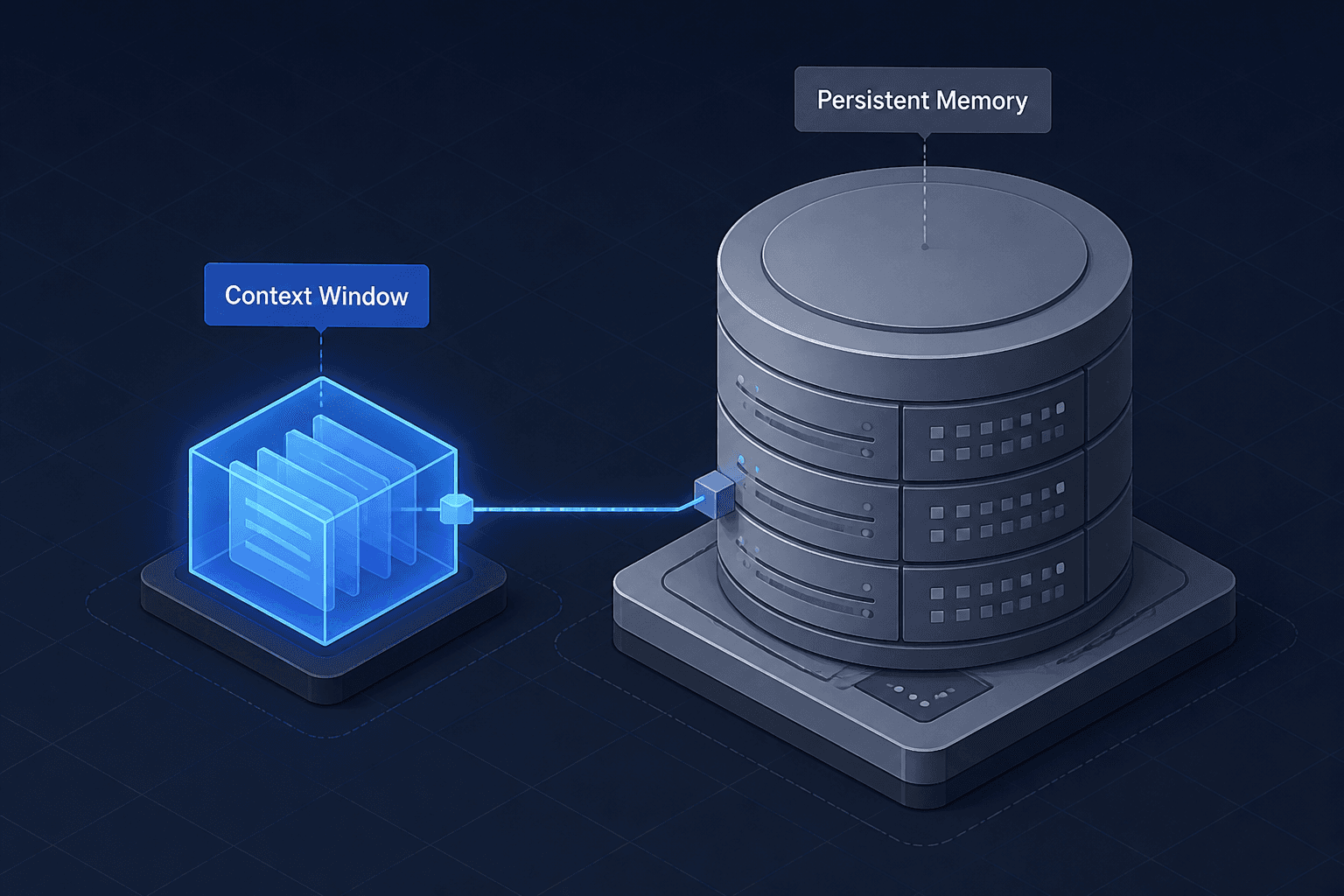
Agent Memory vs Context: Drawing the Line
An examination of the distinction between agent memory and context windows, covering working memory, persistence, and taxonomy for ML engineers.
In the architecture of large language model (LLM) agents, engineers frequently conflate "context" and "memory." This conflation leads to brittle systems that either overflow their context windows or suffer from catastrophic forgetting. The distinction is not merely semantic; it is a fundamental architectural boundary between the model’s immediate computational substrate and the application’s persistent state.
This article is Part 1 of the Agent Memory Systems series.
Context is the transient input buffer. It is the set of tokens currently residing in the model’s active inference path. Memory is the persistent, structured state managed by the application layer, designed to survive beyond the lifetime of a single API call or session. To build scalable agents, you must treat context as a limited resource and memory as a durable asset.
The Context Window: A Mechanism of Transience
The context window is often described as the model’s "attention span," but this is a cognitive metaphor that obscures the underlying engineering reality. The context window is a hard constraint imposed by the Transformer architecture’s attention mechanism.
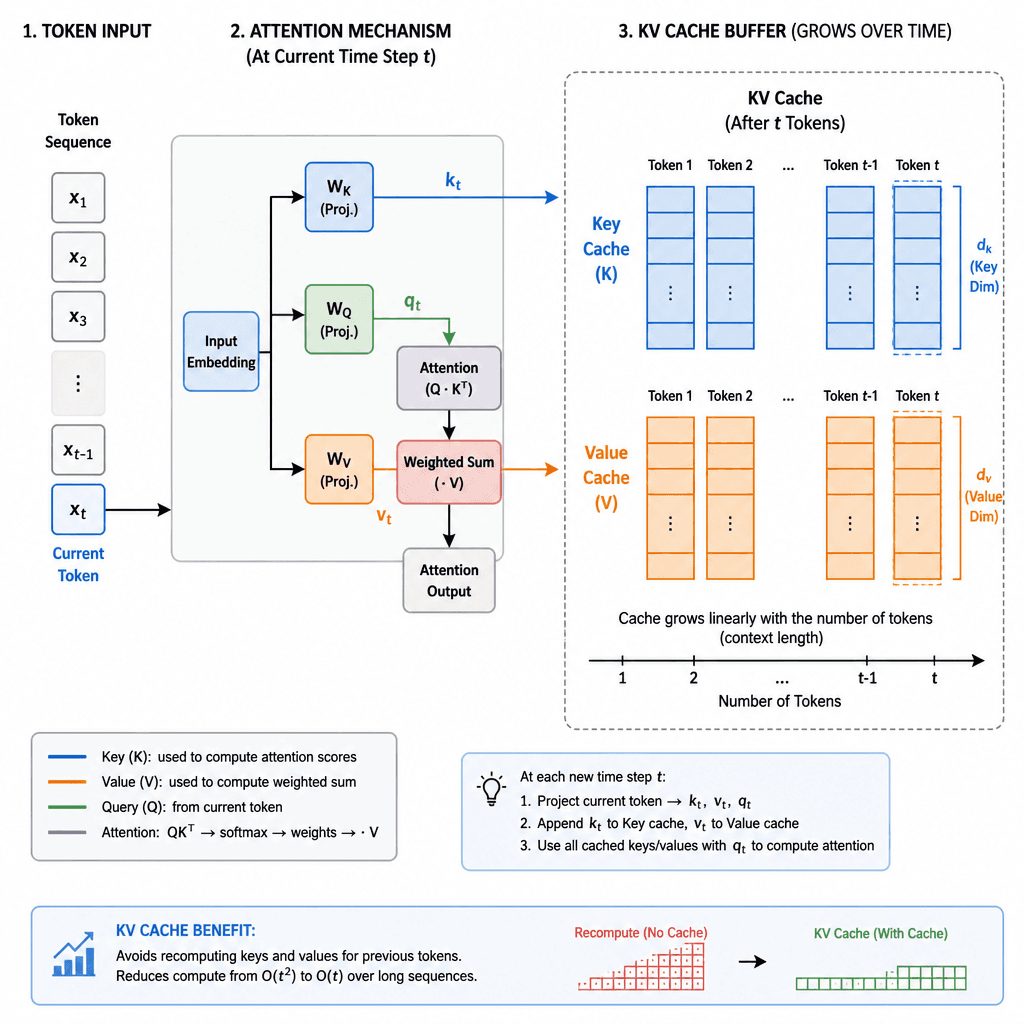
When an LLM processes input, it computes attention scores between every token in the current sequence. This requires maintaining a Key-Value (KV) cache for every previous token to avoid recomputing attention from scratch for each new token generated. The size of this cache grows linearly with the context length. For a model with dimensions and a context length of , the KV cache consumes memory.
This is why context windows are finite: they are bounded by the GPU’s VRAM and the computational cost of quadratic attention complexity if not optimized. Techniques like FlashAttention [1] significantly mitigate this overhead, but the fundamental hardware constraints remain.
In this mechanism, context functions exactly like human working memory. It is:
- Transient: It exists only for the duration of the inference pass. Once the response is generated, the KV cache is discarded (or evicted via sliding window techniques).
- Linear: The model processes tokens in a sequence. While attention allows non-local dependencies, the input is still a flat stream of tokens (unless structured via specific prompting strategies).
- Expensive: Every additional token in the context increases latency and cost linearly (or super-linearly depending on optimization).
For an ML engineer, the context window is a resource to be managed, not a database. It is best used for immediate task instructions, few-shot examples, and the most recent conversation turns. It is a poor substrate for long-term knowledge retention.
[1] Dao, T., et al. "FlashAttention: Fast and Memory-Efficient Exact Attention with IO-Awareness." Advances in Neural Information Processing Systems, 2022.
Persistent Memory: Decoupling State from Inference
Agent memory is the solution to the context window’s transience. It is implemented outside the model’s inference loop, typically in a separate storage layer. This layer persists state across sessions, allowing the agent to recall information from days ago, months ago, or even years ago.
The most common implementation is Retrieval-Augmented Generation (RAG). In this pattern, the agent does not store all knowledge in the context window. Instead, it stores data in a vector database (e.g., Pinecone, Weaviate, or a local FAISS index). When the agent needs to answer a question, it:
- Embeds the user’s query.
- Retrieves the most relevant chunks from the vector store.
- Injects only those chunks into the context window.
This mechanism shifts the burden of storage from the GPU’s VRAM (expensive, volatile) to disk or object storage (cheap, durable). The "memory" is the vector index; the "context" is the subset of that memory retrieved for a specific task.
This separation allows for scalability. An agent can have millions of documents in its memory, but its context window might only contain 500 tokens of relevant excerpts. The architecture scales horizontally by adding storage, not by upgrading GPU hardware.
A Taxonomy of Agent Memory
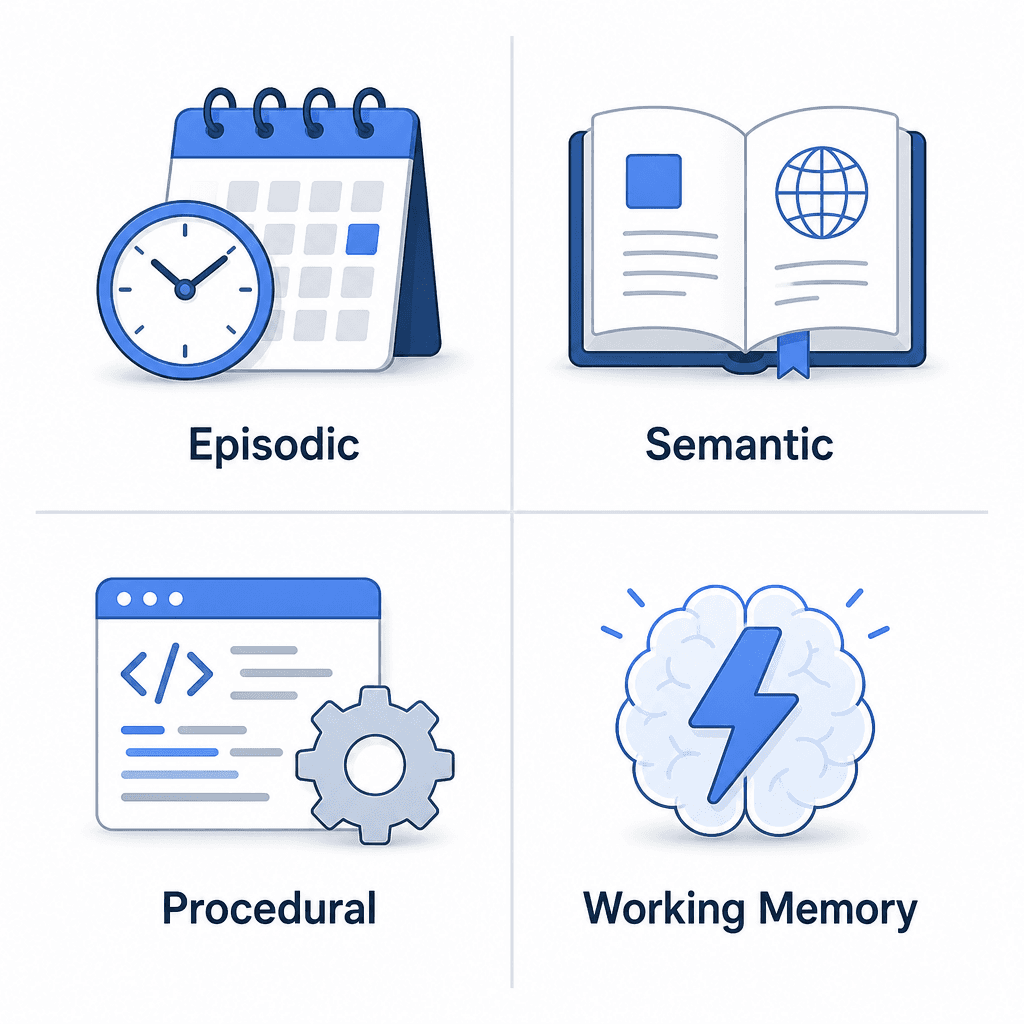
To design robust agents, we must classify memory by its function and persistence mechanism. The standard cognitive taxonomy (episodic, semantic, procedural) maps well to engineering implementations, but with critical distinctions from context. This taxonomy is a cornerstone of effective ai architecture for any system requiring long-term retention.
1. Episodic Memory
- Definition: Records of specific events or interactions (e.g., "User said they prefer Python on Tuesday").
- Implementation: Often stored in a time-series database or a simple log with timestamps.
- Retrieval: Retrieved via similarity search or chronological filtering.
- Context Role: Only the most recent episodic memories are injected into context to maintain conversation coherence.
2. Semantic Memory
- Definition: Factual knowledge independent of time (e.g., "The capital of France is Paris").
- Implementation: Vector stores, knowledge graphs, or SQL databases.
- Retrieval: Retrieved via semantic similarity or explicit query.
- Context Role: Injected on-demand when the user asks a factual question.
3. Procedural Memory
- Definition: Knowledge of how to perform tasks (e.g., "How to deploy a Docker container").
- Implementation: Code snippets, function definitions, or tool descriptions stored in a registry.
- Retrieval: Retrieved via code search or schema matching.
- Context Role: Injected when the agent needs to execute a specific tool.
4. Working Memory (Context)
- Definition: The active set of tokens currently being processed.
- Implementation: The KV cache and the input prompt buffer.
- Retrieval: Implicitly available to the model via attention.
- Constraint: Limited by token count and latency.
The Trade-off: Latency, Cost, and Relevance
The boundary between memory and context is defined by the trade-off between completeness and efficiency.
If you attempt to store all agent memory in the context window, you face:
- Cost Explosion: Input tokens are charged per million. A 100k-token context window is significantly more expensive than a 2k-token one.
- Latency: Longer contexts increase generation time due to the linear growth of KV cache computation.
- Distraction: Irrelevant information in the context window can cause the model to focus on the wrong details (the "lost in the middle" phenomenon).
Conversely, relying solely on persistent memory introduces latency in the retrieval step. The agent must query the database, rank results, and format the injection before inference begins. This adds a round-trip delay, typically 100–500ms, which can impact perceived responsiveness.
Conclusion: Architectural Separation
For ML engineers, the key takeaway is to separate concerns. Do not use the context window as a database. Use it as a high-speed, volatile buffer for immediate reasoning. Use persistent storage for durability and scale.
A well-designed agent architecture looks like this:
- Storage Layer: Vector DB, SQL, and file storage hold the long-term state.
- Retrieval Layer: An embedding model and search algorithm select relevant chunks.
- Context Layer: The prompt builder assembles instructions, retrieved chunks, and recent history into a finite token limit.
- Inference Layer: The LLM processes the context and generates a response.
By respecting this boundary, you build systems that are not only smarter but also scalable, cost-effective, and maintainable. The context window is the lens; memory is the world. Don’t confuse the two.
Common Pitfalls
Even experienced engineers fall into traps when designing memory systems. Here are three common mistakes:
- Overloading the Context Window: Developers often dump entire documents or long chat histories into the context window hoping the model will "find" the answer. This leads to high costs, increased latency, and degraded performance due to the "lost in the middle" effect.
- Ignoring Retrieval Quality: Assuming that any retrieval is sufficient. If the retrieval layer returns irrelevant chunks, those chunks occupy valuable context space, potentially confusing the model and leading to hallucinations.
- Treating Memory as Static: Failing to implement memory decay or update mechanisms. Without periodic pruning or updating, semantic and episodic memory can become stale, causing the agent to provide outdated information.
Practical Takeaways
To apply these concepts effectively, keep these mental models in mind:
- Context is Expensive, Memory is Cheap: Always prioritize moving data out of the context window and into persistent storage. Treat context tokens as a premium resource.
- Retrieve, Don’t Store: The agent should rarely "know" facts directly. Instead, it should know how to find them. This keeps the model lightweight and the system up-to-date.
- Separation of Concerns: Clearly define which layer handles what. The inference layer handles reasoning; the retrieval layer handles relevance; the storage layer handles durability. Mixing these roles leads to brittle systems.
FAQ
Q: Can I use the context window for long-term memory? A: Technically, yes, but it is inefficient and costly. The context window is volatile and finite. For anything beyond a few dozen turns or small documents, persistent memory is required.
Q: How do I decide between vector search and keyword search? A: Use vector search for semantic understanding (meaning) and keyword search for exact matches (IDs, specific names). Many systems use a hybrid approach for best results.
Q: What happens if my context window is full? A: You must implement a strategy to manage overflow. Common strategies include summarization, sliding windows (keeping only the most recent N tokens), or chunking and selective retrieval.
Related posts
Short-Term Memory: Summarization and Compaction
Explore how agents manage context through summarization and compaction techniques for efficient short-term memory.
Long-Context Models vs Retrieval: An Honest Comparison
A technical comparison of long-context models and RAG systems, analyzing cost, latency, and million-token capabilities for architects and ML engineers.
Context Engineering Is the New Prompt Engineering
Explore how context engineering optimizes token budgets and context windows, evolving beyond basic prompt engineering for better LLM outcomes.
