Comparing Open-Source LDAP Solutions: OpenLDAP, 389 DS, and FreeIPA
A technical comparison of OpenLDAP, 389 Directory Server, and FreeIPA for platform and identity engineers, covering replication and deployment.
Comparing Open-Source LDAP Solutions
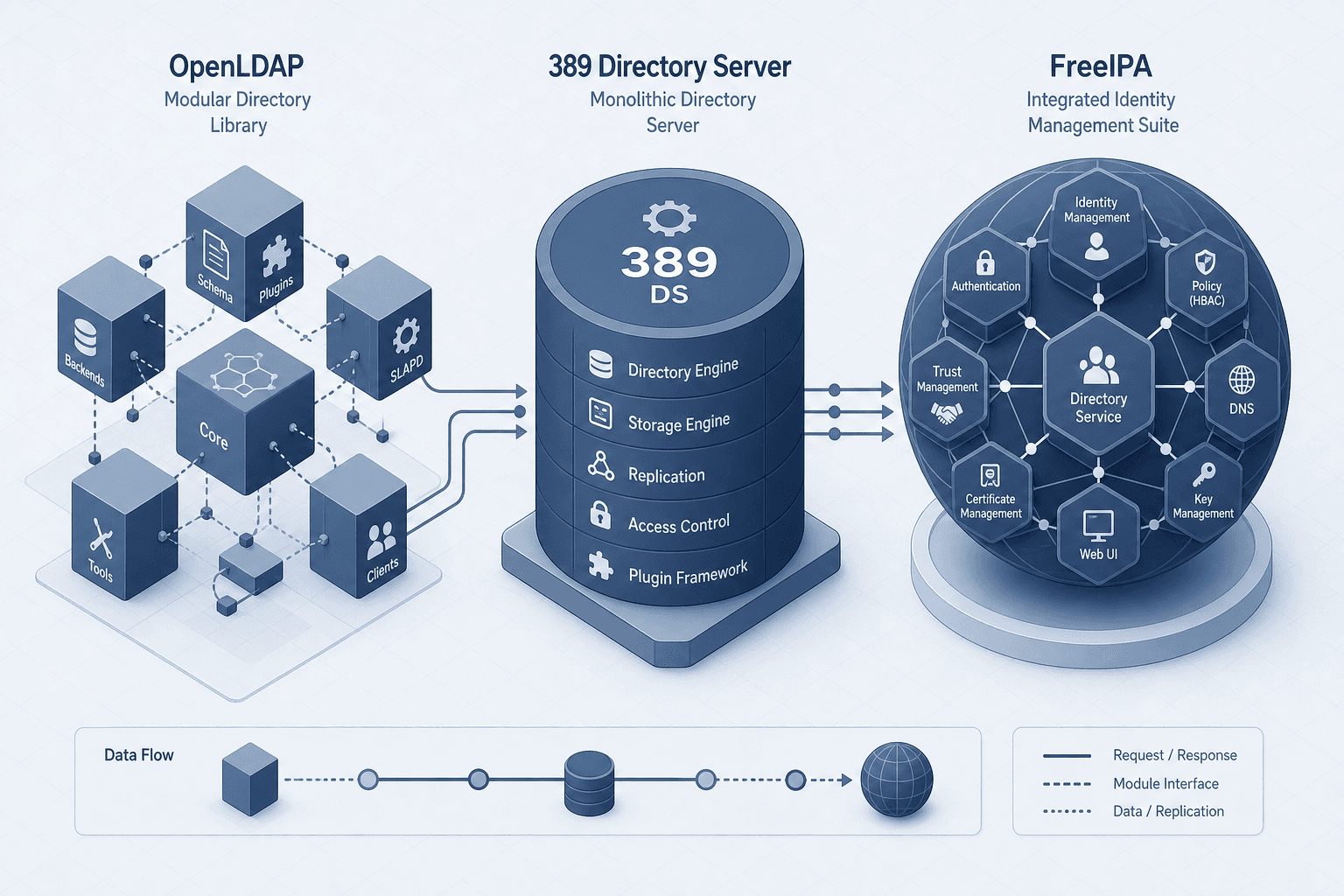
This open-source ldap comparison examines the architectural differences between OpenLDAP, 389 Directory Server, and FreeIPA to help platform and identity engineers select the most suitable directory service. Selecting a directory service is not merely a choice of software packages but a decision about architectural control. The three dominant open-source contenders—OpenLDAP, 389 Directory Server, and FreeIPA—serve different layers of the identity stack. OpenLDAP provides the raw building blocks, 389 Directory Server offers a hardened, standalone directory engine with advanced replication, and FreeIPA delivers a complete, automated identity management solution. Understanding the mechanism-level differences between these tools is critical for designing scalable, secure, and maintainable identity infrastructure.
The Core Engines: OpenLDAP vs. 389 Directory Server
At the lowest level, both OpenLDAP and 389 Directory Server are LDAPv3-compliant directory servers. However, their internal architectures and configuration mechanisms diverge significantly. This openldap vs 389 directory server analysis highlights how their design philosophies impact operational complexity.
OpenLDAP: The Modular Library
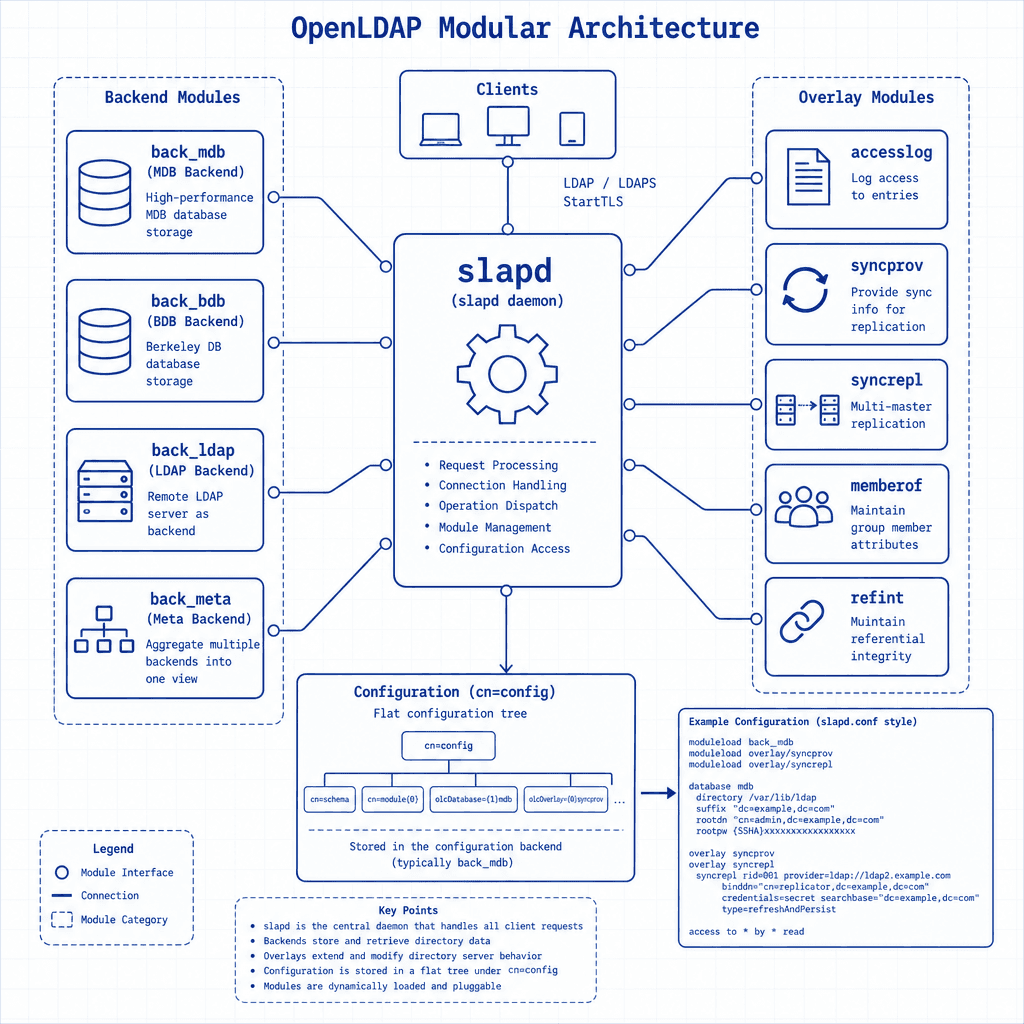
OpenLDAP is fundamentally a library-first implementation. The server daemon, slapd, is highly configurable but demands explicit definition of every component. Its configuration is historically stored in slapd.conf, though modern deployments increasingly use the dynamic cn=config backend, which allows runtime configuration changes via LDAP operations.
The core mechanism of OpenLDAP lies in its modular backend structure. You must explicitly define the database type (e.g., back_bdb, back_hdb, or the modern back_mdb for LMDB). Each backend operates largely in isolation until overlays are applied. This modularity is its strength: you can strip away unnecessary components for performance or embed slapd into custom applications.
However, this flexibility introduces complexity. Replication is not a built-in feature but an overlay module (syncrepl). Engineers must manually configure the provider-consumer relationship, manage synchronization cookies, and ensure operational attributes (like entryCSN) are correctly propagated.
389 Directory Server: The Opinionated Engine
389 Directory Server, originally derived from Netscape Directory Server, is designed as a standalone, enterprise-grade application. Its architecture is more monolithic and opinionated. It uses a hierarchical configuration backend that enforces strict schema compliance. Unlike OpenLDAP’s flat or loosely structured configuration, 389 DS organizes configuration entries under cn=config, but with a deeper integration between configuration and data schemas.
The key differentiator is its approach to replication and schema. 389 DS treats replication as a first-class citizen. It supports multi-master replication natively, meaning multiple nodes can accept write operations and synchronize changes automatically. The server handles conflict resolution using last-writer-wins policies based on timestamps and operational attributes, reducing the operational burden on engineers.
Furthermore, 389 DS includes a comprehensive set of pre-defined schemas and tools for schema management that are tightly integrated with the server’s operational model. This makes it easier to maintain complex directory structures but reduces the flexibility to deviate from standard directory practices compared to OpenLDAP.
Replication Mechanics
Replication is often the deciding factor in directory service selection. The mechanism by which data consistency is achieved varies significantly between these solutions.
OpenLDAP Syncrepl
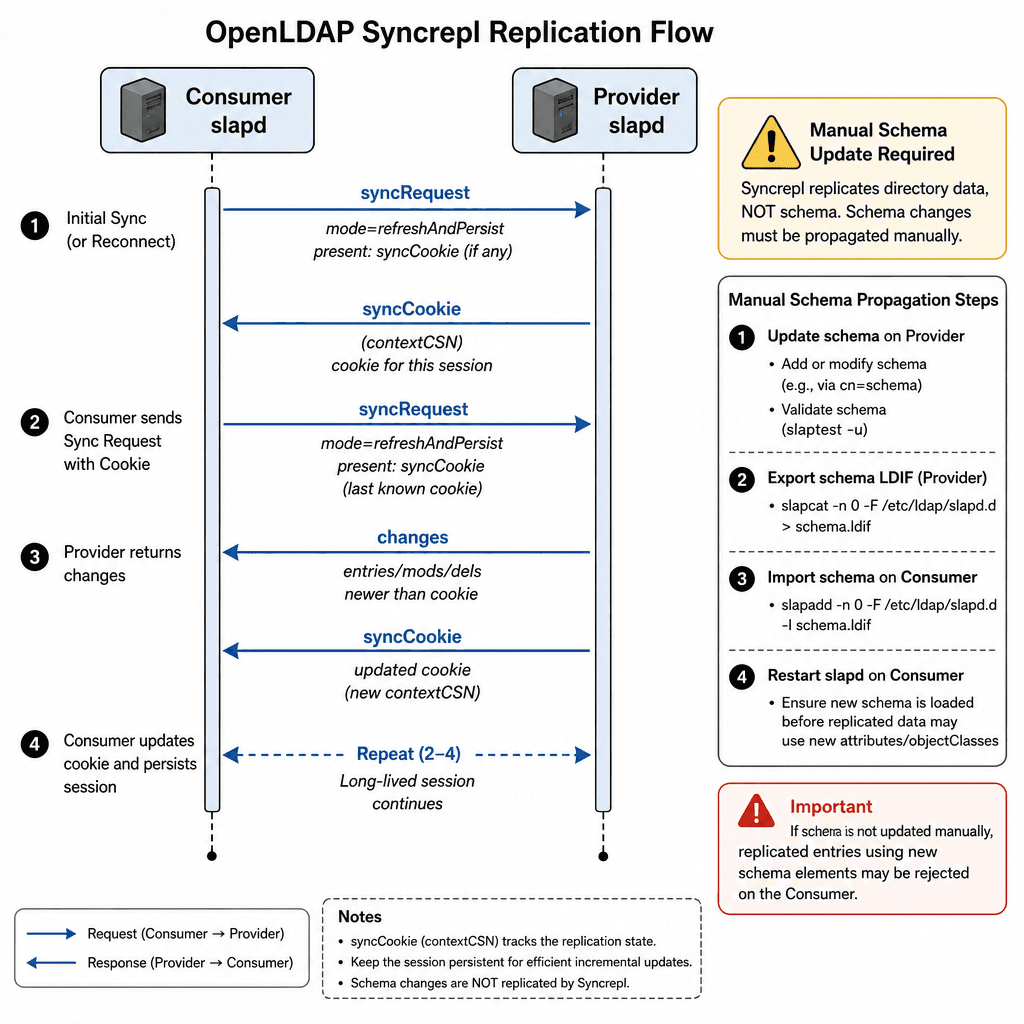
In OpenLDAP, Syncrepl operates on a request-response model. A consumer slapd instance sends a sync request to a provider, including a cookie (a vector of change sequence numbers). The provider returns all changes that have occurred since the last known state.
This mechanism is powerful but fragile. Engineers must carefully manage the syncCookie to avoid data loss or infinite loops. In multi-master scenarios, conflicts are not resolved automatically by the server in a sophisticated manner; instead, the last update to the operational attribute often wins, which can lead to silent data corruption if clocks are not synchronized via NTP. Additionally, OpenLDAP’s ldap replication mechanism does not replicate schema entries (cn=schema) automatically. The consumer daemon must have the same schema loaded independently, typically via matching schema files or by separately replicating the cn=config backend, making schema drift a common operational pitfall in multi-server deployments.
389 DS Multi-Master Replication
389 DS uses a more stable replication protocol. It employs a changelog mechanism where each update is logged with a unique identifier and timestamp. When replicas synchronize, they exchange these changelogs. The server automatically resolves conflicts based on configurable policies. For example, you can define which attribute takes precedence in a conflict.
Crucially, 389 DS supports automatic schema propagation. When a schema change is made on one replica, it is replicated to all other replicas. This eliminates a common source of human error in distributed directory environments. The replication topology is also more flexible, supporting ring, hub-and-spoke, and free-form topologies with built-in health checks.
FreeIPA: The Integrated Identity Suite
FreeIPA should not be viewed as a third competitor in the same category as OpenLDAP and 389 DS. Instead, it is an identity management solution that uses 389 Directory Server as its backend. FreeIPA abstracts the complexity of LDAP, Kerberos, DNS, and certificate management into a unified system.
Architecture and Automation
FreeIPA installs a full 389 DS instance, but it manages it through a set of Python-based tools and systemd services. The core mechanism of FreeIPA is automation. When you add a host to the FreeIPA domain, the system automatically:
- Creates a host principal in Kerberos.
- Registers the host’s DNS records in BIND (if integrated).
- Installs and configures SSSD (System Security Services Daemon) on the client.
- Manages TLS certificates via the integrated Certificate Authority (Dogtag/FreeIPA CA).
This automation removes the need for engineers to manually configure LDAP bind DN passwords, Kerberos keytabs, or DNS zones. For organizations seeking a complete "identity fabric" rather than just a directory, FreeIPA is the most efficient choice, and its freeipa deployment process significantly reduces the operational overhead of managing multiple identity components.
Trade-offs and Limitations
The trade-off for this convenience is reduced flexibility. Because FreeIPA tightly couples LDAP, Kerberos, and DNS, modifying the underlying LDAP schema or replication settings requires using FreeIPA’s CLI tools (ipa-*) rather than direct LDAP modifications. While this ensures consistency, it can feel restrictive for engineers who need fine-grained control over the directory backend.
Additionally, FreeIPA’s replication is based on 389 DS’s multi-master replication, but it adds its own layer of complexity regarding host-to-host replication and DNS integration. Troubleshooting FreeIPA issues often requires debugging the interaction between the directory, Kerberos, and DNS components, which can be more challenging than isolating an issue in a standalone OpenLDAP or 389 DS deployment.
Deployment and Operational Considerations
When choosing between these solutions, consider the operational reality of your environment and how your directory service architecture aligns with your team's capabilities.
OpenLDAP is ideal for embedded systems, lightweight applications, or environments where maximum control over the directory backend is required. It has the smallest footprint and the widest compatibility with legacy systems. However, it demands significant expertise to configure replication and security correctly.
389 Directory Server is the best choice for organizations that need a high-performance, scalable directory service with advanced replication features but do not require the additional identity management services (Kerberos, DNS, CA) provided by FreeIPA. It is a mature, stable server that fits well into existing infrastructure where LDAP is just one component.
FreeIPA is the optimal solution for Linux-centric environments that need a unified identity management system. It simplifies the deployment of LDAP, Kerberos, and DNS, making it easier to manage user and machine identities at scale. However, it is less suitable for non-Linux environments or scenarios where the directory service needs to be decoupled from other identity protocols.
Conclusion
The choice between OpenLDAP, 389 Directory Server, and FreeIPA depends on the level of abstraction and automation required. OpenLDAP offers the most control but demands the most effort. 389 Directory Server provides a stable, standalone directory engine with advanced replication. FreeIPA integrates these components into a comprehensive identity management solution. For platform engineers, understanding these mechanisms ensures that the selected tool aligns with both technical requirements and operational capabilities.
Related posts
LDAP vs Active Directory vs Cloud Directory: Directory Services Compared
A technical comparison of LDAP, Active Directory, and cloud directory services to help teams choose the right identity management solution.
Integrating Keycloak with Active Directory: LDAP, Kerberos & Group Mapping
A technical walkthrough for integrating Keycloak with Active Directory, covering SAMAccountName, group mapping, and Kerberos configuration.
Keycloak LDAP User Federation: Mechanics, Mapping, and Tuning
A practical guide to configuring Keycloak LDAP user federation, covering sync modes, attribute mappers, and performance tuning for identity engineers.
