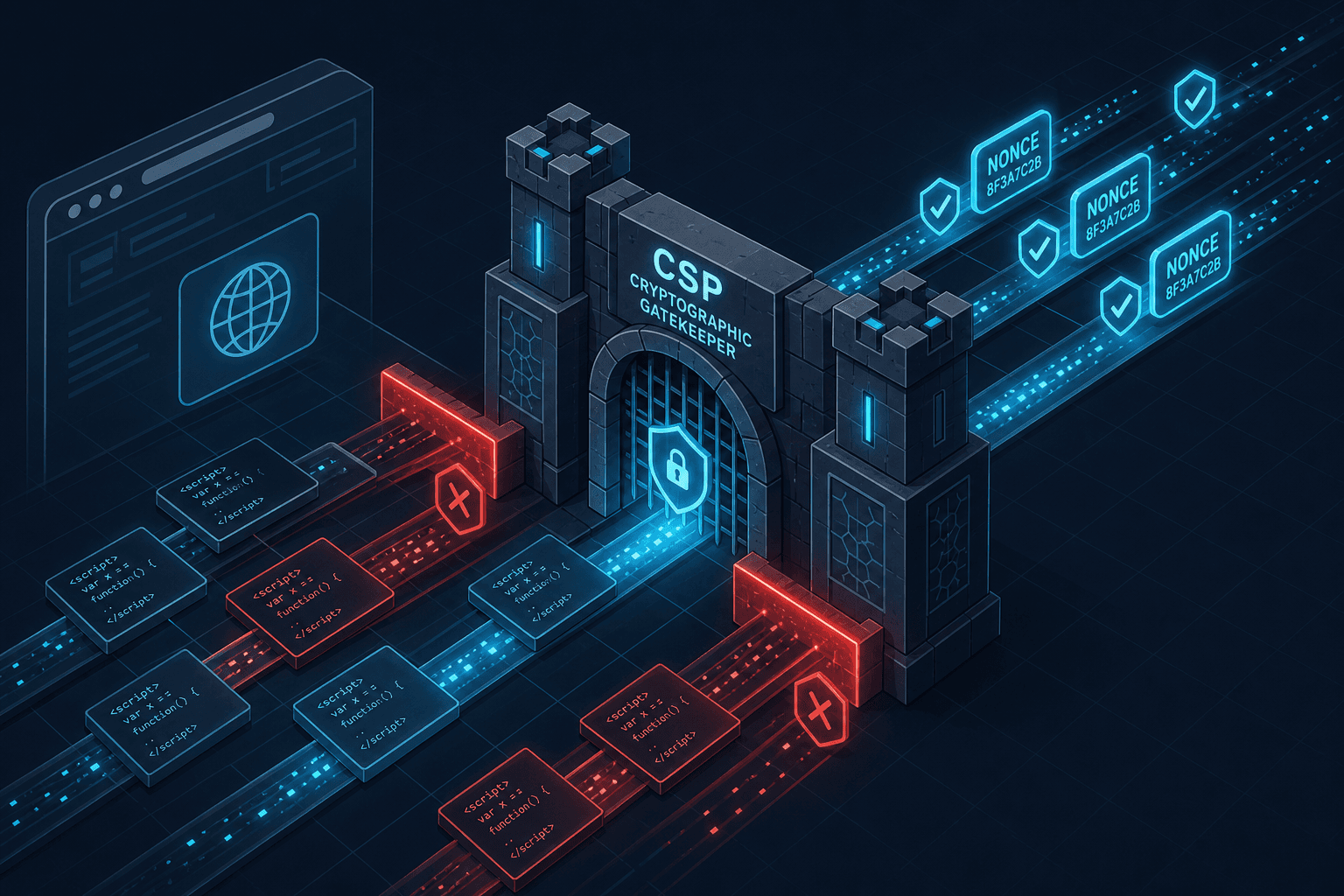
Content Security Policy for Identity Applications
An examination of Content Security Policy implementation to prevent XSS attacks within identity applications.
The Mechanism of Isolation: CSP in Identity Flows
When an attacker injects a malicious script into an identity application, the browser executes it with the same privileges as the legitimate code. In a standard e-commerce site, this might steal a shopping cart. In an identity application, it steals the user's session cookie or captures their password before it is hashed. The Content Security Policy (CSP) acts as a cryptographic gatekeeper, not just a filter. It forces the browser to verify the source of every executable resource before rendering it.
The core mechanism here is the script-src directive. Without CSP, a browser treats any URL or inline script as trustworthy if it originates from the page's domain. With CSP, the browser checks the src attribute against a whitelist of allowed origins. If a script is inline, the browser looks for a cryptographic nonce (number used once) or a hash of the script's content.
Consider the scenario where a developer needs to support a password manager extension. These extensions often inject inline scripts to detect login fields. A strict CSP blocking all inline scripts breaks this functionality. The solution lies in the nonce attribute. The server generates a unique, random 16-byte string for each request.
<!-- Server-side logic generates a random nonce, e.g., 'a1b2c3...' -->
<script nonce="a1b2c3d4e5f6g7h8i9j0k1l2m3n4o5p6">
  // This script runs because the nonce matches the header
  document.getElementById('username').addEventListener('focus', function() {
    // Password manager hook
  });
</script>
The HTTP response header includes Content-Security-Policy: script-src 'self' 'nonce-a1b2c3d4e5f6g7h8i9j0k1l2m3n4o5p6'. When the browser parses the HTML, it compares the nonce attribute on the <script> tag with the value in the header. If they match, the script executes. If an attacker injects <script>alert('xss')</script> without the correct nonce, the browser's parser halts execution immediately. This mechanism ensures that even if the input stream is compromised, the payload cannot execute unless the attacker can forge the server's random nonce, making it practically impossible for an attacker to forge.
The Boundary Problem: Frame Ancestors and Clickjacking
Identity applications frequently redirect users to third-party Identity Providers (IdPs) like Okta, Auth0, or Google. A common attack vector involves embedding the login page inside a transparent iframe on a malicious site, tricking the user into clicking a button that sends credentials to the attacker. This is a Clickjacking attack.
The mechanism to stop this is the frame-ancestors directive. Unlike script-src, which controls code execution, frame-ancestors controls the document tree structure. If a page sets frame-ancestors 'self', the browser refuses to render that page inside any iframe, except those from the same origin.
In an identity flow, this is critical. If your login page is at auth.example.com, you must ensure it cannot be embedded by evil.com.
Content-Security-Policy: frame-ancestors 'self';However, there is a nuance in modern browsers. The X-Frame-Options header was the legacy mechanism, but it lacks the granularity of CSP. If you use CSP, frame-ancestors takes precedence. If you allow specific IdPs, you might see a configuration like frame-ancestors 'self' https://accounts.google.com. This allows the browser to render the login page only if the parent frame is your domain or the specific Google account domain.
This is opinionated but necessary: do not rely on frame-src for this. frame-src controls which URLs can be loaded inside an iframe on your page. frame-ancestors controls who is allowed to load your page inside their iframe. For identity security, the latter is the primary defense against credential harvesting via UI redressing.
The Debugging Trap: Nonce Generation and Statelessness
Implementing nonces introduces a stateful requirement to a stateless protocol. The server must generate a unique nonce for every single HTTP request and include it in the HTML response. If the application is stateless, the nonce must be generated on the fly.
A common failure mode occurs when a developer tries to reuse a nonce across multiple requests to simplify caching. If the same nonce is used for two different sessions, an attacker who intercepts a valid script tag from one session can replay it in another. The browser sees the valid nonce and executes the malicious payload.
Let's look at the artifact flow.
- User requests
/login. - Server generates
nonce: "xyz123". - Server renders HTML:
<script nonce="xyz123">... - Server sends Header:
script-src 'self' 'nonce-xyz123'. - User submits credentials.
- Server processes.
If the server caches the HTML response and serves it to a second user, that second user receives the same nonce. The second user's browser will accept the script. The fix is to ensure the HTML generation happens after nonce creation, bypassing any CDN or reverse proxy caching for pages containing CSP headers with nonces.
For production environments where caching is required, the report-uri or report-to endpoint becomes vital. Instead of blocking requests immediately, the server can send a Content-Security-Policy-Report-Only header. This allows the browser to log violations without stopping the page.
Content-Security-Policy-Report-Only: script-src 'self' 'nonce-xyz123'; report-uri https://csp-report.example.com/collectWhen a script fails validation, the browser sends a JSON POST to the report URI. The payload contains the blocked resource, the directive, and the full document URL. This allows engineers to identify misconfigured nonces or missing sources without breaking the user experience. However, relying solely on Report-Only is dangerous for identity apps. You must eventually transition to a blocking policy once the audit is complete.
Protocol Downgrades and Token Transmission
Identity applications transmit sensitive tokens, often in URL parameters or cookies, during the redirect phase. An attacker on a public Wi-Fi network can perform a Man-in-the-Middle (MitM) attack to downgrade the connection from HTTPS to HTTP. If the connection is downgraded, the CSP header might not be sent at all, or the browser might ignore it if the connection is not secure.
The upgrade-insecure-requests directive applies to subresources requested by the page, instructing the browser to automatically rewrite HTTP URLs to HTTPS before the request is made. This prevents the initial handshake from ever being insecure for subsequent resources. However, if the page itself is served over HTTP, the browser cannot receive the CSP header to enforce upgrade-insecure-requests. Therefore, HSTS (HTTP Strict Transport Security) is the primary defense for securing the initial connection, while upgrade-insecure-requests handles subsequent subresource requests.
Content-Security-Policy: upgrade-insecure-requests;This is particularly relevant for identity flows where the initial redirect might be to a legacy endpoint. If the redirect URL is http://auth.example.com/callback, the browser will silently upgrade it to https:// before sending the request, ensuring the subsequent CSP header is received over a secure channel. Without HSTS, an attacker could intercept the initial redirect and serve a malicious CSP or no CSP at all, allowing the attack to proceed unchecked.
The Final Barrier: Strict-Dynamic and Script Execution
Modern browsers support strict-dynamic. This directive allows a script to load other scripts if the initial script was trusted via a nonce or hash. This is essential for loading libraries dynamically.
In an identity context, strict-dynamic propagates trust from the initial nonce-loaded script. If the initial script is trusted (via nonce), strict-dynamic allows it to load other scripts. The risk is not strict-dynamic itself, but the assumption that the initial script is safe. If an attacker manages to inject a script with a valid nonce, strict-dynamic would allow that script to load further malicious code.
To mitigate this, the script-src should prioritize strict-dynamic but still restrict the sources of subsequent loads. However, for high-security identity apps, script-src without strict-dynamic is often preferred to prevent any dynamic loading entirely. A secure configuration example follows, where the nonce is a placeholder for the server to replace dynamically:
Content-Security-Policy:
  default-src 'none';
  script-src 'self' 'nonce-1234567890abcdef'; /* Replace with server-generated nonce */
  style-src 'self' 'unsafe-inline'; /* Required for login forms */
  img-src 'self' data: https:;
  frame-ancestors 'self';
  form-action 'self' https://accounts.google.com;
  upgrade-insecure-requests;
Note the form-action directive. This restricts where the browser can submit the login form. It ensures that even if an attacker injects a form into the page, the browser will not submit the credentials to evil.com. This closes the final loop of the attack chain.
The implementation of CSP in identity applications is not a "set and forget" task. It requires a continuous feedback loop between the nonce generation logic, the reporting endpoint, and the monitoring of violation reports. Every time a user reports a broken login, the engineering team must investigate if the nonce was dropped, if the CSP header was blocked by a firewall, or if the form-action directive is too restrictive. The mechanism works only if the configuration matches the actual runtime behavior of the application.
By treating the browser as an untrusted execution environment and enforcing cryptographic validation on every script, identity applications can significantly reduce the attack surface. The goal is not just to block known bad actors, but to make the execution of unknown code mathematically impossible within the scope of the application's origin.
Conclusion
Securing identity applications demands a rigorous approach to Content Security Policy. By leveraging nonce attributes, frame-ancestors, and upgrade-insecure-requests, developers can create a strong defense against XSS, Clickjacking, and protocol downgrade attacks. The interplay between these directives requires careful configuration to balance security with the functional needs of modern authentication flows. Continuous monitoring and a willingness to adapt the policy based on real-world usage are essential to maintaining a secure posture. Adhering to these principles ensures that identity application security remains a top priority.
Common Pitfalls
When implementing CSP, developers frequently encounter specific traps that can undermine security:
- Nonce Reuse Across Sessions: Generating a single nonce for the entire application or reusing it across multiple requests allows attackers to capture a valid script tag and replay it in a different session. Each request must generate a unique, random nonce.
- Misunderstanding
upgrade-insecure-requestsScope: Developers often assumeupgrade-insecure-requestssecures the initial page load. In reality, it only rewrites subresource requests. If the initial page is served over HTTP, the CSP header may never be received. HSTS is required to secure the initial connection. - Over-reliance on
strict-dynamic: While convenient for dynamic loading,strict-dynamicpropagates trust from the first script. If that initial script is compromised, the entire chain is compromised. High-security contexts often disablestrict-dynamicto limit dynamic loading to explicitly whitelisted static sources.
Practical Takeaways
To effectively implement CSP in identity apps, keep these mental models in mind:
- Defense in Depth: CSP is a layer, not a silver bullet. Combine it with HSTS, secure cookie flags, and input validation.
- Unique Nonces: Treat nonces as one-time pads. Never cache HTML responses that contain nonces; always regenerate them per request.
- Report-Only First: Start with
Content-Security-Policy-Report-Onlyto gather data on violations before switching to a blocking policy. This prevents breaking legitimate functionality during rollout.
FAQ
Q: Can I use CSP if my application uses third-party widgets?
A: Yes, but you must include the widget's domain in your script-src or frame-src directives. Alternatively, if the widget loads scripts dynamically, ensure your nonce strategy covers them or use strict-dynamic with caution.
Q: Does CSP prevent Cross-Site Request Forgery (CSRF)?
A: CSP does not directly prevent CSRF. However, the form-action directive can restrict where forms are submitted, which mitigates some CSRF vectors by preventing submission to untrusted domains. You should still use anti-CSRF tokens.
Q: How do I handle inline styles required for login forms?
A: Inline styles are often necessary for complex login forms. You can use 'unsafe-inline' in style-src, but be aware this reduces protection. A better approach is to move styles to external files or use a CSP hash of the specific inline style block.
Related posts
Understanding HTTP Strict Transport Security (HSTS) for Identity Applications
An examination of HTTP Strict Transport Security (HSTS) implementation for identity applications using Spring Boot to enhance web security.
JWT Expiration, Rotation, and Revocation: A Lifecycle Guide
A guide to JWT expiration, rotation, and revocation strategies for secure token lifecycle management.
Security Considerations for Identity Tokens in URL Parameters
An examination of security risks when placing identity tokens like JWT or SAML in URL parameters, covering token leakage and referrer header exposure.