ExceptionTranslationFilter: Auth Error Handling
Explore how Spring Security's ExceptionTranslationFilter handles authentication and authorization errors, routing them to the correct entry points or access denied handlers.
ExceptionTranslationFilter and Where Auth Errors Come From
This is Part 5 of the Spring Security Filter Chain Mastery series.
In a Spring Security application, the filter chain is a linear sequence of responsibilities. Most filters perform specific checks: UsernamePasswordAuthenticationFilter validates credentials, FilterSecurityInterceptor verifies permissions, and SessionManagementFilter handles session fixation. However, these filters throw exceptions when checks fail. If an exception propagates uncaught to the servlet container, the client receives a raw 500 Internal Server Error or a stack trace, which is both insecure and confusing.
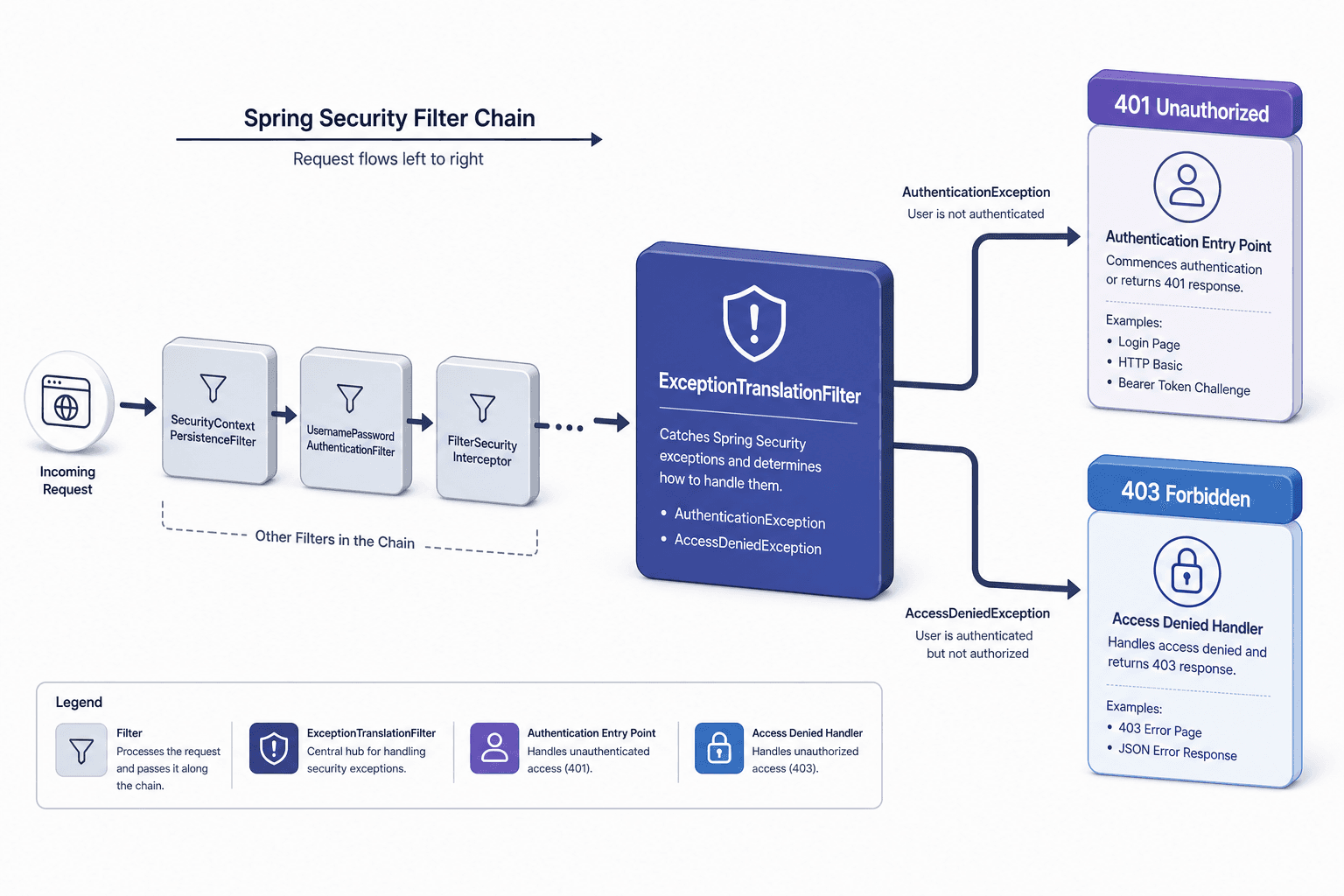
The ExceptionTranslationFilter acts as the central hub for this problem. It does not make security decisions itself. Instead, it listens for exceptions thrown by downstream filters and translates them into appropriate HTTP responses. It distinguishes between two fundamental failure modes: authentication failures (who are you?) and authorization failures (what can you do?). This distinction dictates whether the client receives a 401 Unauthorized or a 403 Forbidden response.
The Position in the Filter Chain
To understand how ExceptionTranslationFilter works, we must look at its position. In the default Spring Security configuration, it is typically placed near the end of the SecurityFilterChain, immediately before FilterSecurityInterceptor. Its primary role is to wrap the execution of the rest of the chain.
When a request arrives, ExceptionTranslationFilter executes the rest of the chain via chain.doFilter(). If an exception is thrown during this execution, the filter catches it. It then analyzes the exception type to decide the next step. If no exception occurs, the request proceeds normally. If an exception occurs, the filter intervenes before the response is committed.
Handling Authentication Errors: The 401 Path
An authentication error occurs when the user is not authenticated, or their credentials are invalid. In Spring Security, this is represented by the AuthenticationException hierarchy (e.g., BadCredentialsException, AccountExpiredException).
When ExceptionTranslationFilter catches an exception, it first checks if the exception is an instance of AuthenticationException. If it is, the filter treats this as an authentication error. The mechanism here is delegation to an AuthenticationEntryPoint.
Worked Scenario: The Redirect
Consider a Spring Boot application with form login. An unauthenticated user sends a GET request to /admin/dashboard.
- The request passes through
ExceptionTranslationFilter, which delegates to the rest of the chain. FilterSecurityInterceptorchecks the currentSecurityContext. It finds noAuthenticationobject (or one with insufficient roles).FilterSecurityInterceptorthrowsAuthenticationCredentialsNotFoundException, a subclass ofAuthenticationException, because noAuthenticationobject is present in theSecurityContext.ExceptionTranslationFiltercatches this exception.- It checks if the caught exception is an instance of
AuthenticationException. Yes, it is. - It delegates to its configured
AuthenticationEntryPoint. In a standard form login setup, this isLoginUrlAuthenticationEntryPoint. LoginUrlAuthenticationEntryPointwrites a 302 Redirect response to/login.
The client receives a redirect, not a 401. This is the standard behavior for browser-based applications where session-based authentication is used. For REST APIs, you might configure a different AuthenticationEntryPoint (e.g., BasicAuthenticationEntryPoint) that writes a 401 status code directly.
Handling Authorization Errors: The 403 Path
Authorization errors occur when the user is authenticated but lacks the required authority. In this case, the AccessDeniedException is thrown by FilterSecurityInterceptor or method security interceptors, but the root cause is not an AuthenticationException. The user is known; they just aren't allowed.
Understanding the nuances of spring security error handling is critical here. ExceptionTranslationFilter detects that the exception is an AccessDeniedException but not an AuthenticationException. It then delegates to its configured AccessDeniedHandler. Properly distinguishing between 401 403 errors ensures that clients receive the correct semantic response for their specific failure mode.
Worked Scenario: The Forbidden Response
Consider an authenticated user with ROLE_USER sending a GET request to /admin/dashboard, which requires ROLE_ADMIN.
- The request passes through
ExceptionTranslationFilter. FilterSecurityInterceptorchecks theSecurityContext. It finds anAuthenticationobject withROLE_USER.- The required role is
ROLE_ADMIN. The check fails. FilterSecurityInterceptorthrowsAccessDeniedException.ExceptionTranslationFiltercatches this exception.- It checks the cause: Is it an
AuthenticationException? No. - It delegates to its configured
AccessDeniedHandler. The default isAccessDeniedHandlerImpl. AccessDeniedHandlerImplchecks if the response has already been committed. If not, it writes a 403 Forbidden response.
In a REST API, you would typically configure a custom AccessDeniedHandler that writes a JSON error response:
{
  "status": 403,
  "error": "Forbidden",
  "message": "You do not have permission to access this resource."
}
This allows the client to distinguish between "I don't know who you are" (401) and "I know who you are, but you can't do that" (403).
Nested Exceptions and Root Cause Analysis
A common point of confusion arises when exceptions are wrapped. For example, a business service might throw a RuntimeException that wraps an AuthenticationException. ExceptionTranslationFilter must unwrap these nested exceptions to determine the correct handling strategy.
The filter uses ThrowableAnalyzer or similar utility methods to traverse the cause chain. It looks for the deepest AuthenticationException or AccessDeniedException. This ensures that even if an exception is wrapped multiple times, the correct entry point or handler is invoked.
However, this mechanism has limitations. If a non-security exception (e.g., NullPointerException) is thrown, ExceptionTranslationFilter will not catch it unless it is wrapped in a security exception. Unhandled exceptions will propagate to the servlet container, resulting in a 500 error. This is intentional: ExceptionTranslationFilter is designed for security-related failures, not general application errors.
Practical Takeaways
- Exception Type Matters: Always check the specific exception type.
AuthenticationExceptiontriggers the login flow;AccessDeniedExceptiontriggers the forbidden flow. - Delegation is Key:
ExceptionTranslationFilternever generates the response itself. It always delegates to anEntryPointorHandler. Customizing these components is how you control the final HTTP response. - Chain Order: Ensure
ExceptionTranslationFilteris positioned correctly in the filter chain. If it is placed after filters that might throw security exceptions, those exceptions may bypass it, leading to unexpected 500 errors.
Common Pitfalls
- Unhandled Non-Security Exceptions: If your application logic throws a generic
RuntimeException(likeNullPointerExceptionorIllegalArgumentException) and it is not wrapped in a security exception,ExceptionTranslationFilterwill ignore it. This results in a raw 500 Internal Server Error being sent to the client, potentially exposing stack traces. - Misconfiguring Filter Order: Placing
ExceptionTranslationFiltertoo early in the chain can cause issues. If a filter after it commits the response or throws an exception that isn't caught, the translation logic won't execute. It should generally be positioned near the end of the chain, just beforeFilterSecurityInterceptor, to catch exceptions from downstream filters. - Assuming AccessDeniedException Means Unauthenticated: A common mistake is assuming that any
AccessDeniedExceptionindicates an unauthenticated user. In reality,AccessDeniedExceptionis thrown for both unauthenticated users (if the entry point is configured to handle it as such) and authenticated users lacking permissions. You must check if the exception is an instance ofAuthenticationExceptionto determine if it's an auth failure or an authz failure.
FAQ
What happens if no handler is configured?
If no custom AuthenticationEntryPoint or AccessDeniedHandler is defined, Spring Security provides defaults. For AuthenticationEntryPoint, it may throw an IllegalStateException if none is found, or use a default implementation depending on the configuration. For AccessDeniedHandler, it defaults to AccessDeniedHandlerImpl, which sends a 403 Forbidden response directly via response.sendError(), with the exact rendering depending on the container's error page settings. It is best practice to explicitly define these.
Can it handle 500 errors?
No. ExceptionTranslationFilter is specifically designed for security exceptions (AuthenticationException and AccessDeniedException). It does not catch general application exceptions that result in 500 Internal Server Errors. These are handled by the servlet container's error handling mechanisms or global exception handlers (e.g., @ControllerAdvice).
How does it interact with Spring Boot auto-configuration?
Spring Boot auto-configures a default SecurityFilterChain that includes an ExceptionTranslationFilter. It automatically wires up sensible defaults for AuthenticationEntryPoint and AccessDeniedHandler based on the presence of other security components (like form login or HTTP basic auth). You can override these defaults by defining your own beans in the context.
Configuration and Customization
The behavior of ExceptionTranslationFilter is highly configurable. You can define custom AuthenticationEntryPoint and AccessDeniedHandler beans to tailor the error responses to your application's needs.
For example, in a Spring Boot application, you can configure a custom AuthenticationEntryPoint for REST APIs:
@Bean
public AuthenticationEntryPoint authenticationEntryPoint() {
    return (request, response, authException) -> {
        response.setStatus(HttpServletResponse.SC_UNAUTHORIZED);
        response.setContentType("application/json");
        response.getWriter().write("{\"error\": \"Unauthorized\"}");
    };
}
Similarly, you can configure a custom AccessDeniedHandler:
@Bean
public AccessDeniedHandler accessDeniedHandler() {
    return (request, response, accessDeniedException) -> {
        response.setStatus(HttpServletResponse.SC_FORBIDDEN);
        response.setContentType("application/json");
        response.getWriter().write("{\"status\": 403, \"error\": \"Forbidden\", \"message\": \"You do not have permission to access this resource.\"}");
    };
}
These configurations ensure that the client receives consistent and meaningful error responses, regardless of the underlying security exception.
Conclusion
ExceptionTranslationFilter is the bridge between the security filter chain and the HTTP response. It translates security exceptions into HTTP status codes and redirects, ensuring that clients receive appropriate responses for authentication and authorization failures. By understanding its mechanism—distinguishing between AuthenticationException and AccessDeniedException—you can configure robust error handling for both web and API applications.
Related posts
addFilterBefore and UsernamePasswordAuthenticationFilter
Learn how to use addFilterBefore to position custom filters before UsernamePasswordAuthenticationFilter in the Spring Security filter chain.
SecurityFilterChain in Spring Security 6
A technical walkthrough of configuring SecurityFilterChain in Spring Security 6 using the Lambda DSL and RequestMatchers for Java developers.
Spring Security Method Security: @PreAuthorize, @Secured, and SpEL
An examination of Spring Security method security using @PreAuthorize, @Secured, and SpEL for implementing RBAC.