Identity Disaster Recovery Planning
A practical guide for SREs and security engineers on building identity disaster recovery plans, covering break-glass procedures, RTO targets, and resolving circular dependencies.
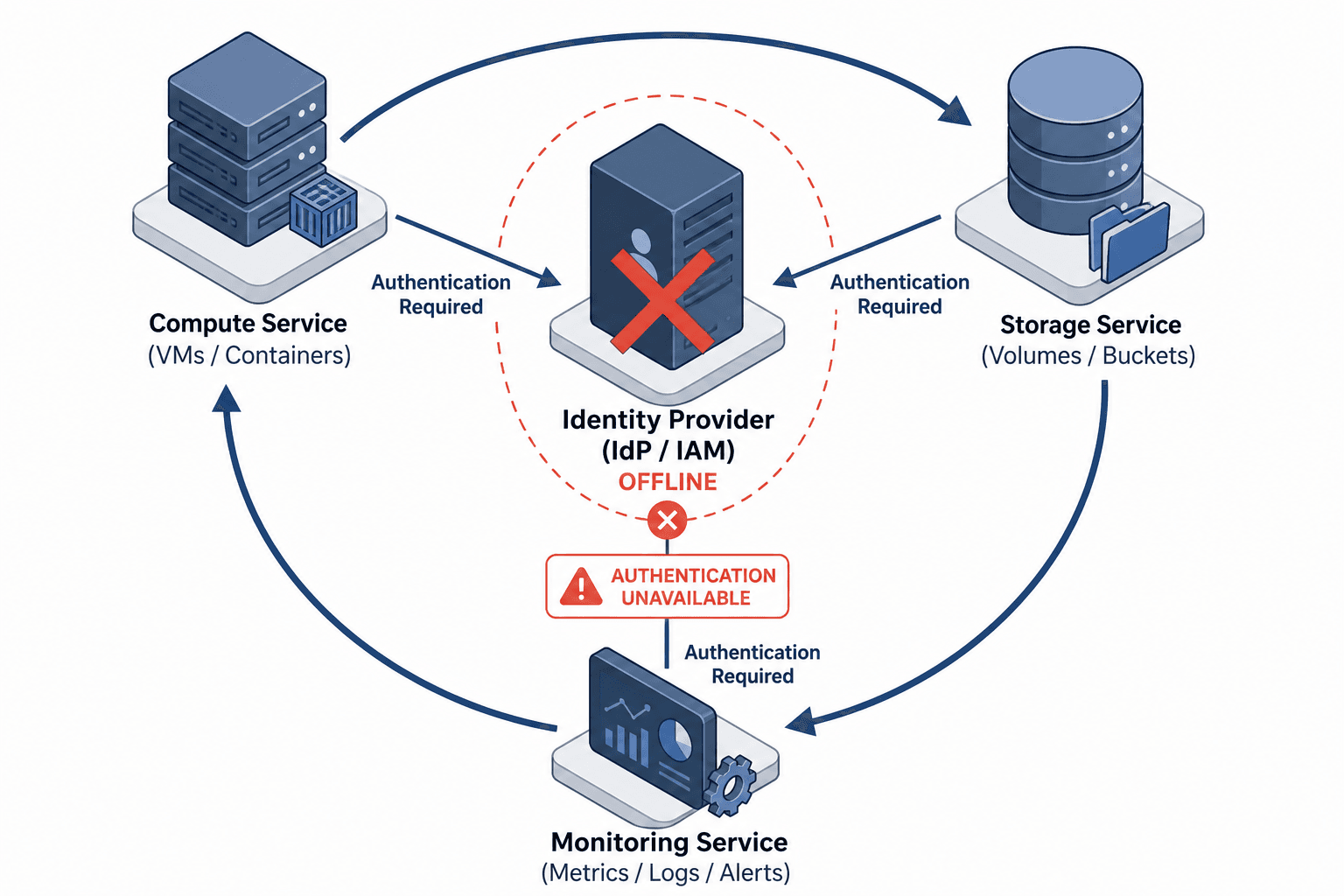
Identity systems are not just another microservice; they are the root of trust for the entire infrastructure graph. When an Identity and Access Management (IAM) system goes offline, it does not merely stop user logins. It creates a circular dependency where you cannot restore the infrastructure because you cannot authenticate, and you cannot authenticate because the infrastructure that validates your credentials is down.
For Site Reliability Engineers (SREs) and security engineers, this creates a specific class of failure mode: the "auth-outage loop." Standard disaster recovery (DR) plans often assume that if the primary data center fails, the DR site can take over seamlessly. In identity, this assumption fails because the DR site’s IAM service is also offline, or the cross-region replication lag prevents immediate consistency.
This guide outlines how to design an identity-specific DR plan that prioritizes out-of-band recovery over in-band restoration.
The Circular Dependency Mechanism
To understand why identity DR is different, we must look at the mechanism of trust. Modern applications rely on short-lived tokens (JWTs, SAML assertions) issued by the Identity Provider (IdP). These tokens contain cryptographic signatures. When a service receives a request, it validates the signature against the IdP’s public keys.
If the IdP is unreachable:
- New tokens cannot be issued.
- Existing tokens may still work if the service caches them, but once they expire, the service loses access.
- Administrative interfaces (Kubernetes dashboards, CI/CD pipelines, cloud consoles) often require active authentication. If these interfaces depend on the same IdP, administrators lose access to the tools needed to fix the outage.
This is the circular dependency. You need the infrastructure to fix the IdP, but you need the IdP to use the infrastructure. Breaking this loop requires decoupling emergency access from the primary identity chain.
Break-Glass Accounts (BGA)
The primary control for breaking this loop is the Break-Glass Account (BGA). A BGA is a high-privilege account designed for emergency use only. It is not part of the normal user lifecycle. It does not have a manager, it is not subject to regular rotation policies, and it is stored in a location physically or logically separate from the primary IAM system.
How BGAs Work Mechanistically
BGAs typically operate by bypassing the primary authentication flow. In many cloud environments, this means:
- MFA Bypass: BGAs do not require multi-factor authentication during the initial login, or they use a hardware token stored in a safe.
- Directory Independence: The BGA credentials are stored in an offline, air-gapped medium (e.g., encrypted USB drive) or a separate isolated vault service accessible via a different network path or protocol than the primary IdP.
- Elevated Privileges: The account has permissions to create new users, reset passwords, and modify IAM policies.
Operational Constraints
Using a BGA is a significant security event. Because it bypasses standard controls, its use must be strictly governed.
- Just-in-Time Access: Ideally, BGAs should not be active by default. They should be enabled only when triggered by an incident.
- Post-Incident Review: Every use of a BGA must trigger an alert to the security operations center (SOC). The account’s activity logs must be reviewed to ensure no unauthorized changes were made.
- Drift Prevention: BGAs are prone to "privilege creep." If engineers are forced to use BGAs frequently for non-emergency tasks, the account becomes a de facto admin account, undermining the security model. Regular audits must ensure that BGAs are used only for true emergencies.
Defining RTO and RPO for Identity
Traditional DR metrics focus on data loss (RPO) and downtime (RTO). For identity, these metrics must be redefined based on the blast radius of the outage. A practical recovery plan must redefine these metrics based on the blast radius of the outage.
Recovery Time Objective (RTO)
The RTO for identity is not defined by how fast the IdP comes back online, but by how fast you can regain administrative control. If your CI/CD pipeline depends on the IdP, and the IdP is down, your RTO is effectively infinite until you can deploy a fix. Therefore, the goal of the DR plan is to reduce the time to administrative access, not necessarily to restore the full IdP service.
A practical RTO target might be 15 minutes to gain access to the infrastructure via BGAs, allowing engineers to begin troubleshooting. The full restoration of the IdP might take hours, but that is a secondary concern.
Recovery Point Objective (RPO)
Identity data is relatively static compared to application data. User attributes and group memberships do not change every second. Therefore, the RPO for identity can be higher. However, the critical data is the configuration of the IAM system itself—roles, policies, and trust relationships. If these are lost, the organization may be locked out permanently.
The RPO should focus on the integrity of the IAM configuration, not just the user database. Backups of IAM policies and trust configurations must be taken frequently and stored offline.
Implementation: A Worked Scenario
Consider a scenario where a cloud provider’s IAM service in Region A experiences a catastrophic failure. The team in Region B needs to restore services in Region A.
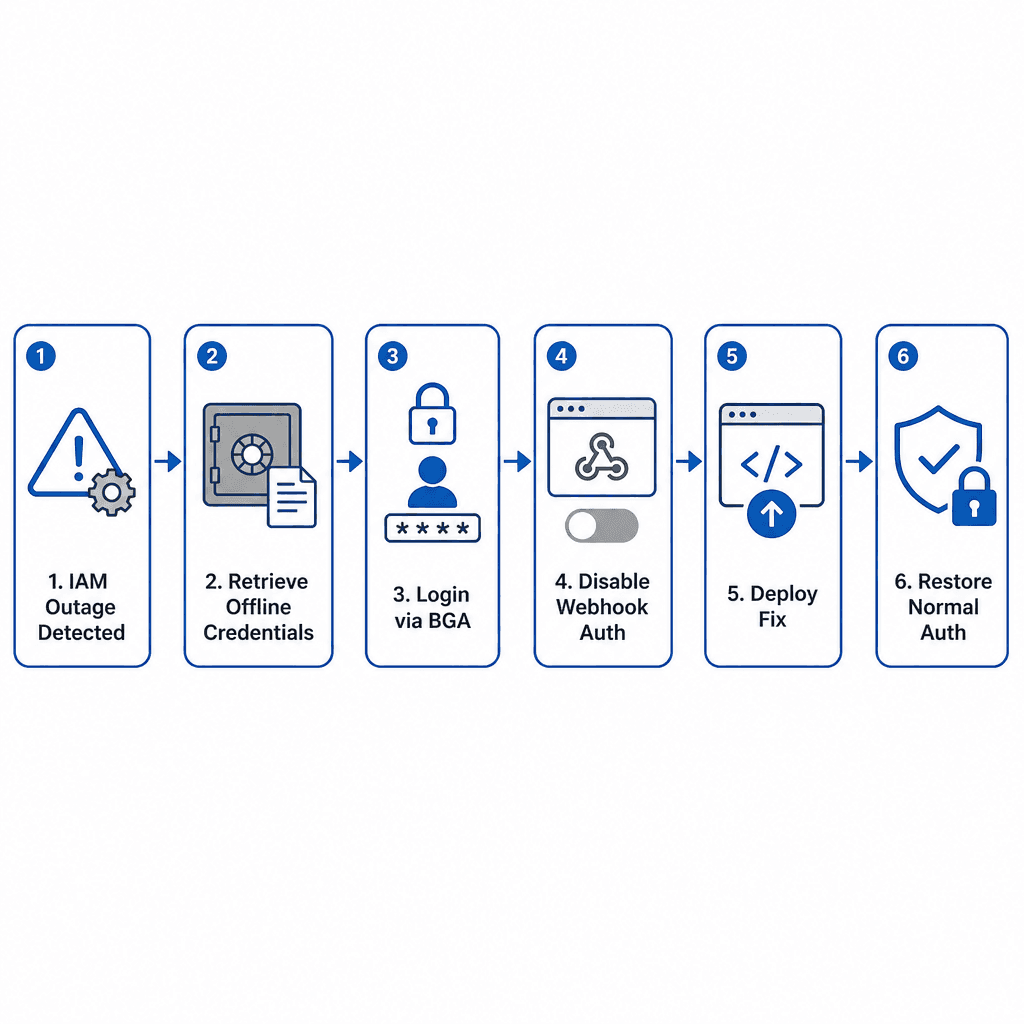
Step 1: Detection and Declaration
The monitoring system detects that the IAM endpoint in Region A is returning 503 errors. The incident commander declares a "Identity Outage."
Step 2: Activation of Break-Glass
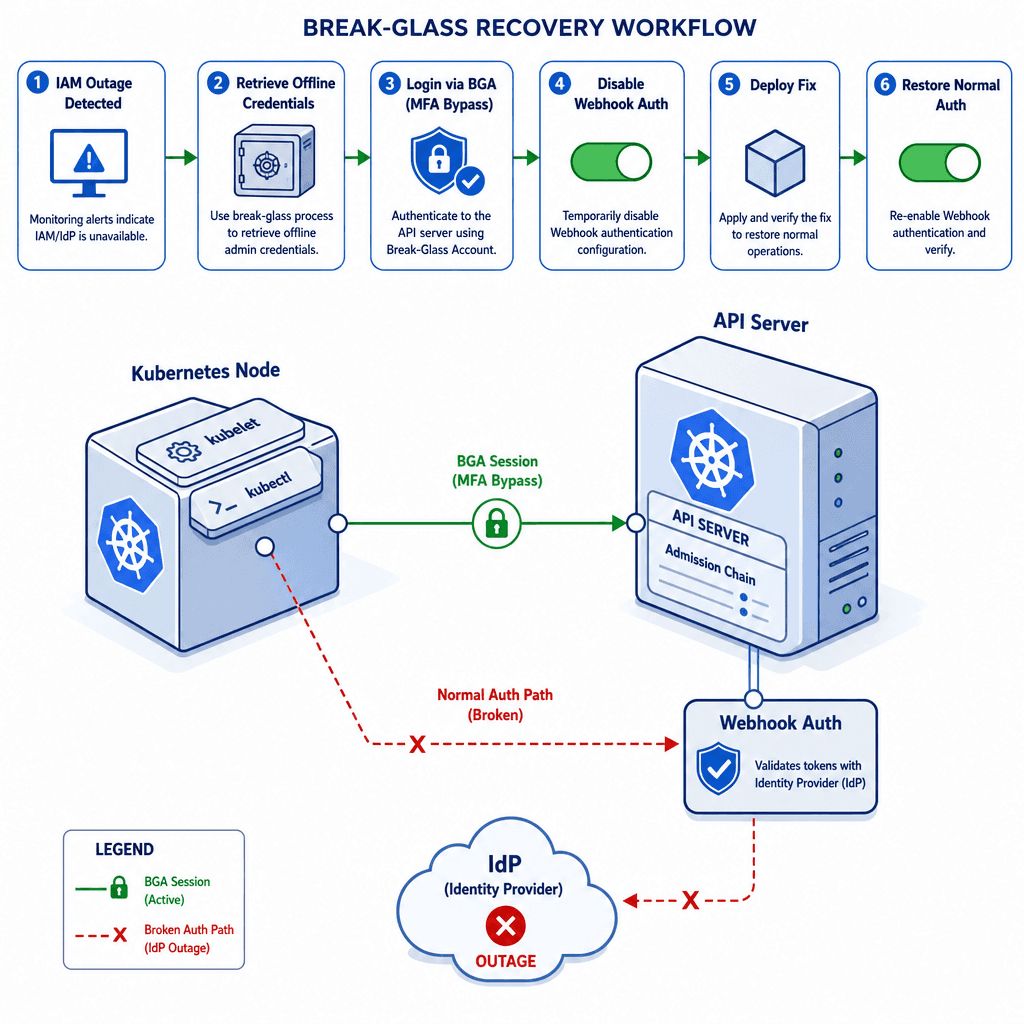
The incident commander retrieves the BGA credentials from the offline password manager (e.g., a hardware-encrypted USB drive stored in a physical safe). They log into the cloud console using the BGA credentials. Because the BGA is configured to bypass MFA, the login succeeds regardless of the MFA service status.
Step 3: Assessment and Containment
Using the BGA, the engineer checks the status of dependent services. They discover that the Kubernetes cluster in Region A cannot authenticate with the API server because the API server relies on the IdP for webhook authentication.
The engineer uses the BGA to temporarily disable the webhook authentication requirement in the Kubernetes API server configuration. This is a risky move, as it exposes the API server to unauthenticated access, but it is necessary to restore control.
Step 4: Restoration
With API access restored, the engineer deploys a patch to the IAM client libraries on the Kubernetes nodes to handle authentication failures gracefully. They also initiate a manual sync of IAM configurations from the offline backup.
Step 5: Post-Incident
Once the IdP is restored, the engineer re-enables MFA for the BGA and reviews all actions taken during the outage. Any temporary configurations (like disabling webhook auth) are reverted. A post-mortem is conducted to identify why the IdP failed and how the circular dependency was exacerbated.
Conclusion
Identity disaster recovery is not about restoring a service; it is about restoring control. By recognizing the circular dependency between identity and infrastructure, and by implementing rigorous break-glass procedures, organizations can ensure that they are never locked out of their own systems. The key is to treat identity as a unique critical infrastructure component, with its own DR plan, separate from the general IT disaster recovery strategy.
Related posts
acr_values and amr: Requesting Authentication Strength
Explore how acr_values and amr claims define authentication strength in OpenID Connect, enabling step-up authentication and MFA enforcement.
Building Your Own Identity Provider: What It Really Costs
An examination of the hidden costs, maintenance burden, and security risks involved in building a custom identity provider versus buying a solution.
SAML Metadata Exchange and Trust Establishment
A technical examination of SAML metadata exchange, covering trust establishment, entity descriptors, certificate rollover, and metadata refresh mechanisms.
