Auth Infrastructure Resilience Patterns
Explore auth resilience patterns including graceful degradation, JWKS caching, and multi-region availability for critical authentication paths.
Authentication is often treated as a binary gate: you are either in or out. However, in distributed systems, the act of verifying that gate is a complex network operation. When the authentication provider (IdP) becomes unreachable, the entire application effectively goes offline, even if the application logic itself is healthy. For Site Reliability Engineers (SREs) and architects, this creates a critical vulnerability: the availability of the business logic is coupled to the availability of the identity provider.
This post examines the mechanisms required to decouple these dependencies. We will explore how to build resilience into the authentication path through aggressive JWKS caching, graceful degradation policies, and multi-region deployment strategies.
The Failure Mode of Synchronous Auth
To understand the solution, we must first isolate the failure mode. In a typical OAuth 2.0 / OIDC flow, the application receives a signed JWT (JSON Web Token). To verify its signature, the application must fetch the public keys from the IdP’s JWKS (JSON Web Key Set) endpoint.
The standard mechanism is synchronous:
- Application receives
Access Token. - Application parses header to find
kid(Key ID). - Application checks local cache for
kid. - If missing, Application makes HTTP GET request to
https://idp.example.com/.well-known/jwks.json. - Application validates signature using the retrieved public key.
If step 4 fails due to a network partition, DNS failure, or IdP outage, the application throws an error. In a high-traffic system, this results in a cascading failure where every incoming request attempts to fetch the JWKS, overwhelming the IdP further or exhausting local connection pools. This is a classic "thundering herd" problem exacerbated by a hard dependency. A robust jwks cache strategy prevents this cascade by serving keys from local memory, but graceful degradation strategies are required when caching fails or keys expire.
The core issue is treating the JWKS endpoint as a live source of truth rather than a configuration artifact. Keys rotate infrequently (hours or days), yet the application treats them as volatile state requiring real-time retrieval.
JWKS Caching as a Resilience Primitive
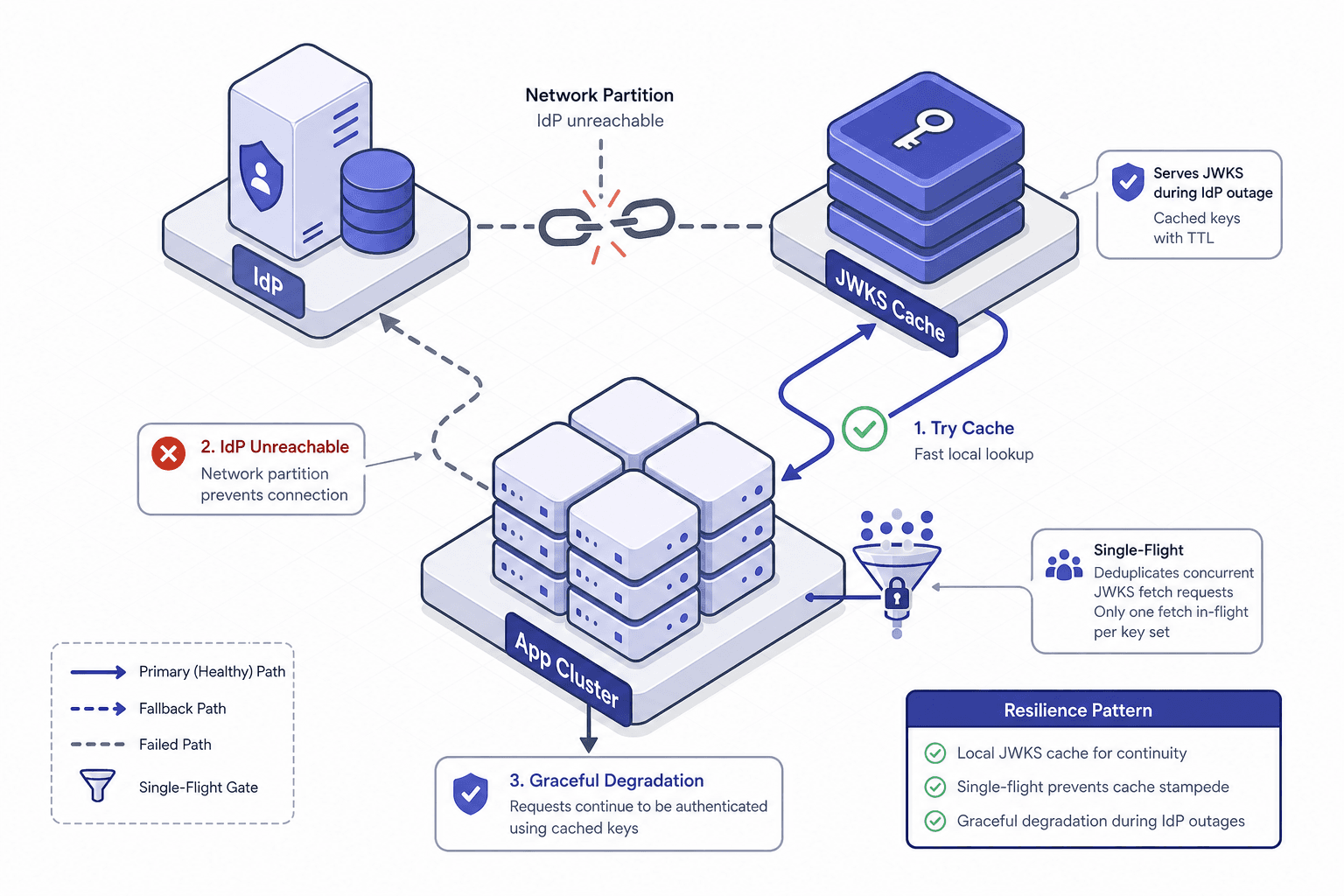
The primary defense against IdP unavailability is local caching of the JWKS. This transforms the authentication path from a network-dependent operation to a local lookup, with background synchronization.
Cache Strategy
The cache must respect the Cache-Control headers provided by the IdP. Most modern IdPs set a max-age of 3600 seconds (1 hour). However, resilience requires a more aggressive approach:
- Initial Load: On startup, fetch the JWKS and store it in memory.
- Validation: Verify signatures using the cached keys.
- Background Refresh: Start a background goroutine/task that fetches the JWKS before the current cache expires (e.g., at 75% of TTL). This ensures that if the refresh fails, the old keys remain valid until they expire naturally.
- Fallback: If the background refresh fails, do not invalidate the existing cache. Continue using the old keys.
Cache Stampede Protection
A common pitfall is multiple concurrent requests hitting the IdP when the cache expires simultaneously. To prevent this, use a "single-flight" or "promise" pattern. When multiple requests arrive for a missing kid, only one request is sent to the IdP; the others wait for the result.
// Pseudocode for single-flight JWKS fetch
func getPublicKey(kid string) (*jose.JSONWebKey, error) {
    if key, ok := localCache.get(kid); ok {
        return key, nil
    }

    // Ensure only one goroutine fetches the JWKS
    flight := singleFlightGroup.Do("jwks-fetch", func() (interface{}, error) {
        jwks, err := fetchJWKSFromIdP()
        if err != nil {
            return nil, err
        }
        updateLocalCache(jwks)
        return jwks.getKey(kid), nil
    })

    if key, ok := flight.(jose.JSONWebKey); ok {
        return &key, nil
    }
    return nil, fmt.Errorf("key not found")
}
This mechanism ensures that even if the IdP is slow, the application only makes one request per refresh cycle, protecting both the IdP and the application’s resource limits.
Graceful Degradation Strategies
Caching alone is not enough. Keys eventually rotate, and if the IdP is down for an extended period, the cached keys will expire. At that point, the application must decide how to behave. This is where graceful degradation comes in.
Option 1: Allow Stale Tokens (High Availability, Lower Security)
If the IdP is unreachable, the application can continue to validate tokens using the last known good key, even if the key has been revoked by the IdP.
- Mechanism: Disable strict key revocation checks. Trust the local cache until a new key is successfully fetched.
- Risk: If the IdP rotates keys due to a compromise, the application may still accept the old (compromised) key for up to the TTL duration.
- Use Case: Non-critical internal APIs where availability is paramount.
Option 2: Fallback to Symmetric Keys (Hybrid Approach)
Some IdPs support both asymmetric (RSA/ECDSA) and symmetric (HMAC) signing. The application can be configured to accept tokens signed with a pre-shared symmetric key as a fallback.
- Mechanism: If asymmetric key validation fails due to missing JWKS, attempt validation with the shared secret.
- Risk: Symmetric keys are harder to manage at scale and require secure distribution.
- Use Case: Microservices with tight coupling where latency and availability are critical.
Option 3: Hard Failure with Retry Logic (Standard Approach)
For most applications, the correct behavior is to return a 503 Service Unavailable rather than a 401 Unauthorized. This distinguishes between "user is not authenticated" and "authentication service is down."
- Mechanism: Implement exponential backoff retries for the JWKS fetch. If retries fail, return 503.
- Benefit: Allows clients to retry later without treating the user as invalid.
Multi-Region Availability
For global applications, a single-region IdP is a single point of failure. If the IdP’s region goes down, all applications in other regions lose access.
DNS-Based Routing
Use DNS routing (e.g., AWS Route 53, Cloudflare Load Balancing) to direct auth requests to the nearest healthy IdP endpoint. However, since JWT validation is stateless, the real benefit of multi-region IdPs is cache locality. Multi-region setups enable graceful degradation by routing around failed regions, protecting the critical path for authentication.
Localized JWKS Caching
Deploy the application in multiple regions. Each region maintains its own jwks cache to ensure local validation. If one region’s IdP endpoint is unreachable, the other regions continue to function independently. This requires that the IdP supports multi-region key rotation synchronization. Multi region deployment strategies ensure that no single region's outage impacts global availability.
Stateful Session Stores
If using session cookies instead of stateless JWTs, ensure the session store (e.g., Redis, DynamoDB) is also multi-region. Cross-region replication adds latency but provides failover capability. For stateless JWTs, this is less critical since the token itself contains the necessary claims, though high availability requirements may still necessitate redundant session stores for refresh tokens or logout operations.
Conclusion
Authentication resilience is not about making the IdP faster; it is about reducing the application’s dependency on the IdP’s real-time availability. By implementing effective JWKS caching, graceful degradation policies, and multi-region architectures, SREs can ensure that the authentication path remains available even when the underlying identity provider is compromised.
The key takeaway is to treat the IdP as an external dependency that may fail, and design the application to continue operating within defined security boundaries during such failures. This shift in mindset—from "auth must always be live" to "auth must be resilient"—is essential for building reliable systems.
Related posts
Building an LLM Load Test That Reflects Real Traffic
A guide to building LLM load tests that reflect real traffic patterns using capacity planning, arrival rates, and saturation metrics.
Shadow Traffic for LLM Deployments
Explore how shadow traffic and traffic mirroring enable safe comparison of candidate LLM models in production without impacting user experience.
Building Your Own Identity Provider: What It Really Costs
An examination of the hidden costs, maintenance burden, and security risks involved in building a custom identity provider versus buying a solution.
