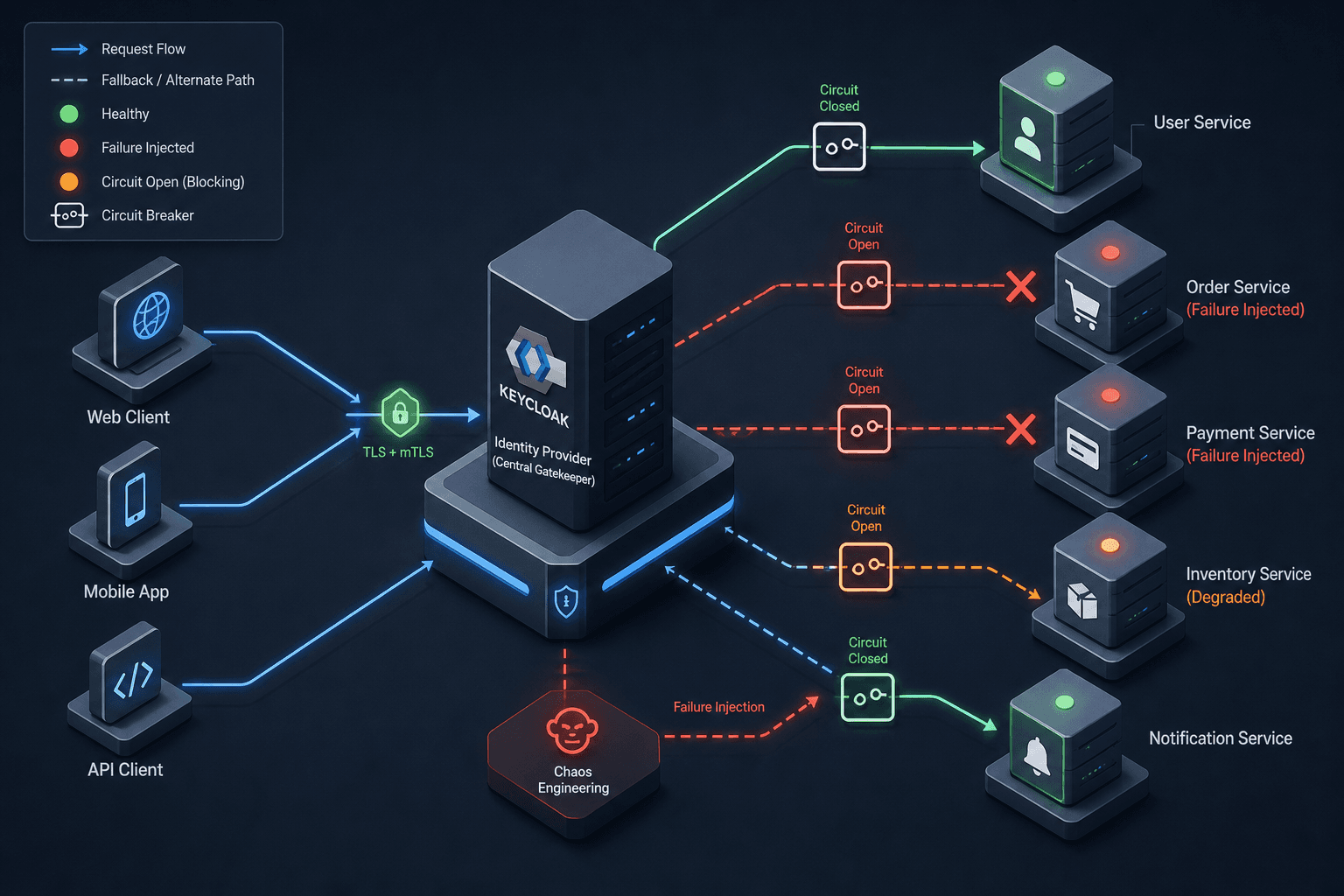
Identity Resilience Testing: Chaos Engineering for IAM Systems
An examination of chaos engineering techniques for Identity and Access Management systems to ensure identity resilience through failure injection and Keycloak testing.
Most engineering teams treat Identity and Access Management (IAM) as a static configuration problem. They assume that if the database is up and the certificates are valid, the system works. This assumption collapses under the weight of real-world distributed systems. In a microservice architecture, the IAM system is not just another service; it is the gatekeeper. When a standard web service fails, the user sees a "Service Unavailable" page. When the IAM system fails, the user sees nothing at all because the request never reaches the application logic. The mechanism here is the synchronous dependency chain: every request must pass through the identity provider before any business logic executes. If the identity provider is slow, the entire application slows. If the identity provider is down, the entire application stops.
To build resilience, we must apply chaos engineering principles specifically to this choke point. Chaos engineering is the practice of injecting failure into a system to test its ability to withstand unexpected conditions. For IAM, this means we cannot simply run load tests. We must break the trust chain. We must sever the connection between the application and the identity provider. We must simulate the exact conditions that cause a security breach or a total outage.
Consider a scenario involving a fintech application named "LedgerFlow" using Keycloak as its identity provider. The application relies on Keycloak to validate JSON Web Tokens (JWTs) for every API request. Under normal operations, the application sends a request to the Keycloak authorization server, receives a validated token, and proceeds. This is a synchronous round-trip. If we introduce a failure, the behavior of the downstream service determines the system's resilience.
The Mechanism of Identity Failure
IAM systems are unique among microservices because they function as a "blocking choke point." Unlike a web server that might return a 503 error after processing a request, an IAM failure blocks the entire request pipeline at the edge. The mechanism taught here is the synchronous prerequisite: identity validation is required before any business logic executes.
In a non-resilient architecture, this creates a single point of failure. If the identity provider is slow, the entire application slows. If the identity provider is down, the entire application stops. This is distinct from typical service failures where users might see a degraded experience. Here, the user sees nothing because the request never reaches the application logic.
Database Connectivity Loss in Keycloak
The first mechanism to test is Database Connectivity Loss. Keycloak stores user sessions, client configurations, and user credentials in a relational database. If the database becomes unreachable due to network partitioning or disk I/O saturation, Keycloak cannot process login requests or update session state.
To simulate this, an SRE engineer would use a tool like Chaos Mesh or a custom script to drop TCP connections to the Keycloak database container. The mechanism here is the "synchronous lock." Crucially, signature verification of a JWT typically relies on in-memory cached keys or a separate key store, not synchronous database reads. Therefore, Keycloak can often still verify the cryptographic signature of an existing token even when the database is unreachable. However, it cannot check if a session is active, verify token revocation status, or process new login attempts.
In a non-resilient system, the application's HTTP client waits for the Keycloak response until the timeout threshold is reached (often 30 seconds). During this wait, the application threads are blocked. If 1,000 users hit the system simultaneously, 1,000 threads hang, consuming memory and CPU, eventually causing the application to crash under its own weight. This is a cascading failure.
In a resilient system, the application implements a circuit breaker pattern. The mechanism here is stateful failure detection. The application tracks the latency and error rate of the Keycloak health check endpoint. When the database failure causes the response time to exceed a threshold (e.g., 200ms), the circuit breaker "opens." Subsequent requests do not attempt to contact Keycloak. Instead, the application immediately returns a 503 Service Unavailable or a specific "Maintenance Mode" response. The key distinction is that the failure is contained. The application does not hang; it fails fast.
Certificate Expiration and Trust Chain Breakage
The second mechanism to test is Certificate Expiration and Trust Chain Breakage. In a production environment, Keycloak uses TLS to secure communication with downstream applications. If the SSL certificate expires or the private key is compromised, the handshake fails.
Imagine a scenario where the certificate for auth.ledgerflow.com expires. The application attempts to connect to Keycloak to validate a JWT, but the TLS handshake fails. The mechanism here is the cryptographic verification failure. Without a valid certificate, the application cannot establish a secure channel to retrieve the public keys needed to verify the JWT signature.
A strong IAM strategy requires the application to handle this gracefully. The mechanism involves Graceful Degradation. When the TLS handshake fails, the application should not retry indefinitely. It should log the error, increment a metric for "Identity Provider Unreachable," and fall back to a predefined safety mode. To align with the Fail-Secure principle, the system should deny access rather than allowing read-only modes or permissive fallbacks when validation is impossible. This prevents the system from accepting unauthorized access while alerting the on-call engineer. The goal is to ensure the system does not become completely unusable, but more importantly, it never defaults to allowing traffic when the trust chain is broken.
High Latency and Token Validation Storms
The third mechanism is High Latency and Token Validation Storms. Keycloak often acts as a central authority for Single Sign-On (SSO). If the Keycloak server is under heavy load, token validation can take hundreds of milliseconds. In a high-traffic system, this latency compounds.
To test this, we inject artificial latency into the Keycloak API using a traffic shaper. We add a 5-second delay to every /protocol/openid-connect/token request. The mechanism here is the Resource Starvation. As the application waits for the delayed responses, its connection pool fills up. New requests queue up behind the waiting ones. The application's own latency increases, creating a feedback loop where the application becomes slower, causing more requests to pile up.
Resilience in this scenario requires Token Caching and Asynchronous Validation. Instead of validating every JWT against Keycloak on every request, the application can cache the public keys locally for a short period (e.g., 5 minutes). It can also validate the JWT signature locally using the cached keys without contacting Keycloak, only validating the expiration and issuer. This reduces the dependency on Keycloak for every single request. If Keycloak goes down, the application can still validate existing tokens for a limited window.
However, this introduces a specific security tradeoff regarding Token Revocation. Local caching solves latency but creates a blind spot specifically for revocation and active session status, not a general security tradeoff. If a user is logged out or a token is revoked, the application might not know immediately if it relies solely on local caching. The mechanism for mitigating this is Short-lived Access Tokens paired with Refresh Tokens. Access tokens expire quickly (e.g., 15 minutes), so the window of exposure is small. Refresh tokens are long-lived but are only used to obtain new access tokens. If Keycloak is down, the application can refuse to issue new access tokens but can continue serving requests with valid, cached access tokens until they expire.
Keycloak Node Failure in a Cluster
The fourth mechanism is Keycloak Node Failure in a Cluster. Keycloak runs in a clustered mode to distribute load. If one node fails, the others should take over. However, if the cluster loses quorum, the entire cluster becomes unavailable.
To test this, we kill a Keycloak node in a three-node cluster. The mechanism here is Distributed Consensus. If the remaining nodes cannot agree on the state of the system (due to network partitions), they may stop accepting writes. The application must detect this cluster state change. It should monitor the health of all Keycloak endpoints, not just the load balancer. If the load balancer routes traffic to a dead node, the application should detect the failure and switch to a different endpoint or enter a degraded mode.
Observability and Verification
This leads to the final mechanism: Observability and Verification. How do we know the chaos test was successful? We look at the metrics. In a failed test, the application might return 500 Internal Server Error or hang indefinitely. In a successful test, the application returns 503 Service Unavailable or a custom error code that the frontend can handle gracefully.
We also monitor the Deny Rate. In a chaos test, the system should deny access to unauthenticated users. If the system starts accepting requests without valid tokens because the validation logic failed, that is a security breach. The mechanism here is Fail-Secure. When in doubt, deny access. The application should never default to "allow" when the identity provider is unreachable.
The following code snippet demonstrates how a resilient application might handle a Keycloak timeout using a circuit breaker pattern in Java (using Resilience4j):
// Pseudo-code for Keycloak validation with circuit breaker
CircuitBreakerConfig config = CircuitBreakerConfig.custom()
    .failureRateThreshold(50) // Open circuit if 50% of calls fail
    .waitDurationInOpenState(Duration.ofSeconds(30)) // Wait 30s before trying again
    .slidingWindowSize(10)
    .build();

CircuitBreaker keycloakCircuitBreaker = CircuitBreaker.of("keycloak-validation", config);

Supplier<String> tokenValidation = () -> {
    // Attempt to validate token with Keycloak
    return keycloakClient.validate(token);
};

// Execute with fallback
String result = CircuitBreaker.executeSupplier(keycloakCircuitBreaker, tokenValidation,
    () -> {
        // Fallback: Return error or cached token if available
        throw new AuthenticationException("Identity Provider Unavailable");
    }
);
This code ensures that if the Keycloak client times out or throws an exception, the circuit breaker opens, preventing further calls to the failing service. The fallback mechanism immediately returns an error, preventing the application from hanging.
Testing these mechanisms requires a disciplined approach. You cannot just "turn off the lights." You must inject specific failures that mimic real-world incidents: network partitions, certificate expirations, database deadlocks, and high-latency spikes. You must measure the impact on the user experience and the security posture.
The ultimate goal of Identity Resilience Testing is to ensure that when the identity provider fails, the system fails in a way that preserves security and minimizes disruption. It is not about making the identity provider faster; it is about making the application smarter about how it handles the identity provider's failure. By understanding the mechanisms of failure and implementing patterns like circuit breaking, token caching, and graceful degradation, you can build an IAM system that is truly resilient.
In the end, the difference between a chaotic outage and a controlled failure is the presence of these mechanisms. They turn a potential catastrophe into a manageable incident. The next time you design an IAM architecture, do not just ask "Is it secure?" Ask "How does it fail?" and then test that answer.
Practical Takeaways
Before diving into implementation, keep these core lessons in mind to guide your chaos engineering efforts for IAM:
- Decouple Cryptographic Verification from State Checks: Understand that verifying a JWT signature is often an in-memory operation, while checking session state or revocation requires a database. Testing connectivity loss must target both scenarios separately.
- Fail-Secure by Default: Never configure a fallback that allows access when the identity provider is unreachable. Denying access is safer than inadvertently granting it.
- Cache with Caution: Token caching improves latency but creates a blind spot for revocation. Mitigate this by using short-lived access tokens and ensuring refresh token logic is robust.
Common Pitfalls
Teams frequently stumble when implementing IAM chaos testing. Avoid these common mistakes:
- Ignoring Certificate Rotation: Focusing only on network failures while neglecting to test the exact moment an SSL certificate expires, which often causes immediate handshake failures across the board.
- Over-relying on Local Caching: Implementing aggressive token caching without a mechanism to handle revocation, leading to a situation where revoked users retain access until their token naturally expires.
- Testing Only the Load Balancer: Monitoring only the load balancer's health status rather than the individual Keycloak nodes, which can hide internal cluster consensus failures that affect write operations.
Conclusion
Identity Resilience Testing transforms IAM from a static configuration problem into a dynamic, verified system. By applying chaos engineering principles to Keycloak and other identity providers, organizations can ensure that their systems fail securely rather than insecurely. The mechanisms of circuit breaking, token caching, and fail-secure logic are essential for maintaining availability and security during identity storms.
FAQ
Q: What happens if Keycloak is completely down?
A: If Keycloak is completely down, a resilient application will open its circuit breaker. It will stop sending requests to Keycloak and immediately return a 503 Service Unavailable or a custom error to the user. It will not hang waiting for a timeout, preserving application resources.
Q: How does token caching affect security? A: Token caching improves performance by allowing local signature verification, but it introduces a delay in detecting token revocation. To mitigate this, use short-lived access tokens so that even if a token is revoked on the server, it remains valid only for a brief window on the client side.
Q: Can I test certificate expiration in a production environment? A: It is generally unsafe to let a real certificate expire in production. Instead, simulate the failure by configuring your load balancer or application to reject valid certificates, or use a staging environment where you can safely let a test certificate expire to observe the failure mode.
Related posts
Log Retention, CloudWatch Logs, and Cost Control
Strategies for managing CloudWatch Logs retention, log classes, and S3 tiering to control AWS logging costs effectively.
AWS Alerting: Fire on Real Threats
Reduce alert fatigue in AWS by configuring EventBridge and GuardDuty to fire only on high-fidelity threats.
Building Identity-Aware Load Balancing with NGINX and Keycloak
Learn how to implement identity-aware load balancing using NGINX and Keycloak for secure authentication routing.