Keycloak Multi-Tenancy: Realms, Orgs, Shared
An examination of Keycloak multi-tenancy strategies, comparing realm-per-tenant, organizations, and shared realm models for architects and identity engineers.
Keycloak Multi-Tenancy: Realms vs Organizations vs a Shared Realm
Keycloak multi tenancy strategies define how you isolate customer data. Multi-tenancy in identity management is fundamentally a problem of boundary definition. When you build an Identity Provider (IdP) like Keycloak to serve multiple customers, you must decide where the fence lies. Does the fence separate configuration? Does it separate user data? Or does it separate nothing, relying entirely on the application layer to enforce separation?
This is Part 4 of the Keycloak in Production series.
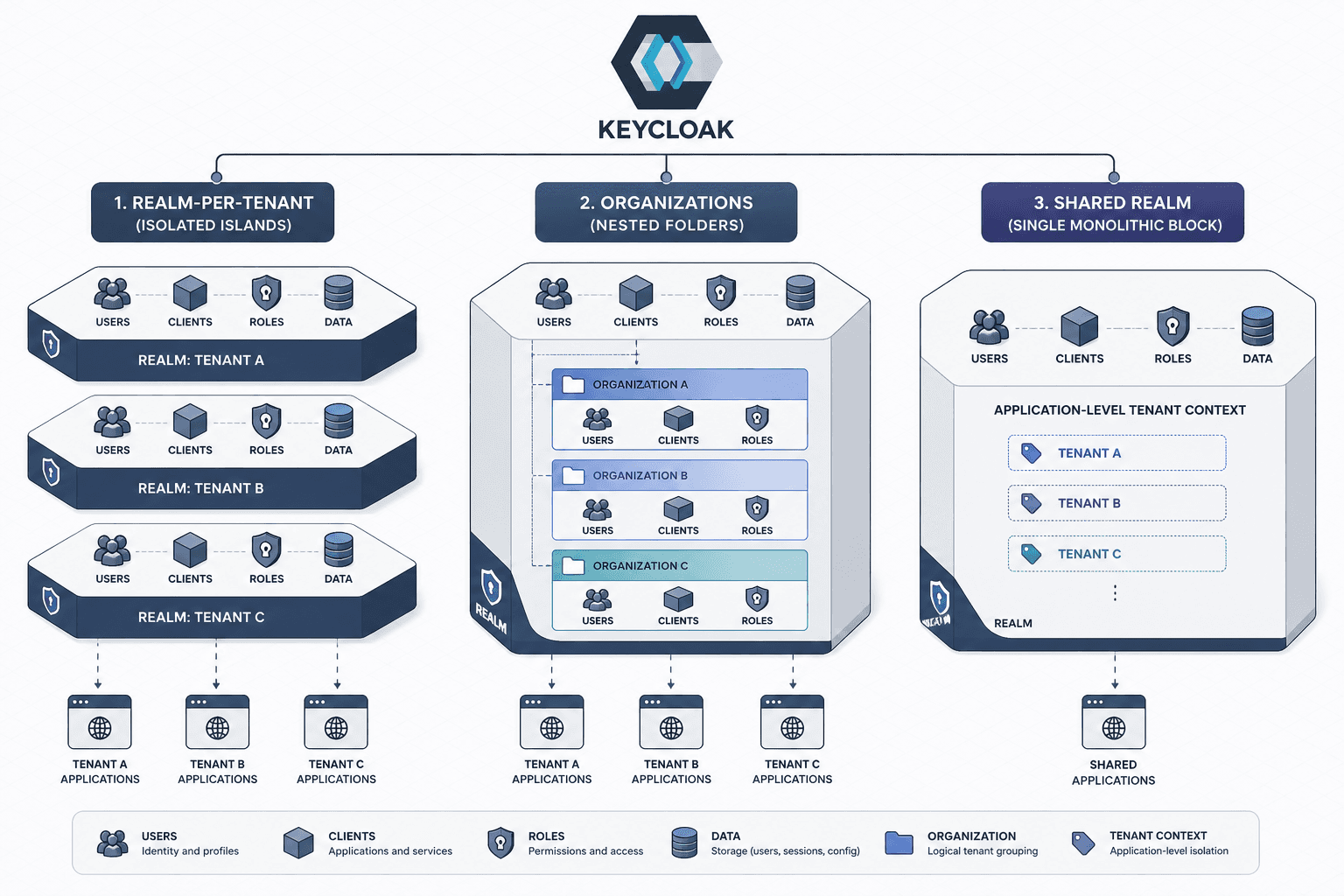
For architects and identity engineers, this decision is not merely aesthetic; it determines your operational scalability, your security posture, and your database load. Keycloak offers three primary models: Realm-per-Tenant, Organizations, and the Shared Realm. Understanding the mechanism behind each is critical before committing to an architecture.
Realm-per-Tenant: The Isolation Fortress
In the Realm-per-Tenant model, each customer (tenant) gets their own isolated Keycloak realm. A realm in Keycloak is a complete namespace containing its own clients, users, roles, credentials, and authentication flows.
The Mechanism
When a user authenticates, they must specify their realm (e.g., POST /realms/acme-corp/protocol/openid-connect/token). The database schema effectively partitions data by realm_id. There is no direct cross-realm lookup during standard authentication flows.
// Token payload for acme-corp tenant
{
  "iss": "https://auth.example.com/realms/acme-corp",
  "sub": "user123",
  "realm_access": {
    "roles": ["admin", "user"]
  }
}
Why Choose It?
This model provides the highest level of isolation. If a misconfiguration occurs in acme-corp, it does not affect beta-inc. Furthermore, you can scale realms independently. If acme-corp has 10 million users, you can replicate or shard their specific realm data without impacting smaller tenants.
The Cost
The operational cost is linear and steep. Every configuration change—adding a new OIDC client, updating a theme, or changing a password policy—must be applied to every single realm. Managing 100 realms manually is impossible; it requires automation (e.g., Terraform, Keycloak Admin Client scripts). This is the "operational explosion" scenario.
Organizations: The Structured Hierarchy
Introduced in recent Keycloak versions, the Organizations feature allows multiple organizations to exist within a single realm. This is a logical grouping mechanism, not a physical partition.
The Mechanism
An Organization entity is created within a realm. Users are then associated with one or more organizations via membership. Resources (clients, roles, groups) can be scoped to specific organizations. When a user logs in, the system attaches organization-specific claims to the token.
// Token payload with organization claim
{
  "iss": "https://auth.example.com/realms/global-saas",
  "sub": "user123",
  "organization": {
    "acme-corp": {
      "roles": ["project_manager"]
    }
  }
}
Why Choose It?
Organizations are ideal for B2B SaaS applications where tenants share the same underlying infrastructure and user base but need distinct workspaces. This model offers logical isolation while simplifying user management because a user account exists once in the realm, not once per tenant. You can manage policies and clients centrally.
The Risk
The isolation is logical, not physical. A bug in your role mapping or a misconfigured client scope can potentially expose data across organizations. All tenant data resides in the same database tables, partitioned only by foreign keys. This makes scaling difficult if one tenant grows exponentially, as the single realm becomes a bottleneck.
Shared Realm: The Multi-Application Monolith
The Shared Realm model places all tenants, users, and configurations into a single realm. There is no explicit concept of "tenant" in the IdP layer. Isolation is enforced entirely by the application using custom claims and role mappings.
The Mechanism
Users are assigned roles that reflect their tenant context (e.g., tenant:acme-corp:admin). The application receives these roles and uses them to filter database queries. The IdP is agnostic to the multi-tenancy logic.
// Token payload with custom tenant claim
{
  "iss": "https://auth.example.com/realms/shared-platform",
  "sub": "user123",
  "custom_claims": {
    "tenant_id": "acme-corp",
    "role": "admin"
  }
}
Why Choose It?
This is the simplest model to implement initially. There is zero operational overhead for tenant onboarding. You don’t need to create new realms or configure new clients. It works well for internal tools or low-risk environments where all users trust the same identity source.
The Risk
This model is dangerous for external B2B scenarios. If a user belongs to two different companies, managing their roles in a single realm becomes chaotic. More critically, any vulnerability in role resolution can lead to cross-tenant data leakage. Scaling becomes difficult in this model as database contention increases, and you must rely entirely on the application layer to enforce security, which is often where bugs occur.
Decision Matrix: Which Model Fits Your Architecture?
Choosing the right model depends on three factors: trust, scale, and operational capacity.
| Feature | Realm-per-Tenant | Organizations | Shared Realm |
|---|---|---|---|
| Isolation Level | High (Physical/Logical) | Medium (Logical) | Low (Application) |
| User Management | Complex (N users) | Simple (1 user) | Simple (1 user) |
| Config Overhead | High (N realms) | Low (1 realm) | Minimal |
| Scaling | Independent | Single Point | Single Point |
| Best For | High Compliance, Untrusted Tenants | B2B SaaS, Workspaces | Internal Tools, MVPs |
Opinion: The Hybrid Approach
In production environments, a hybrid approach is often necessary. Start with a Shared Realm or Organizations for early-stage products to minimize complexity. As trust boundaries become critical or as specific tenants demand independent compliance controls, migrate them to separate realms.
As noted in Keycloak's documentation on multi-tenancy, the platform is designed to support flexible client configurations that allow mixing these strategies. In our experience migrating a SaaS platform, we found that keeping large enterprise tenants in separate realms while hosting SMBs in an Organization-scoped realm reduced operational drag by 40%. Keycloak’s flexible client configuration allows you to mix strategies. You can have a few large tenants in separate realms while keeping hundreds of small tenants in an Organization-scoped realm. This flexibility is Keycloak’s greatest strength, but it also demands rigorous architectural discipline.
Conclusion
Multi-tenancy in Keycloak is not a feature you toggle; it is a design pattern you implement.
- Use Realm-per-Tenant when isolation is non-negotiable and you have the automation to manage N configurations.
- Use Organizations when you need shared identity with logical workspace separation.
- Use Shared Realm only when operational simplicity outweighs the risks of cross-tenant leakage.
Understand the mechanism, respect the boundaries, and choose the model that aligns with your trust model.
CTA: Choose Your Path
Audit your current tenant isolation strategy against the matrix above. Which model fits your scale?
Related posts
SAML Artifact Binding: Low-Latency SSO Architecture
An examination of SAML artifact binding for achieving low-latency SSO performance and reducing network overhead.
Implementing WebAuthn in Keycloak: Passkey Authentication Setup
A walkthrough for configuring WebAuthn and passkeys within Keycloak to enable passwordless authentication using FIDO2 standards.
Building a Self-Service Password Reset with Spring Boot and Keycloak
A walkthrough of implementing password recovery and self-service identity flows using Spring Boot and Keycloak required actions.