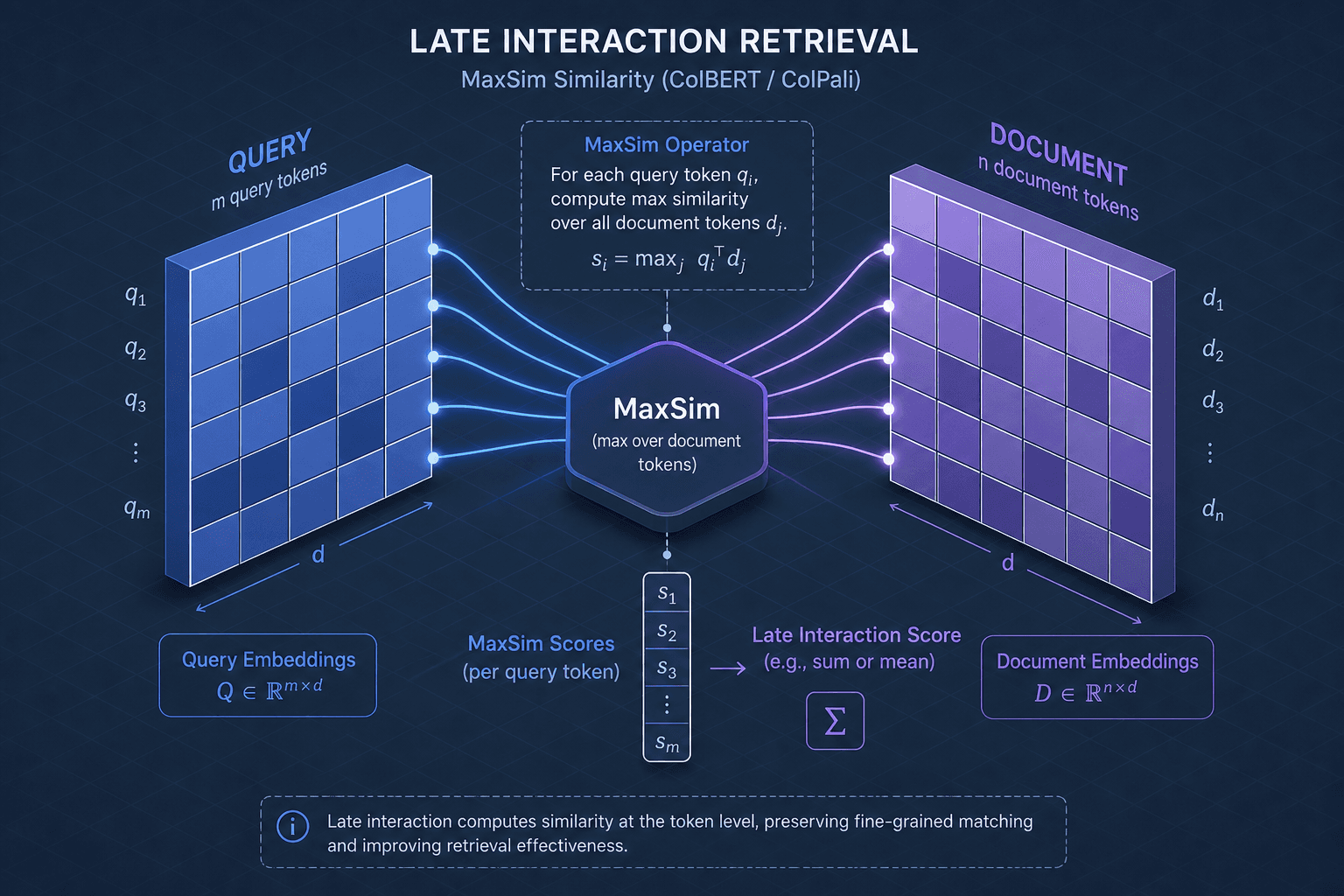
Late Interaction Retrieval with ColBERT and ColPali
Explore late interaction retrieval using ColBERT and ColPali for improved multi-vector search accuracy.
This is Part 3 of the Retrieval Engineering series.
Traditional dense retrieval relies on "early interaction," where a text passage is compressed into a single fixed-length vector via mean pooling before any comparison occurs. This compression discards granular semantic signals, causing the retriever to miss nuanced matches. Late interaction models like ColBERT and ColPali address this by preserving individual token or patch embeddings and computing similarity at retrieval time, offering a mechanism that balances the precision of cross-encoders with the efficiency of dual-encoders.
The Cost of Early Interaction
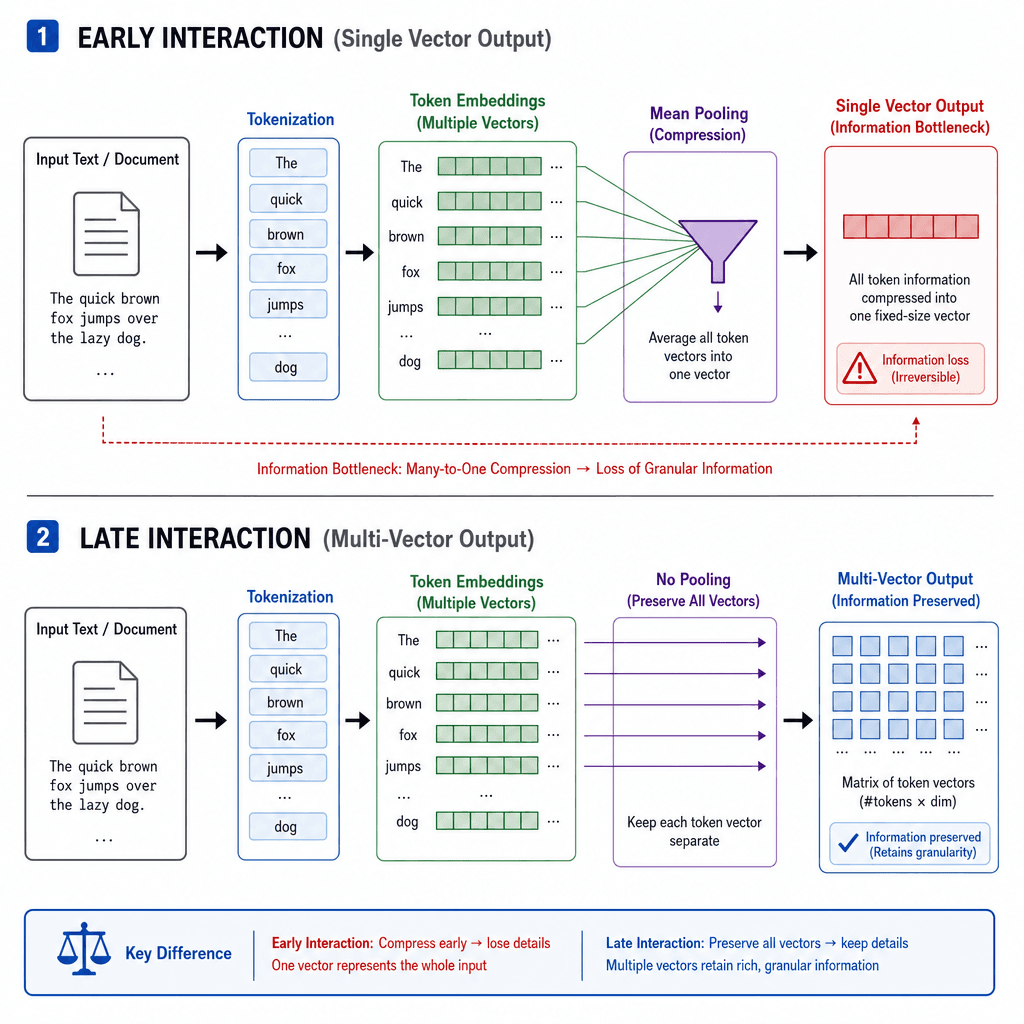
In standard vector search pipelines, an encoder (like BERT or RoBERTa) processes a document to produce a single embedding vector . A query is similarly encoded into . Retrieval is then a simple dot product or cosine similarity between and .
The mechanism fails here because the encoder must average out all token representations. If a document contains both "apple" the fruit and "Apple" the company, the resulting vector is a semantic average. A query for "buy iPhone" might still retrieve the fruit document if the contextual averaging isn't precise enough to separate the entities. This is the "information bottleneck" of early interaction.
Early interaction models struggle significantly with polysemy, where a single word has multiple meanings depending on context. For example, a document discussing "Jaguar" as an animal might be retrieved for a query about "Jaguar" cars because the global vector captures only the most dominant sense, diluting the specific contextual signal. Similarly, long-tail queries that require precise alignment of rare terms often fail because the single vector representation lacks the granularity to distinguish between subtle semantic differences. In these cases, the global vector acts as a lossy compression, discarding the specific token-level relationships necessary for high-precision matching.
In contrast to early interaction, late interaction models preserve token-level details by maintaining the full sequence of embeddings. This approach allows the system to handle polysemy and complex queries by matching specific tokens in the query to their most relevant counterparts in the document, rather than relying on a diluted global average. This preservation of detail is the core advantage of late interaction, enabling multi vector retrieval systems to achieve higher recall on ambiguous or complex queries.
ColBERT: Multi-Vector Late Interaction
ColBERT (Contextualized Late Interaction over BERT) changes the data flow. Instead of producing one vector per document, it produces a matrix of vectors, one for each token in the document. The colbert architecture is fundamentally a late interaction retrieval model that leverages contextualized embeddings to improve matching precision.
The Architecture
ColBERT uses a BERT-based encoder. For a document with tokens , the encoder outputs a sequence of -dimensional vectors:
Each captures the contextual meaning of that specific token within the document. The same process applies to the query , producing .
{
  "document_tokens": ["apple", "fruit", "red"],
  "embeddings": [
    [0.1, 0.2, 0.3],
    [0.4, 0.5, 0.6],
    [0.7, 0.8, 0.9]
  ]
}
The MaxSim Operator
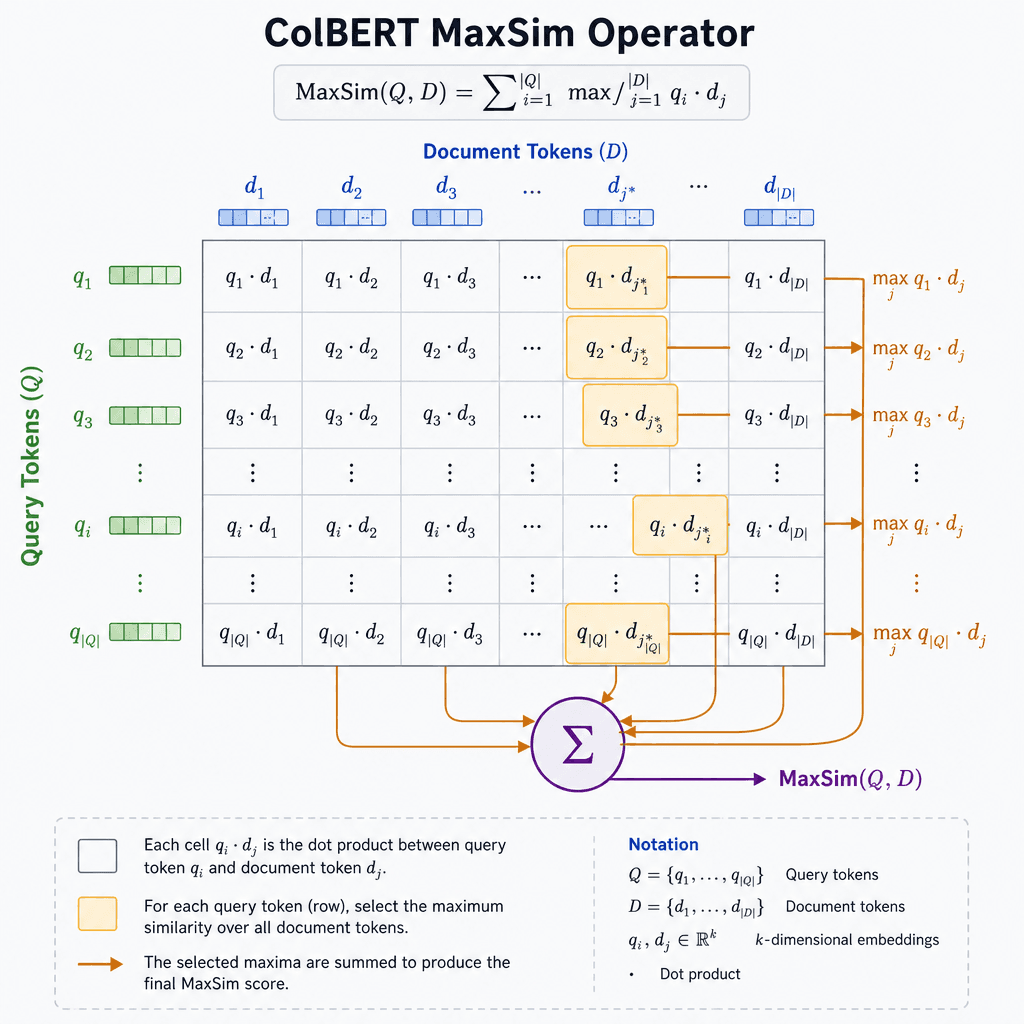
The core innovation is the interaction function. ColBERT does not compare document vectors to query vectors directly. Instead, it computes the maximum similarity between each query token and all document tokens, then sums these maximums.
For a single query token , the score against document is:
The final document score is the sum of these maximums across all query tokens:
This is called maxSim. It allows the system to find the best matching context for each query term individually. If a query has "Apple" and "iPhone," the system finds the best document token match for "Apple" and the best for "iPhone," ensuring that both concepts are satisfied without semantic averaging. This maxsim operation is computationally intensive but precise, allowing for fine-grained matching that early interaction cannot achieve.
ColPali: Late Interaction for Vision
ColPali extends the late interaction paradigm to multimodal retrieval, specifically for image documents. While ColBERT operates on text tokens, ColPali operates on visual patches. The colpali model adapts the late interaction framework to bridge the gap between text queries and visual content.
Patch-Level Embeddings
ColPali uses a SigLIP-based vision encoder (via the PaliGemma vision-language model). An image is divided into a grid of patches. Each patch is encoded into a vector. This creates a spatial map of embeddings rather than a single global image vector.
When a text query is processed, it generates token embeddings as in ColBERT. The retrieval mechanism then computes late interaction between the text query tokens and the image patch embeddings.
Visual Semantic Alignment
This approach allows for fine-grained visual retrieval. A query like "red car on the left" can match specific patches representing the car and the spatial arrangement, rather than relying on a global image caption. The maxSim operator is applied between query tokens and patch vectors, enabling the system to verify the presence of specific visual elements independently. This late interaction mechanism allows for fine-grained visual retrieval by aligning textual semantics with localized visual features, ensuring that specific attributes are matched accurately.
Trade-offs and Implementation
The primary trade-off in late interaction is storage and computation.
Storage Overhead
In early interaction, a document is stored as one vector (e.g., 768 floats). In ColBERT, a document with 512 tokens is stored as 512 vectors of 128 floats (ColBERT uses dimensionality reduction to 128D). This increases storage requirements significantly. However, quantization techniques (e.g., binary quantization) can mitigate this by storing vectors as bits rather than floats, reducing the footprint to near that of early interaction while preserving late interaction benefits. This multi vector retrieval approach requires careful optimization to manage the increased storage footprint efficiently.
Computational Cost
Computing maxSim is more expensive than a single dot product. For a query with 10 tokens and a document with 100 tokens, early interaction requires 1 dot product. Late interaction requires dot products.
To manage this, production systems use two-stage retrieval:
- Candidate Generation: Use a lightweight early interaction model (like a bi-encoder) to retrieve top-K candidates quickly.
- Re-Ranking: Apply the full ColBERT/ColPali
maxSimcomputation only to the top-K candidates.
This hybrid approach preserves the accuracy of late interaction while keeping latency acceptable for real-time applications. Multi vector retrieval systems must balance this computational cost with accuracy, often relying on hardware acceleration or approximate nearest neighbor search to maintain performance.
Conclusion
Late interaction models represent a shift from compressed semantic matching to explicit token-level alignment. ColBERT and ColPali demonstrate that preserving granular representations during encoding and computing interaction at retrieval time yields superior recall and precision, particularly for complex queries and multimodal documents. For ML engineers building retrieval systems, adopting late interaction requires managing increased storage and compute, but the gains in accuracy often justify the engineering complexity.
Related posts
HyDE and Query Expansion: Do They Still Help?
An examination of HyDE and query expansion techniques in modern retrieval systems, assessing their continued relevance and performance benchmarks.
pgvector at 100 Million Vectors: Lessons Learned
Practical lessons on scaling pgvector to 100 million vectors, covering HNSW index tuning, partitioning strategies, and performance optimization for Postgres.
Metadata Filtering at Scale: Vector Search
Learn efficient metadata filtering for vector search, covering multi-tenant isolation, payload indexes, and selectivity optimization.
