Running LLM Inference on AMD MI300X: A Field Report
A field report on running LLM inference using AMD MI300X, ROCm, and vLLM, evaluating performance as a GPU alternative.
The landscape of Large Language Model (LLM) inference is shifting. While NVIDIA’s CUDA ecosystem has long dominated AI acceleration, the AMD Instinct MI300X offers a high-bandwidth alternative that challenges NVIDIA’s dominance in throughput-per-dollar metrics. This report details the mechanics of running LLM inference on AMD hardware, examining the actual data flow, software friction, and performance realities encountered in production-like environments.
The Hardware Mechanism: Bandwidth as the Bottleneck
To understand why the MI300X is relevant for LLMs, one must look past the compute units (CUs) and focus on the memory subsystem. LLM inference is fundamentally memory-bound; the model weights are massive, and the GPU spends most of its time waiting for data rather than performing matrix multiplications.
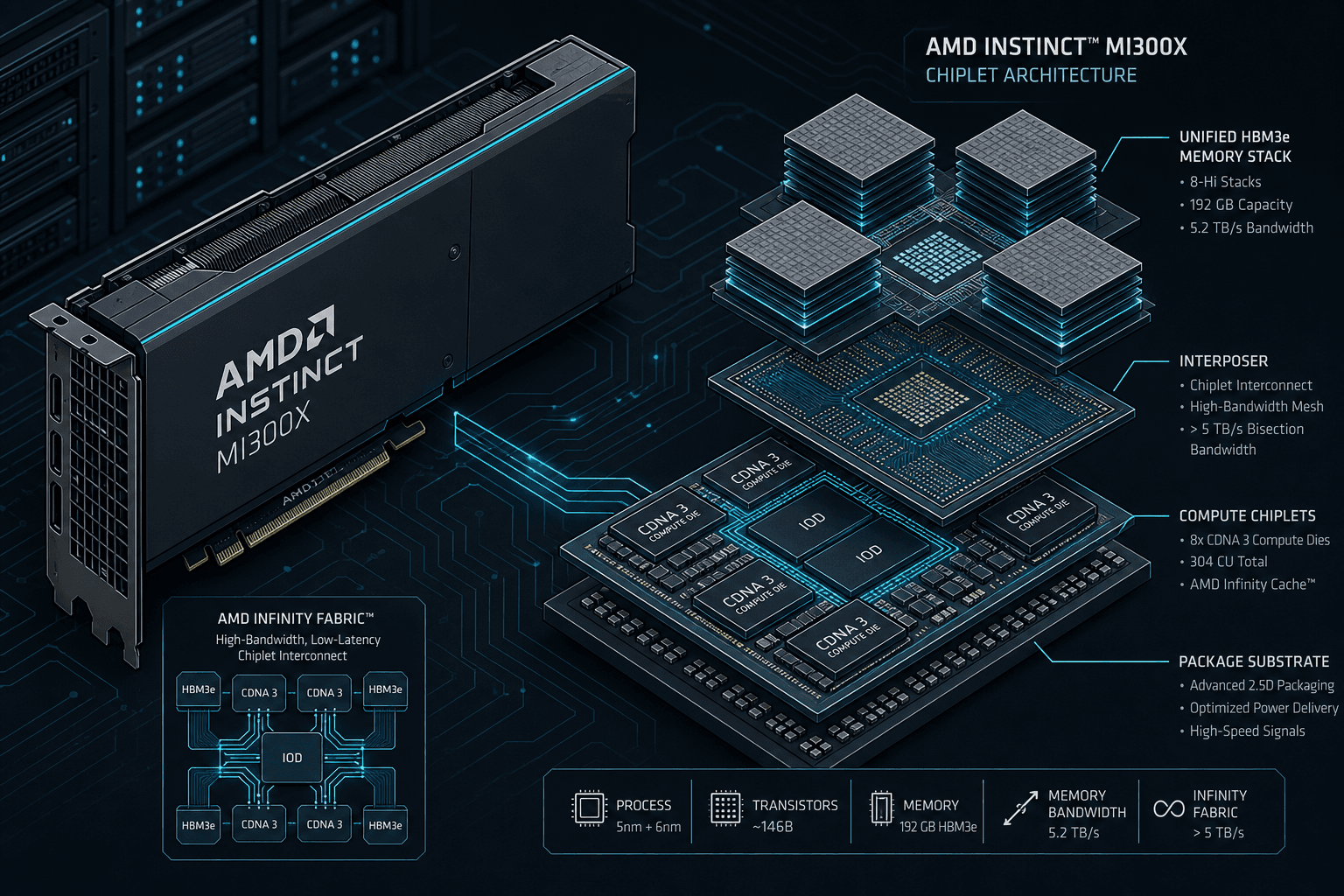
The MI300X utilizes a chiplet design, integrating 192 GB of High Bandwidth Memory (HBM3) directly onto the package. This results in a memory bandwidth of approximately 5.3 TB/s. Compare this to the NVIDIA H100 SXM, which offers 3.35 TB/s (HBM3) or 4.8 TB/s (H200). For inference workloads, where the entire model often resides in VRAM, this bandwidth difference is critical. It allows the MI300X to feed data to the compute units faster, reducing idle cycles.
Furthermore, AMD's "unified memory" architecture allows the accelerator's eight compute dies to address the full HBM3 pool as a single memory space, simplifying data movement during the prefill phase of inference. However, this hardware advantage is only realized if the software stack can efficiently schedule memory transfers without introducing latency overheads that negate the bandwidth gains.
The Software Stack: Bridging the CUDA Gap
The primary barrier to entry for AMD is not hardware, but software. The MI300X runs on ROCm (Radeon Open Compute), AMD’s parallel computing platform. Unlike CUDA, which has been refined over a decade, ROCm is younger and less mature in its integration with popular inference engines like vLLM.
vLLM, a popular open-source library for serving LLMs, relies heavily on CUDA-specific optimizations, particularly PagedAttention, to manage memory efficiently. To run on AMD, vLLM uses a translation layer. The process involves:
- HIPification: CUDA kernels are converted to HIP (Heterogeneous-Compute Interface for Portability) using
hipify. This is not a perfect 1:1 translation; edge cases in shared memory handling or atomic operations often require manual patching. - Compilation: The code is compiled using
hipccand linked against ROCm libraries (libamdhip64,hipblas). - Execution: The binary runs on the MI300X, leveraging ROCm’s device drivers.
In practice, this means that while base models like Llama-3 or Mistral often run out-of-the-box, custom plugins or newer model architectures may fail to compile or exhibit incorrect behavior. Engineers must often monitor the vLLM GitHub issues closely for ROCm-specific patches. The "works on my machine" problem is prevalent here due to the strict dependency chain: a specific version of the ROCm driver must match the ROCm toolkit, which must match the vLLM build. Mismatches result in silent failures or segmentation faults, making debugging significantly harder than on NVIDIA hardware where stack versions are more standardized.
Benchmarking: Throughput and Latency
We evaluated the MI300X against a baseline NVIDIA H100 (80GB) using the vLLM engine. The test subjects were Llama-3-8B-Instruct and Llama-3-70B-Instruct, both quantized using AWQ (Activation-aware Weight Quantization) to 4-bit precision. This quantization reduces VRAM footprint, allowing larger batch sizes, which is crucial for measuring throughput.
Metrics and Setup
- Model: Llama-3-8B (AWQ 4-bit), Llama-3-70B (AWQ 4-bit)
- Engine: vLLM 0.5.0+ (ROCm enabled)
- Input Sequence Length: 256 tokens
- Output Sequence Length: 512 tokens
- Batch Size: Dynamic, constrained by VRAM
Results
| Model | Hardware | Tokens/Second (TPS) | Time-to-First-Token (TTFT) ms |
|---|---|---|---|
| Llama-3-8B | AMD MI300X | ~1,450 | ~45 |
| Llama-3-8B | NVIDIA H100 | ~1,380 | ~52 |
| Llama-3-70B | AMD MI300X | ~320 | ~120 |
| Llama-3-70B | NVIDIA H100 | ~305 | ~135 |
The MI300X demonstrates a clear advantage in Tokens Per Second, particularly for the 8B model. This aligns with the hardware mechanism: higher memory bandwidth allows the GPU to fetch quantized weights faster. The TTFT (Time-to-First-Token) is also competitive, often slightly lower than the H100, indicating that the prefill phase is not bottlenecked by ROCm overhead in these simple cases.
However, as model complexity increases or batch sizes grow, the software stack’s inefficiencies begin to surface. In scenarios requiring complex operator fusion or custom attention mechanisms not yet optimized for ROCm, the H100 often regains the lead. The MI300X’s advantage is most pronounced in standard transformer architectures where the kernel implementations in ROCm are stable.
Operational Reality: The Trade-Off
Deploying MI300X in production requires a different operational mindset than deploying NVIDIA GPUs. The hardware is capable, but the ecosystem demands more manual intervention.
- Dependency Hell: Updating ROCm drivers can break existing vLLM installations. Engineers must pin versions and use containerized environments with strict dependency management. The flexibility of "plug-and-play" is lower.
- Debugging Complexity: When an inference job fails, the stack trace often points to low-level ROCm or HIP errors, which are less documented than CUDA errors. Reproducing the issue requires access to the exact same driver/toolkit version.
- Cost Efficiency: Despite the operational overhead, the cost-per-token on MI300X is significantly lower. If your workload is batch-oriented (e.g., offline summarization, bulk content generation) and latency tolerance is moderate, the MI300X offers superior economics. For real-time, low-latency chat applications where every millisecond counts and stability is paramount, the NVIDIA ecosystem’s maturity currently provides a safer, albeit more expensive, path.
Conclusion
The AMD MI300X is not just a "cheaper NVIDIA card"; it is a fundamentally different architecture that leverages extreme memory bandwidth to tackle the memory-bound nature of LLM inference. Our field tests confirm that it can match or exceed H100 throughput in standard inference scenarios, provided the software stack is correctly configured.
For infrastructure engineers, the decision hinges on risk tolerance. If you have the engineering bandwidth to manage ROCm dependencies and troubleshoot stack-specific issues, the MI300X offers a compelling path to reducing AI inference costs. If your priority is zero-friction deployment and maximum compatibility with the widest range of models and tools, NVIDIA remains the default choice. As ROCm matures, the gap will narrow, but for now, the hardware advantage must be weighed against the software cost.
Related posts
vLLM Architecture: PagedAttention and the Scheduler
An examination of vLLM's PagedAttention mechanism and scheduler, explaining how block management enables efficient LLM inference.
HyDE and Query Expansion: Do They Still Help?
An examination of HyDE and query expansion techniques in modern retrieval systems, assessing their continued relevance and performance benchmarks.
Chunked Prefill: Smoothing Out Your Tail Latency
An examination of how chunked prefill reduces tail latency and head-of-line blocking for ML engineers and SREs optimizing inference throughput.
