Session Management Security: Cookies, Tokens, and Best Practices
An examination of session management security focusing on cookie attributes like HttpOnly and SameSite, JWT session handling, and defenses against session fixation.
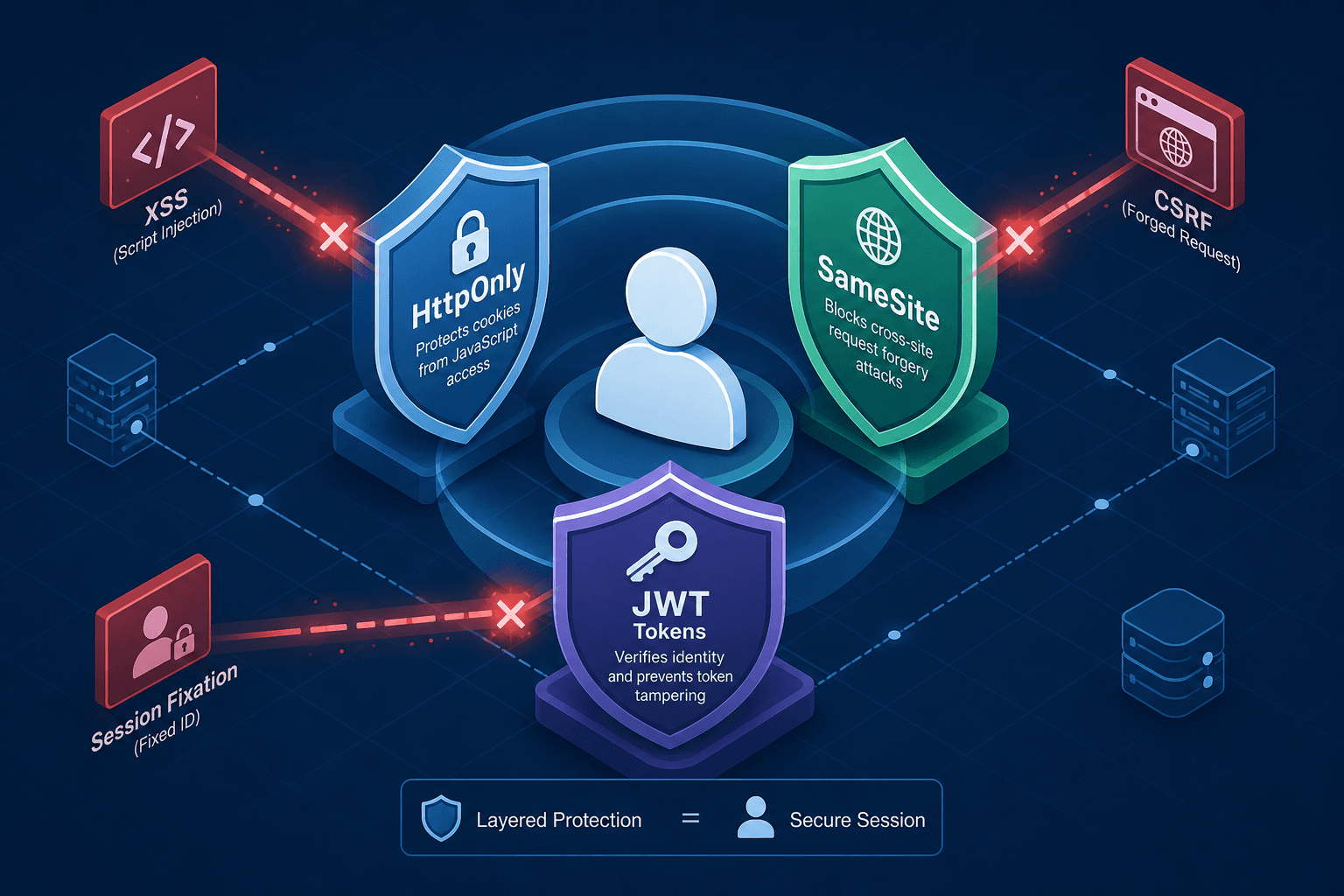
The core vulnerability in most web application breaches is not a flaw in the encryption algorithm, but a failure in the session lifecycle management. When a user authenticates, the server generates a unique identifier—a Session ID or a JWT—and binds it to the user's identity. The security of this entire exchange rests on three distinct mechanisms: preventing the token from being read by malicious scripts (XSS), preventing the token from being sent to unauthorized domains (CSRF), and ensuring the token cannot be hijacked before authentication completes (Session Fixation). While JWTs are a powerful tool for stateless architectures, they are just one approach among many; the choice between stateless tokens and server-side sessions depends on specific scalability needs and revocation requirements.
The Browser as a Gatekeeper: Cookie Attributes
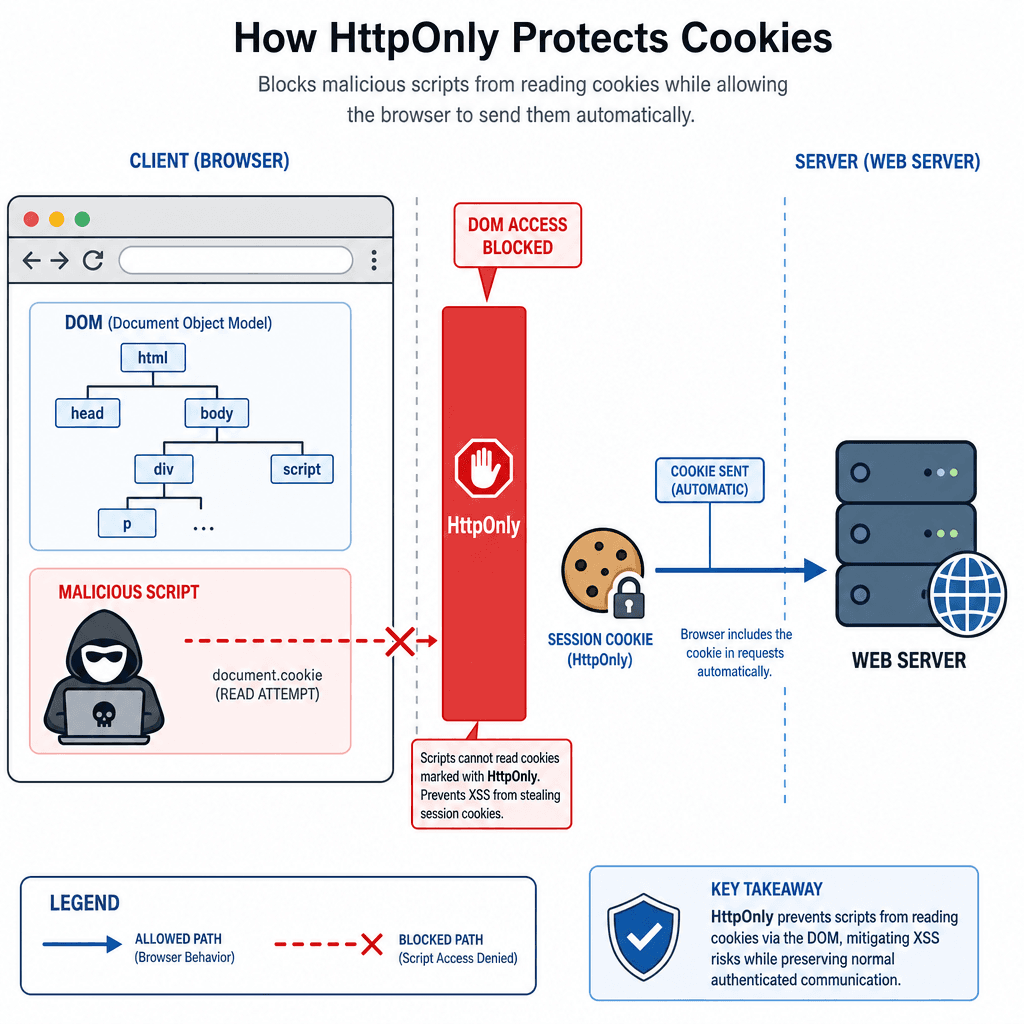
Browsers do not automatically treat cookies as secure by default. Without explicit configuration, a cookie is a plain text file accessible to any script running in the page context. To close this door, we must configure the HttpOnly flag.
Consider a scenario where an attacker injects a script into your application via a Cross-Site Scripting (XSS) vulnerability. The script executes as if it were part of your legitimate code. If the session cookie lacks the HttpOnly flag, the script can execute document.cookie to exfiltrate the session ID. The attacker then uses this ID to impersonate the user. By setting the HttpOnly flag, the browser enforces a hard boundary: the cookie is stored in memory and sent automatically with every HTTP request to the domain, but it is completely invisible to the JavaScript runtime. This does not prevent the injection of the script, but it renders the stolen session ID useless to the attacker.
Set-Cookie: session_id=abc123; Path=/; HttpOnly; SecureHowever, HttpOnly alone does not stop Cross-Site Request Forgery (CSRF). In a CSRF attack, an attacker tricks a logged-in user into visiting a malicious site that sends a forged request to the target application. The browser automatically includes the session cookie with this request because it matches the domain. To mitigate this, the SameSite attribute is required.
The SameSite attribute dictates when the browser sends the cookie based on the context of the request.
SameSite=Strict: The cookie is never sent on cross-site requests. This provides the highest security but breaks legitimate workflows like logging in via an OAuth provider or using third-party widgets.SameSite=Lax: The cookie is sent on "top-level navigation" (e.g., clicking a link) but not on cross-site sub-resources (e.g., images, iframes) or POST requests initiated by other sites. This is the modern default balance.SameSite=None: The cookie is sent on all requests, but this requires theSecureflag to be set, ensuring the cookie is only transmitted over HTTPS.
Set-Cookie: session_id=abc123; Path=/; SameSite=Lax; SecureThe Secure flag ensures the cookie is never transmitted over unencrypted HTTP, preventing network-level interception.
The JWT Paradigm: Stateless vs. Stateful Storage
JSON Web Tokens (JWTs) introduced a shift toward stateless authentication, where the token itself contains the user's claims (subject, roles, expiration). This allows the server to verify the token without querying a database, relying instead on a cryptographic signature. However, the security model changes drastically based on where the token is stored.
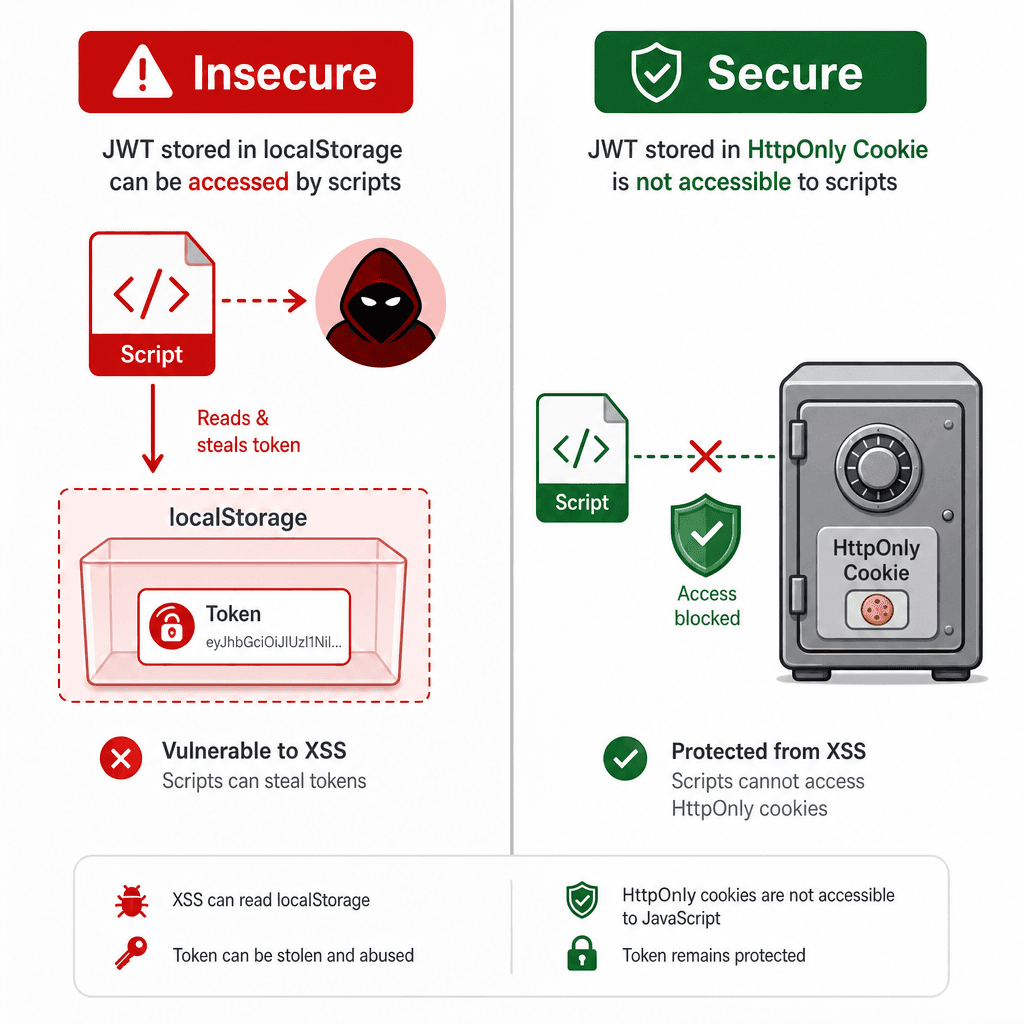
A common mistake is storing the JWT in localStorage. Unlike cookies, localStorage has no built-in protection against XSS. If an attacker can inject a script, they can read the token directly from localStorage and send it to their server. Because the JWT is self-contained, the attacker can use this token immediately to make API calls, bypassing the need for a server-side session store.
The secure pattern for JWTs mimics the cookie model: store the token in an HttpOnly cookie. This prevents JavaScript from reading the token, effectively neutralizing the XSS vector for token theft. This approach is a cornerstone of secure token handling in modern web applications.
However, JWTs introduce a unique challenge: revocation. In a traditional session store, you can delete a session ID from the database to log a user out immediately. With a JWT, the token remains valid until its expiration time, even if the server knows the user should be logged out. To solve this, the industry standard is the "Access Token / Refresh Token" pattern.
The Access Token is short-lived (e.g., 15 minutes) and stored in an HttpOnly cookie. The Refresh Token is long-lived and also stored in an HttpOnly cookie. When the Access Token expires, the client sends the Refresh Token to a dedicated endpoint to get a new Access Token. If the user logs out, the server can revoke the Refresh Token (by adding it to a blacklist or deleting it from the database), rendering the long-lived token useless.
// Vulnerable: Storing JWT in localStorage
localStorage.setItem('token', jwtToken);

// Secure: Storing JWT in HttpOnly cookie (Server-side implementation)
res.cookie('access_token', jwtToken, {
  httpOnly: true,
  secure: true,
  sameSite: 'lax',
  maxAge: 15 * 60 * 1000 // 15 minutes
});
Neutralizing Session Fixation
Session fixation occurs when an attacker forces a user to use a known session ID. The attacker generates a session ID on their own server, tricks the victim into logging in with that specific ID, and then uses that ID to access the victim's account after the victim's credentials are validated.
The mechanism to defeat this is "Session Regeneration." The server must generate a completely new, random Session ID immediately after a successful authentication event.
Imagine an attacker creates a session and obtains the ID attacker_id. They send a link to the victim: https://bank.com/login?session=attacker_id. The victim clicks the link and enters their password. If the server accepts this login and retains attacker_id, the attacker now controls the session.
To prevent this, the authentication flow must include a regeneration step:
- User submits credentials.
- Server validates credentials.
- Server generates a new, cryptographically secure random Session ID.
- Server invalidates the old ID (if one existed).
- Server sends the new ID to the client via the
Set-Cookieheader. - Server associates the new ID with the authenticated user in the backend.
This ensures that even if the attacker knew the ID before the login, that ID becomes invalid the moment the user authenticates. The attacker is left with a dead key, while the victim proceeds with a fresh, unknown key. This process is a critical component of session hijacking prevention, ensuring that pre-existing knowledge of a session ID cannot be exploited post-authentication.
It is critical to note that regenerating the session ID is only effective if the cookie attributes (HttpOnly, Secure, SameSite) are already in place. If the cookie is not HttpOnly, an XSS attack could steal the new session ID immediately after regeneration.
Operational Tradeoffs and Implementation
Implementing these controls requires careful consideration of the application architecture. For instance, enforcing SameSite=Strict can break legitimate third-party integrations, such as Single Sign-On (SSO) flows or embedded widgets. In these cases, SameSite=Lax or None (with Secure) is necessary, but the application must ensure that the CSRF protection is handled at the application layer (e.g., using anti-CSRF tokens) rather than relying solely on the browser.
Opinion: While JWTs offer scalability benefits by removing the need for server-side session stores, they introduce significant complexity in key management and revocation. For most internal applications or those requiring immediate logout capabilities, server-side sessions with regenerated IDs remain the more robust default choice. JWTs should be reserved for scenarios where the stateless nature is a strict requirement, and even then, they must be treated as sensitive data requiring HttpOnly storage.
The convergence of these mechanisms—proper cookie attributes, secure token storage, and session regeneration—forms the bedrock of modern session security. Relying on a single layer is insufficient; the defense must be layered, ensuring that if one vector is compromised, the others hold the line.
Common Pitfalls
Developers frequently stumble when implementing these security controls. Being aware of common mistakes can save significant remediation time.
- Storing JWTs in
localStorage: This is the most prevalent error. BecauselocalStorageis accessible via JavaScript, it exposes tokens to XSS attacks. Always preferHttpOnlycookies for JWT storage. - Neglecting Session Regeneration: Failing to issue a new session ID upon login leaves applications vulnerable to session fixation attacks, where an attacker can hijack a session they helped create.
- Misconfiguring
SameSitefor Cross-Origin APIs: SettingSameSite=Noneto allow cross-origin API calls without implementing server-side anti-CSRF tokens creates a severe vulnerability. If you must useSameSite=None, you are responsible for adding CSRF tokens to all state-changing requests.
Practical Takeaways
To simplify the implementation of session security, remember these three mental models:
- HttpOnly blocks XSS theft: It ensures that malicious scripts cannot read session cookies, even if they manage to execute on the page.
- Session Regeneration prevents Fixation: Changing the session ID immediately after login invalidates any ID an attacker might have planted beforehand.
- Lax is the default balance for SameSite: Use
Laxfor most applications to balance security with usability, only dropping toNonewhen absolutely necessary for cross-origin functionality.
FAQ
Q: How do I revoke a JWT if it doesn't expire? A: JWTs are stateless by design, so the server cannot invalidate them immediately unless they are short-lived. The standard solution is the "Access Token / Refresh Token" pattern. The Access Token expires quickly (e.g., 15 minutes), while the Refresh Token is stored server-side and can be revoked (deleted from a blacklist or database) to prevent the issuance of new Access Tokens.
Q: What is the practical difference between SameSite=Strict, Lax, and None?
A: Strict blocks all cross-site cookie sending, breaking most integrations. Lax allows cookies on top-level navigations (like clicking a link) but blocks them on sub-resources (images, iframes) and cross-site POSTs, offering a good balance. None sends cookies on all requests but requires the Secure flag and mandates server-side CSRF protection.
Q: Are anti-CSRF tokens still needed if I use SameSite=Lax?
A: For simple GET requests, Lax usually provides sufficient protection. However, for state-changing POST, PUT, or DELETE requests, especially from cross-origin contexts, it is best practice to implement anti-CSRF tokens as a secondary defense layer. Relying solely on browser attributes can be risky if the SameSite attribute is misconfigured or bypassed.
Conclusion
Effective session management relies on the precise configuration of transport-layer attributes and the strict separation of stateless token storage from stateful server-side validation. By enforcing HttpOnly to block DOM access, configuring SameSite to restrict cross-origin state transmission, and implementing session regeneration upon privilege escalation, developers can neutralize the primary vectors for XSS, CSRF, and session fixation attacks. These controls form a cohesive defense strategy that protects user identity and data integrity in modern web architectures.
Related posts
How Browser Cookies Work in SSO: A Technical Deep Dive
An examination of how browser cookies function within Single Sign-On systems, covering SameSite attributes, third-party cookie limitations, and cross-domain security.
JWT Expiration, Rotation, and Revocation: A Lifecycle Guide
A guide to JWT expiration, rotation, and revocation strategies for secure token lifecycle management.
Implementing Back-Channel Logout in OIDC: Reliable Session Termination
An examination of back-channel logout implementation in OpenID Connect to ensure reliable session termination and secure logout token handling.