Choosing an Embedding Model in 2026
A practical guide for ML engineers on selecting the right embedding model for RAG systems in 2026, covering MTEB benchmarks, Matryoshka representations, and multilingual support.
This is Part 3 of the "RAG from Zero to Production" series.
The era of treating embedding models as interchangeable black boxes is over. In 2026, the landscape for Retrieval-Augmented Generation (RAG) systems is defined by three converging pressures: the need for sub-millisecond latency in production, the complexity of multilingual data pipelines, and the demand for storage efficiency without sacrificing semantic fidelity. For ML engineers, selecting the right embedding model is no longer about picking the highest-ranked model on a generic leaderboard. It is about matching specific architectural capabilities—particularly Matryoshka representations and cross-lingual alignment—to your system’s constraints.
This guide breaks down the technical mechanisms you must evaluate to make a defensible choice in the current environment.
The MTEB Benchmark: Beyond the Aggregate Score

The Massive Text Embedding Benchmark (MTEB) remains the standard for evaluating embedding models, but relying on the aggregate score is a common pitfall. MTEB evaluates models across diverse tasks: retrieval (e.g., MS MARCO, BEIR), classification, clustering, and reranking. A model that excels at semantic textual similarity (STS) may perform poorly on dense retrieval tasks crucial for RAG.
When evaluating candidates, you must look at the task-specific breakdown. For a RAG system, the Retrieval subset of MTEB is paramount. Within this, distinguish between:
- Passage Retrieval: Retrieving relevant documents from a large corpus.
- Query-Document Retrieval: Matching user queries to stored chunks.
A model like text-embedding-ada-002 might show strong performance on STS tasks but lag in long-context retrieval compared to newer architectures. Always filter MTEB results by the specific task that mirrors your production workload. If your RAG system deals with legal documents, prioritize models tested on legal-specific subsets or high-recall benchmarks like NQ (Natural Questions) or TREC if your system involves factual QA.
Matryoshka Representations: Dynamic Dimensionality

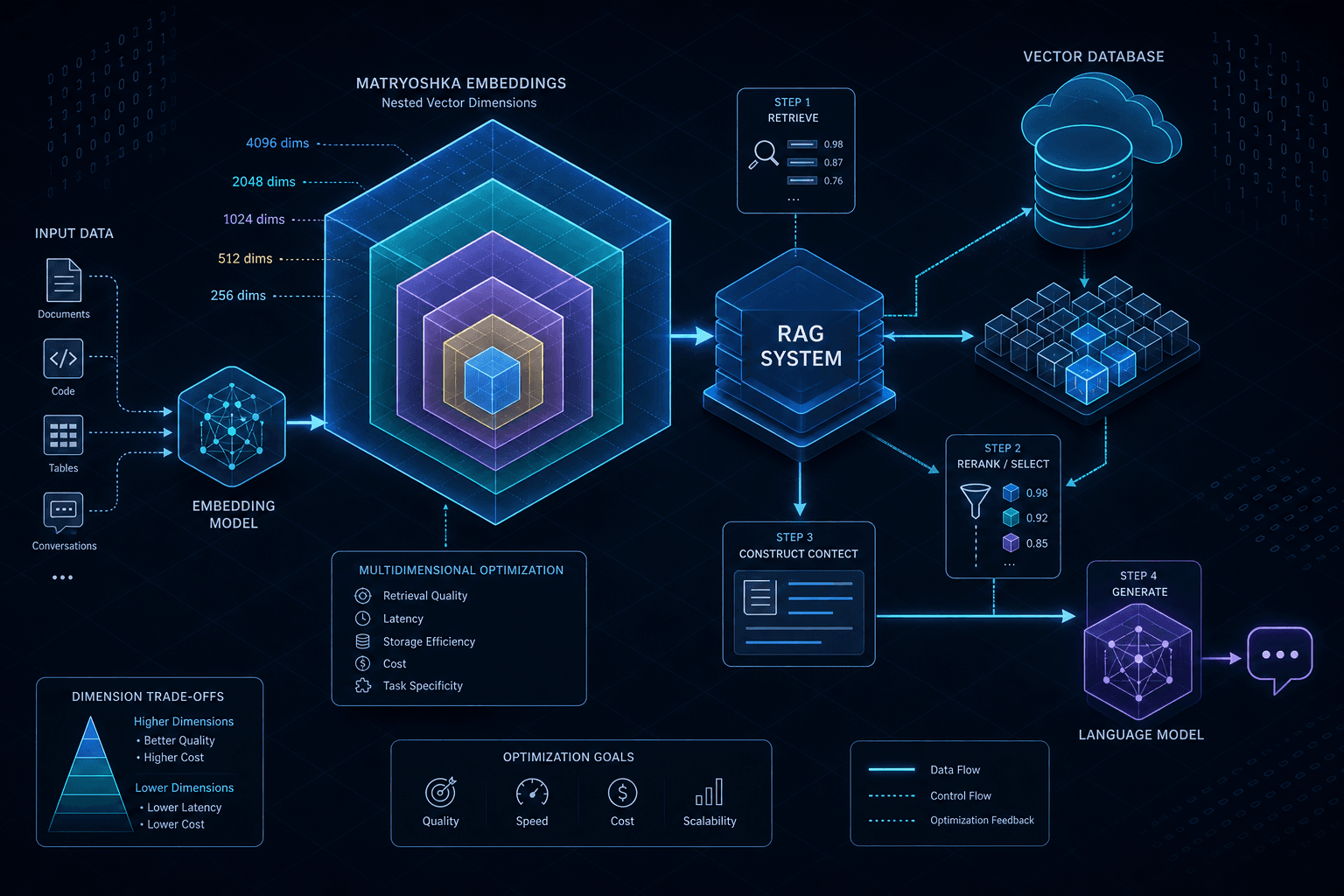
The most significant architectural advancement in 2026 embedding models is the adoption of Matryoshka Representation Learning (MRL). Traditionally, embedding models output fixed-dimensional vectors (e.g., 768D or 1536D). Truncating these vectors manually often resulted in disproportionate information loss.
Matryoshka models solve this by learning nested representations. The first dimensions capture the most salient semantic features, while subsequent dimensions add progressively finer granularity. This allows you to truncate the vector at inference time based on your latency and storage budget.
Consider a model like jina-embeddings-v3 or nomic-embed-text-v1.5. These models can output vectors of up to 1024 dimensions, but you can truncate them to 256 or 512 dimensions with minimal degradation in retrieval performance.
Mechanism of Benefit:
- Storage: Reducing vector dimensionality from 1024D to 256D reduces storage footprint by 75%.
- Latency: Smaller vectors reduce the computational cost of dot product or cosine similarity calculations during retrieval.
- Flexibility: You can experiment with different dimensions in staging without retraining or changing the model architecture.
To leverage this, you must benchmark the model’s performance at various truncation points. Plot MTEB retrieval scores against vector dimensionality. Look for the "elbow point" where performance drops significantly. Choose a dimensionality slightly above this point to maximize efficiency.
Multilingual and Cross-Lingual Alignment

Monolingual embeddings are becoming obsolete in global applications. The key challenge in 2026 is not just supporting multiple languages, but achieving cross-lingual alignment. This means that a query in English and its translation in Spanish should map to nearby points in the same latent space, even if the words are entirely different.
Models like bge-m3 and multilingual-e5-large demonstrate strong cross-lingual capabilities. They achieve this by training on multilingual corpora with contrastive learning objectives that pull translations of the same concept closer together in vector space.
Evaluation Strategy:
- Identify Language Pairs: Determine which source-target language pairs are critical for your RAG system.
- Check MTEB Multilingual Subset: MTEB provides scores for specific language pairs. Look for models with high recall in your target languages.
- Test Zero-Shot Transfer: Evaluate if the model can retrieve documents in a language it was not explicitly optimized for, by using a translated query.
Be cautious of models that perform well in English but degrade sharply in low-resource languages. Always validate with real-world data from your specific domain, as benchmark datasets may not reflect your data’s linguistic nuances.
Production Decision Framework
Selecting an embedding model requires a structured evaluation process. Follow this workflow to minimize risk:
- Define Primary Task: Is your RAG system focused on dense retrieval, hybrid search, or semantic classification? Filter MTEB scores accordingly.
- Evaluate Matryoshka Flexibility: If storage or latency is a concern, prioritize models that support Matryoshka representations. Benchmark performance at 256D, 512D, and full dimensionality.
- Assess Multilingual Needs: If your data is multilingual, choose models with proven cross-lingual alignment. Test with actual query-document pairs in your target languages.
- Stress Test Latency: Measure end-to-end latency, including vector generation and retrieval. Smaller vectors do not always mean faster inference if the model itself is computationally heavy.
- Validate with Domain Data: Run a pilot with a small subset of your production data. Compare retrieval quality using human evaluation or automated metrics like NDCG@10.
Conclusion
In 2026, the "best" embedding model does not exist in a vacuum. It is the one that best balances MTEB performance, Matryoshka dimensionality, and multilingual alignment with your specific operational constraints. By moving beyond aggregate scores and leveraging nested representations, ML engineers can build RAG systems that are both efficient and semantically robust. The key is to treat embedding selection as an ongoing optimization problem, not a one-time decision.
Related posts
HyDE and Query Expansion: Do They Still Help?
An examination of HyDE and query expansion techniques in modern retrieval systems, assessing their continued relevance and performance benchmarks.
Query Rewriting: The Underrated RAG Upgrade
Explore how query rewriting and expansion improve RAG recall by resolving coreference and enhancing conversational search capabilities.
Reranking: The Cheapest Quality Win in RAG
Reranking is the most cost-effective way to boost RAG accuracy. Learn how to implement cross-encoders like Cohere and BGE for better retrieval results.
