Chunking Strategies That Survive Real Documents
Explore effective chunking and text splitting techniques for RAG systems, including semantic chunking and parent document retrieval to handle real-world documents.
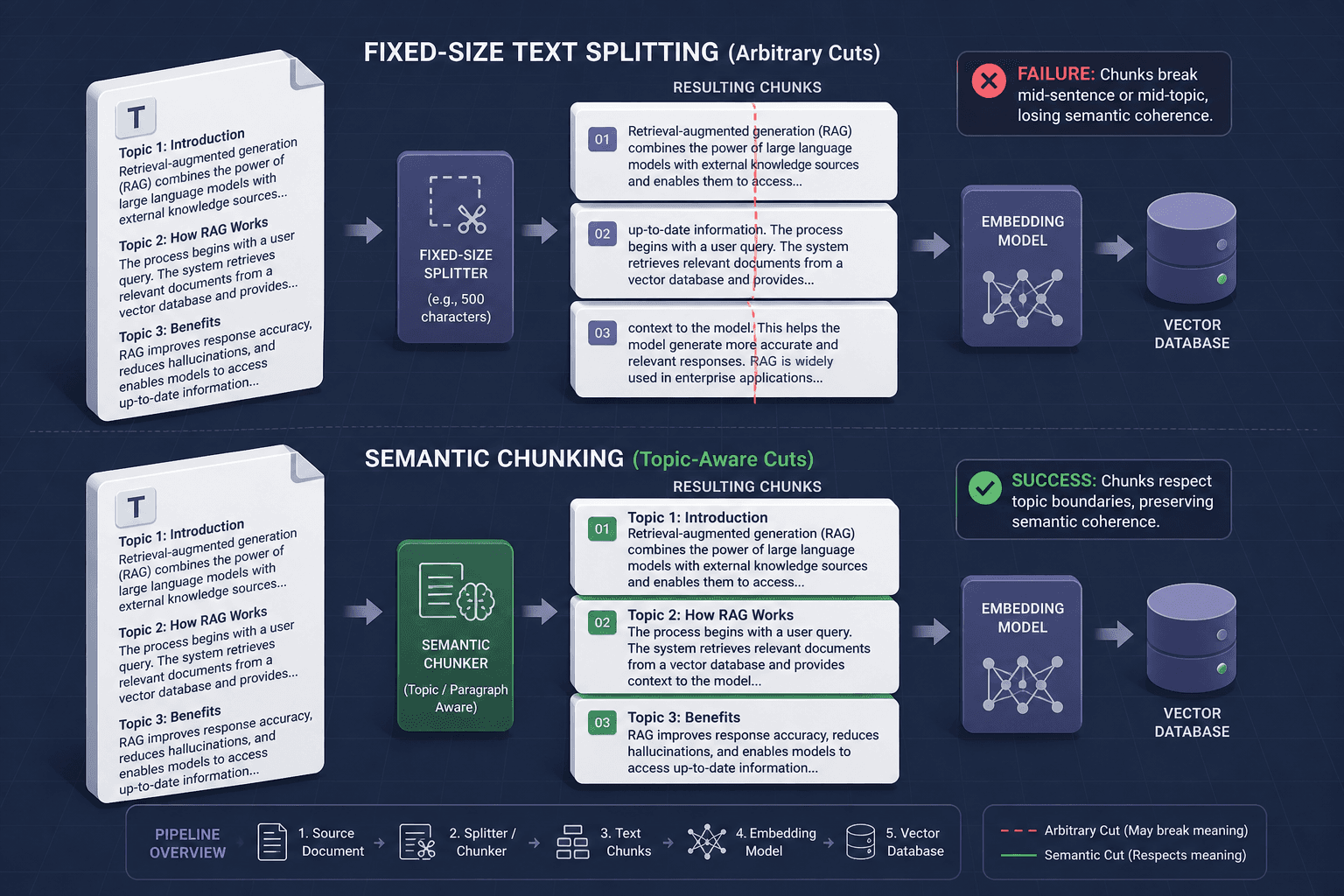
Real documents are messy. They contain tables, code snippets, mixed languages, and abrupt topic shifts. A naive approach to preparing these documents for Retrieval-Augmented Generation (RAG) is to slice them into fixed-size blocks. This strategy assumes that meaning is evenly distributed across text, which is false. When you split a document by character count or token limit, you often sever the grammatical or logical connections between sentences. The result is a retrieval system that returns fragments without context, leading to hallucinated or incomplete answers.
This post details three critical techniques to build an effective RAG pipeline: semantic chunking, parent document retrieval, and strategic overlap. These mechanisms respect semantic boundaries and preserve contextual relationships where simple splitting fails.
The Failure of Fixed-Size Splitting
Consider a standard RecursiveCharacterTextSplitter with a chunk size of 500 tokens. If a document contains a paragraph of 600 tokens, the splitter cuts it at token 500. If the first sentence of the next paragraph begins at token 501, the cut happens mid-thought.
The mechanism of failure here is semantic isolation. Vector embeddings represent meaning based on surrounding context. If a query asks, "What was the final decision?" and the answer lies in the second half of a cut paragraph, the vector for the first half will not match. The retrieval system returns a fragment that lacks the subject or the conclusion.
This is not just a theoretical problem. In legal or technical documentation, a single clause can span multiple sentences, and cutting it arbitrarily destroys the conditional logic required for accurate generation. This approach, commonly known as text splitting, is the industry term for this naive method of dividing documents into uniform segments regardless of their internal structure.
Semantic Chunking: Aligning Chunks with Meaning
Instead of splitting by size, semantic chunking splits by topic coherence. The goal is to identify natural boundaries where the meaning shifts significantly.
How It Works
- Embedding Generation: The system generates embeddings for individual sentences or small groups of sentences.
- Distance Calculation: It calculates the cosine distance between consecutive sentence embeddings.
- Thresholding: If the distance exceeds a predefined threshold, a new chunk begins. This indicates a shift in topic or semantic theme.
For example, in a technical manual, the section on "Installation" might have high internal similarity but low similarity with the subsequent "Troubleshooting" section. A semantic splitter will keep all installation steps together and all troubleshooting steps together, regardless of their total length.
This approach ensures that each chunk is a self-contained unit of meaning. While this increases computational cost during indexing (due to embedding generation), it significantly improves retrieval precision because the vectors align with human conceptual boundaries. Semantic chunking is one of the key RAG strategies for improving retrieval accuracy by ensuring that the indexed units reflect actual semantic units rather than arbitrary character counts.
Parent Document Retrieval (PDR)
Even with semantic chunking, small chunks may lack the broader context needed for an LLM to answer complex questions. This is where Parent Document Retrieval comes in.
The Two-Step Mechanism
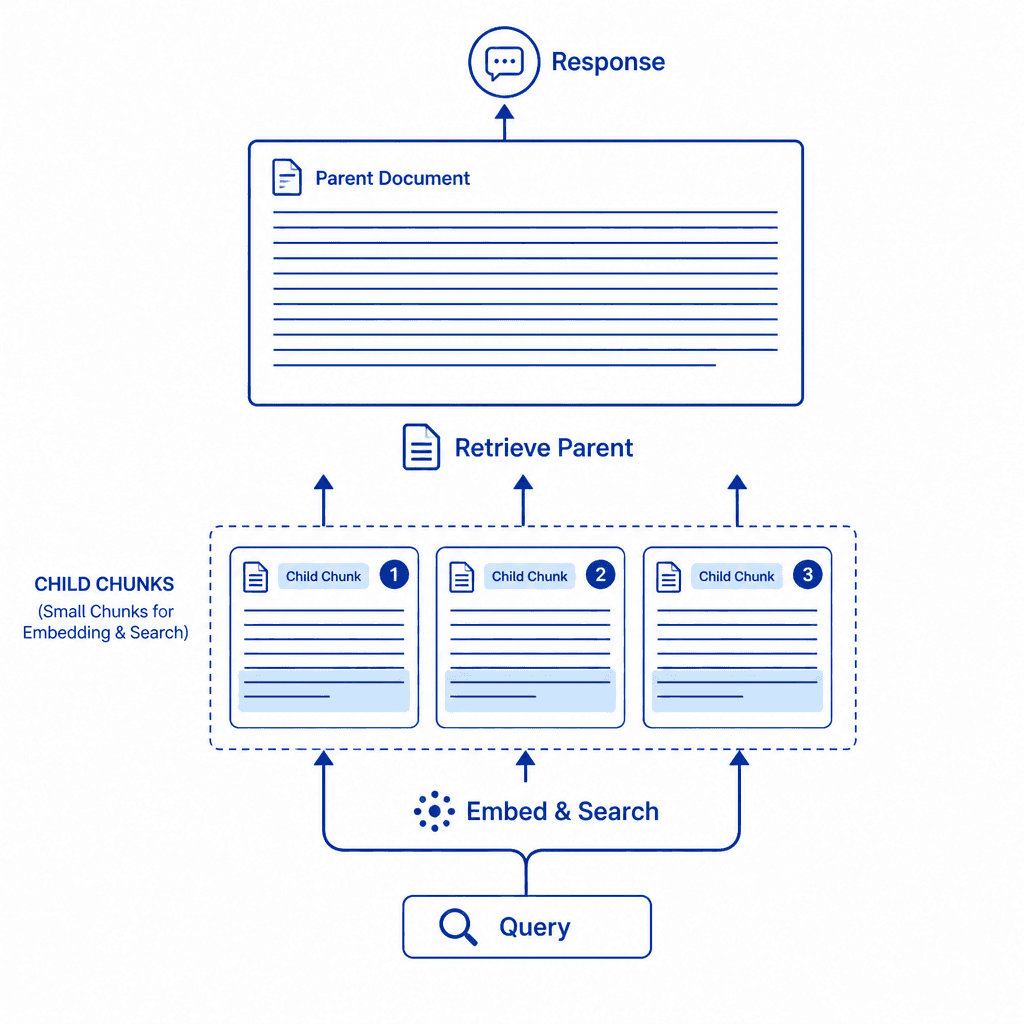
- Child Chunking: The original document is split into small, semantically coherent "child" chunks. These are embedded and stored in the vector database. Their small size allows for precise retrieval.
- Parent Mapping: Each child chunk is mapped to its "parent" document—the larger block (e.g., a full section or page) from which it was derived. This mapping is stored separately.
Retrieval Flow
When a user query is embedded and searched, the system retrieves the most relevant child chunks. However, before passing these to the LLM, the system looks up the parent documents associated with those children. The LLM receives the full parent context, not just the small snippet.
This solves the "needle in a haystack" problem. The vector search finds the specific needle (the precise fact), but the LLM reads the entire haystack (the surrounding context) to understand it. This avoids the need to embed massive documents, which would dilute the signal and increase latency. Importantly, the "parent" refers to the immediate larger context block defined in the mapping step, which may or may not be the full original document.
Overlap: The Safety Net
No chunking strategy is perfect. Semantic boundaries are not always sharp, and some critical information may lie exactly at the edge of a chunk. Overlap addresses this by including a portion of text from the previous chunk at the beginning of the next.
How Overlap Works
If you have a chunk size of 500 tokens and an overlap of 50 tokens, the second chunk starts with the last 50 tokens of the first chunk. This creates a sliding window effect.
Trade-offs
- Pros: Prevents information loss at chunk boundaries. Ensures that entities or phrases spanning two chunks are present in at least one full chunk.
- Cons: Increases storage requirements (redundant data) and can introduce noise if the overlap contains irrelevant filler.
A common practice is to use 10-20% overlap. This balances the risk of missing context against the cost of storing duplicate vectors. For high-stakes applications, higher overlap may be justified. These techniques are critical steps in the overall document processing pipeline, ensuring that raw text is transformed into a format suitable for efficient retrieval.
Conclusion
Effective chunking is not about minimizing storage; it’s about maximizing semantic integrity. Fixed-size splitting is a blunt instrument that severs context. Semantic chunking respects topic boundaries, ensuring that each vector represents a coherent idea. Parent Document Retrieval adds depth by providing the LLM with the necessary background context. Overlap acts as a buffer against boundary errors.
By combining these techniques, you build a RAG system that understands not just keywords, but the structure and flow of human language. This is essential for handling the messy reality of real-world documents and serves as a foundation for vector search optimization in RAG systems.
Related posts
Query Rewriting: The Underrated RAG Upgrade
Explore how query rewriting and expansion improve RAG recall by resolving coreference and enhancing conversational search capabilities.
Reranking: The Cheapest Quality Win in RAG
Reranking is the most cost-effective way to boost RAG accuracy. Learn how to implement cross-encoders like Cohere and BGE for better retrieval results.
Choosing an Embedding Model in 2026
A practical guide for ML engineers on selecting the right embedding model for RAG systems in 2026, covering MTEB benchmarks, Matryoshka representations, and multilingual support.
