Shipping RAG: Monitoring, Freshness, and Feedback Loops
Explore strategies for monitoring RAG systems, ensuring index freshness, and implementing feedback loops to maintain retrieval accuracy and reduce drift.
Part 8 of the RAG from Zero to Production series.
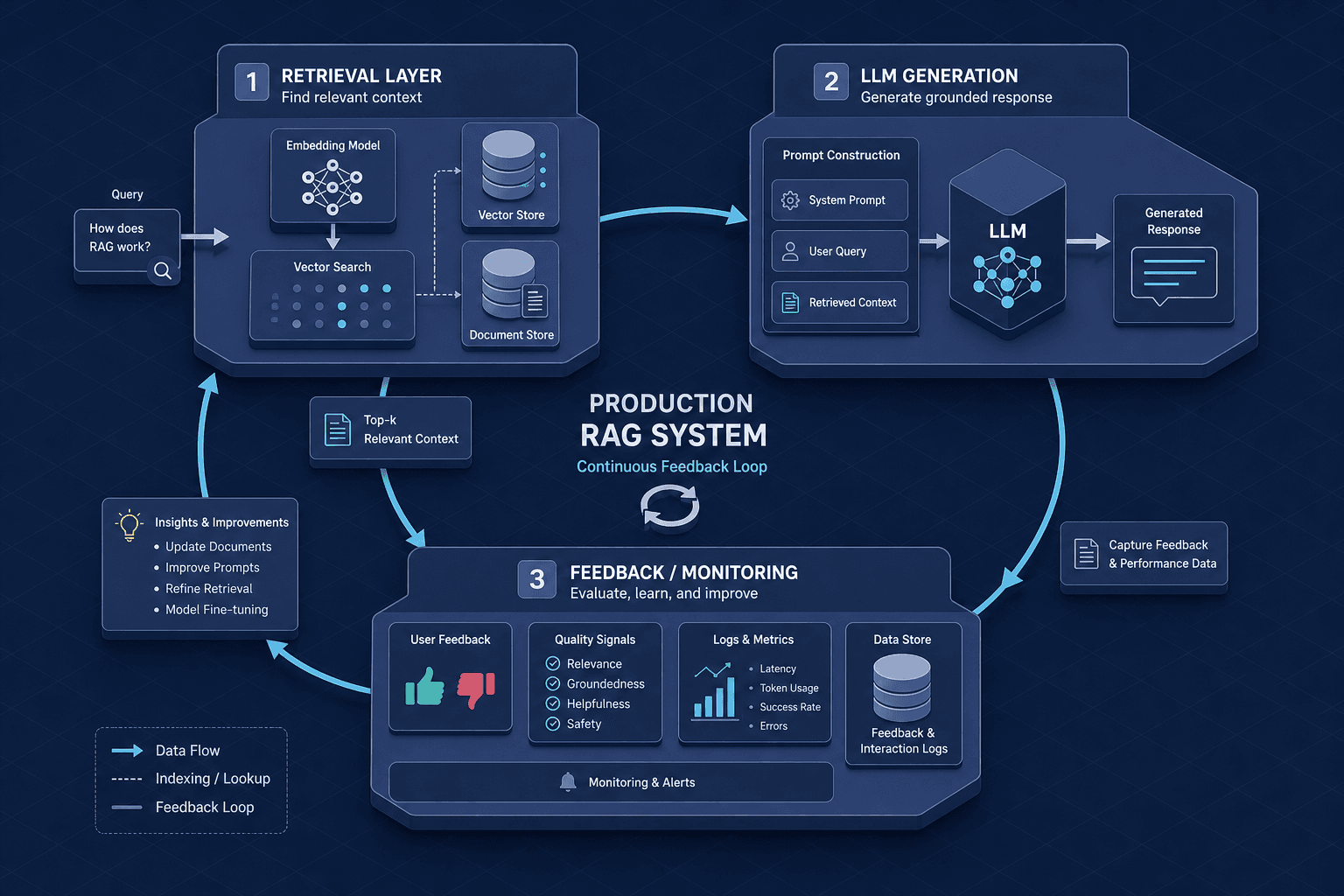
In the early stages of building a Retrieval-Augmented Generation (RAG) system, success is often measured by whether the system works on a curated dataset. In production, however, effective rag monitoring reveals that the system is not a static pipeline; it is a dynamic system that degrades unless actively managed. Data drift, schema changes in source documents, and shifts in user intent cause retrieval accuracy to decay silently. To ship reliable RAG, you must treat the retrieval layer as a monitored service, enforce index freshness through automated synchronization, and implement closed-loop feedback to correct errors.
The Illusion of Static Retrieval
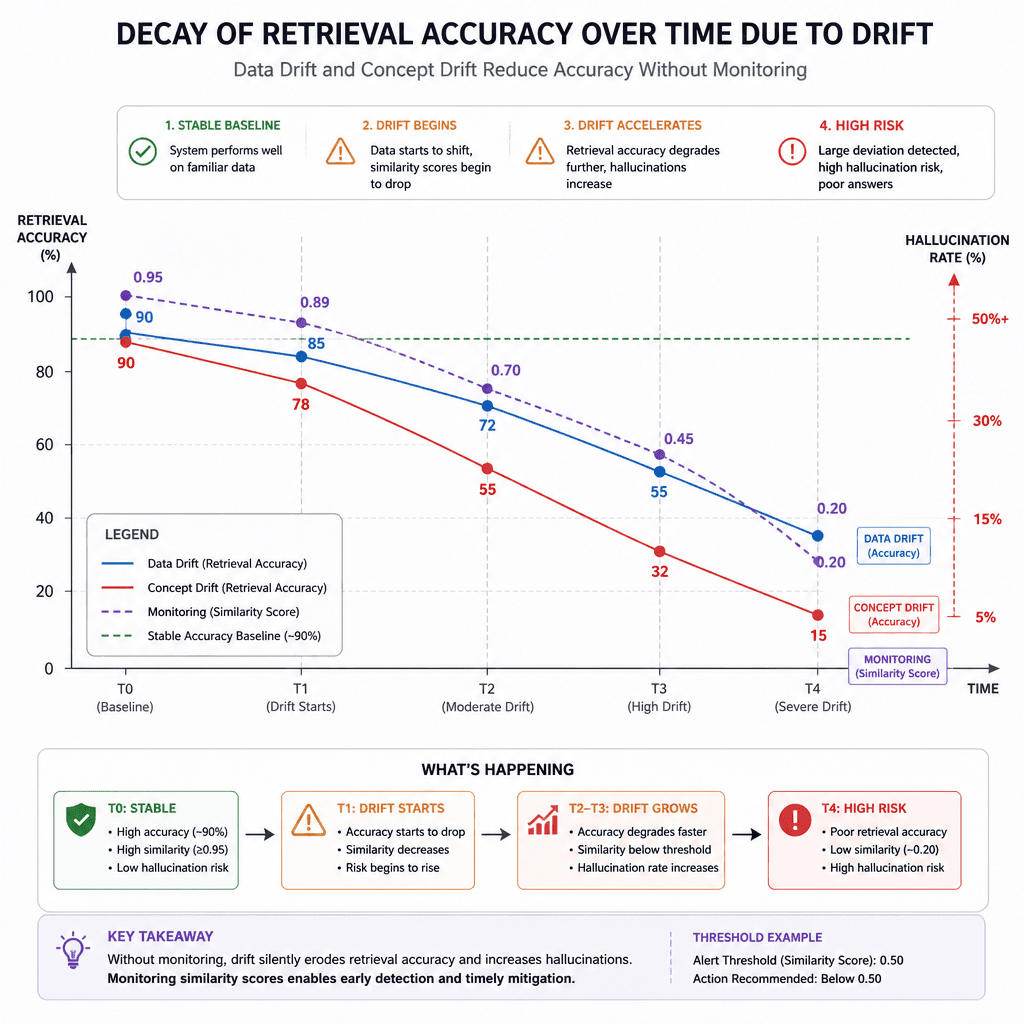
RAG systems are vulnerable to two types of drift: data drift and concept drift. Data drift occurs when the underlying source documents change—new entries are added, old ones are deleted, or their structure evolves. Concept drift happens when user queries evolve to reflect new terminology or expectations that the current embedding space does not capture.
Without monitoring, these changes manifest as subtle increases in hallucination rates or irrelevant responses. The mechanism of failure is often invisible because the LLM still generates a fluent answer, but the grounding is weak. Therefore, the first step in productionizing RAG is decoupling the monitoring of the retrieval phase from the generation phase. You must observe the quality of the chunks returned before they ever reach the LLM.
Monitoring the Retrieval Layer
Effective RAG monitoring requires metrics that go beyond simple latency. You need to instrument the retriever component to track the health of the vector search. Key retrieval metrics include:
- Vector Similarity Score Distribution: Track the mean and variance of cosine similarity scores for retrieved chunks. A sudden drop in average similarity indicates that the query is moving away from the distribution of indexed data.
- Chunk Hit Rate: Measure the percentage of queries that return at least one relevant chunk. This can be approximated by tracking empty results or fallback responses.
- Latency Percentiles: Monitor P95 and P99 latency for the retrieval step. High tail latency can indicate network issues or index fragmentation.
To implement this, you can use an OpenTelemetry-compatible tracer to wrap the retrieval call. For example, in Python with LangChain:
from opentelemetry import trace
from opentelemetry.trace import SpanKind

tracer = trace.get_tracer(__name__)

def retrieve_documents(query: str) -> List[Document]:
    with tracer.start_as_current_span("retrieval.search", kind=SpanKind.CLIENT) as span:
        span.set_attribute("query.length", len(query))
        start_time = time.perf_counter()

        # Perform vector search
        docs = vector_store.similarity_search(query, k=5)

        elapsed = time.perf_counter() - start_time
        span.set_attribute("retrieval.latency_ms", elapsed * 1000)
        span.set_attribute("results.count", len(docs))

        if docs:
            avg_score = sum(doc.metadata.get('score', 0) for doc in docs) / len(docs)
            span.set_attribute("retrieval.avg_similarity", avg_score)

        return docs
This instrumentation allows you to set alerts on similarity score drops. If the average similarity falls below a threshold (e.g., 0.75), it triggers an investigation into whether new data has entered the system without proper embedding updates.
Ensuring Index Freshness
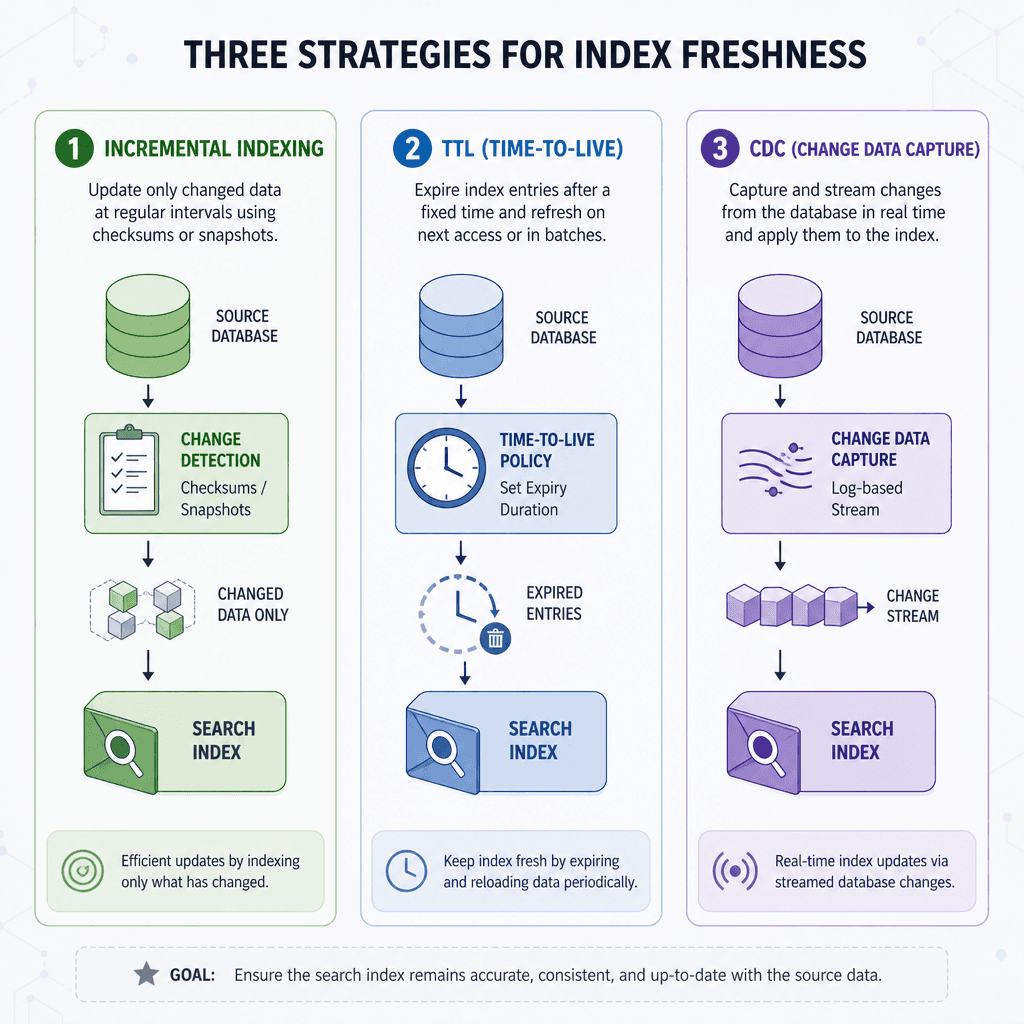
A vector index is only as good as the data it contains. In production, source data is rarely static. Documents are updated, deleted, or newly created. Stale data in the index leads to irrelevant retrievals and potential misinformation.
The mechanism for maintaining index freshness depends on the nature of the source data:
- Incremental Indexing: For high-volume, frequently changing data (e.g., logs, chat histories), use incremental updates. Instead of re-indexing the entire corpus, identify changed documents via checksums or timestamps and update only those entries in the vector store.
- Time-To-Live (TTL): For ephemeral data, such as temporary user sessions or short-lived announcements, implement TTL policies. The vector store automatically removes entries after a specified period, preventing stale data from cluttering the index.
- Change Data Capture (CDC): Integrate with your database’s CDC stream to trigger re-indexing events in real-time. This ensures that the vector index mirrors the source of truth with minimal latency.
For example, if using a PostgreSQL database with a vector extension like pgvector, you can set up a listener on table changes to update the corresponding vector embeddings. This approach reduces the window of staleness from hours to seconds.
Closed-Loop Feedback
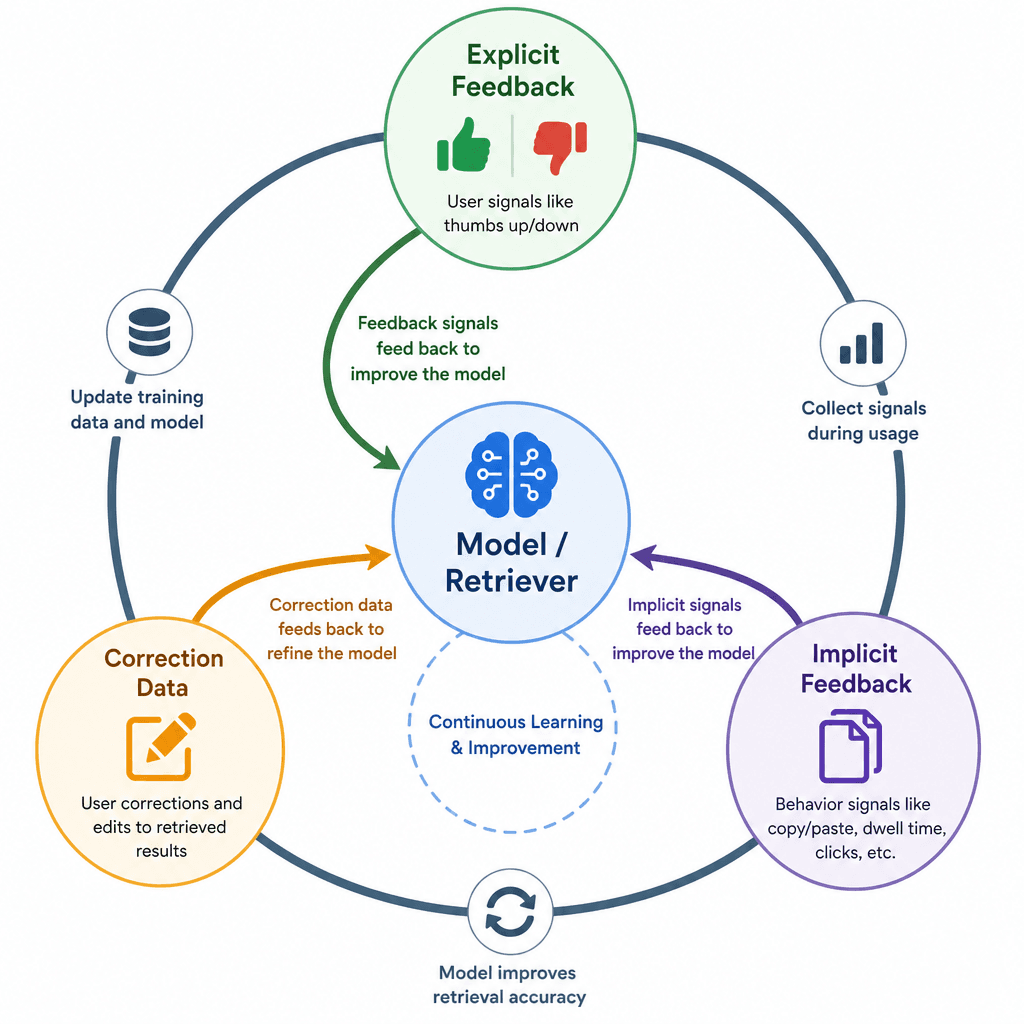
The final piece of the production RAG puzzle is a feedback loop. User interactions provide the most valuable signal for improving retrieval accuracy. However, this feedback must be captured and mapped back to specific retrieval events to be useful.
Implement a feedback loop that captures:
- Explicit Signals: Thumbs up/down buttons on responses.
- Implicit Signals: Copy/paste actions, follow-up queries, or session termination after a response.
- Correction Data: When users edit the generated response, the corrected text can serve as a ground truth for future training.
Store these feedback events alongside the original query and retrieved chunks. This dataset can then be used to:
- Retrain Embedding Models: Fine-tune the embedding model on positive/negative pairs to better capture semantic relevance.
- Adjust Reranker Weights: Use feedback to tune the parameters of the reranking stage, which often has a greater impact on final relevance than the initial retrieval.
- Detect Drift: Analyze feedback trends over time to identify when the system starts consistently failing on specific topics or query types, allowing you to address drift before it impacts users significantly.
By closing the loop, you transform passive monitoring into active improvement. The system learns from its mistakes, adapting to changes in user intent and data structure.
Conclusion
Shipping RAG to production is not a one-time deployment but an ongoing process of optimization. By monitoring retrieval health, ensuring index freshness, and implementing feedback loops, you can maintain high accuracy and relevance over time. These practices transform RAG from a fragile prototype into a resilient, self-correcting system capable of handling the complexities of real-world data and user behavior. Effective rag monitoring is the cornerstone of this longevity, ensuring your system remains accurate and reliable.
Related posts
Ragas, DeepEval, and TruLens Compared
A comparison of Ragas, DeepEval, and TruLens for RAG evaluation, helping ML engineers choose the right metric framework.
Continued Pretraining for Domain Adaptation
Explore continued pretraining techniques for domain adaptation, including corpus mixing and handling drift in ML models.
Incremental Indexing: Keeping Your Vector Store Fresh
Explore incremental indexing techniques like CDC, upserts, and tombstones to maintain vector store freshness without full reindexing.
