Measuring Quantization Damage: Perplexity Isn't Enough
An examination of why perplexity alone fails to capture model degradation during quantization, exploring alternative metrics for accurate quality regression assessment.
Part 5 of the Quantization in Practice series.
When an ML engineer compresses a Large Language Model (LLM) from FP16 to INT4 using techniques like GPTQ or AWQ, the first metric checked is almost always Perplexity (PPL). It is intuitive: lower perplexity means the model is more confident about the data it has seen. If the PPL of the quantized model is within 5% of the base model, the engineer assumes the model is "fine."
This assumption is dangerous. Perplexity measures how well the model predicts the next token in a static dataset. It does not measure how well the model solves problems, reasons, or generates code. In many cases, a quantized model will have near-identical perplexity to the base model while producing completely incoherent or hallucinated outputs. This is because perplexity is a proxy for likelihood, not utility. To accurately assess quantization damage, we must look beyond the log-probabilities of the training distribution and measure the stability of the inference distribution.
The Illusion of Stability in Average Perplexity

Perplexity is calculated as the exponential of the average negative log-likelihood of the test data. Mathematically, it averages the error across all tokens in the evaluation set. This averaging is where the signal gets lost, highlighting one of the primary perplexity limitations in the context of model compression.
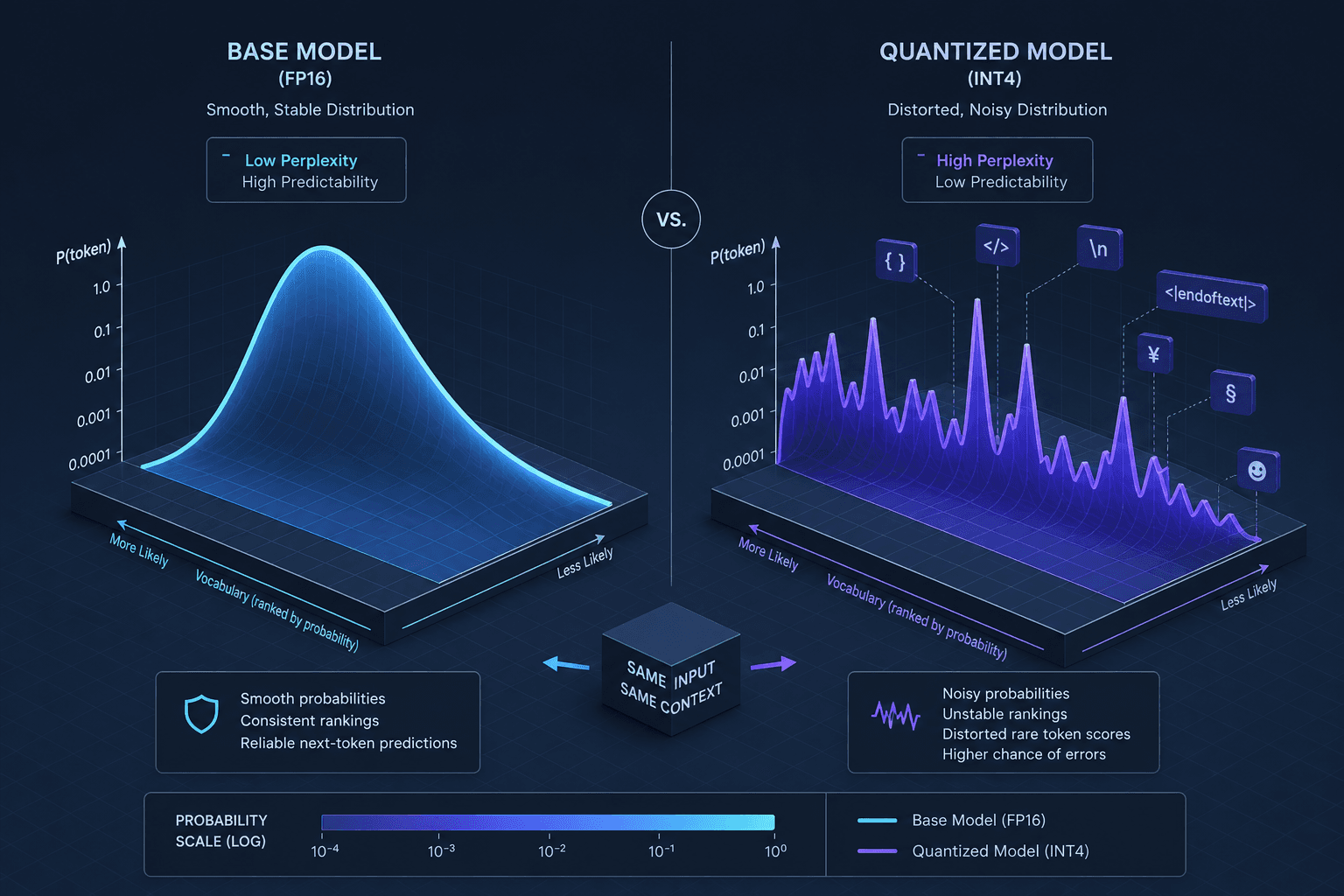
Consider a model with 10,000 tokens in its vocabulary. 95% of these tokens are common words (the, and, is). 5% are rare technical terms, specific entities, or code snippets. During quantization, the weight matrices are discretized. The quantization noise introduced is generally uniform across the weight space, but its impact on the output logits is not.
The "head" of the vocabulary (common tokens) has massive gradient magnitude and robust representation. A small perturbation in weights results in a negligible change in the probability assigned to these tokens. The "tail" (rare tokens) relies on sparse, precise activations. When quantization reduces precision, the subtle distinctions required to identify a rare token are lost. The model might assign a 0.01 probability to the correct rare token and 0.009 to a similar-looking common token. In the base model, the correct token might have had 0.05 probability.
When you average these losses over the entire dataset, the catastrophic failure on the rare tokens is drowned out by the perfect performance on the common tokens. The average PPL remains stable, but the model’s ability to handle specialized domains has collapsed. This is known as distributional collapse or representation degradation, where the model loses the fine-grained distinctions necessary for specialized tasks.
Logit Distortion and Sampling Amplification

The second reason perplexity fails is that it ignores the non-linear amplification that occurs during text generation. Perplexity is a greedy, next-token prediction metric. It asks: "What is the probability of the correct next token?" It does not ask: "What happens if the model makes a mistake?"
In practice, LLMs generate text autoregressively. The output of step becomes the input for step . Quantization introduces noise into the logits (the raw scores before softmax). Let’s say the base model produces a logit vector for the next token, and the quantized model produces a slightly different vector. In isolation, the difference might be tiny. However, when these logits are fed through the softmax function and used for sampling (especially with temperature > 0), small differences in logits can lead to large differences in sampled tokens.
This is particularly true for "chaotic" models or those with high entropy. A slight shift in the top-2 logits can cause the model to pick a completely different path in the decoding tree. This divergence compounds over time. A model might have identical perplexity on a static dataset but generate entirely different stories when prompted with the same input. Perplexity cannot capture this "trajectory divergence" because it evaluates each token independently against a ground truth, rather than evaluating the coherence of a generated sequence. For rigorous quantization evaluation, we must account for these dynamic errors.
Better Metrics: Task-Specific and Consistency-Based
To measure quantization damage accurately, we need metrics that reflect the model’s actual utility. Two approaches are superior to raw perplexity:
1. Task-Specific Benchmarks (e.g., MMLU, HumanEval)
The gold standard for evaluating LLMs is not how well they predict the next word, but how well they perform tasks. When selecting LLM quantization metrics, we should prioritize those that reflect functional capability. Benchmarks like MMLU (Massive Multitask Language Understanding) or HumanEval (code generation) force the model to use its knowledge in a structured way.
If a quantized model drops significantly on MMLU but has stable perplexity, it indicates that the quantization has corrupted the model’s reasoning capabilities or factual recall, even if its basic language modeling skills remain intact. This drop is a clear indicator of quality regression for production systems. In modern ml-ops pipelines, monitoring these benchmark scores is essential for detecting degradation before deployment. Furthermore, comprehensive model-evaluation workflows must include these benchmarks to ensure that the trade-offs of model compression do not compromise critical capabilities.
2. Self-Similarity and Consistency Scores
For tasks where ground truth is unavailable (e.g., creative writing, open-ended QA), we can measure consistency. We run the same prompt through the quantized model multiple times with different random seeds. If the quantization noise is manageable, the outputs should be semantically similar. If the outputs vary wildly in structure or content, the model is unstable.
Metrics like BLEU, ROUGE, or semantic similarity (using a separate embedding model) between multiple generations can quantify this instability. A high variance in self-similarity scores is a strong indicator of quantization damage that perplexity would miss.
Conclusion

Perplexity is a useful diagnostic for checking if a quantization procedure has gone wrong entirely (e.g., if PPL explodes), but it is a poor metric for fine-grained quality assessment. It masks the loss of rare token accuracy and ignores the compounding errors of autoregressive generation.
For ML engineers, the workflow should be:
- Check Perplexity as a sanity check.
- Run Task-Specific Benchmarks (MMLU, etc.) to measure utility.
- Run Consistency Tests to measure stability.
Only by combining these metrics can we truly understand the trade-offs of quantization and ensure that compressed models remain reliable in production.
Related posts
Shadow Traffic for LLM Deployments
Explore how shadow traffic and traffic mirroring enable safe comparison of candidate LLM models in production without impacting user experience.
Deploying a Quantized Model End to End
A walkthrough of deploying quantized models end-to-end, covering model artifacts, kernel optimization, and serving strategies for ML engineers.
Building an LLM Load Test That Reflects Real Traffic
A guide to building LLM load tests that reflect real traffic patterns using capacity planning, arrival rates, and saturation metrics.
