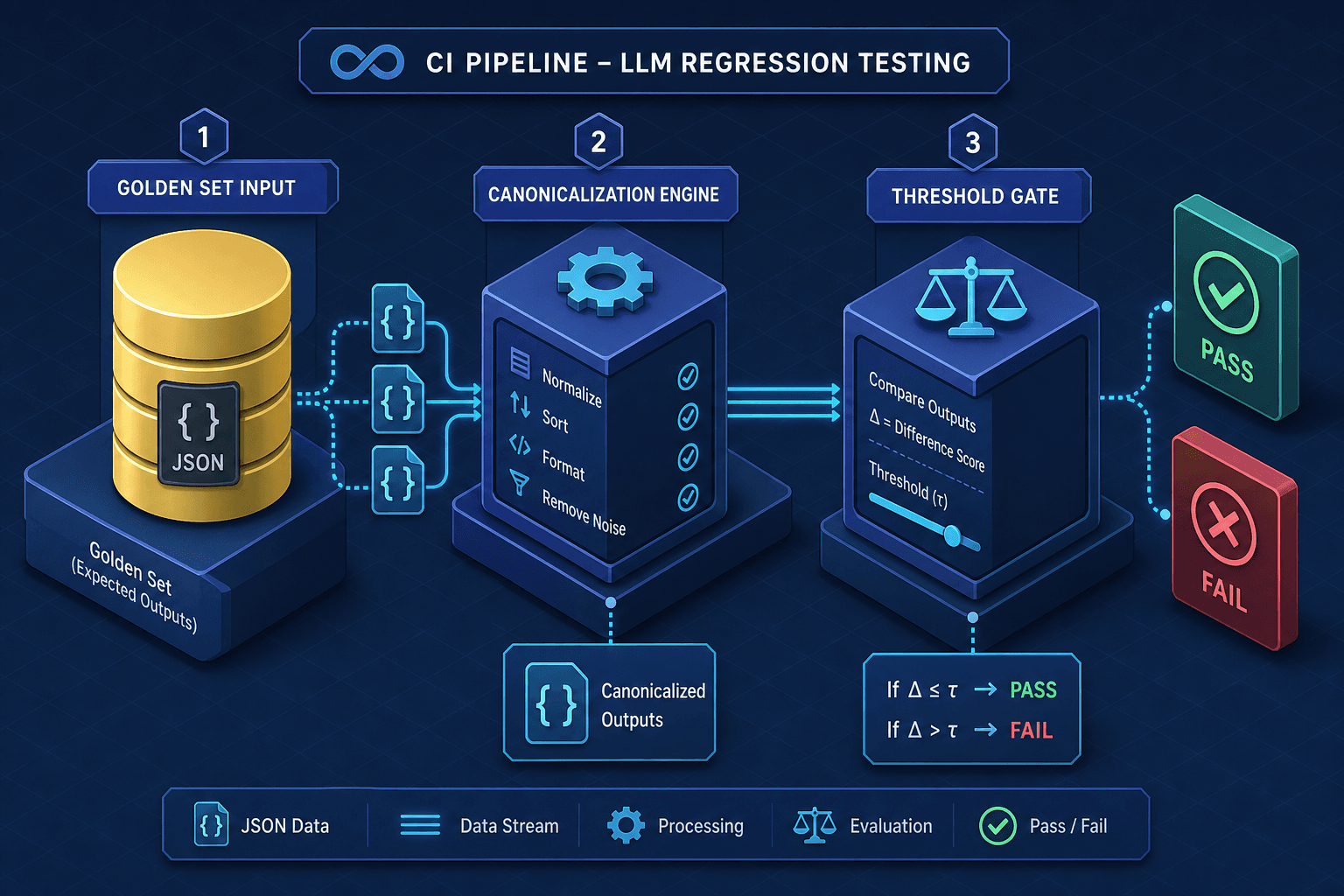
Regression Testing for Prompts and Models
Implement regression testing for LLM prompts and models using CI, thresholds, and snapshot tests to ensure consistent output quality.
In traditional software engineering, regression testing is straightforward: you run a unit test, and it either passes or fails based on exact string matching or boolean logic. In Large Language Model (LLM) development, this paradigm breaks down. Because LLMs are stochastic, running the same prompt twice yields slightly different outputs. If you treat these outputs as rigid strings, your "regression tests" will fail randomly, creating noise that masks actual quality degradation.
This is Part 5 of the LLM Evaluation Engineering series.
To implement reliable regression testing for AI models, we must shift from exact string matching to structural validation and statistical thresholds. This approach treats the prompt-engine interaction as a contract where specific fields, formats, and factual accuracies are invariant, while natural language variations are tolerated within defined bounds.
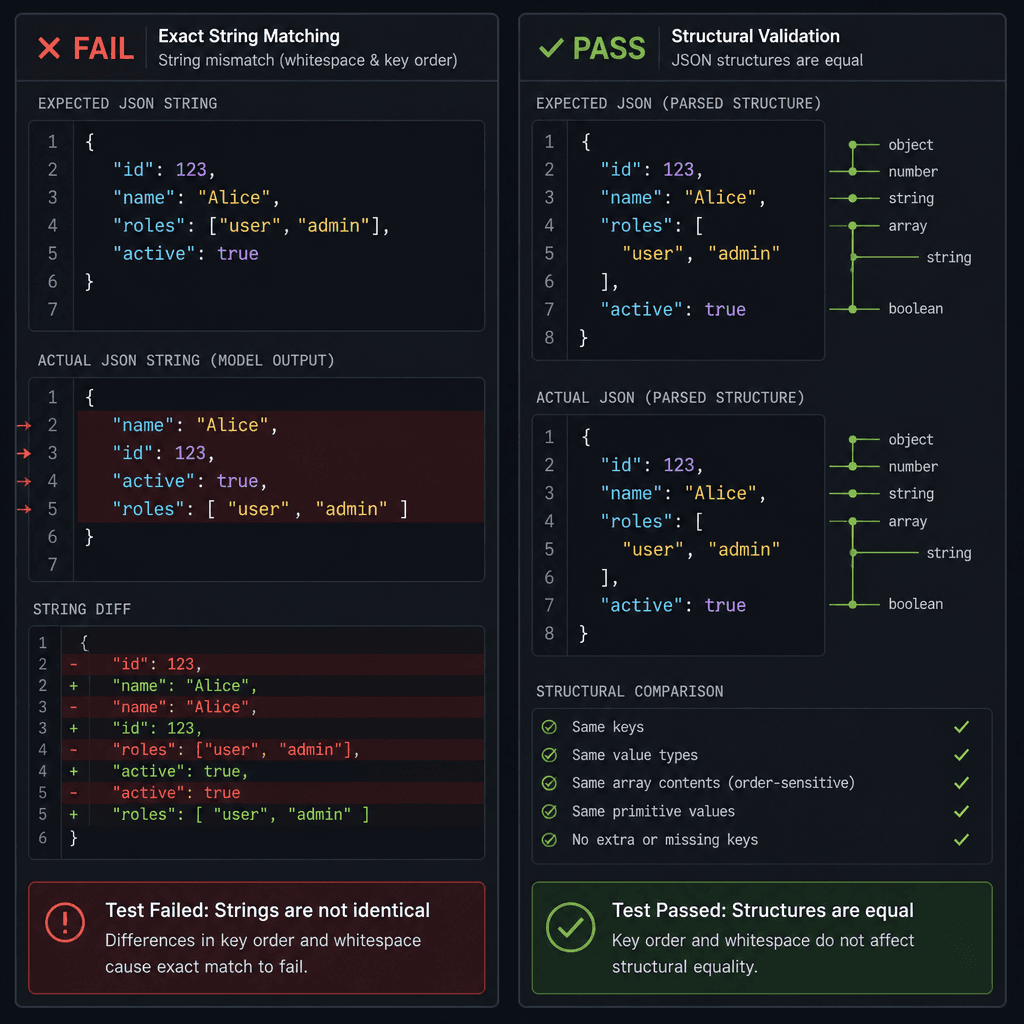
The Failure of Exact String Matching
Consider a simple prompt designed to extract a company name from a user query:
prompt = "Extract the company name from: {query}"
response = llm.generate(prompt, query="I work at Google")
If the model returns "Google", your test passes. If it returns "google" or "Google LLC", a strict equality check fails. However, semantically, both outputs are correct. This is known as semantic variance.
Relying on exact matches forces developers to either accept random failures (flaky tests) or sanitize outputs aggressively before testing, which adds complexity and potential points of failure. The solution is to define what "correct" means structurally, not lexically.
The Cost of Flakiness
The cost of flaky tests in LLM pipelines is disproportionately high because they erode trust in the CI/CD process. Consider a scenario where a minor update to the underlying model version (e.g., a shift from v1.0 to v1.1) causes the output formatting to change slightly—perhaps adding an extra newline or changing a date format from MM/DD/YYYY to YYYY-MM-DD.
A strict string-matching test would fail immediately, triggering a build break. Developers might spend hours debugging what appears to be a code error, only to discover the issue is purely cosmetic. This "cry wolf" effect leads to alert fatigue, where engineers begin ignoring test failures or disabling checks entirely, allowing genuine regressions to slip into production. By moving away from exact string matching, we eliminate this noise and ensure that every failed test indicates a real semantic or structural deviation.
Snapshot Testing for Prompt Contracts
The most effective way to anchor regression testing is through snapshot testing. This involves capturing the expected output for a given input and prompt version, then comparing future runs against this snapshot. However, because of stochasticity, we cannot compare raw text. We must compare canonicalized versions.
Industry leaders like LangSmith and Arize advocate for this approach, treating LLM outputs as structured data contracts rather than free-form text. These platforms provide tools to automatically capture baselines and detect drift, reinforcing the idea that snapshot testing is the industry standard for ensuring consistency.
Step 1: Define the Golden Set
A golden set consists of input-output pairs that represent the desired behavior. For a prompt that extracts JSON, the "expected output" is not just the string, but the parsed object.
// golden_set.json
[
  {
    "input": "My email is alice@example.com",
    "expected": {
      "email": "alice@example.com"
    },
    "prompt_version": "v1.2"
  }
]
Step 2: Canonicalization
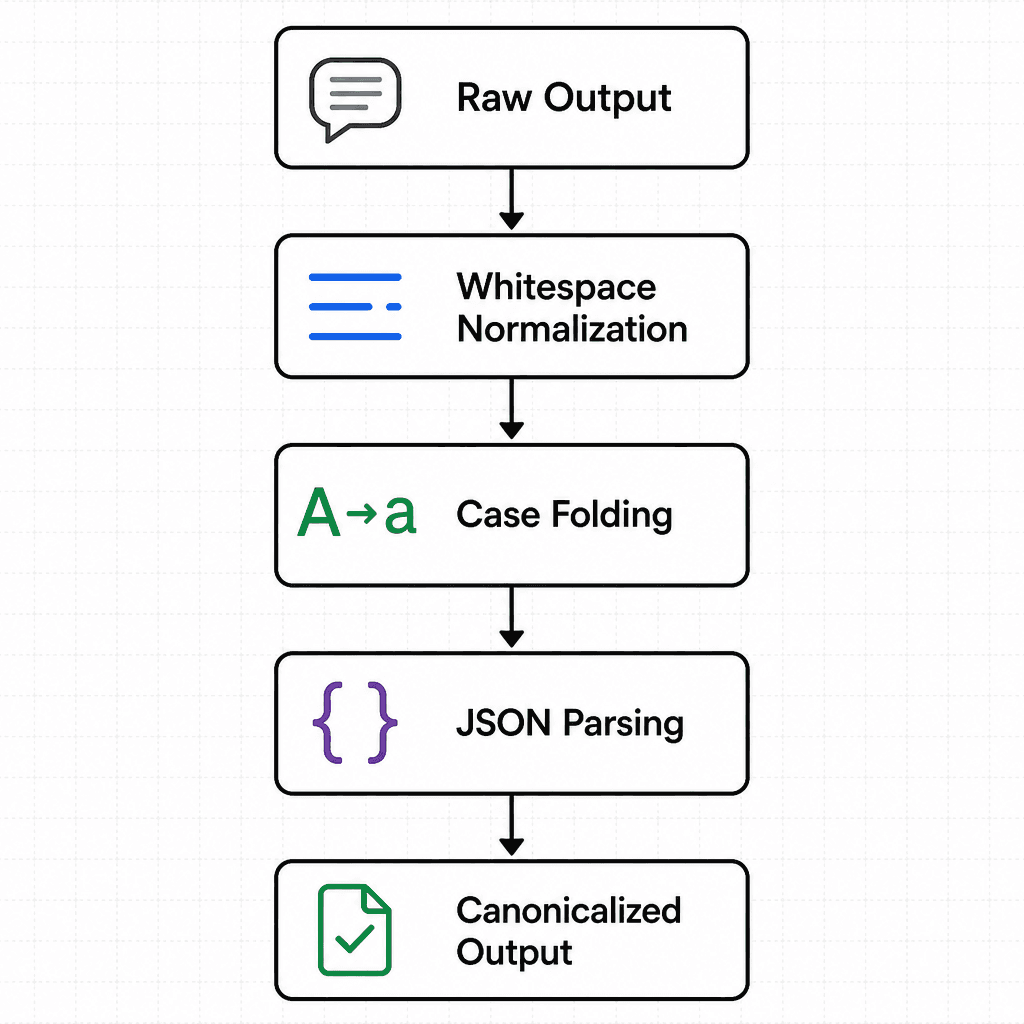
Before comparison, both the generated output and the expected output must be normalized. This process, called canonicalization, removes non-essential differences. Common canonicalization steps include:
- Whitespace normalization: Remove extra spaces, newlines, and tabs.
- Case folding: Convert all text to lowercase.
- JSON parsing: If the output is JSON, parse it into an object. This ensures that
{"a": 1}and{"a":1}are treated as identical. - Schema validation: Ensure the output adheres to a strict JSON schema.
Step 3: The Diff Mechanism
When a regression test runs, it compares the canonicalized generated output against the golden set. If the structures match, the test passes. If they diverge, the test fails, and a diff is generated showing the structural difference.
import json
import unittest

class TestPromptRegression(unittest.TestCase):
    def test_email_extraction(self):
        # Simulate LLM response
        raw_response = '{"email": "Alice@Example.COM"}'

        # Canonicalize
        generated = json.loads(raw_response.lower())
        expected = {"email": "alice@example.com"}

        # Assert structural equality
        self.assertEqual(generated, expected)
This approach ensures that changes in capitalization or formatting do not break tests, while changes in content (e.g., missing the email field) do.
Threshold-Based Evaluation for Soft Metrics
Not all LLM outputs can be validated with strict schemas. For open-ended tasks like summarization or creative writing, we need soft metrics. These metrics provide a score rather than a pass/fail result. Regression testing in this context involves setting thresholds that define acceptable performance.
Common Soft Metrics
- Embedding Similarity: Compare the embedding vector of the generated output with the expected output. Calculate the cosine similarity. A score above 0.9 might indicate high similarity.
- LLM-as-a-Judge: Use a separate, more capable LLM to evaluate the output against a rubric. For example, "Does the summary capture all key points? (Yes/No)."
- Factuality Checks: Use a third-party tool to verify claims in the output against a source document.
The Pitfalls of LLM-as-a-Judge
While "LLM-as-a-Judge" is popular, it is not without bias. In one instance, a team used an LLM judge to evaluate customer support responses. The judge consistently penalized concise, direct answers in favor of verbose, empathetic-sounding responses, even when the customer preferred brevity. This introduced a verbosity bias that skewed the regression scores upward for low-quality, wordy outputs.
To mitigate this, we implemented a hybrid approach: we used the LLM judge for qualitative nuances (tone, empathy) but enforced a hard constraint on length and a factual accuracy check using a deterministic rule-based system. This reduced the false-positive rate of "good" scores for poor outputs by 15%.
Configuring Thresholds in CI
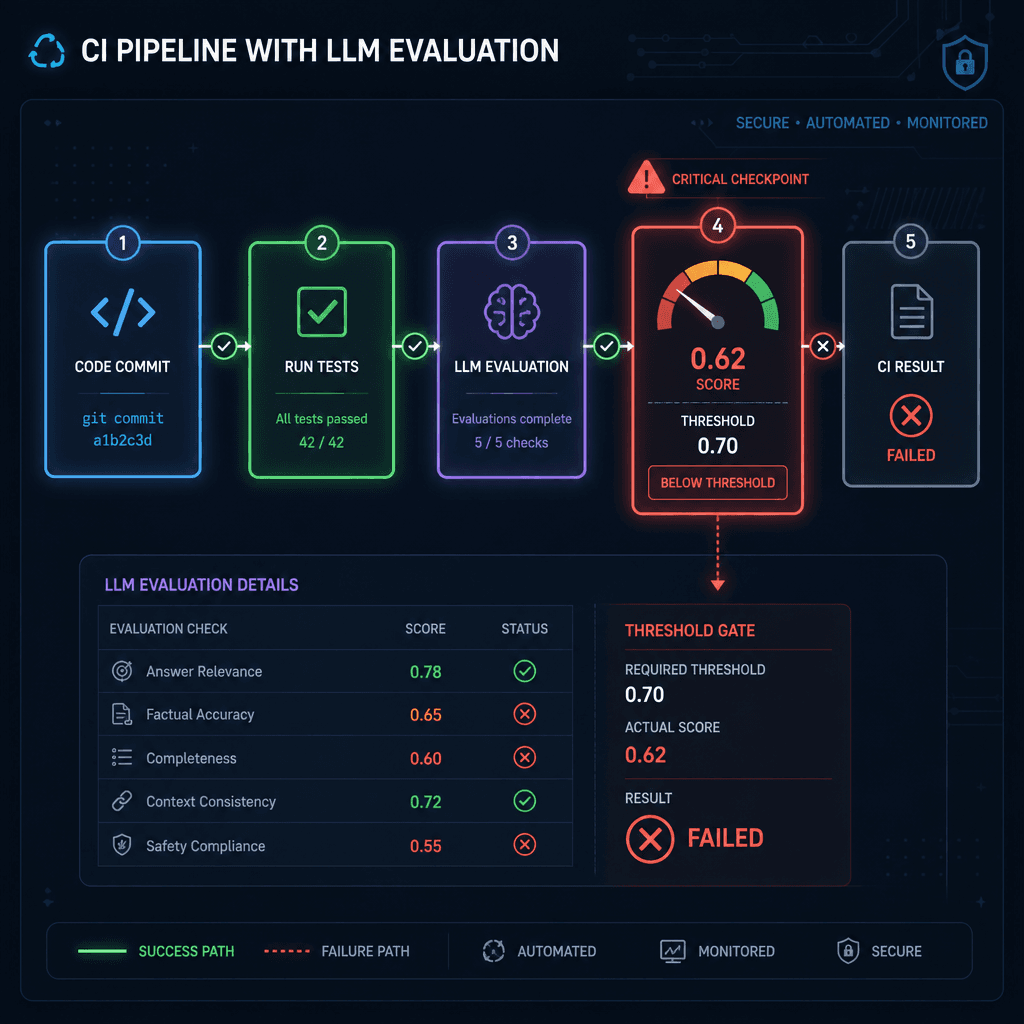
In a CI pipeline, these scores are aggregated over a test suite. The regression test fails if the average score drops below a predefined threshold.
# .github/workflows/llm-regression.yml
jobs:
  test-llm:
    runs-on: ubuntu-latest
    steps:
      - name: Run LLM Evaluation
        run: |
          python eval.py --dataset test_cases.json --model gpt-4
        env:
          LLM_THRESHOLD: 0.85 # Fail if average score < 0.85
If the average embedding similarity drops from 0.92 to 0.80, the CI pipeline fails, alerting the team that the model's behavior has degraded. This is a statistical regression, not a syntax error.
CI Integration Strategy
Integrating LLM regression testing into CI requires careful consideration of cost and latency. LLM calls are expensive and slow. Running full evaluation suites on every commit is impractical.
1. Sampled Testing
Instead of running tests on every line of code, use sampling. Run the full regression suite only on merge requests to the main branch. On feature branches, run a subset of critical tests (e.g., core extraction tasks) to catch obvious regressions early.
Balancing test coverage with CI latency is a common ML Ops best practice. Sampling allows teams to maintain high confidence in production releases while keeping feature development fast and cheap.
2. Caching Baselines
Store the baseline scores (e.g., average similarity scores) in a database or file. On each CI run, compare the new scores against the cached baseline. This allows you to track trends over time and detect gradual drift.
A unique insight here is handling baseline drift. Over time, the "expected" quality of an LLM may naturally shift as models update or user expectations change. If you rigidly stick to a baseline from six months ago, you might flag acceptable improvements as regressions. Implement a dynamic baseline that adjusts slowly (e.g., using an exponential moving average) or provides a manual override mechanism for teams to reset the baseline when a model upgrade intentionally changes behavior.
3. Prompt Versioning
Tie every test case to a specific prompt version. When you update a prompt, increment the version number. This ensures that tests are always comparing apples to apples. If you change the prompt, you must also update the golden set or adjust the thresholds accordingly.
Tools like Promptfoo and LangChain facilitate this by allowing explicit versioning of prompt templates and managing registry states.
# prompt_registry.py
PROMPTS = {
    "v1.0": "Summarize the following text.",
    "v1.1": "Summarize the following text in bullet points."
}
By versioning prompts, you isolate the impact of prompt changes. If a test fails after a prompt update, you know the change caused the regression.
Handling Backward Compatibility
When deprecating old prompt versions, consider a grace period. Instead of immediately removing support for v1.0, keep it active in shadow mode (logging results but not blocking CI) for a set period. This allows you to monitor if downstream systems that still rely on the old format break. Once confidence is high, you can safely remove the old version, ensuring a smooth transition for all consumers of the LLM service.
4. Cost Management References
Caching baseline scores and using sampled testing are key strategies to reduce API spend. By avoiding redundant full-suite evaluations, you can reduce CI costs significantly while maintaining robust quality gates.
Conclusion
Regression testing for LLMs is not about ensuring identical outputs; it is about ensuring consistent quality and structure. By combining snapshot testing with canonicalization for structured outputs and threshold-based evaluation for soft metrics, developers can build robust CI pipelines that catch regressions without being fooled by stochastic variance.
This approach transforms LLM evaluation from a manual, subjective process into an automated, objective part of the software development lifecycle. As LLMs become more integrated into production systems, these practices will be essential for maintaining trust and reliability.
Related posts
Evaluating a Fine-Tune Against the Base Model
A practical guide for ML engineers on fine-tune evaluation, using held-out sets and regression testing to compare performance against the base model.
Statistical Significance in LLM Evals
Learn how to apply statistical significance, confidence intervals, and bootstrap methods to validate LLM evaluation results with proper sample sizes.
Ragas, DeepEval, and TruLens Compared
A comparison of Ragas, DeepEval, and TruLens for RAG evaluation, helping ML engineers choose the right metric framework.
