
LLM-as-a-Judge: Making It Reliable
Examines how to improve LLM-as-a-judge reliability using rubrics, grading strategies, and bias mitigation techniques for ML evaluation.
When an ML engineer asks a Large Language Model (LLM) to evaluate another LLM’s output, they are not invoking a divine arbiter. They are invoking a stochastic classifier. The LLM-as-a-Judge (LLM-aJ) paradigm has become ubiquitous in reinforcement learning from human feedback (RLHF) and automated benchmarking because it scales. However, its reliability is often assumed rather than demonstrated. The core problem is not that LLMs are bad at language; it is that they are highly sensitive to structural artifacts in their input—specifically position, verbosity, and calibration drift. To make LLM-aJ reliable, we must treat the judge not as a static oracle, but as a model with measurable failure modes that require engineering controls.
This article is Part 3 of the LLM Evaluation Engineering series.
The Mechanism of Error: Why Judges Fail
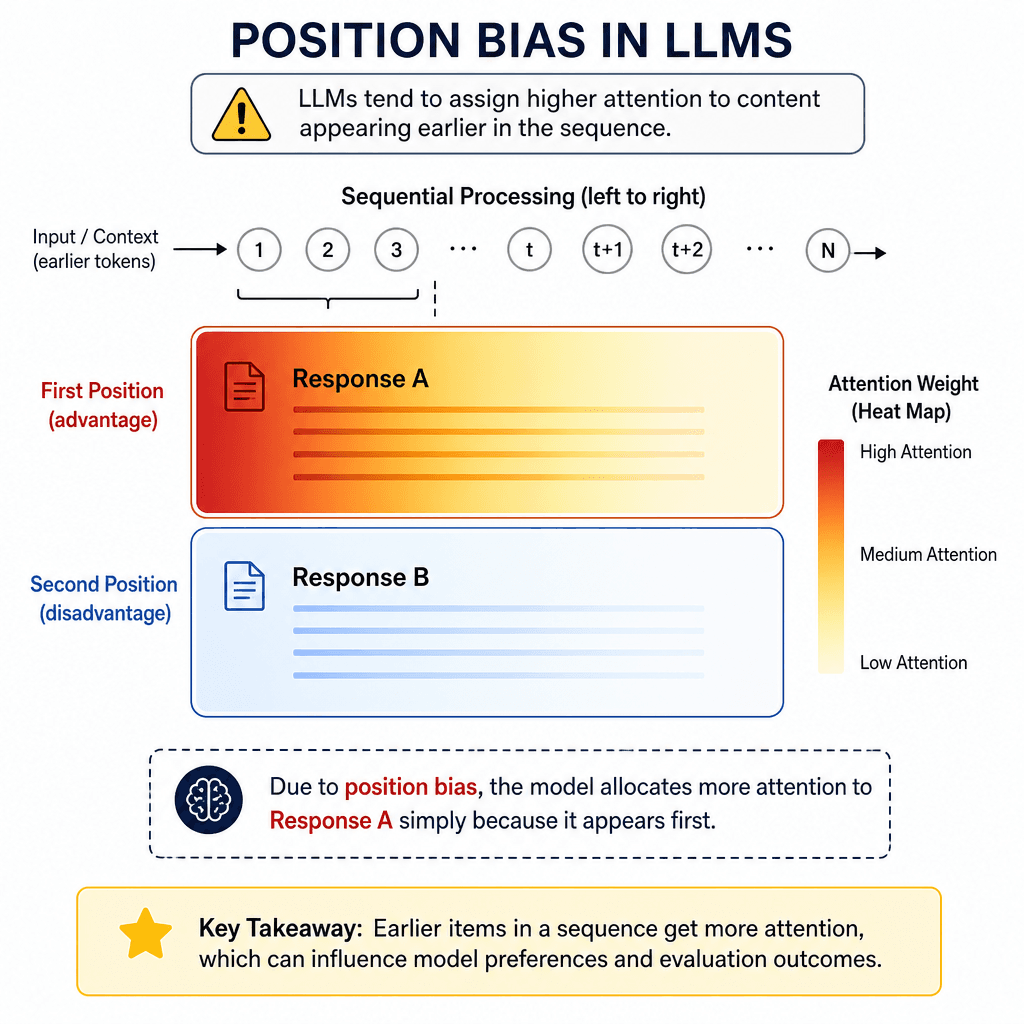
To fix reliability, we must first understand the mechanism of error. LLMs predict the next token based on the probability distribution learned during pre-training and fine-tuning. This process introduces two primary biases in evaluation contexts: position bias and verbosity bias.
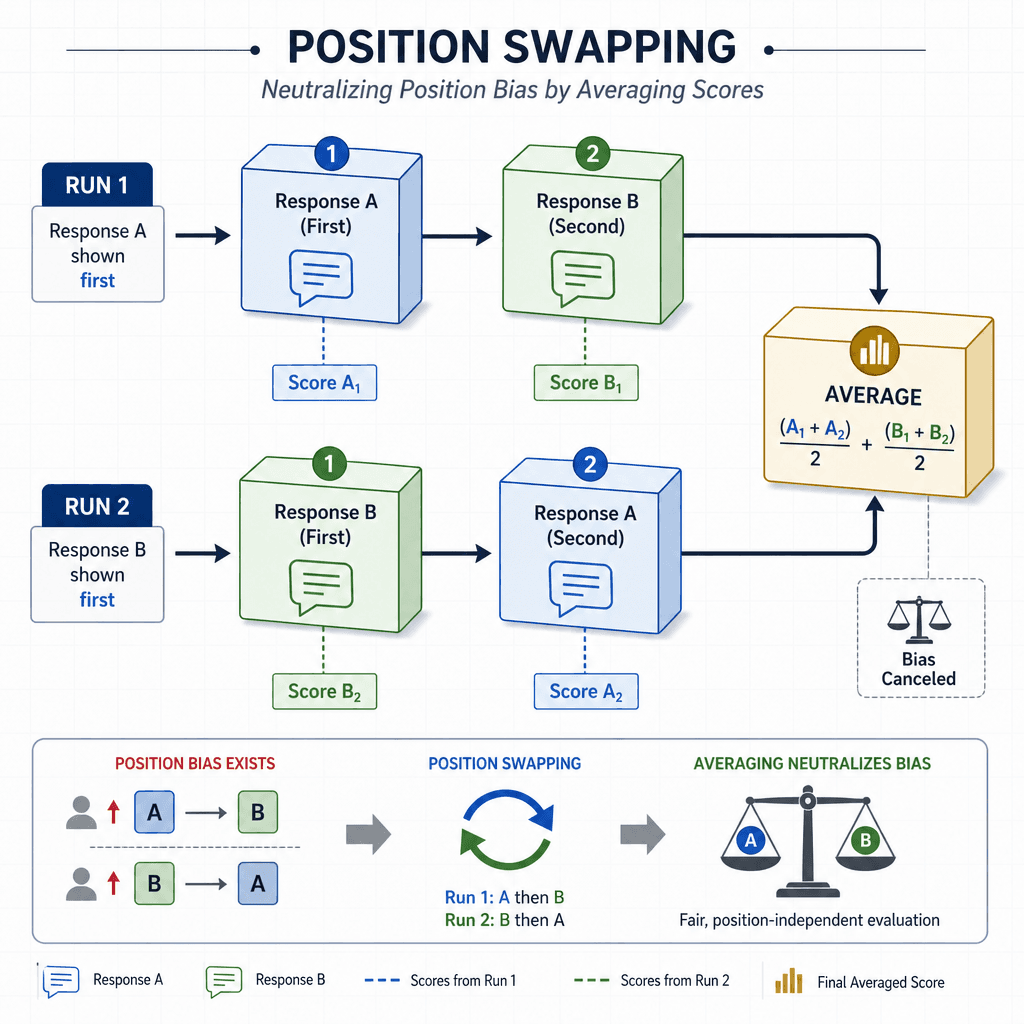
Position Bias arises because the model processes tokens sequentially. In many training datasets, the "correct" or "preferred" answer often appears in a specific position (e.g., the first choice in multiple-choice questions, or the first response in a dialogue). When asked to compare two responses, the model may unconsciously associate the earlier position with higher quality, regardless of content. This is not a logical deduction; it is a statistical correlation baked into the weights. The inherent sequential nature of the transformer architecture means that the first items processed have a slight cognitive advantage in attention allocation. While system prompting cannot eliminate this architectural tendency, structured interventions such as position swapping can neutralize the resulting error in final scores.
Verbosity Bias is another artifact. During instruction tuning, models are often rewarded for being helpful and detailed. Consequently, a longer response is frequently correlated with higher quality in the training data, though this correlation varies significantly depending on the specific dataset used for fine-tuning and the underlying model architecture. When evaluating two responses of differing lengths, the judge may assign higher scores to the verbose one, even if the shorter one is more accurate. This creates a false positive in evaluation metrics.
These biases are structural properties of the model's training distribution and attention mechanism. No amount of system prompting can eliminate position bias because the model’s attention mechanism is inherently sequential. The solution lies in structural interventions that neutralize these artifacts.
Rubric Design as Constraint

A common mistake in LLM-aJ is providing a vague instruction: "Evaluate the following response for helpfulness." This leaves the judge’s latent space unbounded, allowing it to fill in the criteria with its own biases. The mechanism for improvement is constraint. By defining explicit, atomic criteria, we reduce the variance in the judge’s decision-making process. Effective rubric design requires breaking down subjective qualities into objective, observable features. This forces the model to perform discrete checks rather than relying on holistic intuition, which is prone to bias.
Consider a scenario where we are evaluating code generation. A poor rubric might say: "Check if the code works." This is ambiguous. The judge might interpret "works" as "compiles," "runs without error," or "produces the correct output for all edge cases."
A well-designed rubric, however, breaks down the evaluation into discrete, observable features:
# Evaluation Rubric: Code Correctness

1. **Syntax Validity**: Does the code compile/run without syntax errors? (Yes/No)
2. **Logic Accuracy**: Does the code produce the expected output for the provided test cases? (Yes/No)
3. **Efficiency**: Is the time complexity within O(n log n)? (Yes/No)
4. **Edge Cases**: Does the code handle empty inputs or null values? (Yes/No)

Final Score: Sum of Yes responses / 4
By forcing the judge to evaluate each criterion independently, we isolate the decision-making process. This reduces the "hallucination of judgment" where the model invents a reason for a score based on stylistic preferences. The rubric acts as a filter, ensuring that only relevant features influence the final token prediction. Furthermore, atomic criteria allow for granular error analysis, enabling engineers to identify exactly where the generated code fails rather than receiving a single monolithic score.
Grading Strategies for Stability
Even with a perfect rubric, a single inference from an LLM is a noisy estimate. To stabilize the score, we must employ grading strategies that mitigate stochastic variance and structural biases. These strategies transform a single point estimate into a more robust statistical measure.
1. Position Swapping (A/B Testing)
The most effective way to neutralize position bias is to swap the order of the responses. If Model A is evaluated against Model B, we run the judge twice: once with A first, and once with B first. We then average the scores.
def evaluate_pair(response_a, response_b, judge_model):
    # Run 1: A is first
    score_1 = judge_model.evaluate(response_a, response_b)

    # Run 2: B is first
    score_2 = judge_model.evaluate(response_b, response_a)

    # Average to cancel out position bias
    return (score_1 + score_2) / 2
This technique assumes that position bias is symmetric. While not perfectly true (the first position often has a slight advantage), it significantly reduces the error margin. For high-stakes evaluations, this is a non-negotiable step.
2. Self-Consistency and Voting
Another mechanism to reduce variance is self-consistency. Instead of asking the judge for a single score, we ask for multiple independent evaluations and take the majority vote or median score. This works because the random noise in the model’s output tends to cancel out, while the signal (the actual quality of the response) remains consistent.
def robust_evaluate(response, judge_model, num_votes=5):
    scores = []
    for _ in range(num_votes):
        # Each call is independent due to temperature > 0
        score = judge_model.evaluate(response)
        scores.append(score)

    # Use median to avoid outlier influence
    return sorted(scores)[len(scores)//2]
This approach increases computational cost but provides a more stable estimate of the true quality. It is particularly useful when the rubric is complex and the judge’s confidence varies across trials.
3. Calibration
Finally, we must address calibration. An LLM judge might give a score of 0.9 to a response, but does that mean it is 90% likely to be correct? Often, no. LLMs are overconfident. Calibration involves mapping the raw scores to human-aligned probabilities. This can be done by training a simple regression model on a small set of human-labeled data, where the input is the LLM’s score and the output is the human’s rating.
from sklearn.linear_model import LinearRegression
import numpy as np

# X: LLM scores, y: Human ratings
model = LinearRegression()
model.fit(llm_scores.reshape(-1, 1), human_ratings)

# Define the new score to be calibrated (e.g., from a new test instance)
new_llm_score = np.array([[0.85]])

# Calibrated score
calibrated_score = model.predict(new_llm_score)
This step transforms the judge’s output from a raw number into a statistically meaningful metric. Without calibration, comparisons between different judges or different tasks are invalid.
Conclusion
LLM-as-a-Judge is a tool, but it is not a black box. It is a model with specific, predictable failure modes. By understanding the mechanisms of position bias and verbosity bias, designing constrained rubrics, and applying grading strategies like position swapping and calibration, we can transform LLM-aJ from a noisy heuristic into a reliable evaluation engine. The key is not to trust the model’s intuition, but to engineer its environment to minimize error.
Related posts
Shadow Traffic for LLM Deployments
Explore how shadow traffic and traffic mirroring enable safe comparison of candidate LLM models in production without impacting user experience.
Statistical Significance in LLM Evals
Learn how to apply statistical significance, confidence intervals, and bootstrap methods to validate LLM evaluation results with proper sample sizes.
Ragas, DeepEval, and TruLens Compared
A comparison of Ragas, DeepEval, and TruLens for RAG evaluation, helping ML engineers choose the right metric framework.
